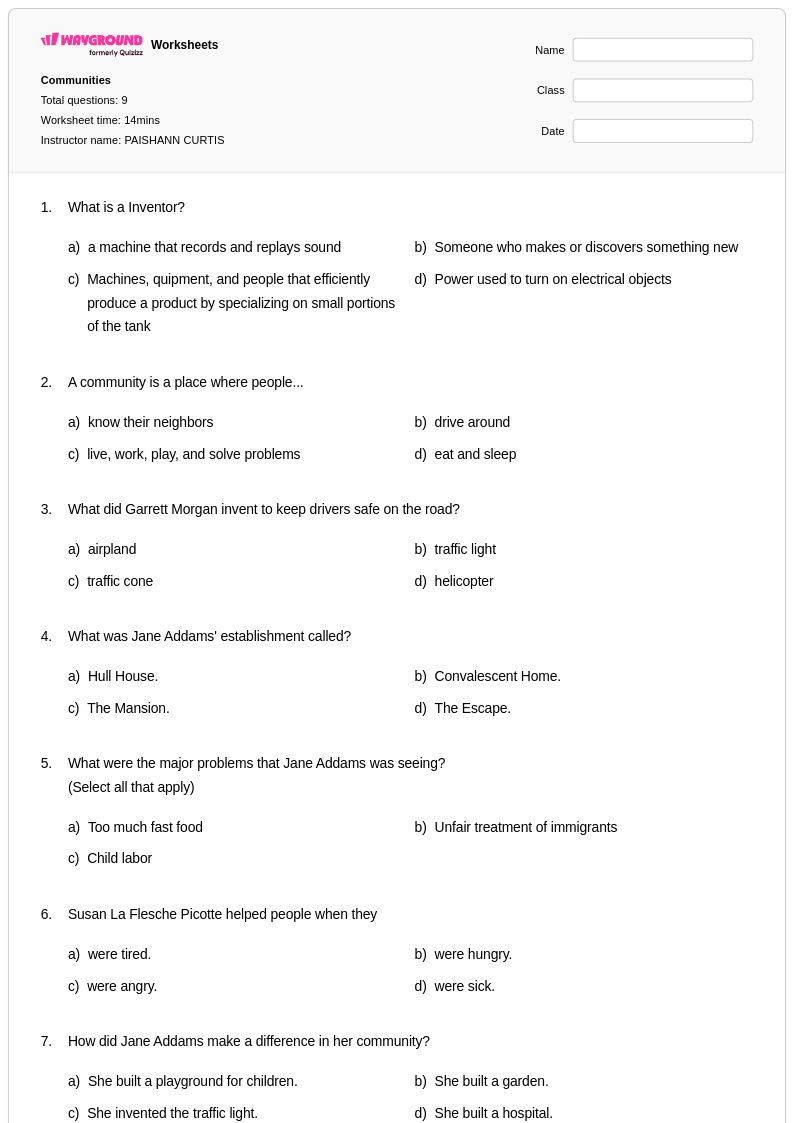
Explore free traffic signals worksheets and printables that help students understand community safety rules, road signs, and cultural transportation systems through engaging practice problems with answer keys.
Traffic signals worksheets available through Wayground (formerly Quizizz) provide students with essential learning opportunities to understand how traffic control systems function within their communities and contribute to public safety. These comprehensive educational resources strengthen critical thinking skills as students analyze the purpose and meaning of different traffic signals, explore the rules and regulations that govern road safety, and examine how traffic management systems reflect organized community planning. The collection includes detailed answer keys and free printable materials that guide students through practice problems involving traffic signal identification, pedestrian safety protocols, and the relationship between traffic systems and community infrastructure, helping educators assess student comprehension while building foundational knowledge about civic responsibility and community organization.
Wayground (formerly Quizizz) supports teachers with an extensive collection of traffic signals worksheets drawn from millions of teacher-created resources, featuring robust search and filtering capabilities that allow educators to quickly locate materials suited to their specific classroom needs. The platform's standards alignment ensures that traffic signals content connects appropriately to social studies curriculum requirements, while differentiation tools enable teachers to customize worksheets for diverse learning levels and accommodate various student abilities. These resources are available in both printable PDF formats and interactive digital versions, providing flexibility for classroom instruction, homework assignments, and independent practice sessions. Teachers can efficiently plan comprehensive lessons on community systems, create targeted remediation activities for students who need additional support with civic concepts, and develop enrichment opportunities that deepen understanding of how traffic signals represent broader themes of community cooperation, rule-following, and public safety infrastructure.
FAQs
How do I teach traffic signals to elementary students?
Start by connecting traffic signals to students' real-world experiences, such as crossing the street or riding in a car. Use color-coded visuals to introduce red, yellow, and green light meanings before expanding to pedestrian signals, warning signs, and regulatory signs. Grounding the lesson in community safety gives students a concrete reason to engage with the material.
What kinds of practice exercises help students learn traffic signal rules?
Effective practice includes signal identification activities where students match signs to their meanings, scenario-based questions that ask what a driver or pedestrian should do at a given signal, and sequencing tasks that reinforce the logic of traffic flow. Worksheets that combine visual recognition with written reasoning build both recall and application skills.
What common mistakes do students make when learning about traffic signals?
Students often confuse regulatory signs with warning signs, or assume that a yellow light always means stop rather than prepare to stop. Another frequent error is failing to distinguish between signals directed at drivers versus those directed at pedestrians, such as the walk and don't-walk indicators. Targeted practice on these distinctions helps prevent these misconceptions from becoming ingrained.
How do traffic signals connect to social studies standards?
Traffic signals are typically addressed within community helpers, civic responsibility, and community systems units in early elementary social studies curricula. They illustrate how communities create shared rules to promote public safety and organize daily life, which connects directly to standards around civic participation and community infrastructure. Using traffic signal content as a lens for community planning helps students see rules as purposeful rather than arbitrary.
How can I use Wayground's traffic signals worksheets in my classroom?
Wayground's traffic signals worksheets are available as printable PDFs for traditional classroom use and in digital formats for technology-integrated learning environments, so they work equally well as seat work, homework, or center activities. Teachers can also host them as a quiz directly on Wayground to track student responses and comprehension in real time. Each worksheet includes a complete answer key, making them straightforward to use for both instruction and formative assessment.
How can I differentiate traffic signals instruction for students at different levels?
For students who need additional support, reduce the number of answer choices on identification tasks to lower cognitive load and consider enabling the Read Aloud feature on Wayground so questions are read to them. More advanced students can be challenged with scenario-based questions that require them to apply signal rules to novel situations or explain the reasoning behind specific traffic regulations. Wayground allows teachers to apply these accommodations at the individual student level without affecting the rest of the class.