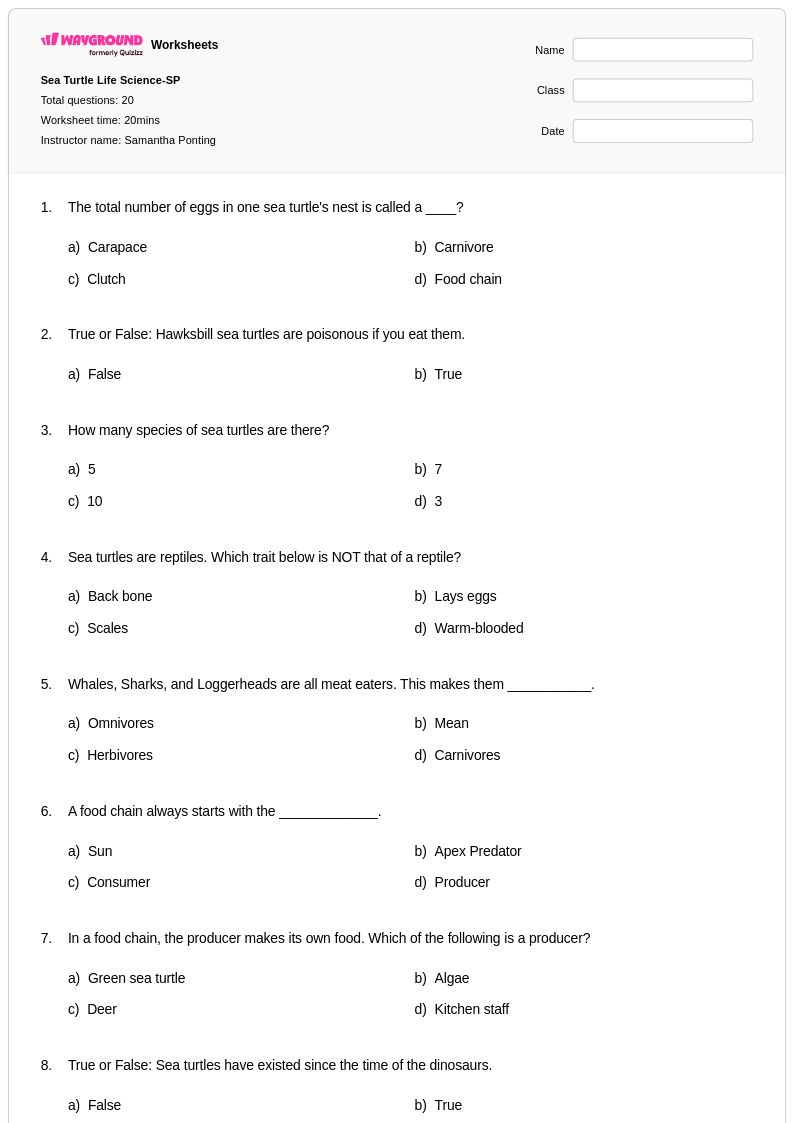
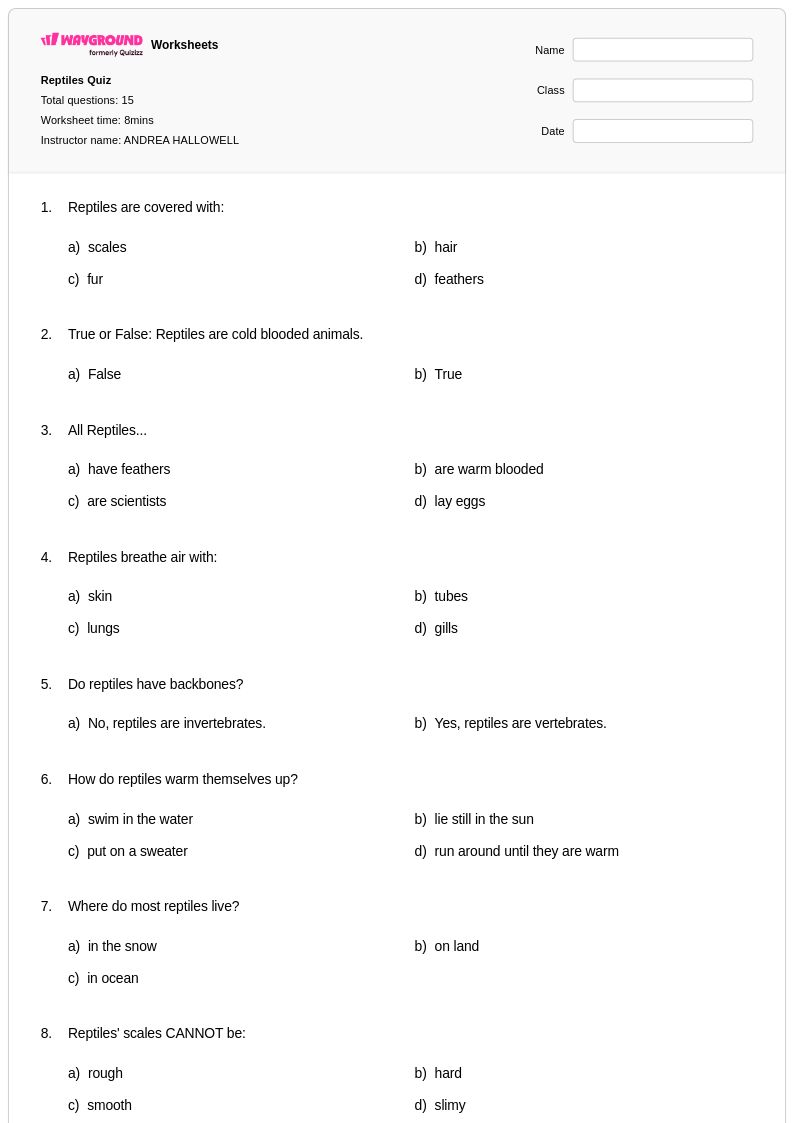
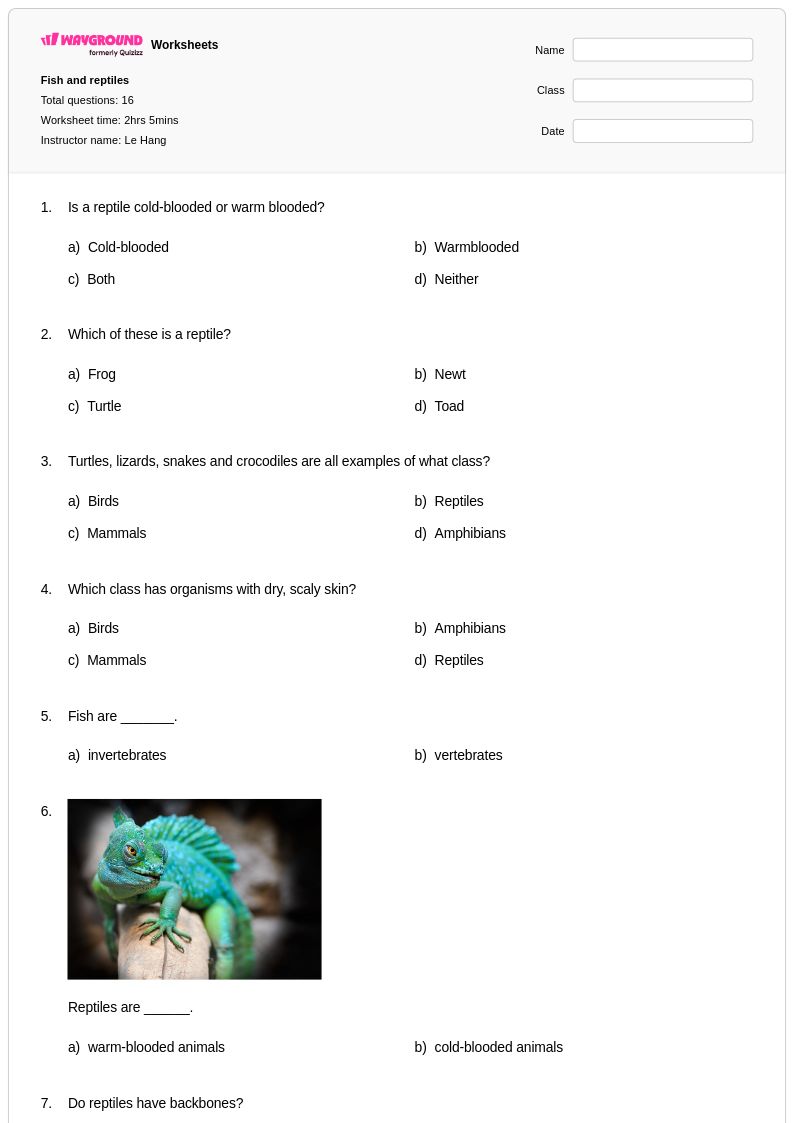
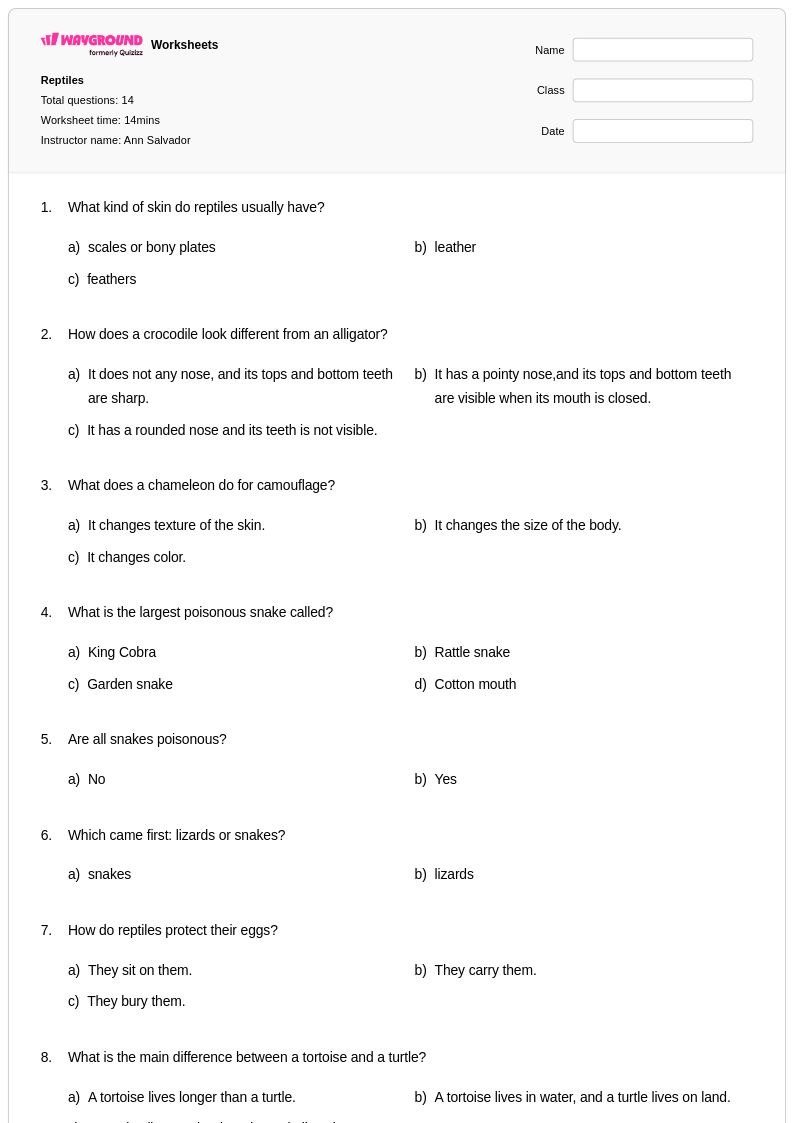
Explore Grade 2 turtle life science worksheets and printables that help young students discover turtle habitats, anatomy, and behaviors through engaging practice problems with complete answer keys available as free PDF downloads.
Grade 2 turtle worksheets through Wayground (formerly Quizizz) provide young learners with engaging opportunities to explore these fascinating reptiles while building essential life science knowledge. These carefully crafted educational materials help students develop observation skills, scientific vocabulary, and understanding of animal characteristics through age-appropriate activities focused on turtle anatomy, habitats, life cycles, and behaviors. The comprehensive collection includes practice problems that encourage critical thinking about how turtles adapt to their environments, answer key resources that support independent learning, and free printables designed specifically for second-grade reading and comprehension levels. Students strengthen their ability to classify living things, make scientific observations, and understand the connection between animal features and survival needs through these thoughtfully structured pdf worksheets.
Wayground (formerly Quizizz) empowers educators with access to millions of teacher-created turtle and life science resources, complete with robust search and filtering capabilities that make finding grade-appropriate content effortless. The platform's standards alignment features ensure that turtle-focused activities support curriculum objectives while differentiation tools allow teachers to customize worksheets for diverse learning needs within their Grade 2 classrooms. These versatile materials are available in both printable and digital formats, including convenient pdf downloads that facilitate seamless lesson planning and implementation. Teachers can effectively use these resources for skill practice, remediation support for struggling students, and enrichment opportunities for advanced learners, creating a comprehensive approach to life science education that meets every student's developmental needs while fostering genuine curiosity about the natural world.
FAQs
How do I teach students about turtle biology and adaptations?
Start with observable physical features — shell structure, limb morphology, and sensory organs — before connecting each adaptation to a specific survival function. Comparing marine turtles (streamlined flippers, salt glands) with freshwater and terrestrial species helps students see how environment drives adaptation. Anatomical diagram activities and habitat analysis exercises are effective tools for anchoring these concepts in concrete, visual learning.
What worksheets help students practice turtle life cycles and reproduction?
Worksheets that sequence the stages of a turtle's life cycle — from egg-laying and incubation to hatchling emergence and maturation — give students a structured framework for understanding reproduction in reptiles. Practice problems that ask students to label diagrams, order stages, or compare turtle reproduction with other reptiles reinforce both content knowledge and scientific sequencing skills.
What misconceptions do students commonly have about turtles?
A common misconception is that turtles can leave their shells, which students often absorb from cartoons. In reality, the shell is fused to the turtle's spine and ribcage and is a permanent part of its skeleton. Students also frequently confuse turtles, tortoises, and terrapins — a comparative species activity that distinguishes habitats and physical features can directly address this error.
How can I use turtle worksheets to support conservation awareness in science class?
Turtle worksheets that include conservation-focused content — such as threats from habitat loss, bycatch, and climate impacts on nesting — give students meaningful context for why biodiversity matters. Pair these with activities that ask students to evaluate conservation strategies or analyze population data to build both content knowledge and scientific argumentation skills.
How do I use Wayground's turtle worksheets in my classroom?
Wayground's turtle worksheets are available as printable PDFs for traditional classroom use and in digital formats for technology-integrated environments, so they work whether your students are at desks or on devices. You can also host any worksheet as a live quiz on Wayground, giving you real-time visibility into student responses. All worksheets include complete answer keys, which makes grading and feedback efficient for busy teachers.
How can I differentiate turtle worksheets for students at different skill levels?
For students who need additional support, focus on basic reptile characteristics and labeled diagram activities before introducing ecological relationships or multi-species comparisons. Advanced students benefit from comparative studies across marine, freshwater, and terrestrial turtle species that require higher-order analysis. On Wayground, teachers can also apply individual accommodations — such as read aloud, extended time, or reduced answer choices — to specific students without disrupting the rest of the class.