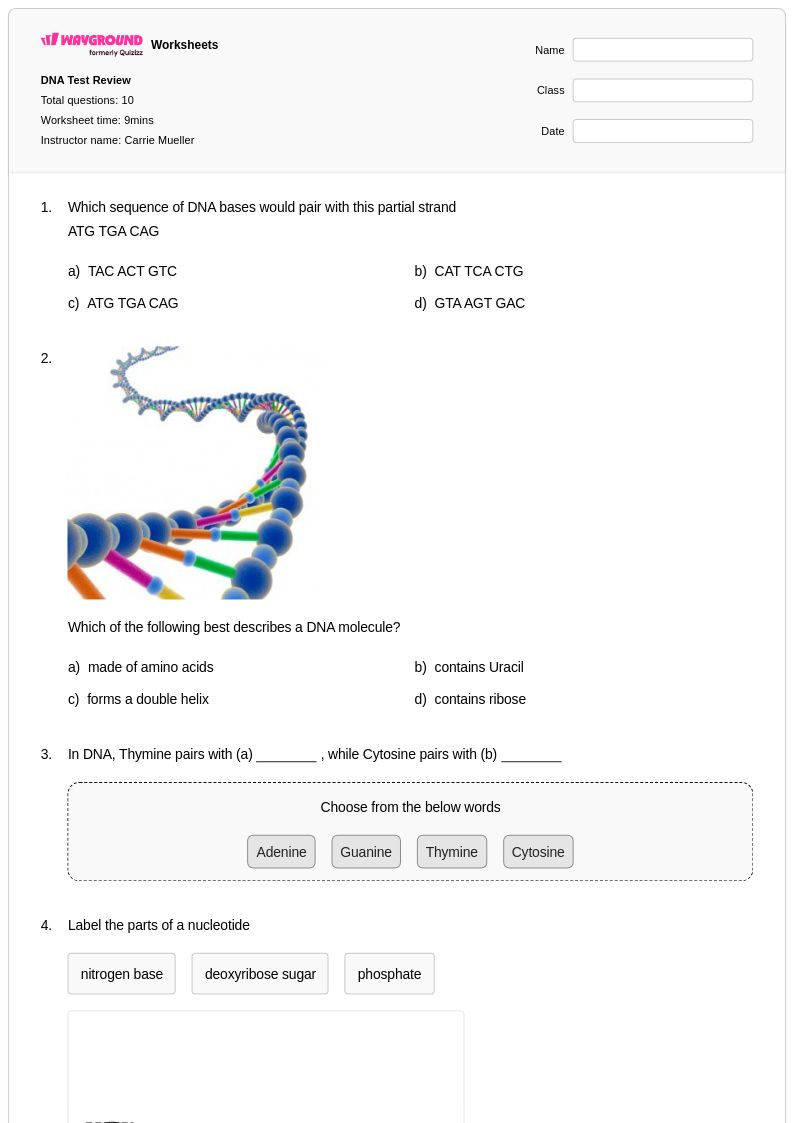
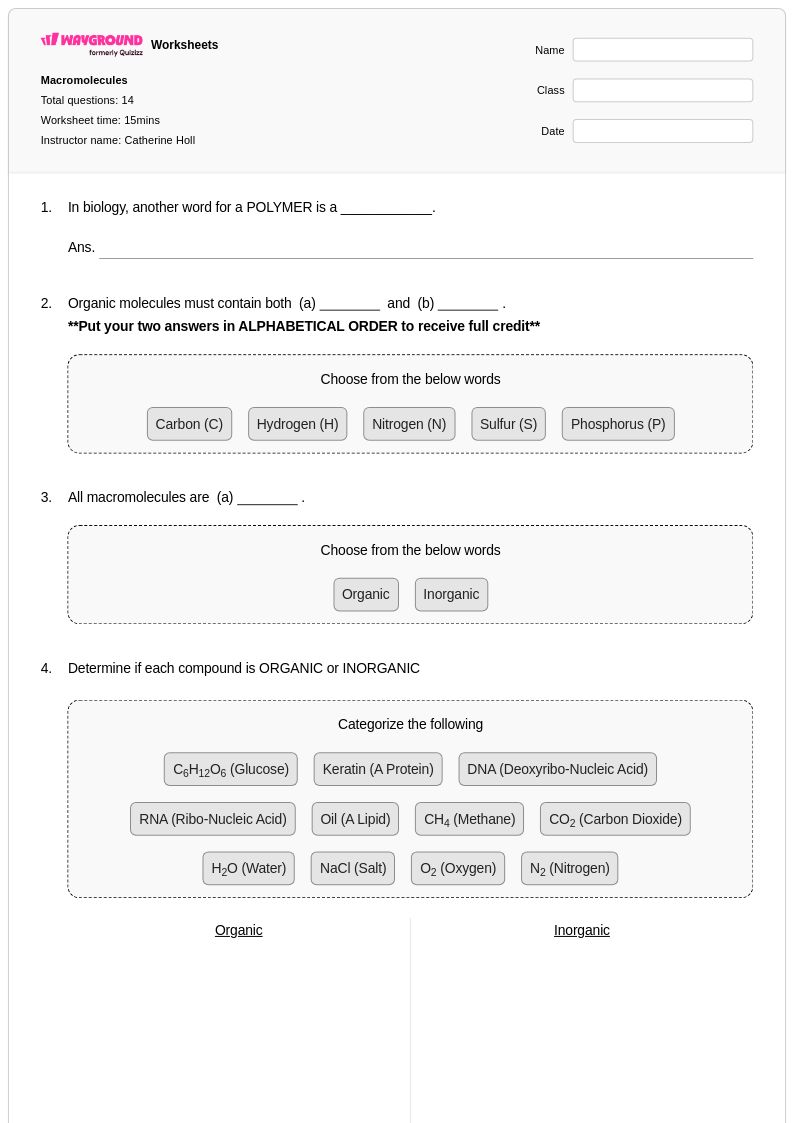
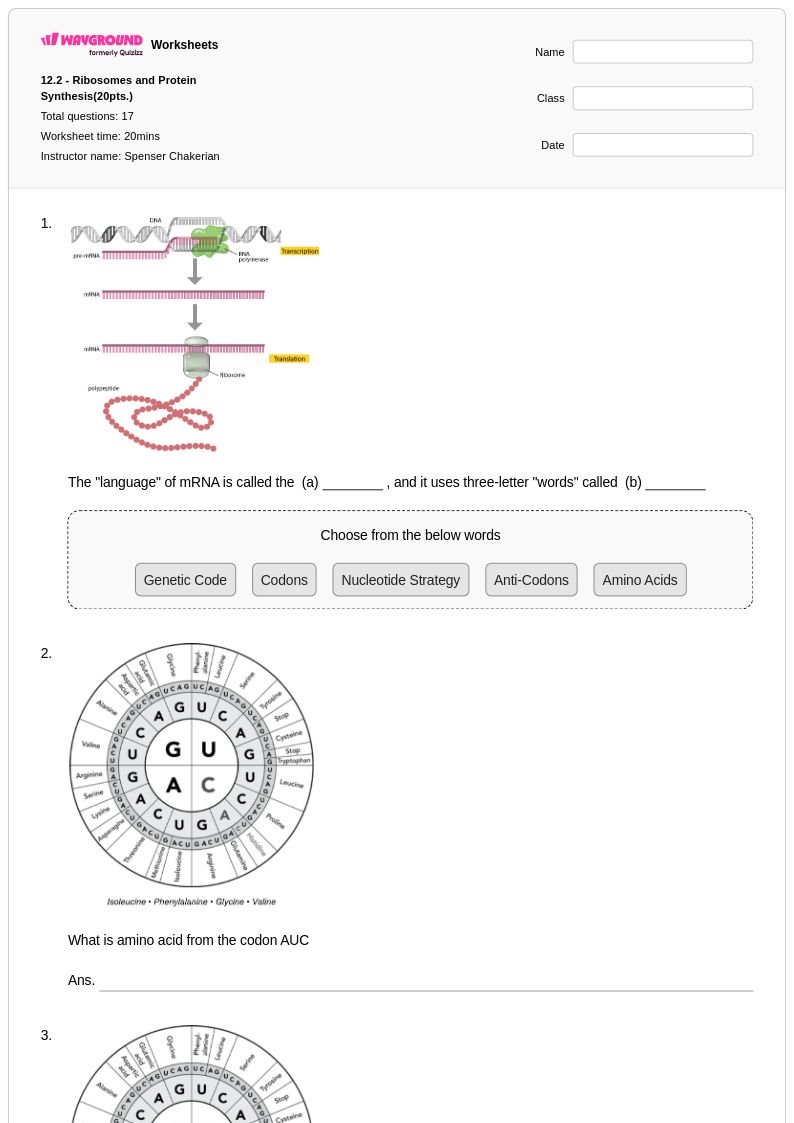
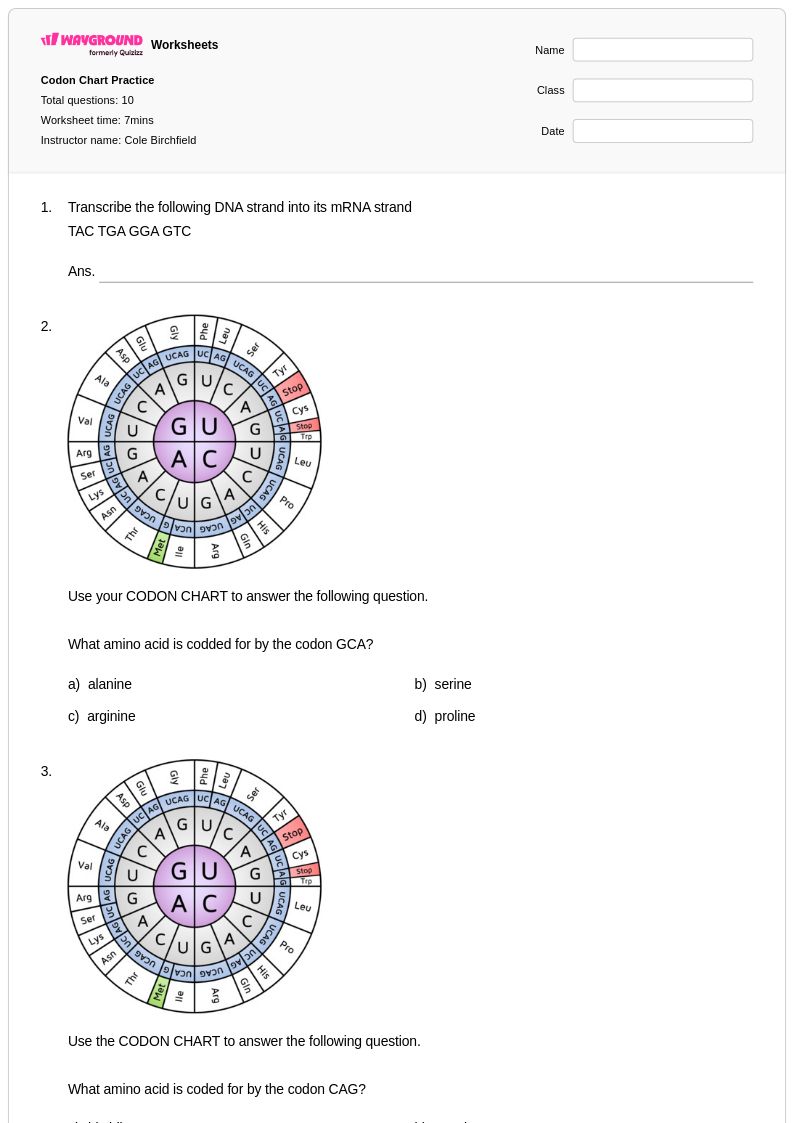
Explore Wayground's comprehensive Class 11 amino acid worksheets featuring printable PDFs and practice problems with answer keys to help students master protein building blocks, molecular structures, and biochemical processes through engaging free worksheets and activities.
Explore printable Amino Acid worksheets for Class 11
Amino acid worksheets for Class 11 students available through Wayground (formerly Quizizz) provide comprehensive coverage of protein building blocks and their essential roles in biological systems. These expertly crafted resources strengthen students' understanding of amino acid structure, including the universal amino group and carboxyl group components, side chain variations that determine chemical properties, and the twenty standard amino acids found in living organisms. The worksheets incorporate detailed practice problems that challenge students to identify amino acid classifications, analyze peptide bond formation, and explore protein synthesis pathways, while accompanying answer keys enable independent learning and self-assessment. Available as free printables and downloadable pdf resources, these materials support mastery of complex biochemical concepts through systematic skill-building exercises that prepare students for advanced study in molecular biology and biochemistry.
Wayground (formerly Quizizz) empowers educators with an extensive collection of millions of teacher-created amino acid worksheets specifically designed for Class 11 biology instruction. The platform's robust search and filtering capabilities allow teachers to quickly locate resources aligned with curriculum standards, while built-in differentiation tools enable customization for diverse learning needs and ability levels. Whether delivered in printable pdf format for traditional classroom use or through interactive digital formats for technology-enhanced learning, these worksheet collections support flexible lesson planning and targeted skill practice. Teachers can seamlessly integrate these resources into remediation programs for struggling learners, enrichment activities for advanced students, or regular practice sessions that reinforce fundamental concepts about amino acid chemistry, protein structure, and enzymatic functions essential for Class 11 biology success.
FAQs
How do I teach amino acids to students who are new to biochemistry?
Start by grounding students in the shared structure all amino acids have: a central carbon bonded to an amino group, a carboxyl group, a hydrogen atom, and a variable R group (side chain). Use visual diagrams to show how the R group determines each amino acid's chemical properties, then build toward classification by polarity, charge, and whether the amino acid is essential or non-essential. Connecting amino acid structure to protein function early helps students see why these distinctions matter biologically.
What exercises help students practice identifying and classifying amino acids?
Effective practice includes labeling structural diagrams, sorting amino acids by side chain polarity and charge, and completing tables that match amino acid names to their one-letter and three-letter abbreviations. Problems that ask students to predict how amino acid properties influence protein behavior, such as which side chains are likely to appear in a hydrophobic protein interior, move practice beyond memorization into applied reasoning. Worksheets that integrate peptide bond formation as a follow-on exercise help students connect amino acid structure directly to protein synthesis.
What mistakes do students commonly make when learning about amino acids?
One of the most frequent errors is confusing the ionization state of amino acids at different pH levels, particularly misidentifying when an amino acid acts as a zwitterion. Students also commonly conflate the terms 'essential' and 'non-essential' with biological importance rather than understanding that essential amino acids simply cannot be synthesized by the body and must come from diet. A third common misconception is treating all amino acids as structurally identical except by name, rather than recognizing how profoundly different R groups create the chemical diversity that drives protein function.
How do I use amino acid worksheets to support students at different proficiency levels?
For introductory learners, focus on basic amino acid identification, structural labeling, and essential versus non-essential classification. Advanced students benefit from problems involving zwitterion formation, isoelectric point calculations, and the role of specific side chains in protein folding and enzyme active sites. On Wayground, teachers can assign digital versions of these worksheets and apply built-in accommodations such as read aloud support or reduced answer choices for individual students, making it straightforward to differentiate within the same assignment.
How do Wayground amino acid worksheets work in the classroom?
Wayground amino acid worksheets are available as free printable PDFs for traditional classroom use and in digital formats for technology-integrated learning environments, including the option to host them as a quiz directly on Wayground. Each worksheet includes a complete answer key, reducing prep time for teachers. The platform's search and filtering tools make it easy to find resources aligned to specific biochemistry standards or skill levels, from basic structure identification to advanced protein synthesis pathways.
How does zwitterion formation fit into an amino acid unit, and how should I teach it?
Zwitterion formation is best introduced after students are comfortable with amino acid structure and basic acid-base chemistry. At physiological pH, the amino group is protonated and the carboxyl group is deprotonated, resulting in a molecule that carries both a positive and negative charge simultaneously — the zwitterion form. Teaching this concept with titration curve diagrams and connecting it to isoelectric point helps students understand why amino acids behave differently in acidic versus basic environments, which is foundational for understanding protein solubility and gel electrophoresis.