Free Printable Body Regions Worksheets for Class 8
Explore Class 8 body regions with Wayground's free biology worksheets and printables, featuring practice problems and answer keys to help students master human anatomy systems and organizational structures.
Explore printable Body Regions worksheets for Class 8
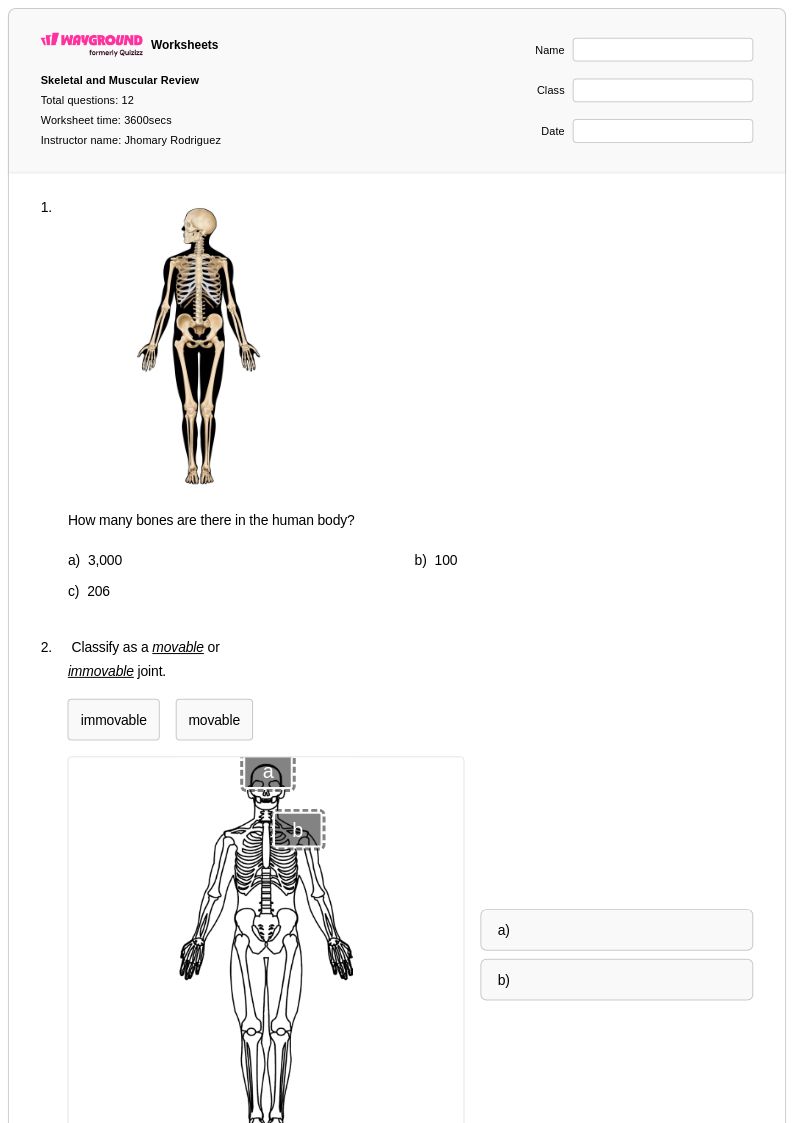
Body regions worksheets for Class 8 students through Wayground (formerly Quizizz) provide comprehensive coverage of human anatomical organization, helping students master the fundamental skill of identifying and understanding the major body regions used in medical and scientific contexts. These educational resources strengthen students' ability to recognize anatomical position, distinguish between axial and appendicular regions, and accurately locate specific areas such as the cranial, thoracic, abdominal, and pelvic regions along with their subdivisions. The worksheet collection includes detailed practice problems that challenge students to apply directional terms, identify body cavities, and understand the relationship between different anatomical regions. Each resource comes with a complete answer key and is available as free printables in pdf format, making them accessible for both classroom instruction and independent study.
Wayground (formerly Quizizz) supports science educators with millions of teacher-created resources specifically designed for Class 8 biology instruction, including extensive body regions worksheet collections that align with national science standards. The platform's advanced search and filtering capabilities allow teachers to quickly locate worksheets that match their specific curriculum needs, whether focusing on basic anatomical terminology or more complex regional relationships. These differentiation tools enable educators to customize content for varying skill levels within their classrooms, supporting both remediation for struggling students and enrichment opportunities for advanced learners. Available in both printable pdf formats and interactive digital versions, these worksheets streamline lesson planning while providing flexible options for skill practice, formative assessment, and reinforcement of essential anatomical concepts that form the foundation for advanced biological studies.
FAQs
How do I teach body regions to biology students?
Start by establishing the anatomical position as a universal reference point before introducing regional terminology. From there, work systematically through the axial regions (head, neck, trunk) and appendicular regions (upper and lower limbs), using labeled diagrams to build spatial familiarity. Connecting regional names to their Latin or Greek roots helps students retain terminology more effectively than rote memorization alone.
What exercises help students practice identifying body regions?
Labeling diagrams of the human body is one of the most effective practice formats for body regions, as it forces students to apply terminology in context rather than recognize it passively. Matching exercises that pair regional names with anatomical landmarks, and fill-in-the-blank problems using directional relationships between regions, also reinforce accurate recall. Repeated low-stakes practice with answer keys allows students to self-correct and build confidence before formal assessment.
What mistakes do students commonly make when learning body regions?
The most common error is confusing anatomical directional terms with everyday language, for example using 'above' instead of 'superior' or assuming 'medial' always means left. Students also frequently misplace the boundary between axial and appendicular regions, particularly around the shoulder and hip girdles. Another persistent mistake is failing to apply terminology relative to anatomical position, which causes errors whenever a figure is shown in a non-standard pose.
How can I differentiate body regions instruction for students with different learning needs?
For students who struggle with dense anatomical vocabulary, reducing the number of regions introduced at one time and pairing written labels with visual cues can lower the cognitive load significantly. On Wayground, teachers can enable the Read Aloud accommodation so questions and terminology are read to students who need auditory support, and the Reduced Answer Choices setting can help students with processing difficulties focus on the most critical distinctions. Extended time can also be assigned to individual students directly from the Students or Classes tab without disrupting the rest of the class.
How do I use Wayground's body regions worksheets in my classroom?
Wayground's body regions worksheets are available as printable PDFs for traditional classroom use and in digital formats for technology-integrated environments, giving teachers flexibility for in-class activities, homework, or remediation sessions. Teachers can also host the worksheets as a live quiz on Wayground, which provides immediate feedback for students and streamlines grading. Each worksheet includes a complete answer key, making them practical for both teacher-led instruction and independent student practice.
How do body regions connect to other topics in a human anatomy course?
Body regions serve as the spatial and terminological foundation for nearly every subsequent topic in anatomy, including organ systems, body cavities, and physiological processes. Without a firm grasp of regional terminology and directional language, students struggle to interpret clinical descriptions, lab dissection instructions, or medical imaging references. Establishing this vocabulary early in a course reduces confusion and accelerates comprehension when more complex structures are introduced.