Free Printable Center of Mass Worksheets for Class 10
Explore Wayground's free Class 10 center of mass worksheets and printables with practice problems and answer keys to help students master physics concepts involving the balance point of objects and systems.
Explore printable Center of Mass worksheets for Class 10
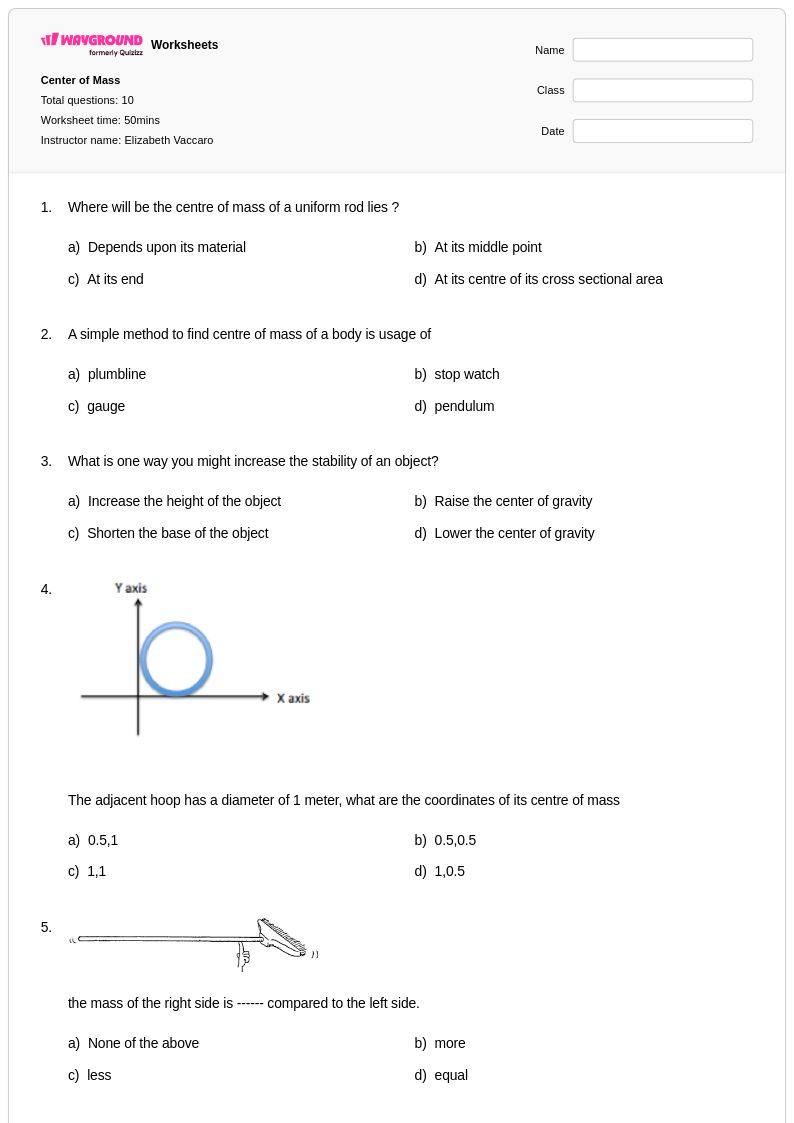
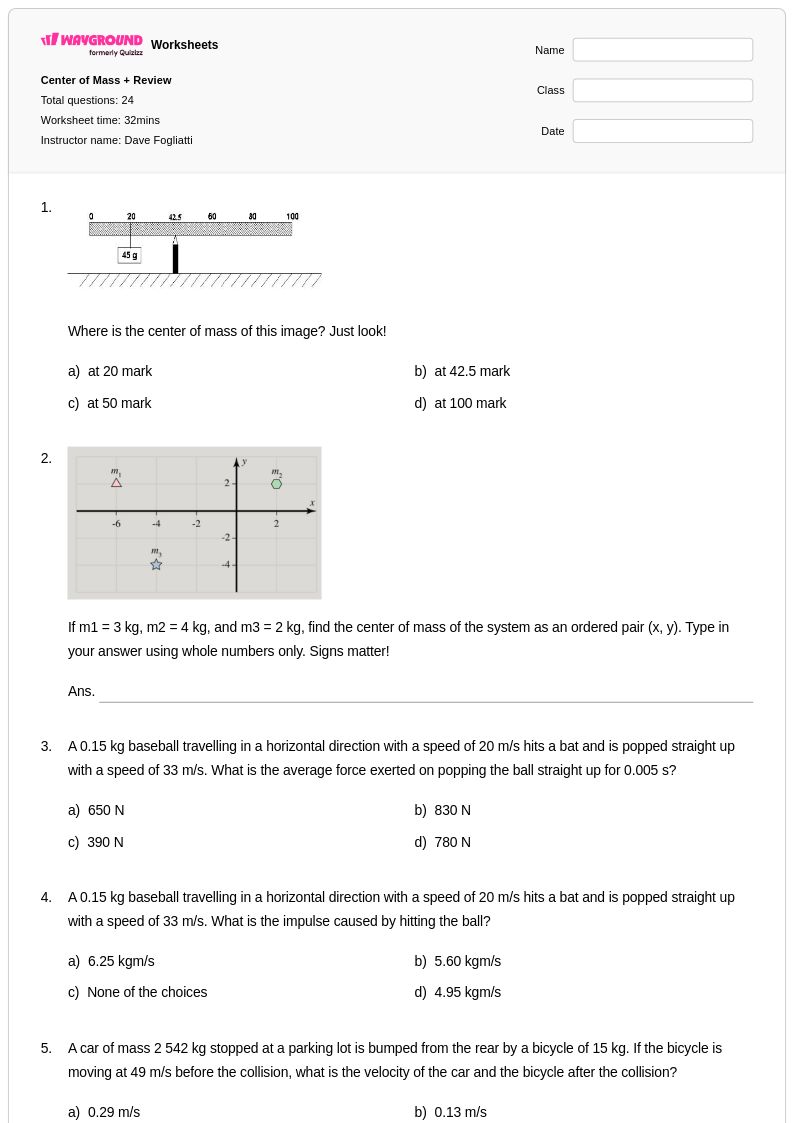
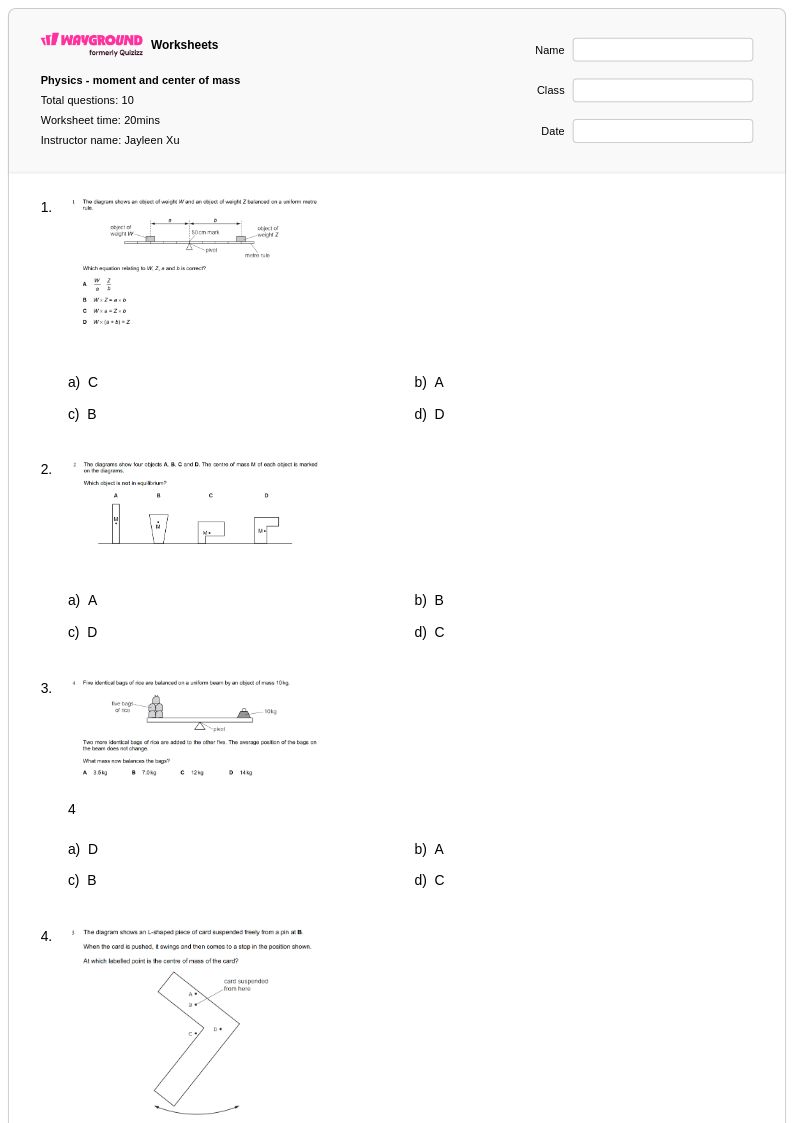
Center of mass worksheets for Class 10 physics students available through Wayground (formerly Quizizz) provide comprehensive practice with this fundamental concept that bridges mechanics and equilibrium principles. These expertly designed worksheets strengthen students' abilities to calculate the center of mass for various object configurations, analyze the motion of systems with multiple components, and apply center of mass principles to real-world scenarios involving rigid bodies and particle systems. Each worksheet includes detailed practice problems that progress from simple two-object systems to complex multi-dimensional arrangements, complete with answer keys that guide students through step-by-step solutions. The free printables encompass both theoretical calculations and practical applications, ensuring students develop proficiency in locating centers of mass using coordinate geometry, understanding how center of mass affects rotational motion, and recognizing the relationship between center of mass and stability in physical systems.
Wayground (formerly Quizizz) empowers physics educators with access to millions of teacher-created center of mass resources that can be seamlessly integrated into Class 10 curricula through advanced search and filtering capabilities. The platform's standards-aligned worksheet collections support differentiated instruction by offering varying complexity levels, from introductory center of mass problems suitable for foundational learning to challenging multi-step calculations that prepare advanced students for higher-level physics concepts. Teachers can customize these digital and printable pdf resources to target specific learning objectives, whether focusing on mathematical computation skills, conceptual understanding of center of mass in equilibrium, or applications in engineering and biomechanics. This flexibility makes the worksheets invaluable for lesson planning, targeted remediation of students struggling with vector addition and weighted averages, enrichment activities for accelerated learners, and comprehensive skill practice that reinforces the mathematical and conceptual foundations essential for success in advanced physics coursework.
FAQs
How do I teach center of mass in a physics class?
Start by building intuition with physical demonstrations, such as balancing a ruler at its midpoint or finding the balance point of irregular cardboard shapes, before introducing the mathematical formula. From there, move students through one-dimensional systems with two or three objects before progressing to two-dimensional and multi-object problems. Connecting the concept to real-world applications like vehicle stability, gymnastics, and structural engineering helps students see why center of mass matters beyond the formula.
What exercises help students practice finding the center of mass?
Effective practice progresses from uniform objects with obvious symmetry to non-uniform objects and multi-body systems where students must apply the weighted average formula. Problem sets should include both numerical calculations and conceptual questions, such as predicting how removing or adding mass shifts the center of mass. Mixed-format worksheets that combine diagrams, data tables, and calculation steps build the analytical fluency students need for assessments.
What mistakes do students commonly make when calculating center of mass?
The most common error is treating center of mass as a simple geometric midpoint rather than a mass-weighted average, which leads to incorrect answers whenever objects have unequal masses. Students also frequently forget to establish a consistent reference point or origin before calculating, producing answers that are technically correct but contextually meaningless. In two-dimensional problems, another frequent mistake is calculating the x- and y-coordinates independently but then failing to correctly interpret the resulting coordinate pair as a position in the system.
How does center of mass relate to equilibrium and rotational motion?
The center of mass is the point through which the net gravitational force effectively acts on an object, which is why an object balanced at its center of mass is in translational equilibrium. In rotational motion, torques are analyzed relative to the center of mass, making its location essential for predicting whether an object will rotate, tip, or remain stable. Understanding this connection is critical for topics including static equilibrium, angular momentum, and the stability of structures.
How can I use Wayground's center of mass worksheets in my classroom?
Wayground's center of mass worksheets are available as free printable PDFs for traditional classroom use and in digital formats for technology-integrated environments, including the option to host them as a quiz directly on Wayground. This flexibility makes them suitable for in-class practice, homework assignments, remediation, or enrichment. Each worksheet includes a detailed answer key, so teachers can use them for self-paced student practice or quick formative checks without additional grading prep. For students who need support, Wayground also offers accommodations such as read aloud, extended time, and reduced answer choices, which can be configured individually from the Students or Classes tab.
How do I differentiate center of mass instruction for students at different ability levels?
Scaffold instruction by assigning simpler one-dimensional two-object problems to students who are still building fluency, while directing advanced students toward multi-object, two-dimensional, or non-uniform density scenarios. On Wayground, teachers can apply individual accommodations such as read aloud, reduced answer choices, and extended time to specific students without affecting the experience of the rest of the class. These settings are saved per student and carry forward to future sessions, reducing the administrative burden of repeated setup.