Free Printable Cosmology and Astronomy Worksheets for Class 10
Explore Class 10 cosmology and astronomy worksheets through Wayground's free printable collection, featuring practice problems and answer keys that help students master universe structure, stellar evolution, and celestial mechanics concepts.
Explore printable Cosmology and Astronomy worksheets for Class 10
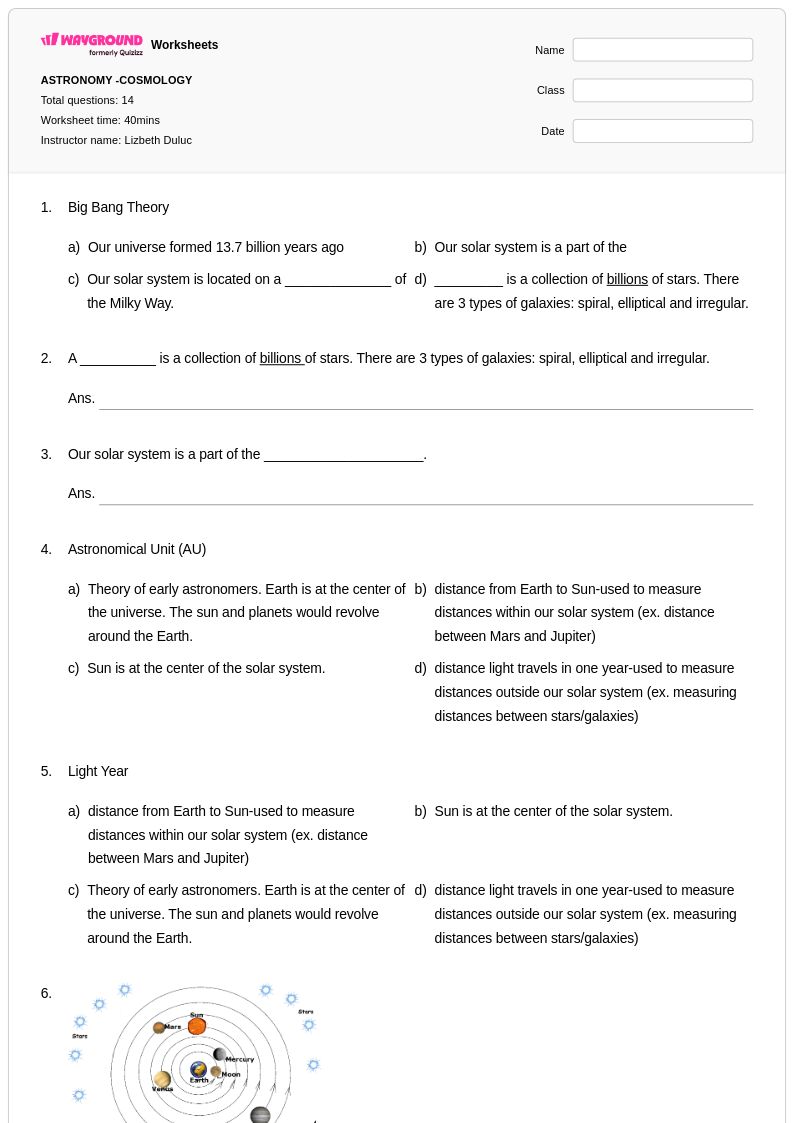
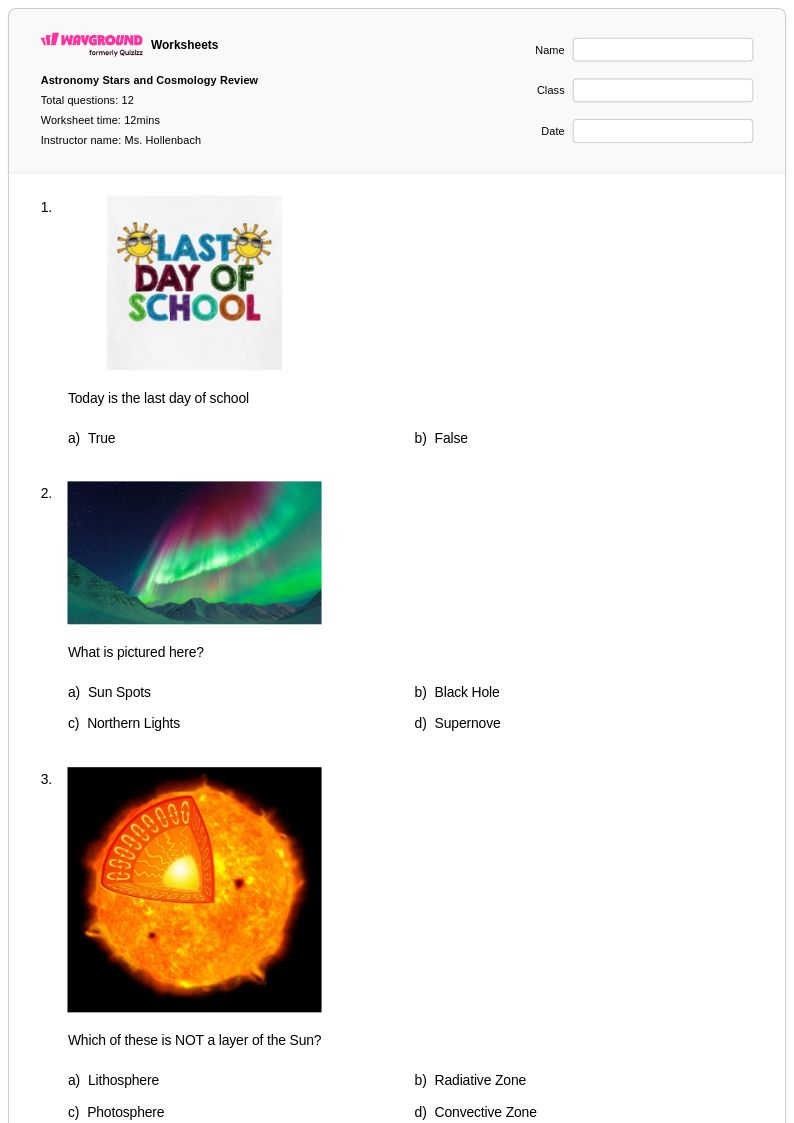
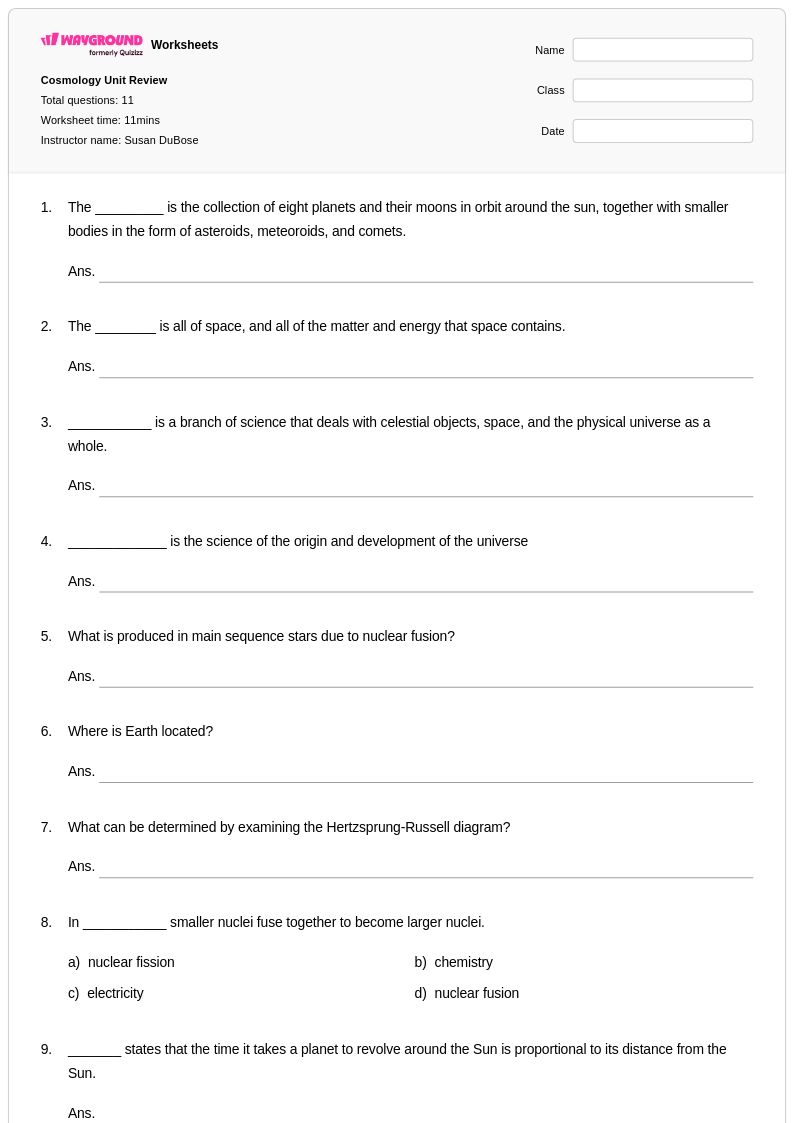
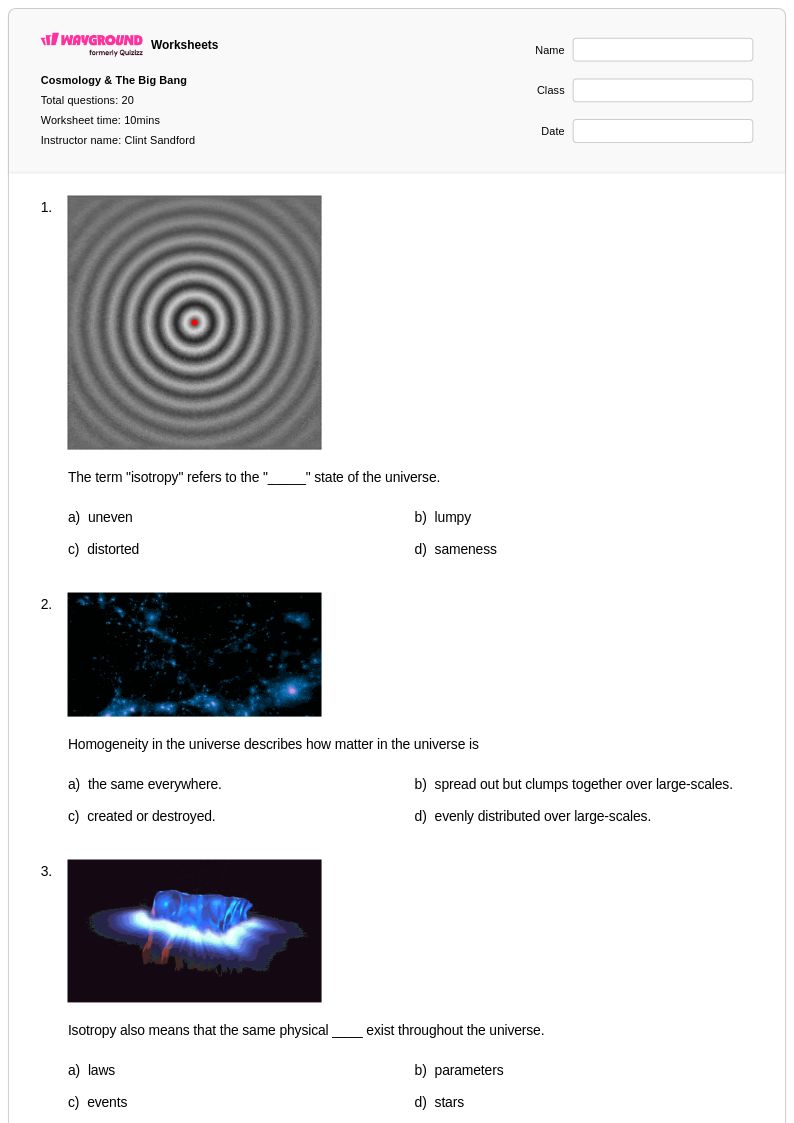
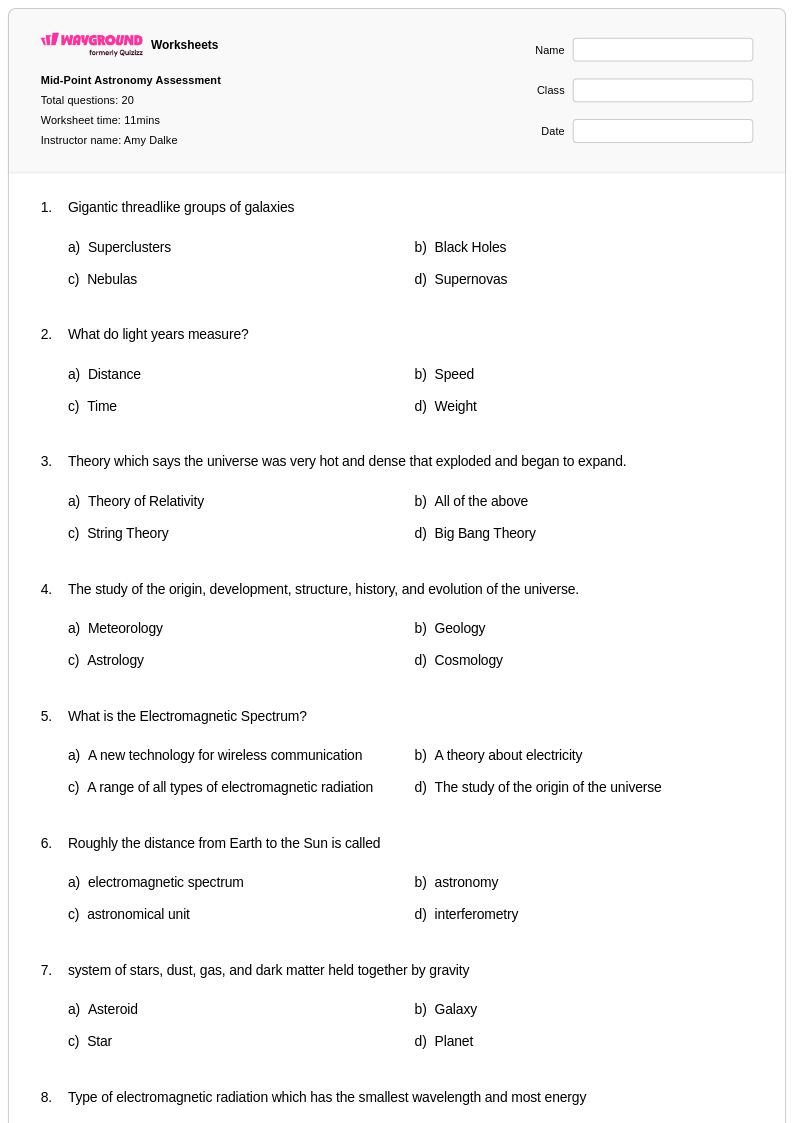
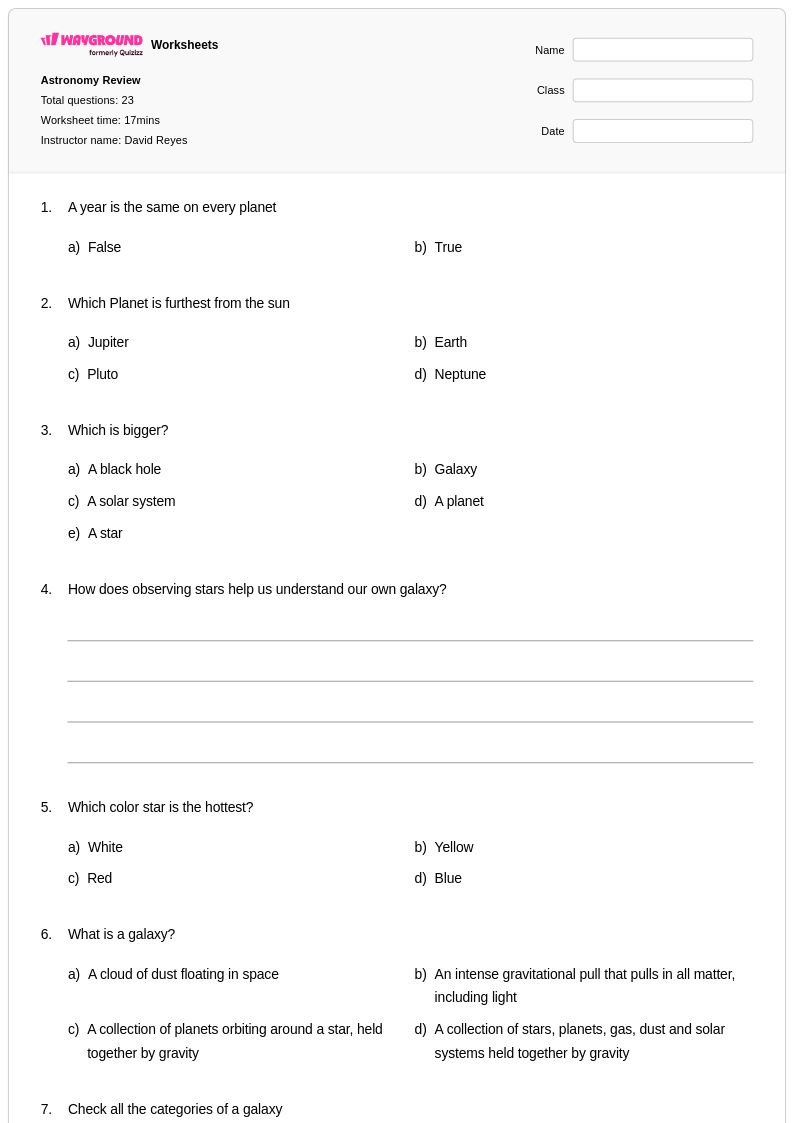
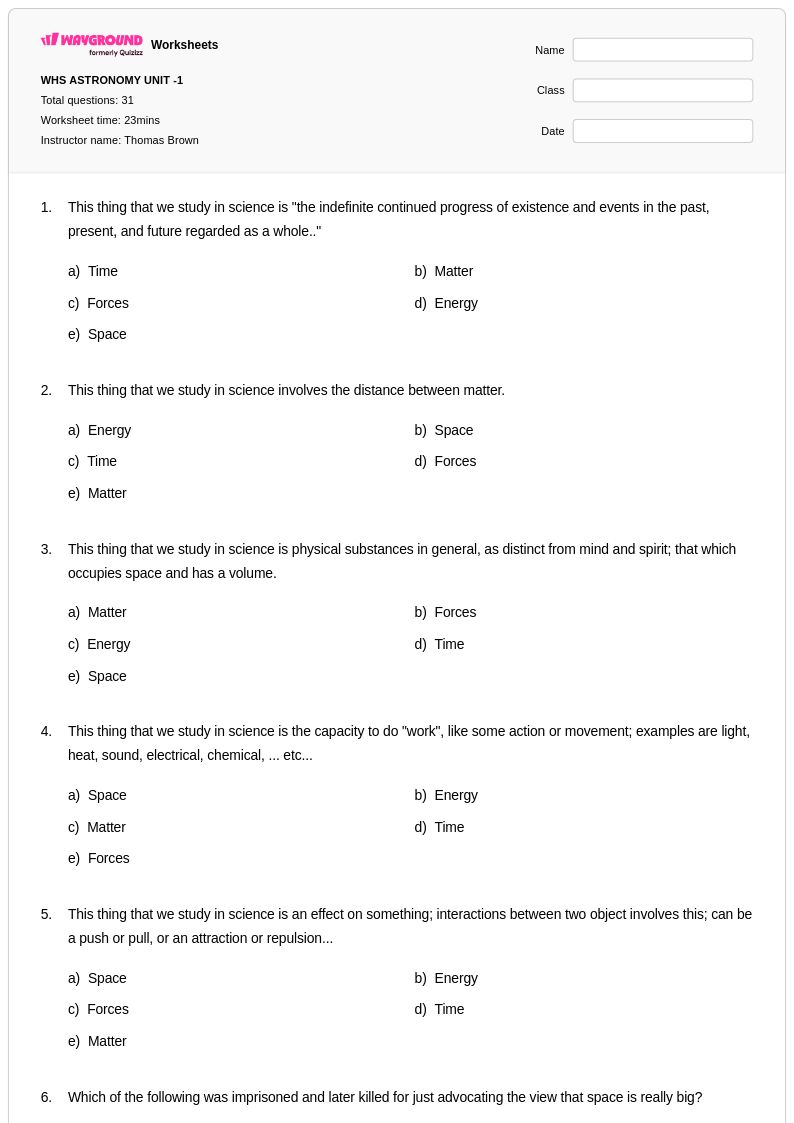
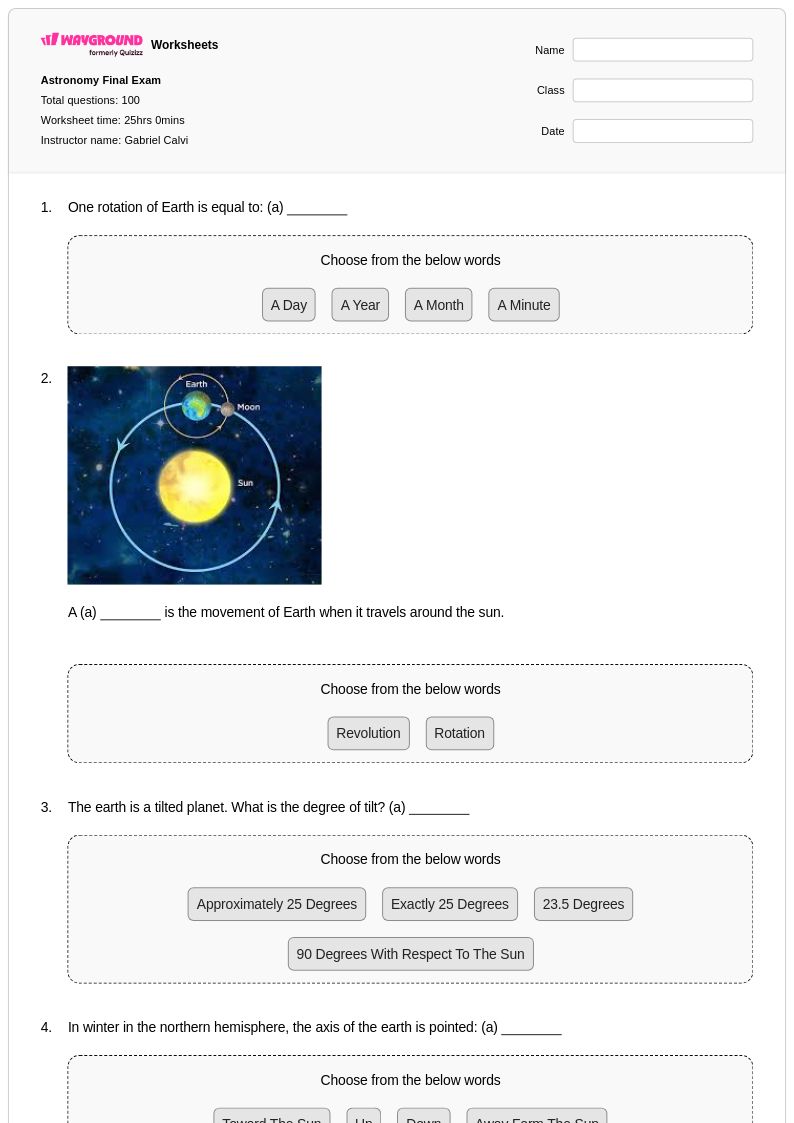
Cosmology and astronomy worksheets for Class 10 students available through Wayground (formerly Quizizz) provide comprehensive coverage of our universe's structure, origin, and evolution. These educational resources strengthen critical thinking skills as students explore fundamental concepts including the Big Bang theory, stellar life cycles, galactic formation, dark matter, and cosmic microwave background radiation. The worksheet collections feature carefully crafted practice problems that guide students through complex calculations involving light-years, redshift measurements, and Hubble's Law, while answer keys ensure accurate self-assessment and independent learning. Each printable resource incorporates real astronomical data and observations, helping students connect theoretical physics concepts with observable phenomena in our universe, making these free materials invaluable for developing scientific reasoning skills essential for advanced physics coursework.
Wayground's extensive library supports physics educators with millions of teacher-created cosmology and astronomy worksheet resources that streamline lesson planning and enhance classroom instruction. The platform's robust search and filtering capabilities allow teachers to quickly locate materials aligned with specific learning standards and curriculum requirements, while differentiation tools enable customization for diverse learning needs and ability levels. These comprehensive worksheet collections are available in both printable pdf formats and interactive digital versions, providing flexibility for in-class activities, homework assignments, and remote learning environments. Teachers can efficiently address individual student needs through targeted remediation worksheets focusing on challenging concepts like cosmic scale and time, while advanced students benefit from enrichment materials exploring cutting-edge topics such as exoplanet detection methods and gravitational wave astronomy, ensuring every Class 10 physics student receives appropriate skill practice opportunities.
FAQs
How do I teach cosmology and astronomy concepts to students who have no background in physics?
Start with observable phenomena students already recognize, such as the day/night cycle and moon phases, before building toward abstract concepts like stellar evolution and the Big Bang theory. Scaffolding is essential: introduce celestial mechanics and electromagnetic radiation before tackling redshift, Hubble's Law, or spacetime curvature. Connecting each concept to real data, such as actual light spectra or Hubble Space Telescope images, helps students anchor abstract ideas in concrete evidence.
What types of practice problems help students understand Hubble's Law and cosmic distance measurements?
Students benefit most from problems that require them to apply Hubble's Law (v = H₀d) to calculate recessional velocities and distances for real or simulated galaxies. Stellar parallax calculations and standard candle problems using Cepheid variables also reinforce how astronomers measure cosmic distances at different scales. Pairing calculation problems with interpretation questions, such as explaining what a galaxy's redshift tells us about the universe's expansion, deepens conceptual understanding alongside procedural fluency.
What misconceptions do students commonly have about the Big Bang theory and the expanding universe?
The most persistent misconception is that the Big Bang was an explosion occurring at a single point in space, when in fact it describes the rapid expansion of space itself from an extremely dense state. Students also frequently confuse the expansion of the universe with galaxies moving through space, rather than understanding that space between galaxies is stretching. A related error is assuming that redshift means galaxies are moving away from Earth specifically, rather than that all distant objects recede from all observers in an expanding universe.
What common errors do students make when interpreting stellar classification and the Hertzsprung-Russell diagram?
Students often misread the H-R diagram by assuming hotter stars are always brighter or larger, failing to account for the distinct populations of white dwarfs and giant stars that fall off the main sequence. Another frequent error is conflating a star's color with its temperature in an inverse way, not recognizing that blue stars are hotter than red stars. Students also struggle with the concept of stellar luminosity as an intrinsic property, often confusing apparent brightness with absolute magnitude when interpreting observational data.
How can I use Wayground's cosmology and astronomy worksheets in my classroom?
Wayground's cosmology and astronomy worksheets are available as both printable PDFs and in digital formats, making them practical for traditional classroom instruction, homework assignments, and technology-integrated learning environments. Teachers can host worksheets as a quiz directly on Wayground, enabling real-time tracking of student performance on topics like dark matter, galactic structure, and cosmological models. Each worksheet includes a complete answer key, so they work equally well for guided practice during instruction, independent review, or targeted remediation of challenging concepts.
How do I differentiate astronomy instruction for students at different skill levels?
For foundational learners, focus on qualitative understanding of stellar evolution stages and basic celestial mechanics before introducing quantitative calculations. Advanced students can be challenged with multi-step problems involving Hubble's Law, stellar parallax, or analysis of cosmic microwave background radiation data. On Wayground, teachers can apply accommodations at the individual student level, including reduced answer choices to lower cognitive load for struggling learners and read-aloud support for students who need it, without other students being notified of those settings.