Free Printable Doppler Effect Worksheets for Class 11
Class 11 Physics Doppler Effect worksheets from Wayground provide comprehensive printables and practice problems with answer keys to help students master wave frequency changes and relative motion concepts through engaging free PDF exercises.
Explore printable Doppler Effect worksheets for Class 11
Doppler Effect worksheets for Class 11 students available through Wayground (formerly Quizizz) provide comprehensive practice with wave frequency changes due to relative motion between sources and observers. These expertly designed materials strengthen students' understanding of frequency shifts in sound waves, light waves, and electromagnetic radiation, helping them master calculations involving moving sources, moving observers, and scenarios with both elements in motion. The worksheets include detailed practice problems that guide students through real-world applications such as radar detection, medical ultrasound, and astronomical redshift observations, with complete answer keys that support independent learning and self-assessment. Available as free printables in convenient PDF format, these resources systematically build proficiency in applying Doppler Effect equations and interpreting frequency change data across various physics contexts.
Wayground (formerly Quizizz) empowers educators with millions of teacher-created Doppler Effect resources that streamline lesson planning and differentiated instruction for Class 11 physics courses. The platform's robust search and filtering capabilities allow teachers to quickly locate materials aligned with specific curriculum standards and learning objectives, while built-in differentiation tools enable seamless adaptation of content complexity for diverse student needs. These worksheet collections are available in both printable and digital formats, including downloadable PDFs, providing maximum flexibility for classroom implementation, homework assignments, and laboratory exercises. Teachers can customize existing materials or create targeted practice sets for remediation and enrichment, ensuring that students receive appropriate challenge levels while developing mastery of wave physics concepts and mathematical problem-solving skills essential for advanced scientific study.
FAQs
How do I teach the Doppler effect to physics students?
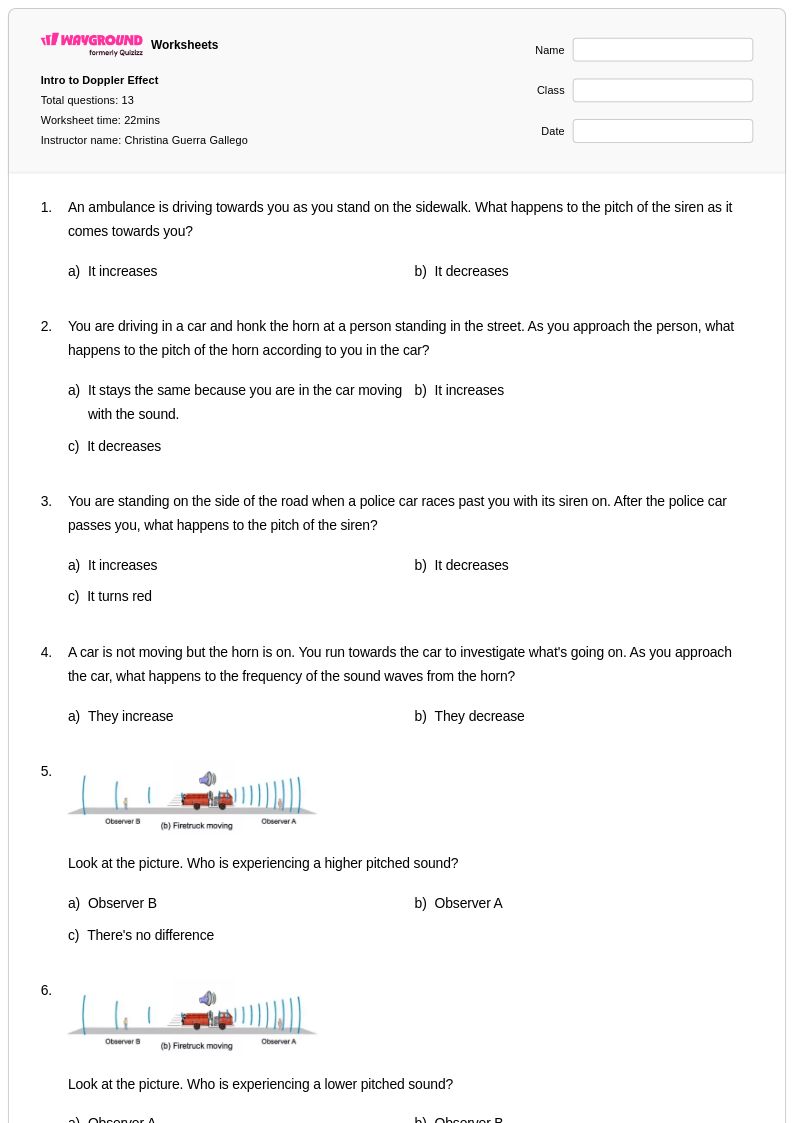
Start with a concrete auditory example, such as the pitch change of a passing ambulance siren, before introducing the mathematical relationship between frequency, wave speed, and relative motion. Building from qualitative understanding to quantitative calculation helps students connect the formula to physical intuition. Once students can predict whether frequency increases or decreases based on source and observer motion, introduce problems involving moving sources, moving observers, and then both simultaneously.
What kinds of practice problems help students master Doppler effect calculations?
Effective practice should progress from single-variable problems, where only the source or observer is moving, to multi-step scenarios involving both moving sources and observers. Problems grounded in real-world contexts, such as radar speed detection, medical ultrasound imaging, and redshift in astronomical observations, reinforce why the concept matters and improve retention. Including problems that require students to identify whether the source and observer are approaching or receding is essential for building reliable procedural fluency.
What mistakes do students commonly make when solving Doppler effect problems?
The most frequent error is misapplying the sign convention in the Doppler formula, particularly confusing when to add or subtract velocities depending on whether the source and observer are approaching or moving apart. Students also frequently conflate the speed of sound with the speed of the observer or source, treating them interchangeably in the formula. A third common misconception is believing the Doppler effect changes the speed of the wave rather than its observed frequency.
How can I differentiate Doppler effect worksheets for students at different skill levels?
For students new to wave physics, begin with conceptual problems and basic frequency shift calculations using sound waves at standard conditions before introducing variables like temperature-dependent wave speed. Advanced students can tackle problems involving electromagnetic waves, relativistic Doppler effects, or multi-step scenarios that require unit conversion and algebraic manipulation. On Wayground, teachers can assign differentiated problem sets to individual students and apply accommodations such as reduced answer choices or read-aloud support to lower cognitive load for students who need additional scaffolding.
How do I use Doppler effect worksheets from Wayground in my classroom?
Wayground's Doppler effect worksheets are available as printable PDFs for traditional classroom use and in digital formats for technology-integrated instruction, including the option to host them as a graded quiz directly on the platform. This flexibility makes them suitable for in-class practice, homework assignments, lab follow-up activities, or test preparation. Each worksheet includes a detailed answer key, supporting both teacher-led review and independent student self-assessment.
How does the Doppler effect apply to real-world technology students might recognize?
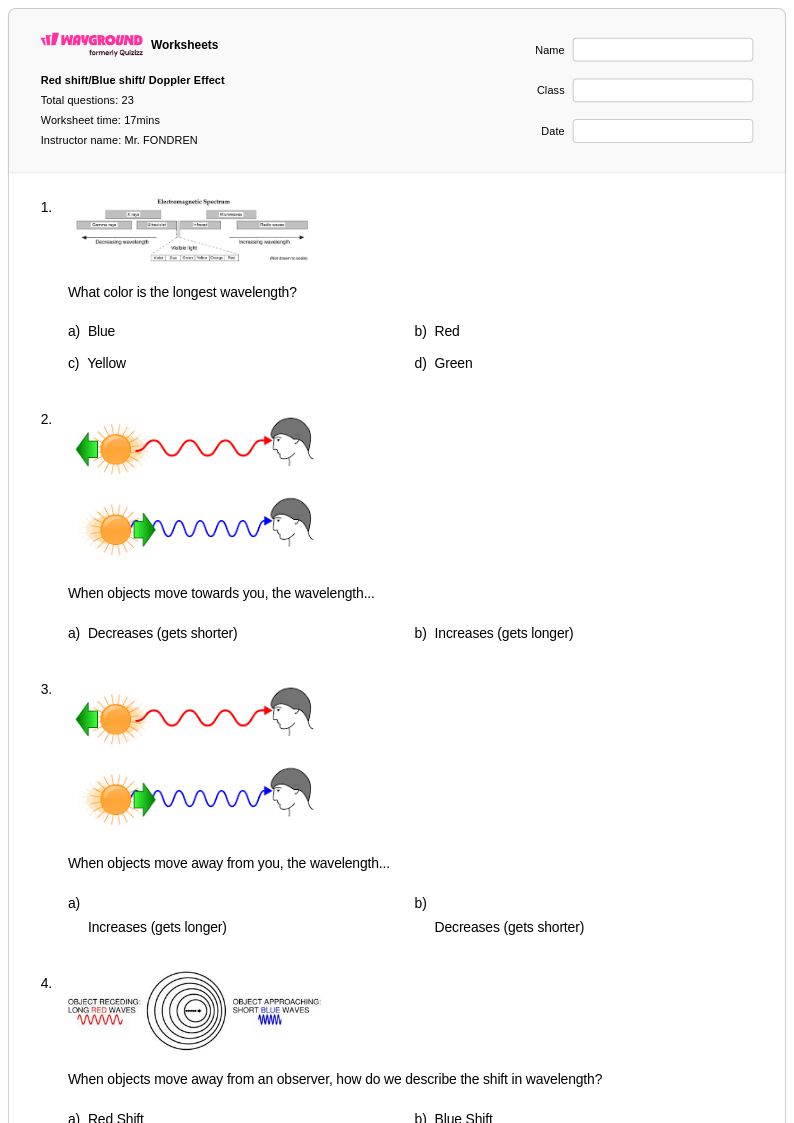
The Doppler effect underlies several technologies students encounter in everyday life, including police radar guns, weather Doppler radar, and medical ultrasound imaging. In astronomy, it explains how scientists determine whether stars and galaxies are moving toward or away from Earth by analyzing shifts in their light spectra. Connecting worksheet problems to these applications gives students meaningful context and helps them understand why mastering the frequency-shift formula has practical significance beyond the physics classroom.