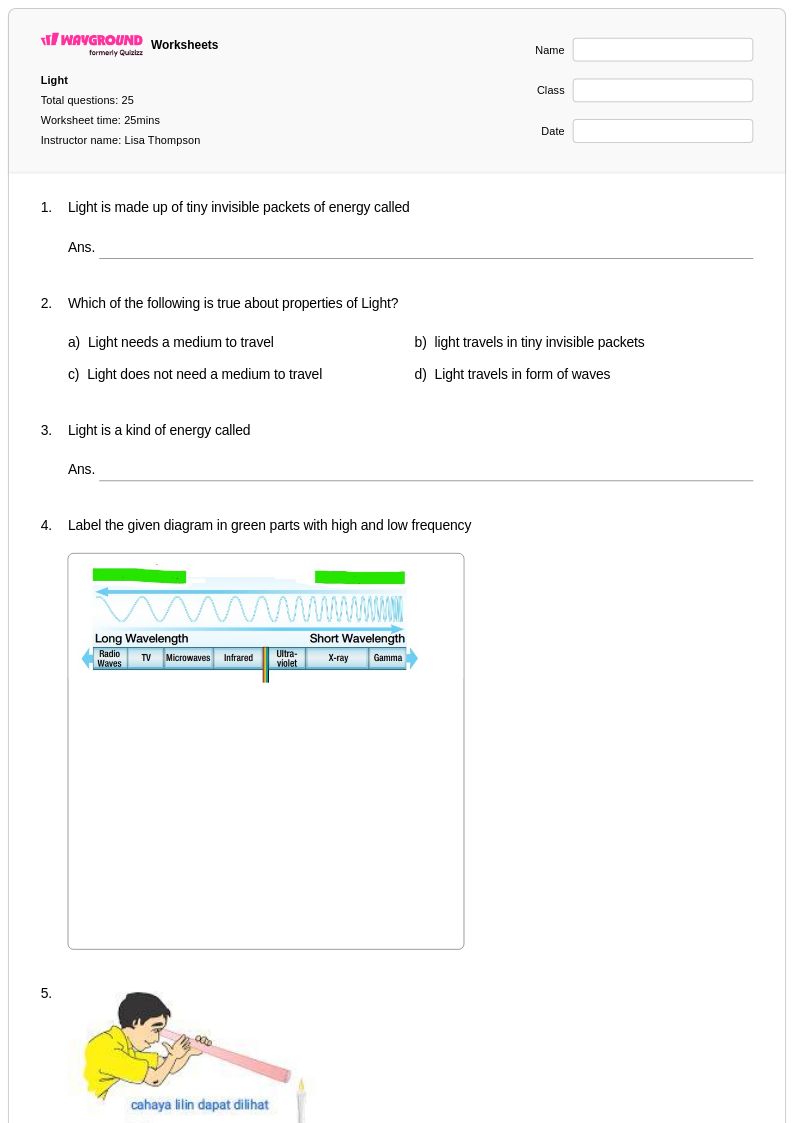
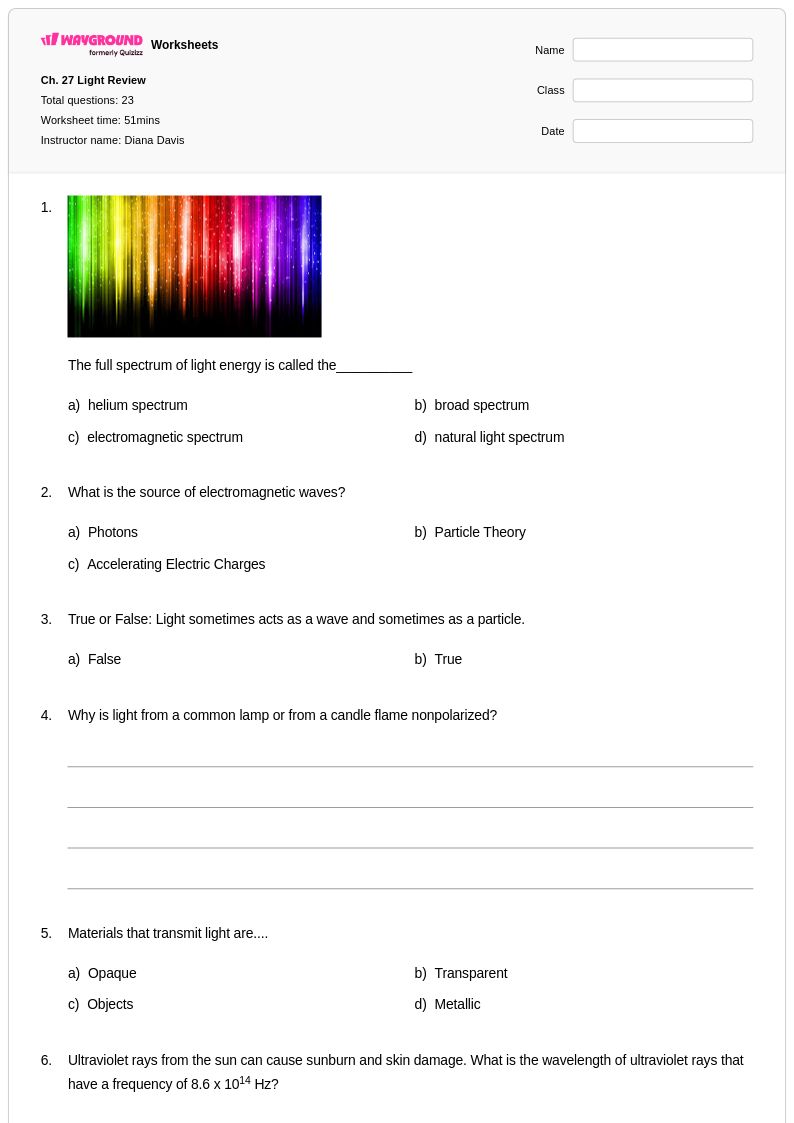
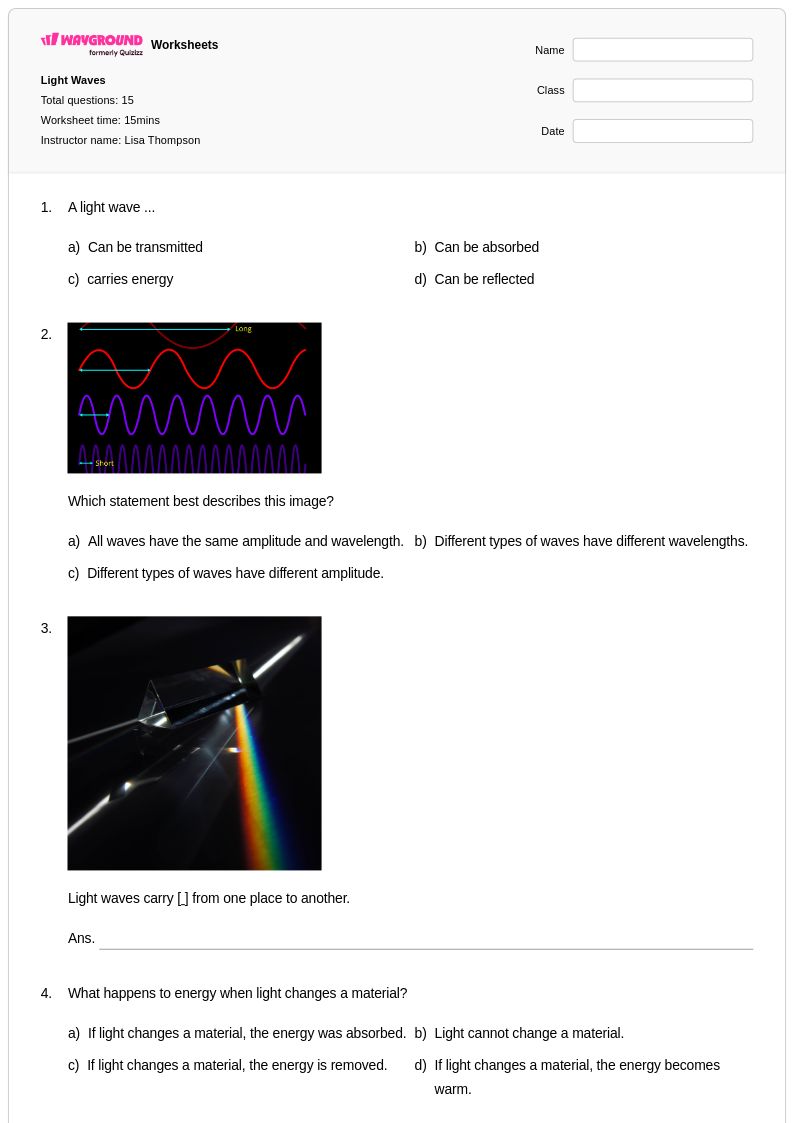
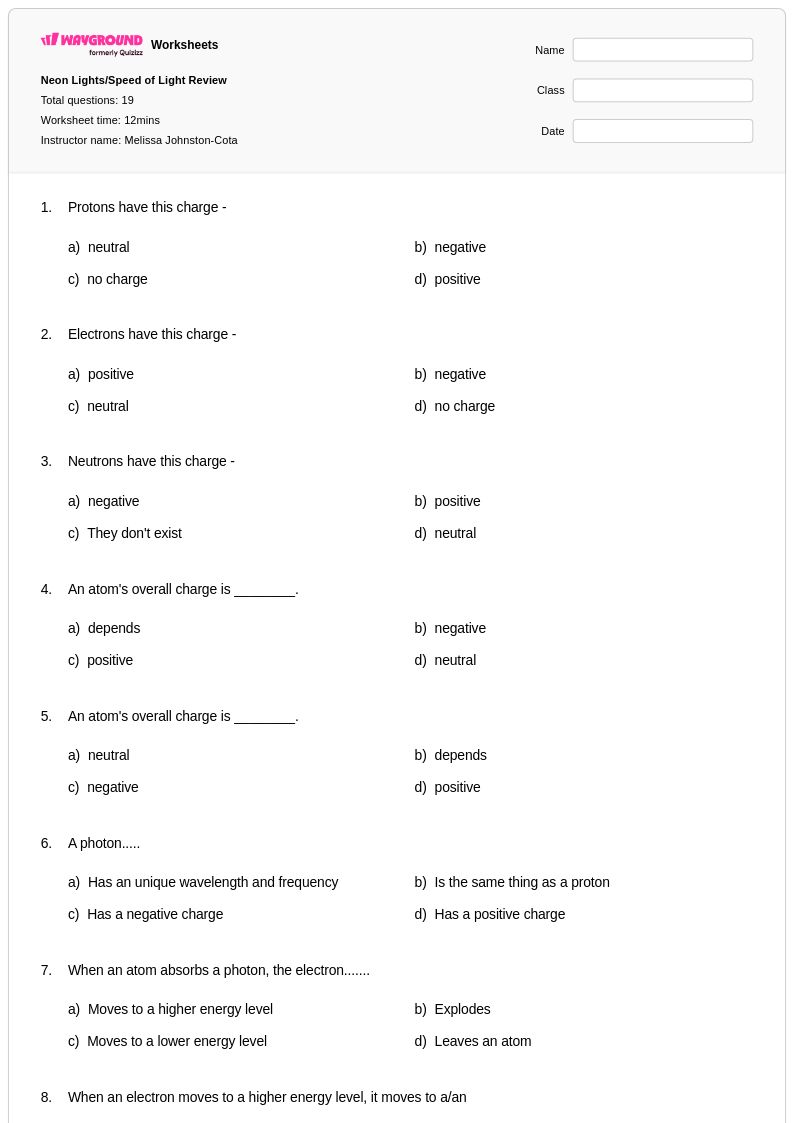
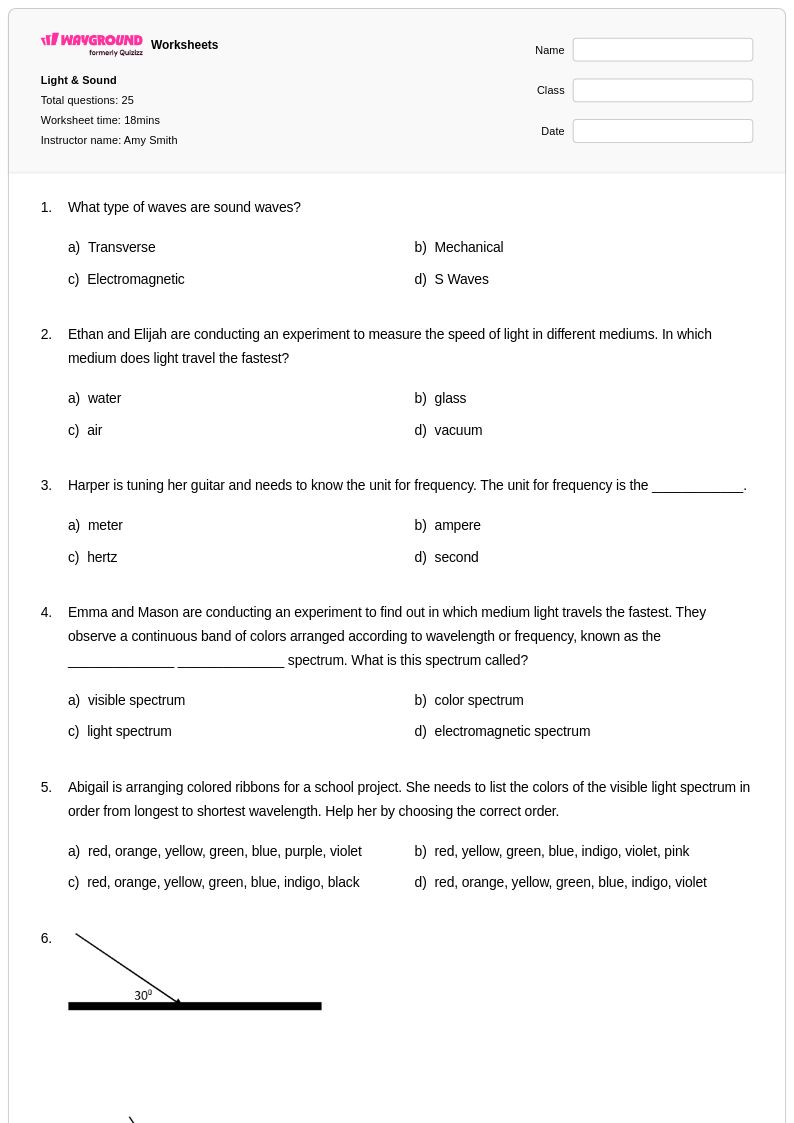
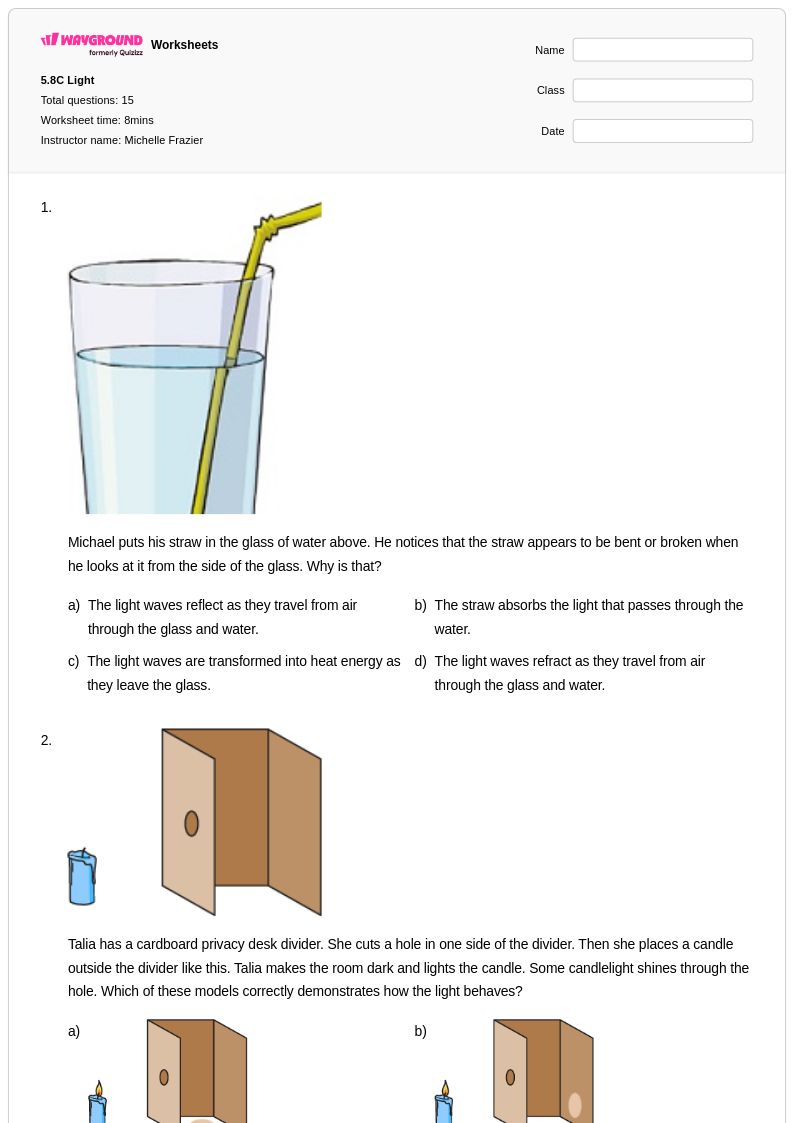
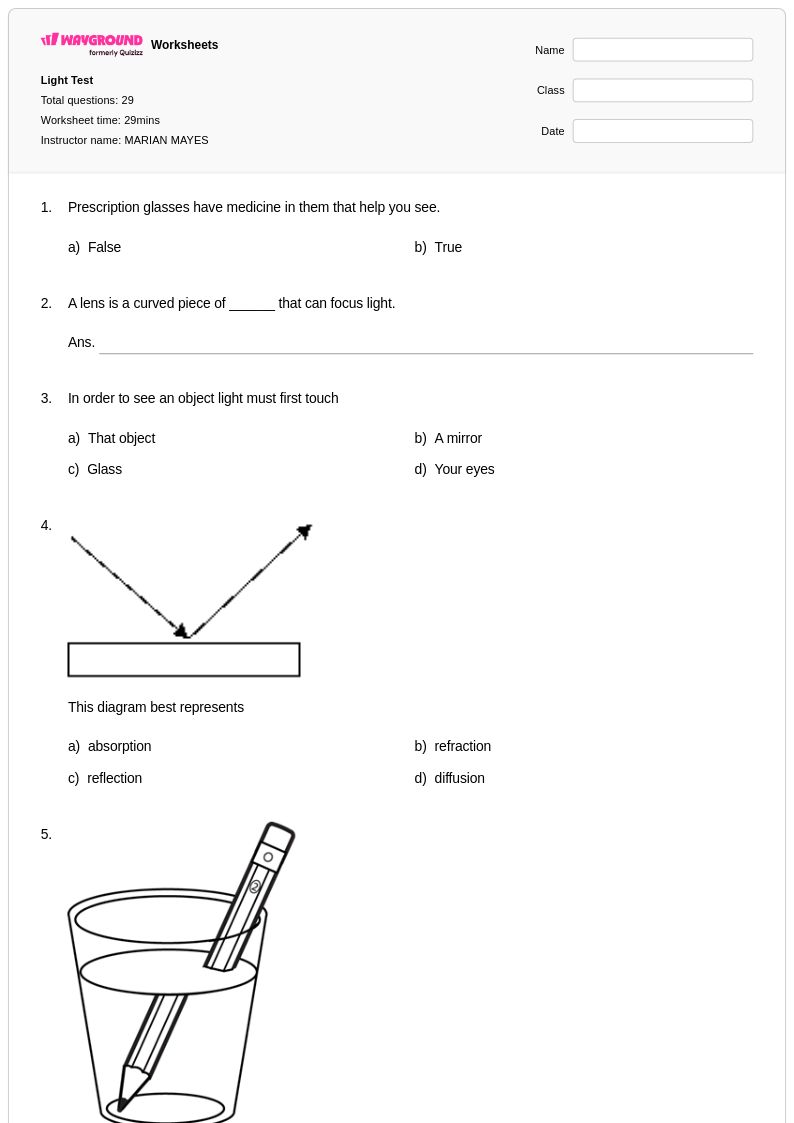
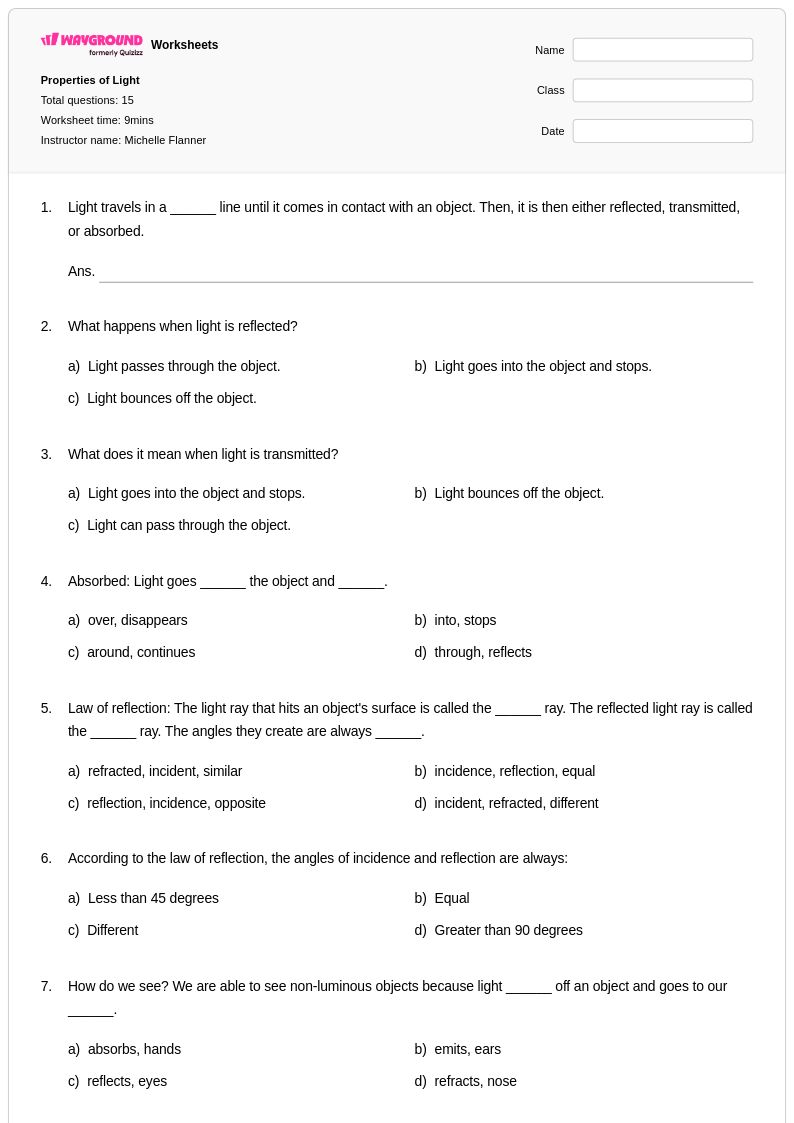
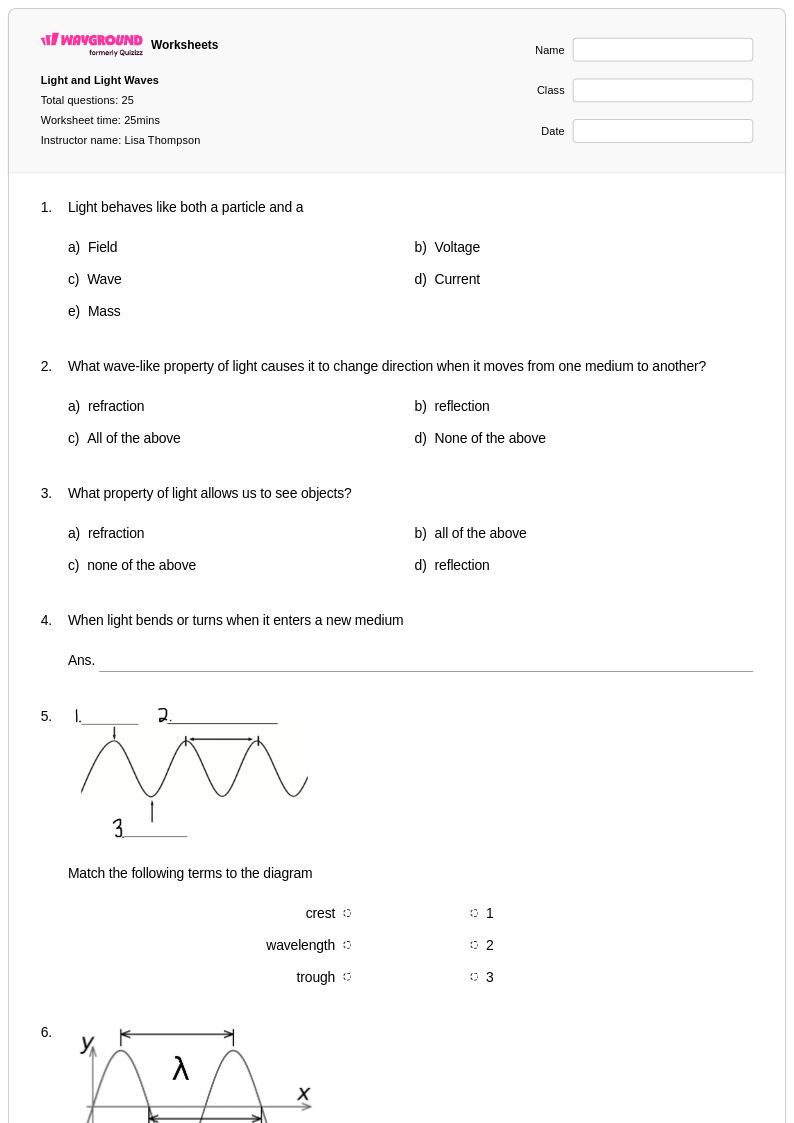
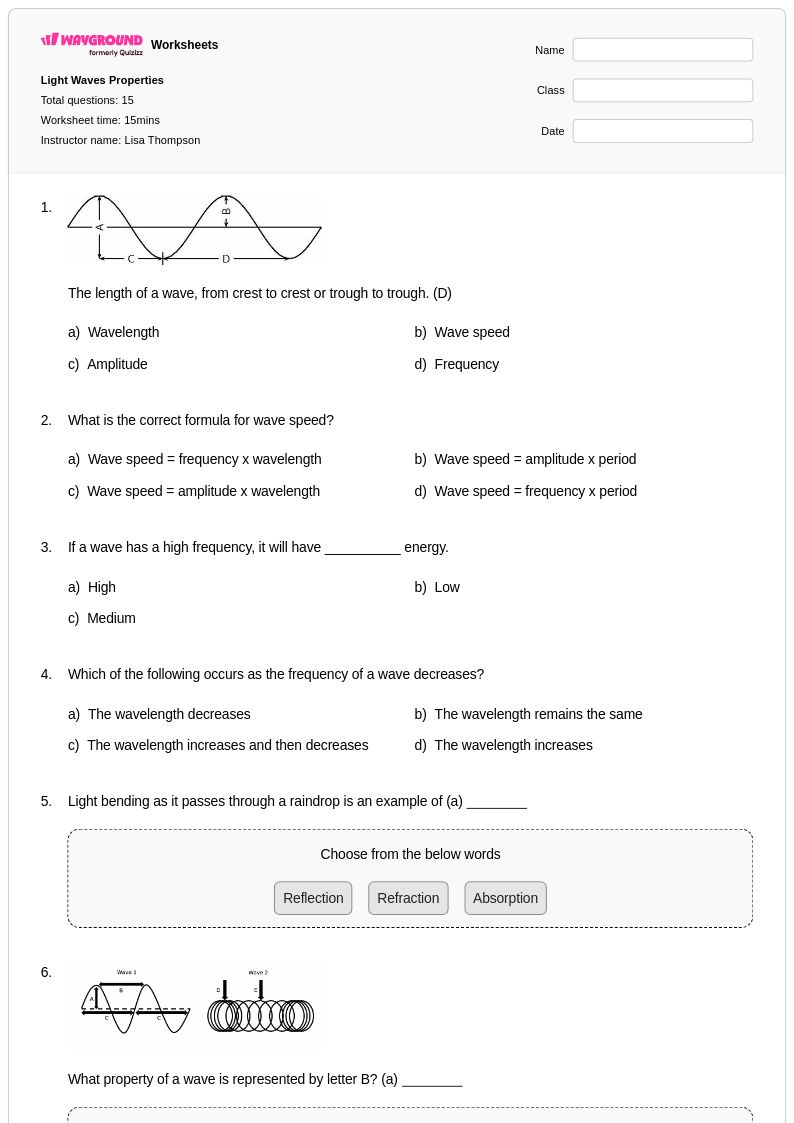
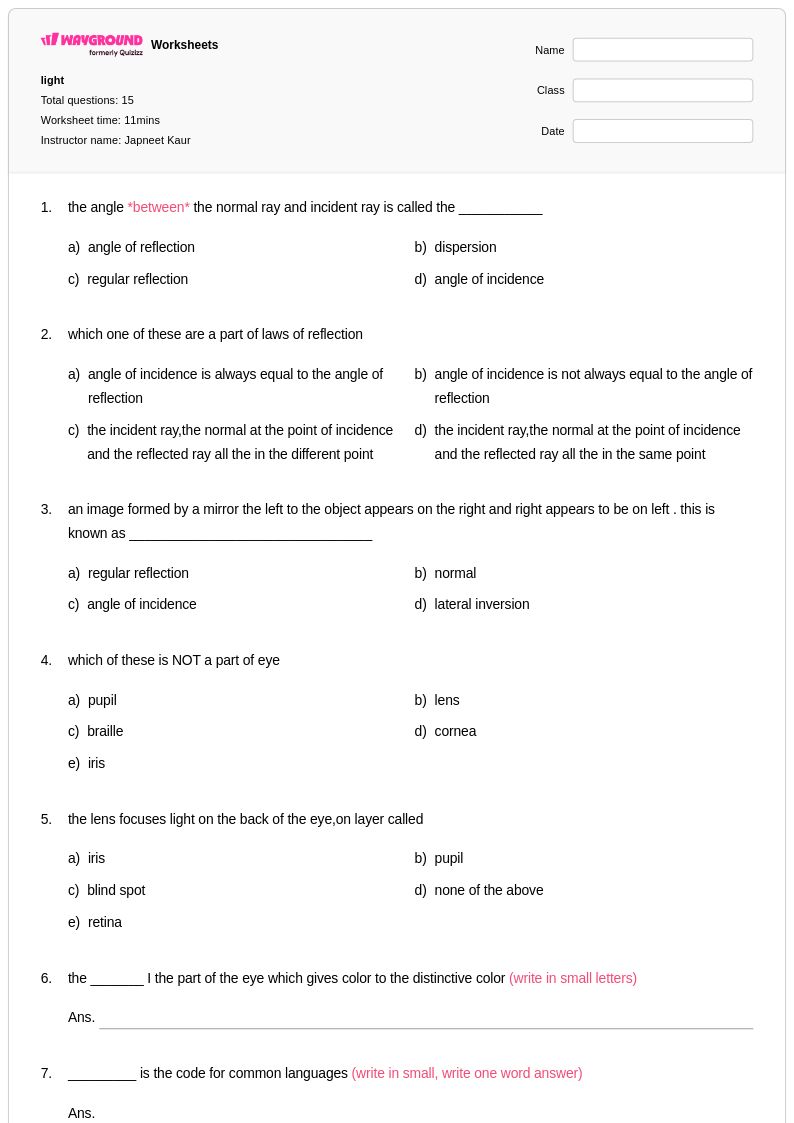
Explore Wayground's comprehensive Class 11 light physics worksheets featuring free printables and practice problems with answer keys to help students master optical principles, wave properties, and electromagnetic radiation concepts.
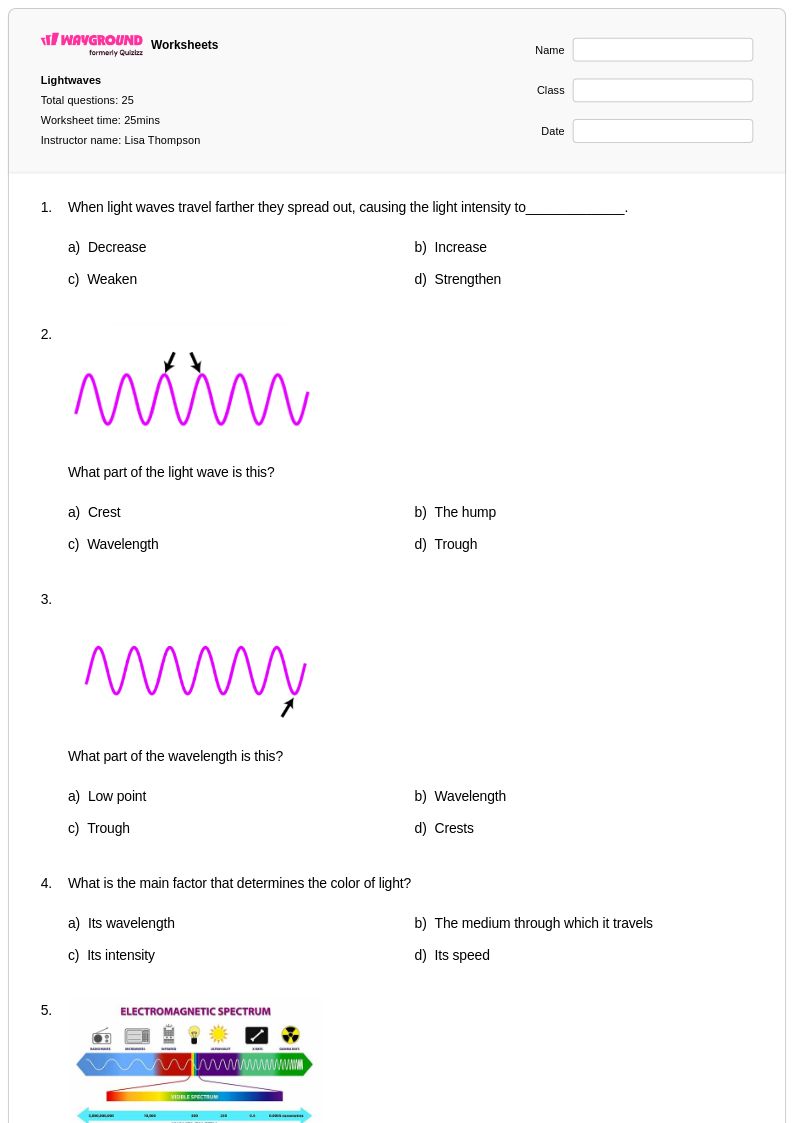
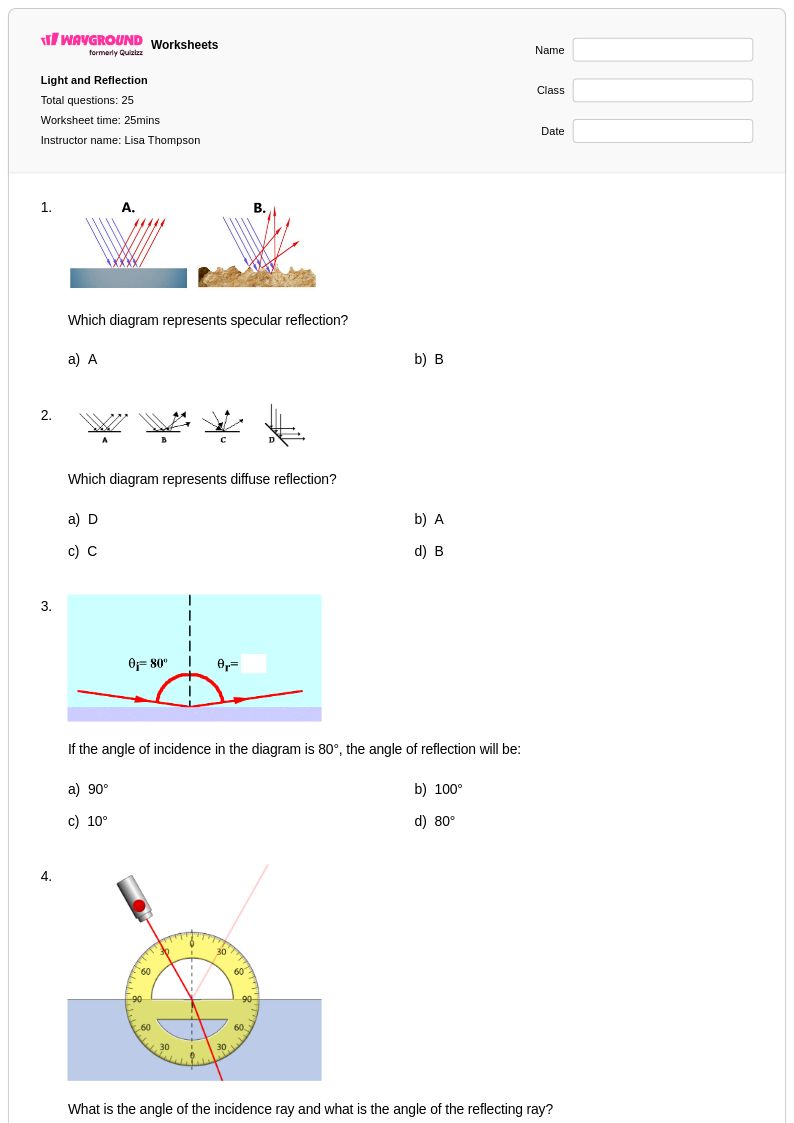
Light worksheets for Class 11 physics students available through Wayground (formerly Quizizz) provide comprehensive coverage of optical phenomena, electromagnetic radiation principles, and wave-particle duality concepts essential for advanced high school physics curricula. These carefully designed practice problems strengthen students' analytical skills in areas such as reflection and refraction calculations, interference and diffraction patterns, polarization effects, and photon energy computations. The worksheet collections include detailed answer keys that enable independent learning and self-assessment, while the free printable format allows educators to seamlessly integrate these resources into classroom instruction, homework assignments, and laboratory activities that reinforce theoretical concepts with practical applications.
Wayground (formerly Quizizz) empowers physics educators with access to millions of teacher-created light and optics worksheets that can be easily located through robust search and filtering capabilities designed specifically for Class 11 physics standards alignment. The platform's differentiation tools allow instructors to customize problem difficulty levels and modify content to meet diverse learning needs, while the flexible format options support both traditional printable pdf distributions and interactive digital implementations. These comprehensive worksheet collections facilitate strategic lesson planning by providing educators with ready-to-use resources for skill practice sessions, targeted remediation of challenging optical concepts, and enrichment opportunities that extend learning beyond basic curriculum requirements, ultimately supporting improved student mastery of complex light phenomena and electromagnetic theory applications.
FAQs
How do I teach light and optics to middle and high school students?
Start with the wave properties of light, establishing frequency, wavelength, and speed before moving into reflection and refraction. Use ray diagrams to make abstract concepts visual, and connect each principle to everyday phenomena like mirrors, lenses, and rainbows. Building from particle vs. wave debate history gives students a conceptual anchor before working through mathematical relationships like Snell's law.
What worksheets help students practice reflection and refraction concepts?
Ray diagram exercises are the most effective practice format for reflection and refraction because they require students to apply the law of reflection and Snell's law visually before confirming with calculations. Worksheets that present multiple scenarios, such as light passing from air into water or glass, help students recognize how the angle of incidence and medium density affect the bending of light. Practice problems that connect these principles to real optical instruments, like concave mirrors or converging lenses, deepen conceptual transfer.
What mistakes do students commonly make when learning about the electromagnetic spectrum?
A frequent misconception is that visible light is a separate phenomenon from the electromagnetic spectrum rather than one region within it. Students also regularly confuse the relationship between frequency and wavelength, often believing higher frequency means longer wavelength. Another common error is conflating the speed of light with the speed of sound, which can be addressed by explicitly contrasting how each wave type propagates and through which media.
How do I help students understand why light bends when it enters a new medium?
Students grasp refraction more reliably when it is framed in terms of speed change rather than just angle change. Explaining that light slows down when entering a denser medium, and that the change in speed is what causes the bending, gives students a causal model rather than a rule to memorize. Analogies such as a car wheel rolling from pavement onto grass at an angle can make the directional shift intuitive before students work through Snell's law numerically.
How can I use Wayground's light worksheets in my classroom?
Wayground's light worksheets are available as printable PDFs for traditional classroom use and in digital formats for technology-integrated environments, making them flexible for homework, in-class practice, or lab follow-up. Teachers can also host worksheets directly as a quiz on Wayground, enabling real-time student response tracking. All worksheets include complete answer keys, supporting independent practice, self-assessment, and efficient teacher grading.
What common errors do students make when drawing ray diagrams for mirrors and lenses?
Students frequently draw incident and reflected rays without respecting the normal line, resulting in inaccurate angle measurements. For lenses, a common mistake is failing to use all three principal rays when locating an image, which leads to incorrect image position or orientation. Many students also confuse converging and diverging behavior, particularly for concave versus convex lenses, which can be addressed through repeated diagram practice with immediate feedback.
How do I differentiate light and optics instruction for students at different skill levels?
For students who are still building foundational understanding, focus on qualitative descriptions of reflection, refraction, and the electromagnetic spectrum before introducing equations. Advanced students can extend into wave optics topics such as interference, diffraction, and polarization. On Wayground, teachers can apply accommodations such as reduced answer choices or read-aloud support to individual students, allowing the same worksheet to serve multiple learner needs without creating separate assignments.