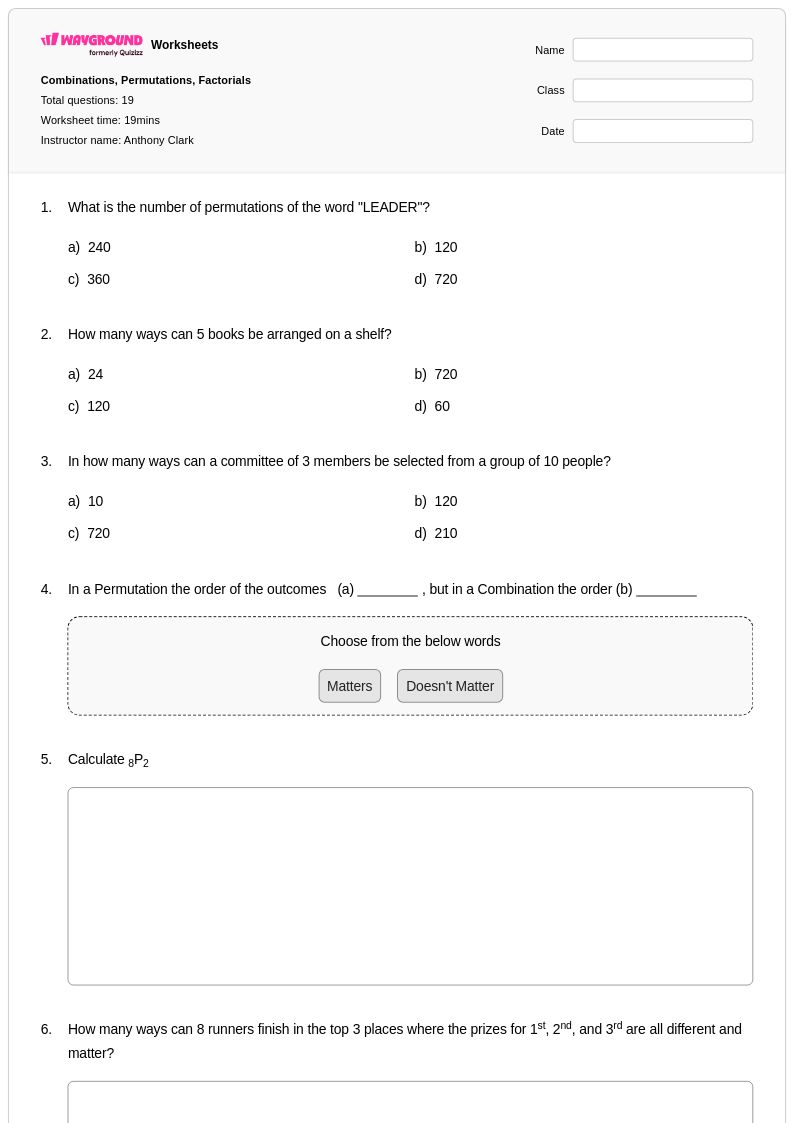
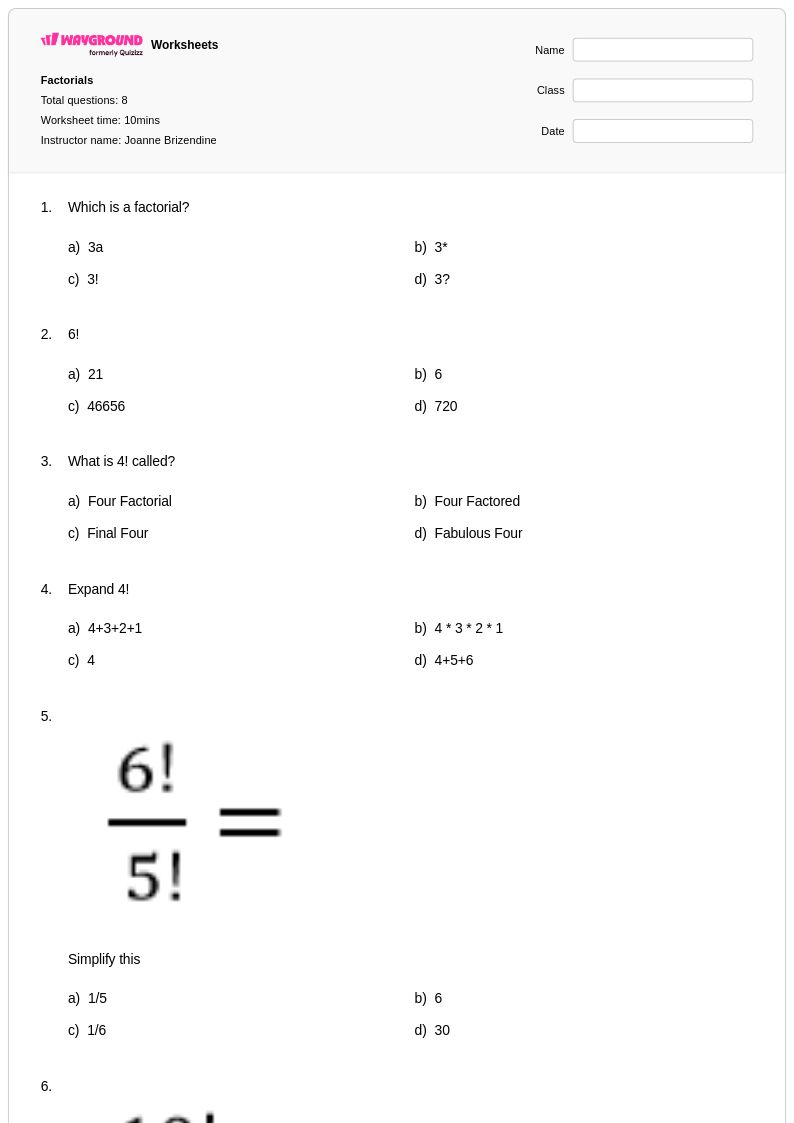
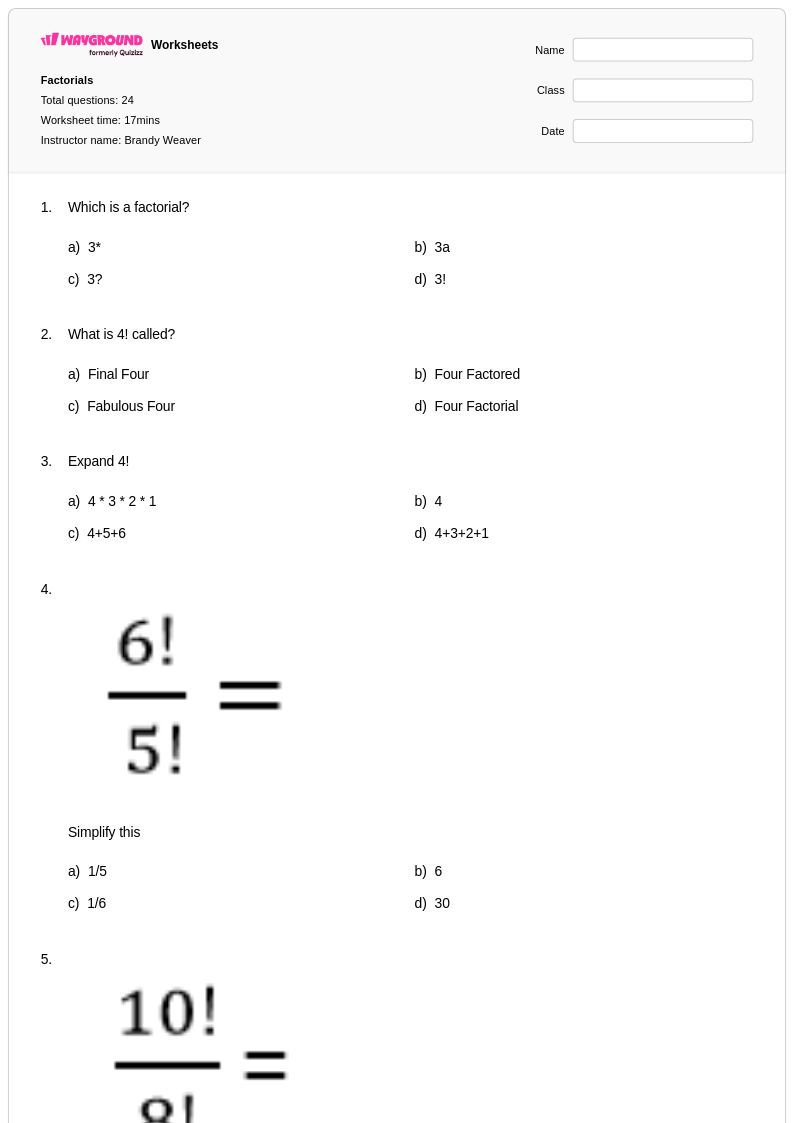
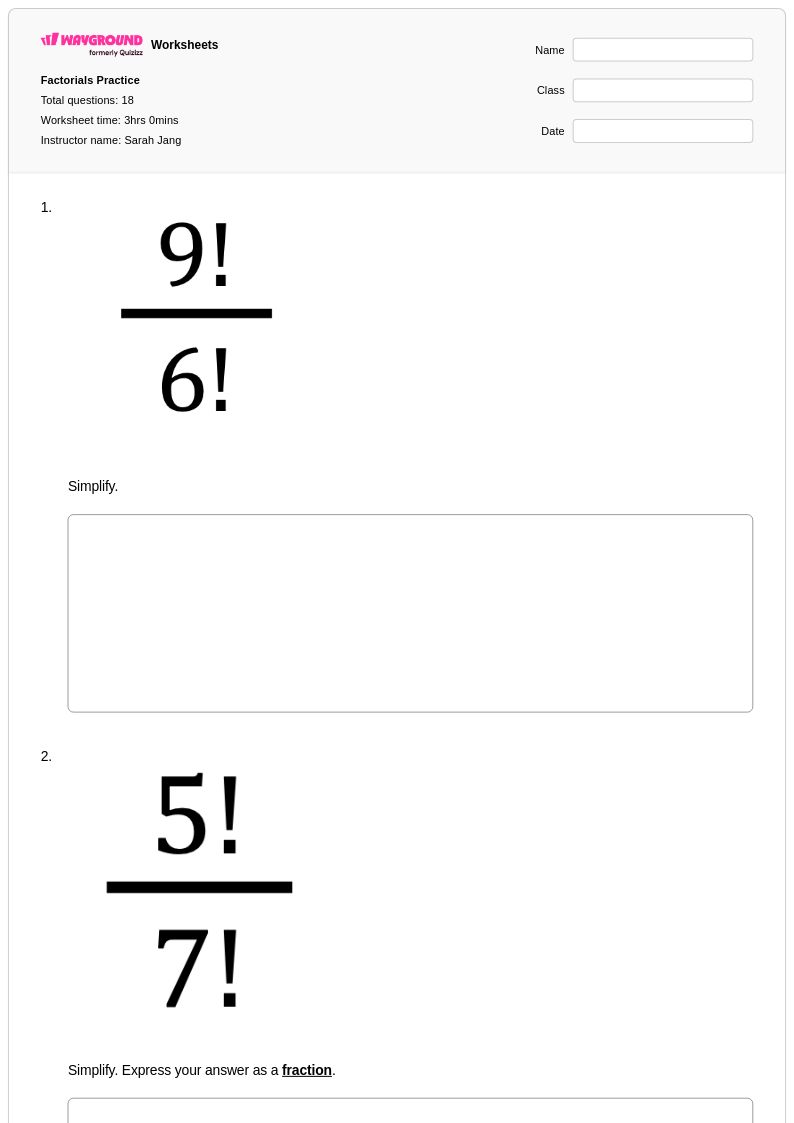
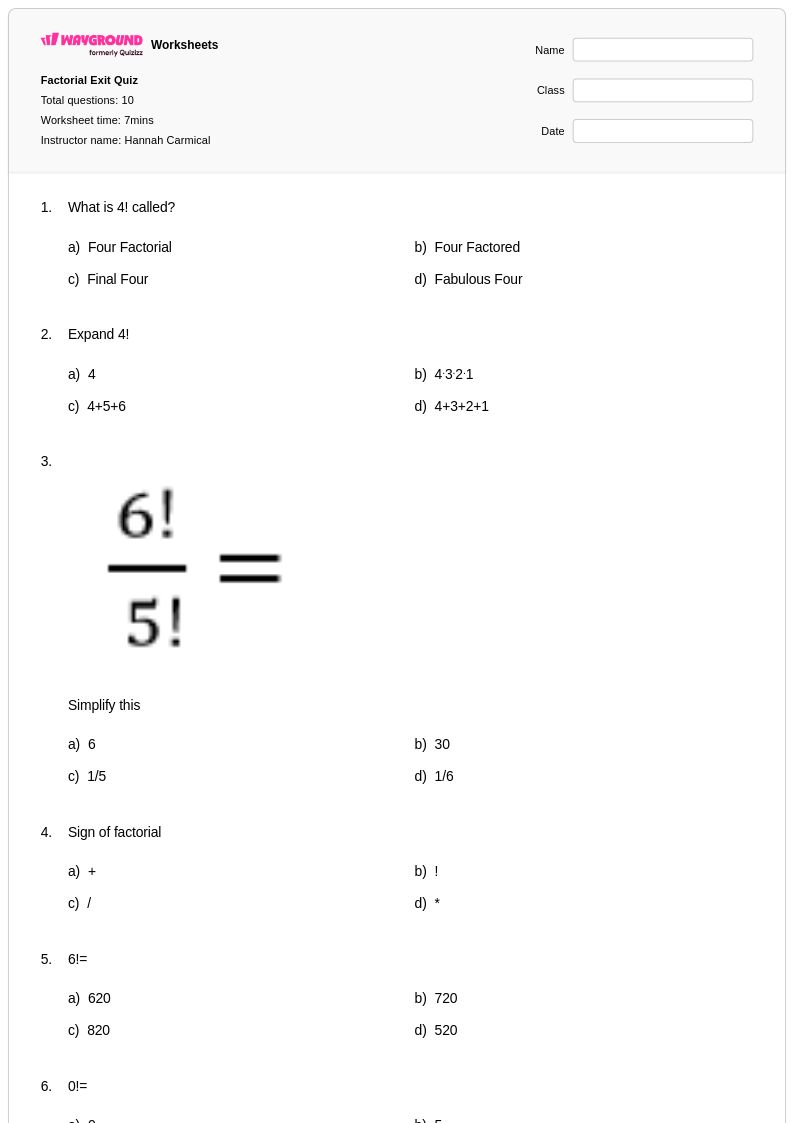
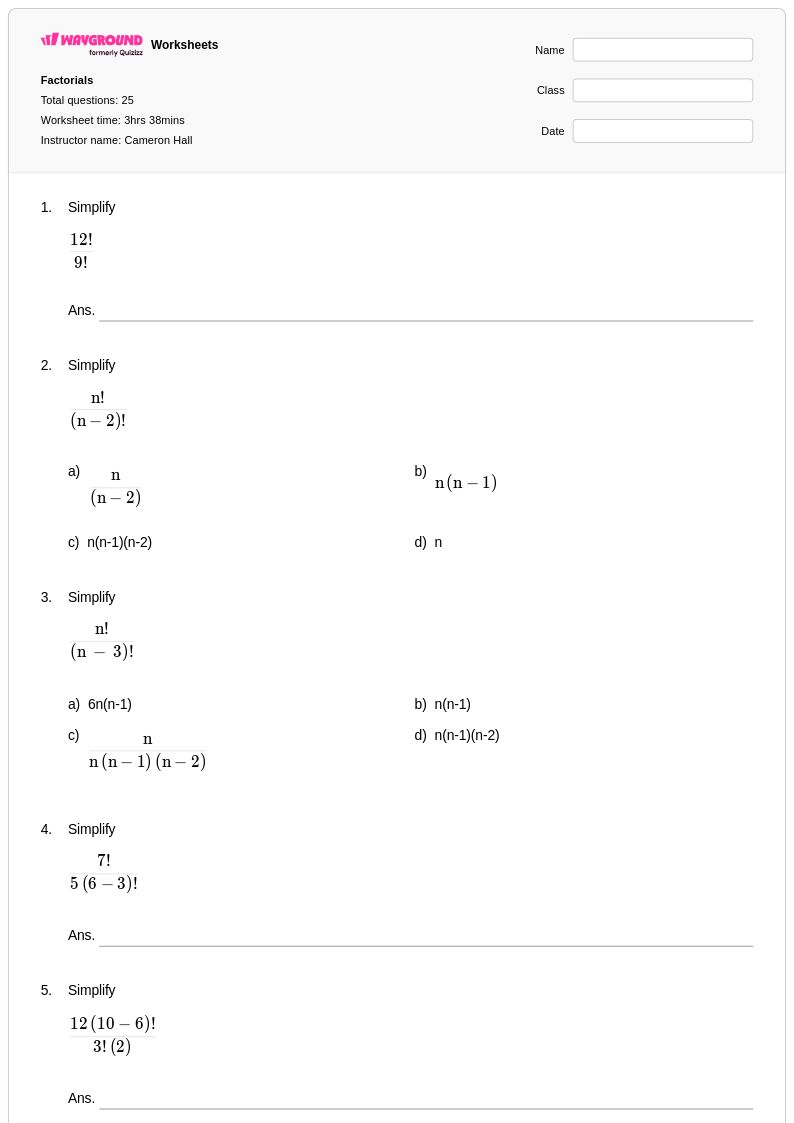
Explore Wayground's comprehensive collection of factorial worksheets and printables that help students master calculating factorials, understanding permutations, and solving complex probability problems with step-by-step practice problems and detailed answer keys.
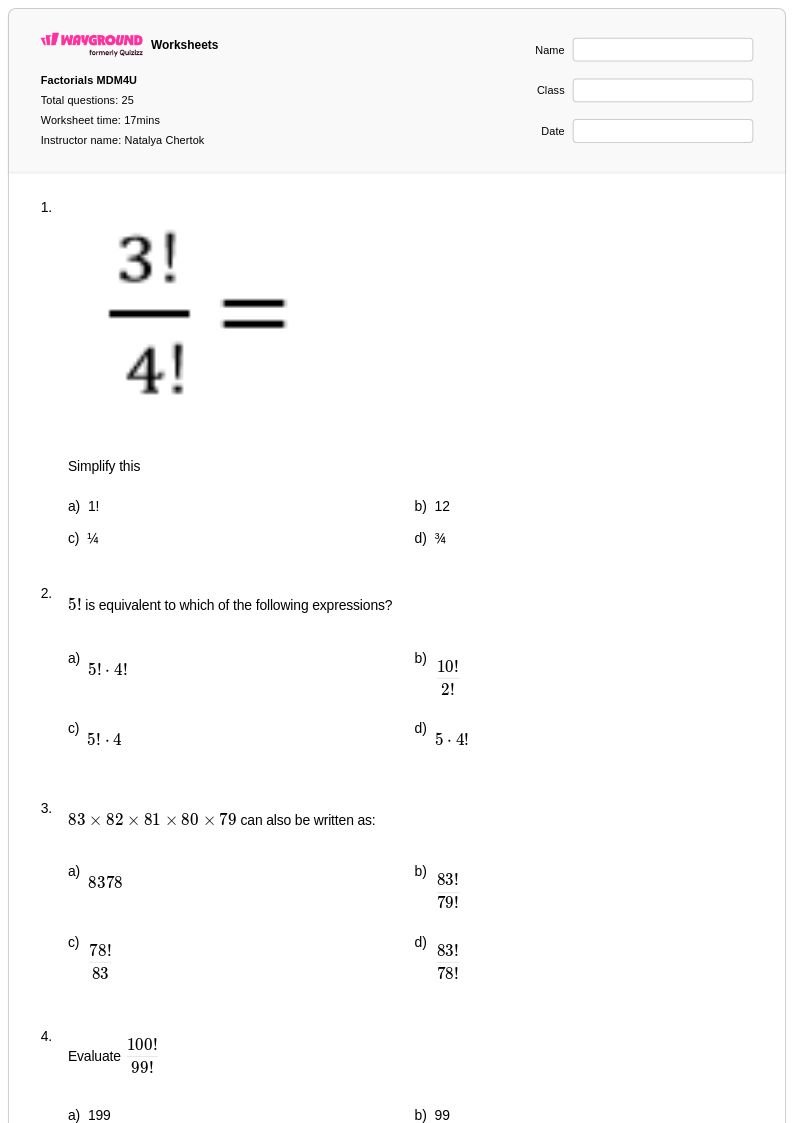
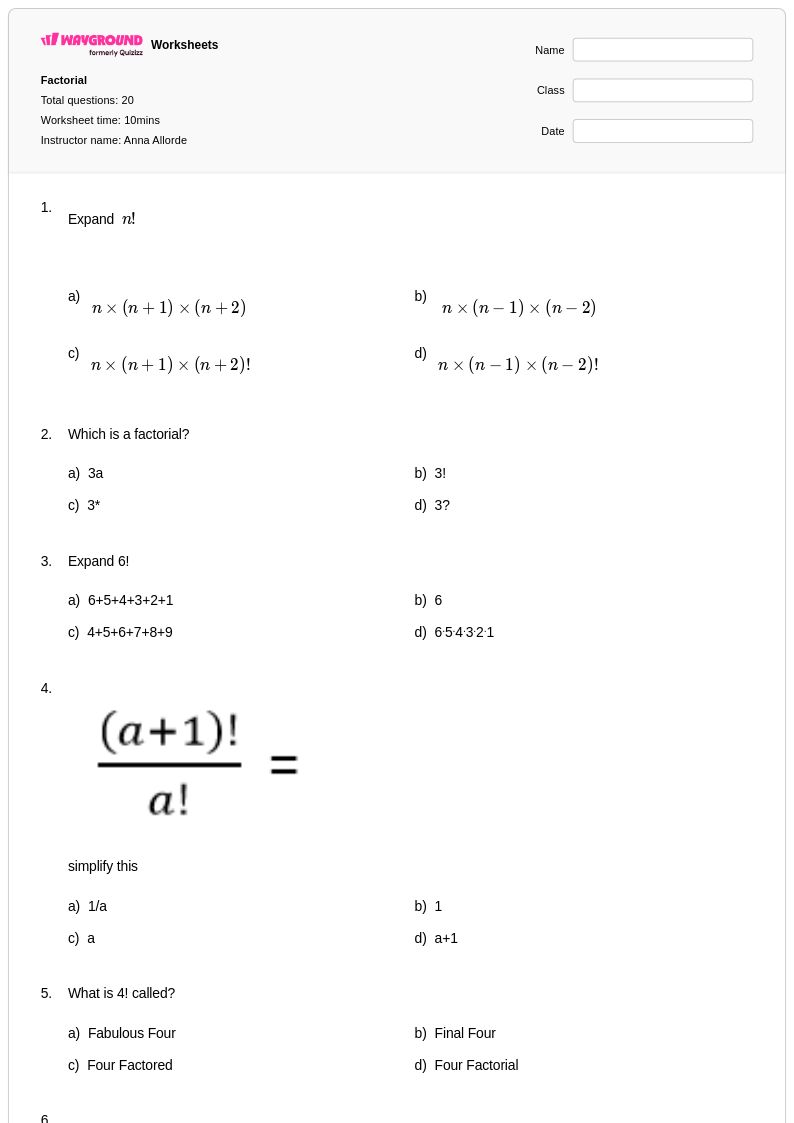
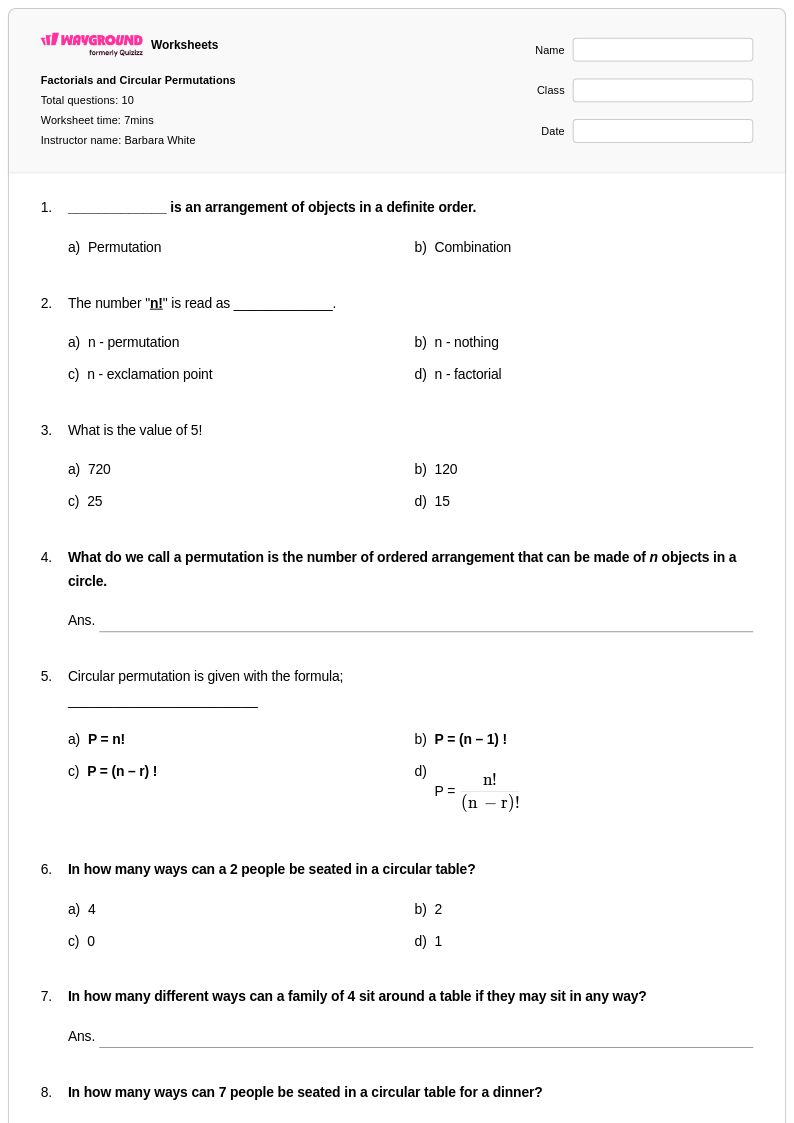
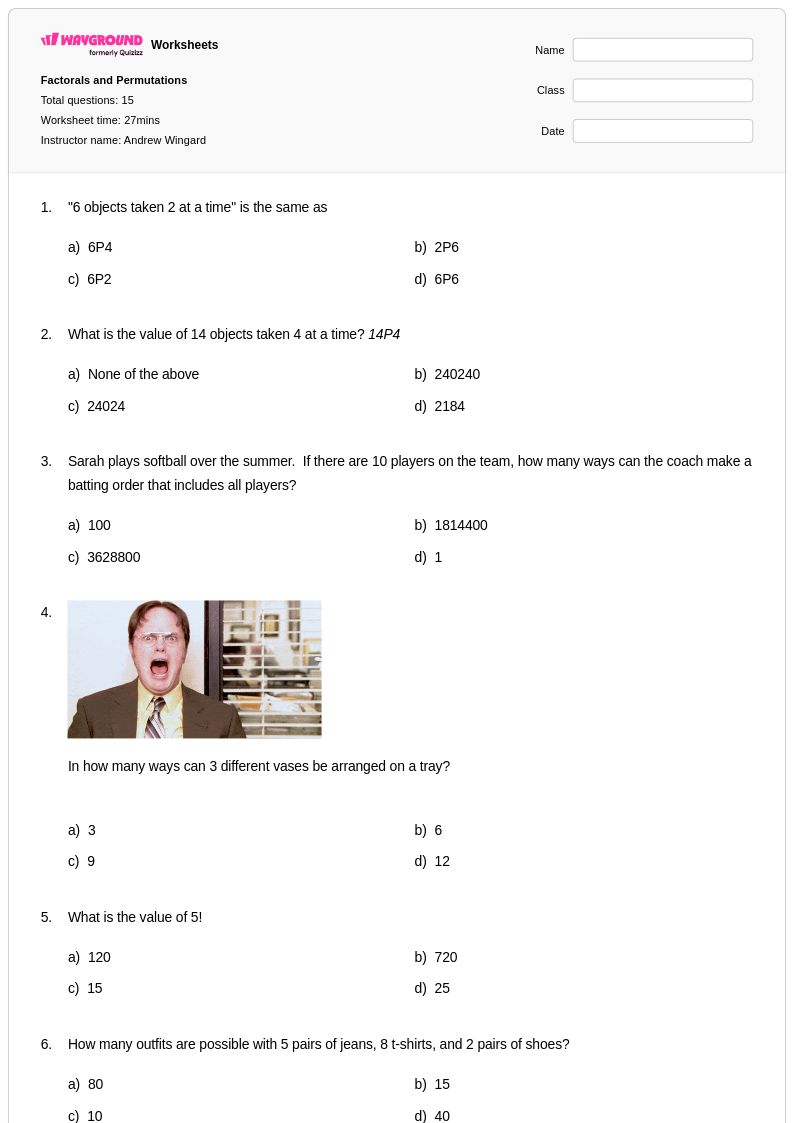
Factorials worksheets available through Wayground (formerly Quizizz) provide comprehensive coverage of this fundamental mathematical concept that bridges arithmetic and advanced probability theory. These educational resources systematically guide students through the calculation and application of factorial notation, from basic computations like 5! = 5 × 4 × 3 × 2 × 1 to more complex problems involving factorial expressions in permutations, combinations, and statistical distributions. The worksheets strengthen essential skills including pattern recognition, computational accuracy, and mathematical reasoning while building the foundation needed for advanced topics in probability and statistics. Each resource includes detailed practice problems with accompanying answer keys, and the materials are available as free printables in convenient pdf format to support both classroom instruction and independent study.
Wayground (formerly Quizizz) empowers educators with an extensive collection of teacher-created factorial worksheets drawn from millions of high-quality resources that can be easily located through robust search and filtering capabilities. The platform's standards-aligned materials support differentiated instruction by offering worksheets at varying complexity levels, from introductory factorial concepts to advanced applications in combinatorics and probability calculations. Teachers benefit from flexible customization tools that allow them to modify existing worksheets or create targeted practice sets for specific learning objectives, whether for initial skill development, remediation of computational gaps, or enrichment activities for advanced learners. The dual availability of printable pdf worksheets and interactive digital formats provides instructional versatility, enabling seamless integration into diverse teaching environments while supporting both traditional paper-based practice and technology-enhanced learning experiences.
FAQs
How do I teach factorials to students who've never seen them before?
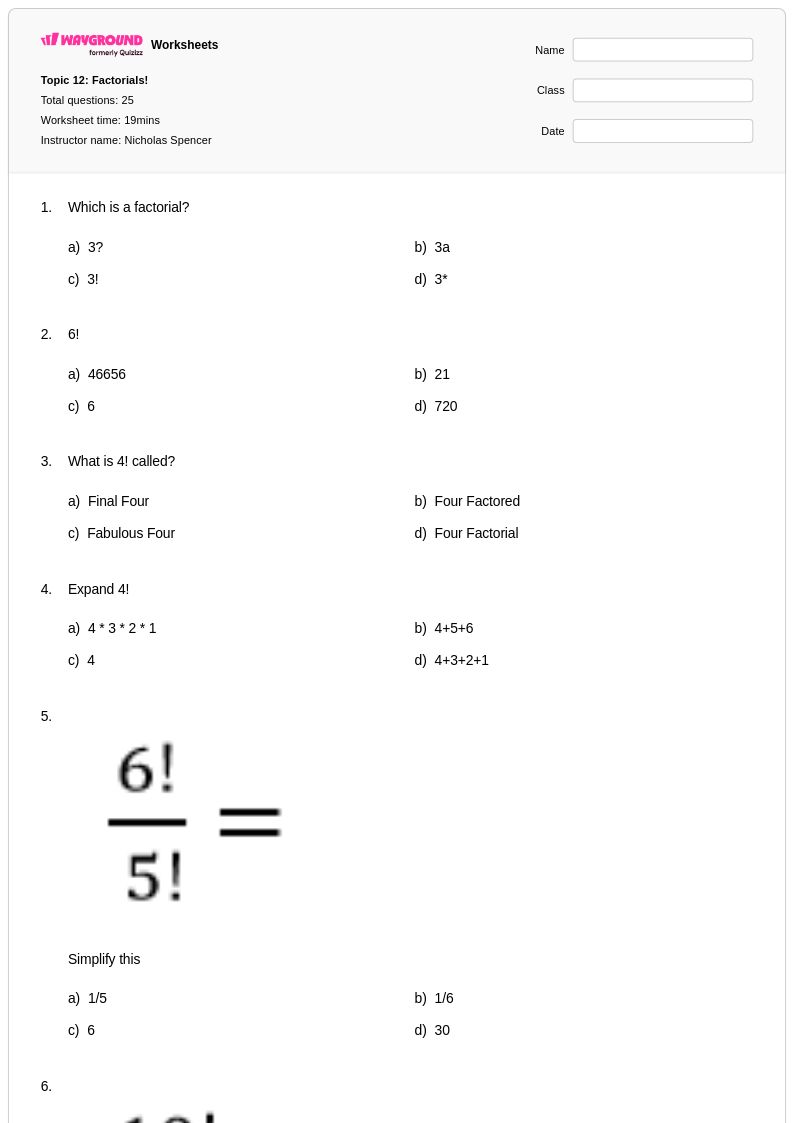
Start with the concrete question: 'In how many different orders can three people line up?' Walk students through listing all six arrangements by hand, then show that 3 × 2 × 1 = 6 gives the same count instantly. That connection between counting arrangements and multiplying descending integers is the core idea. Once students see why the operation exists, the notation (3!) becomes a shorthand they understand rather than a symbol they memorize.
What kinds of exercises help students practice factorials effectively?
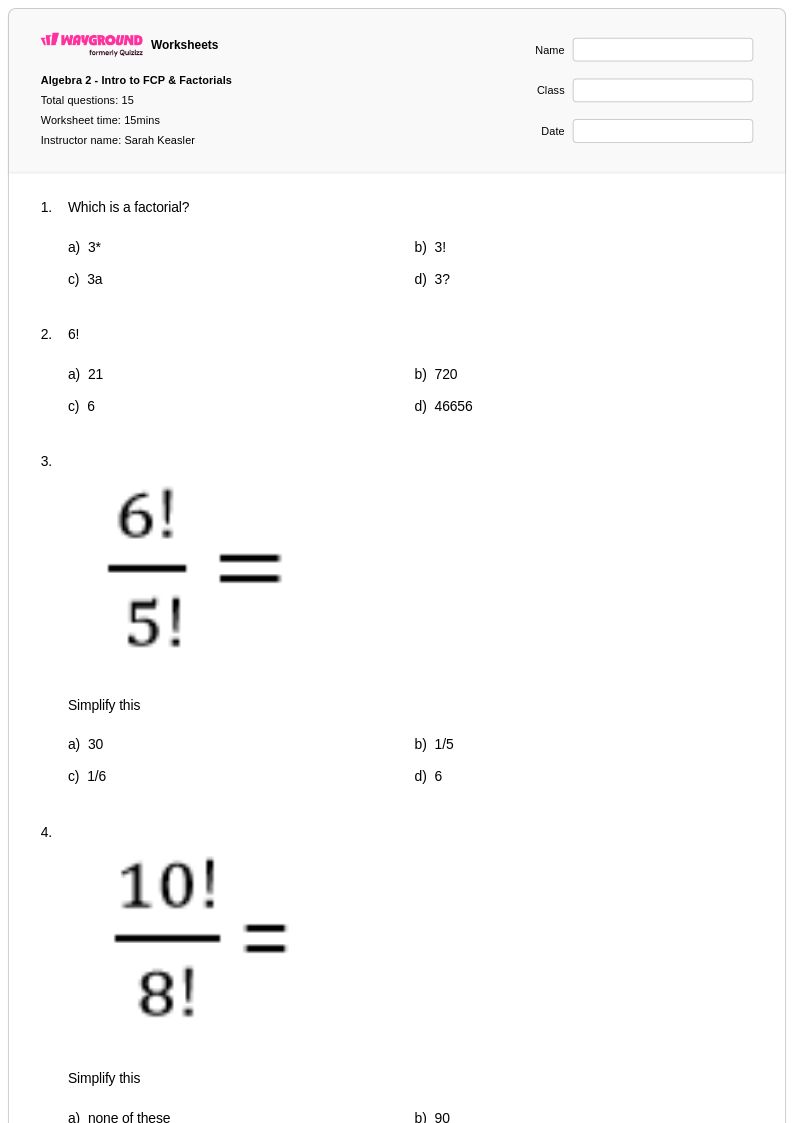
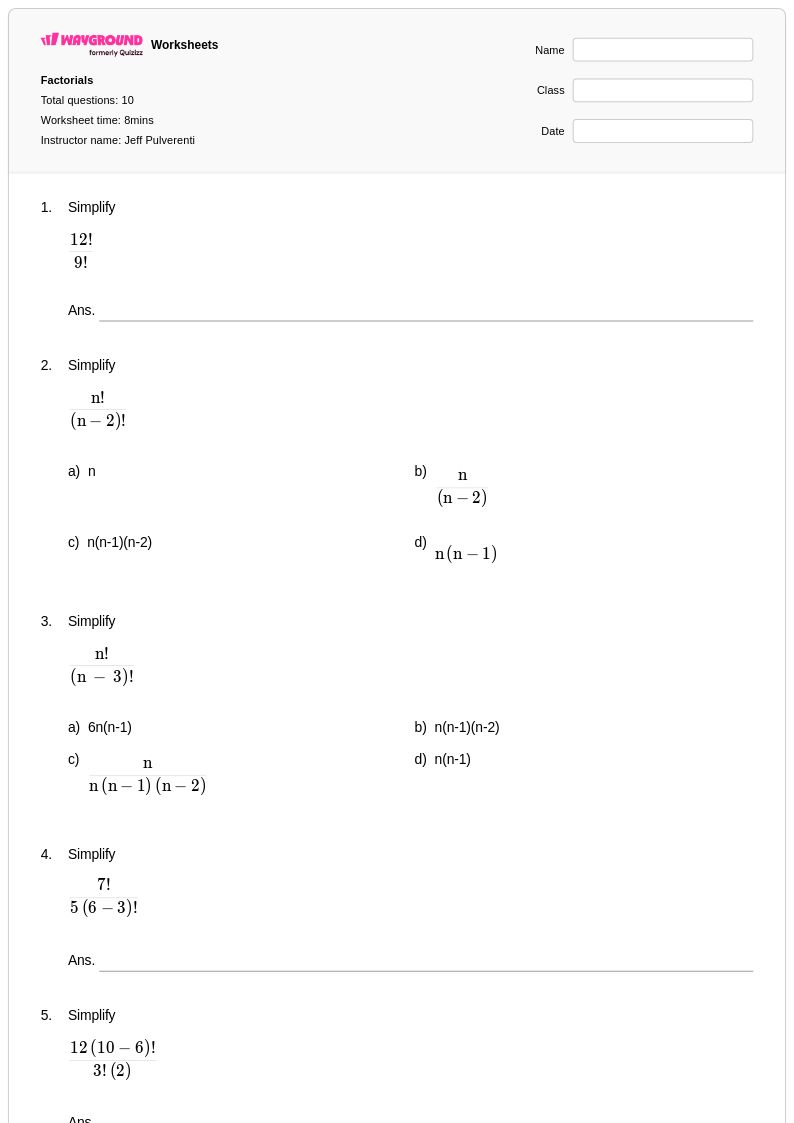
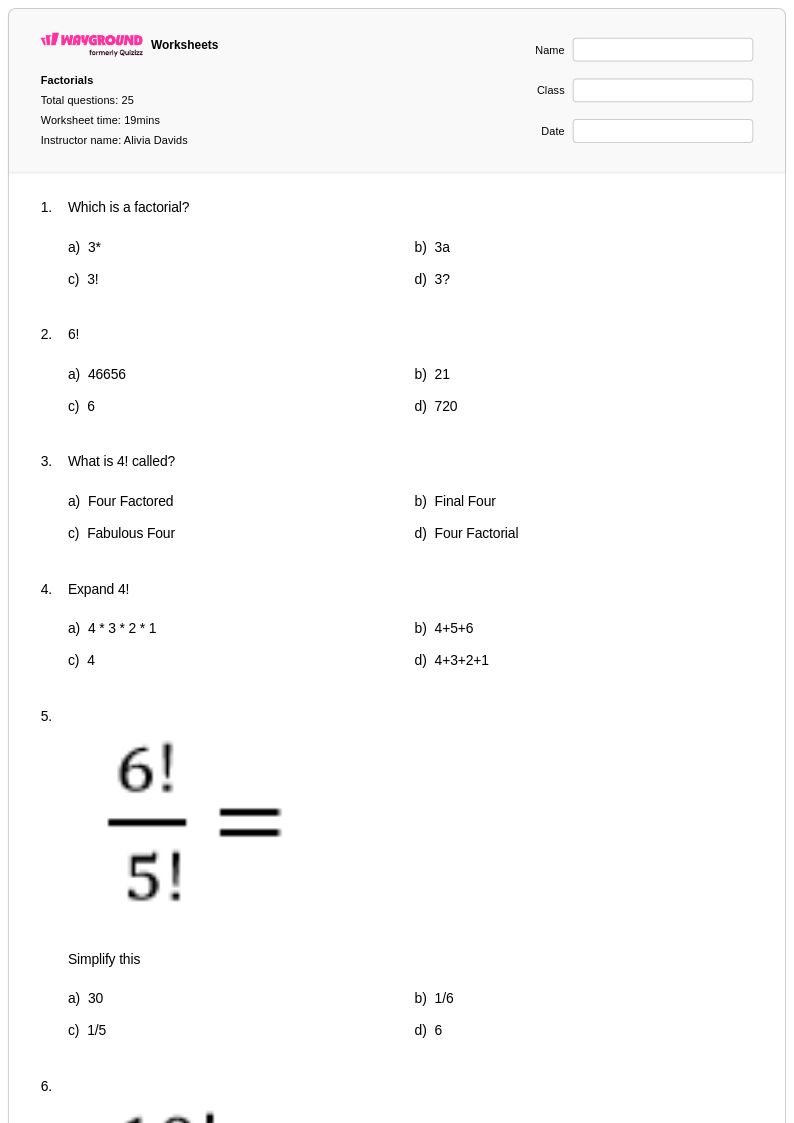
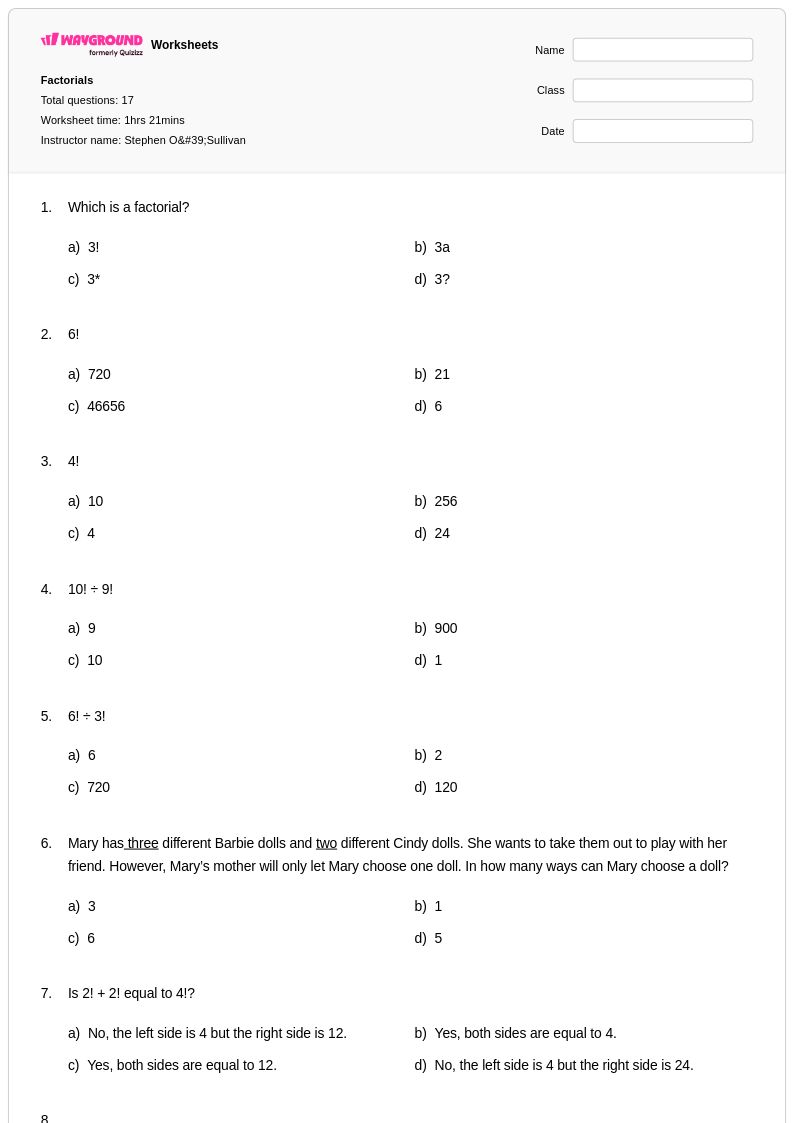
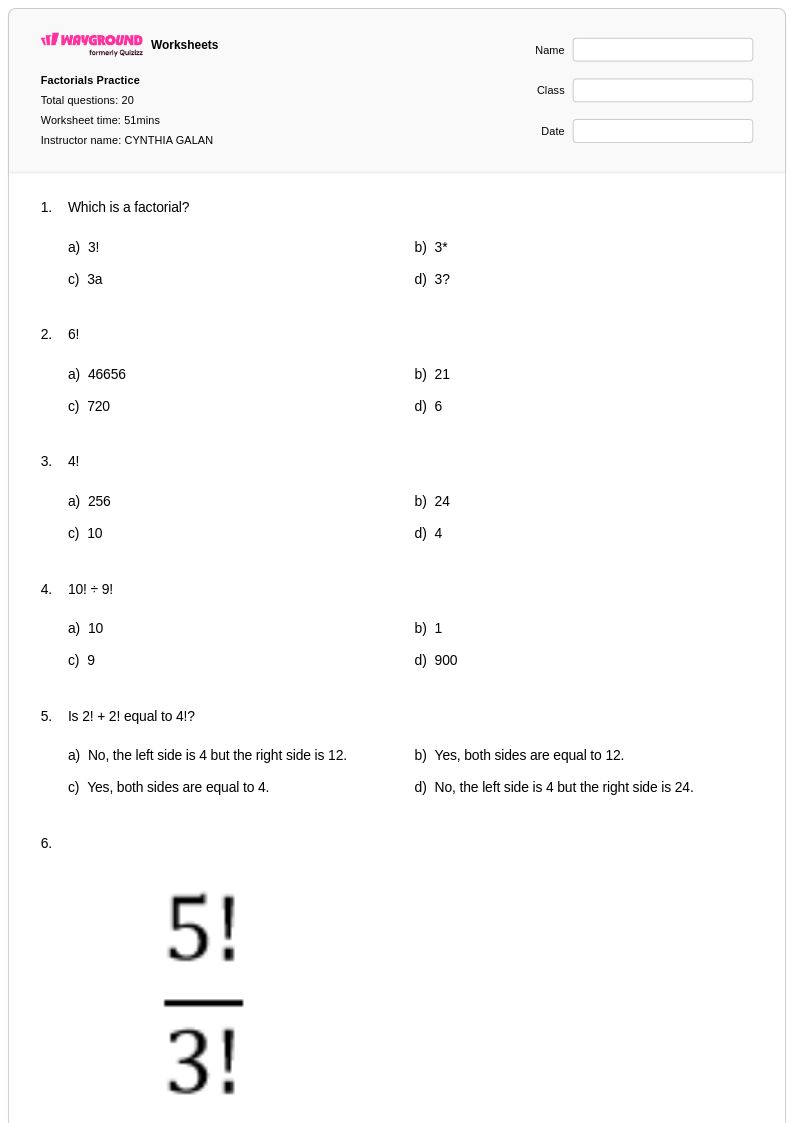
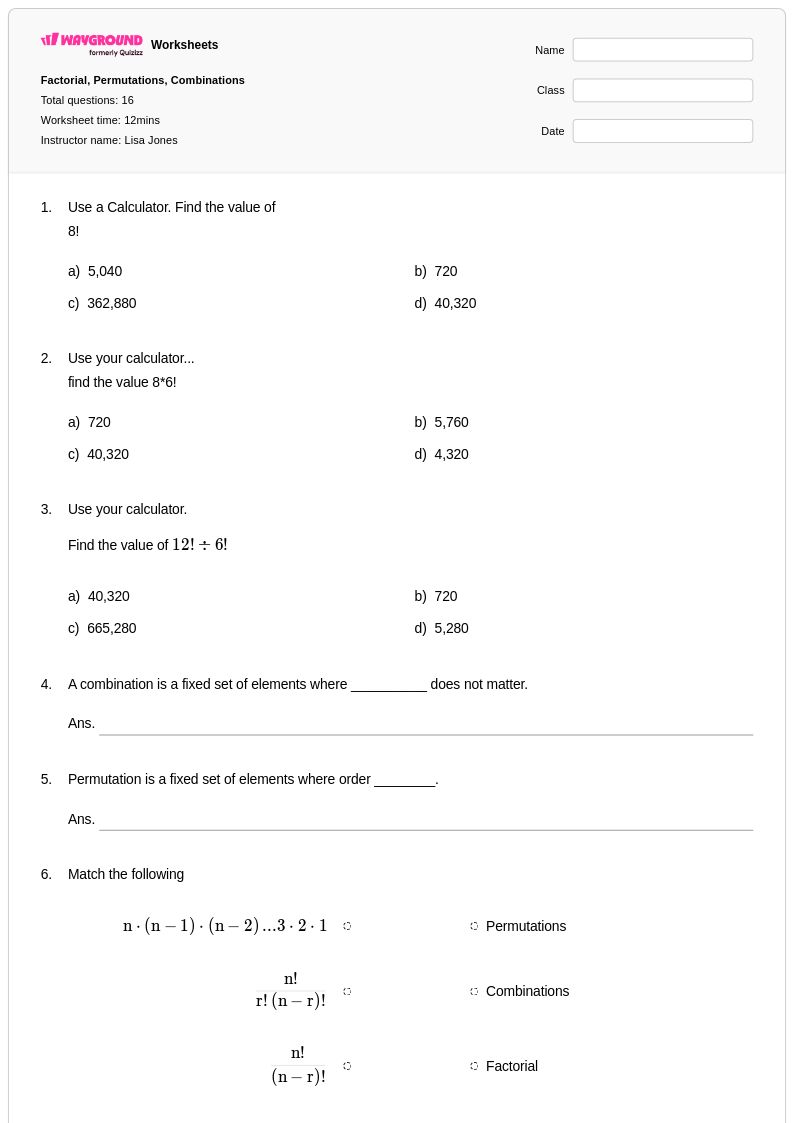
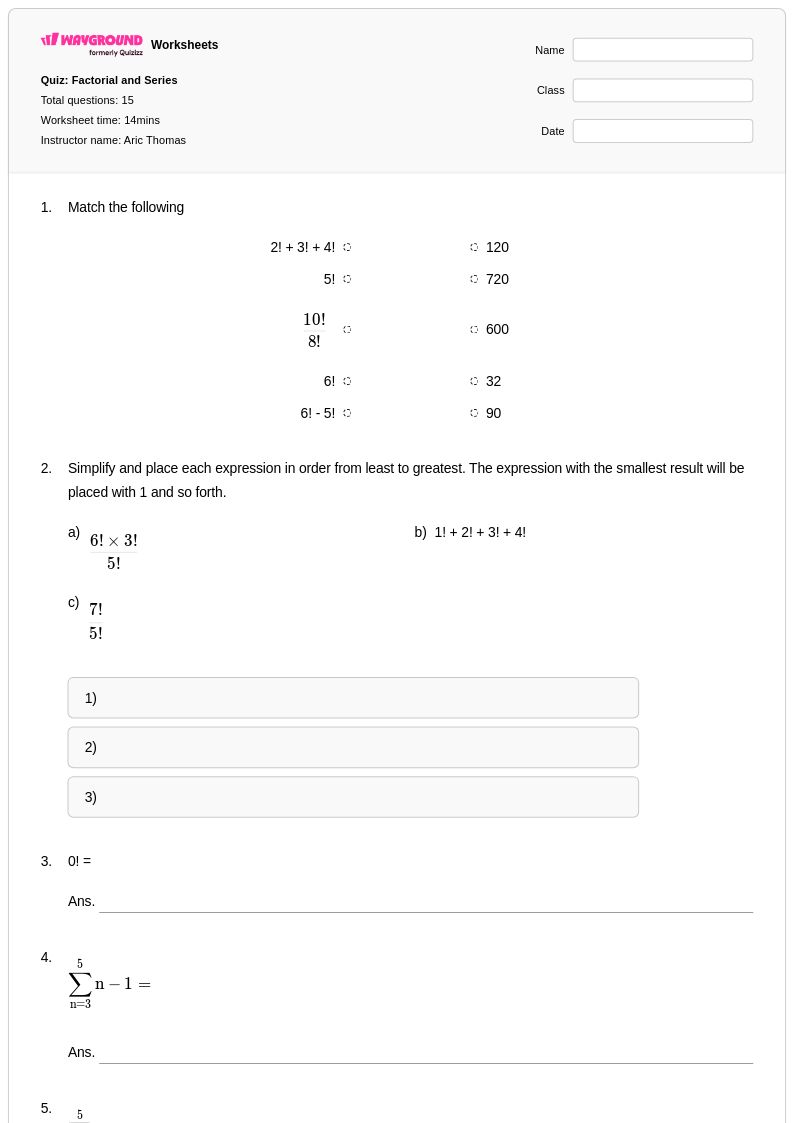
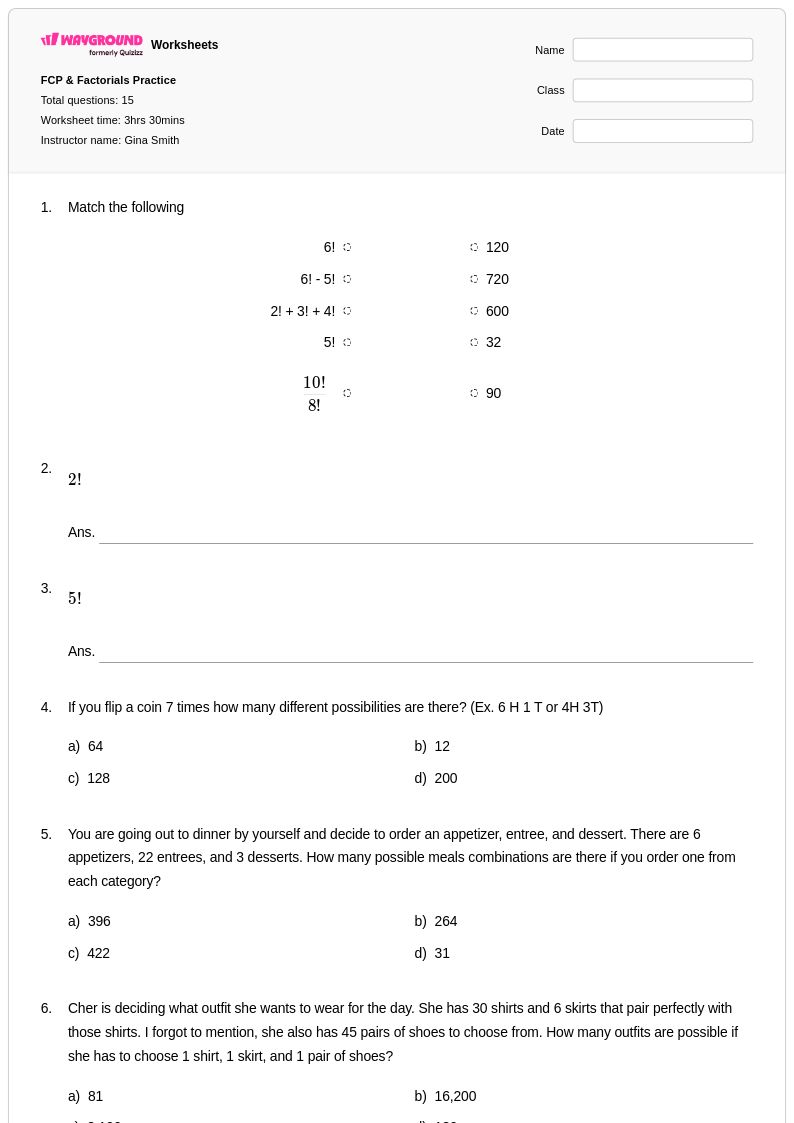
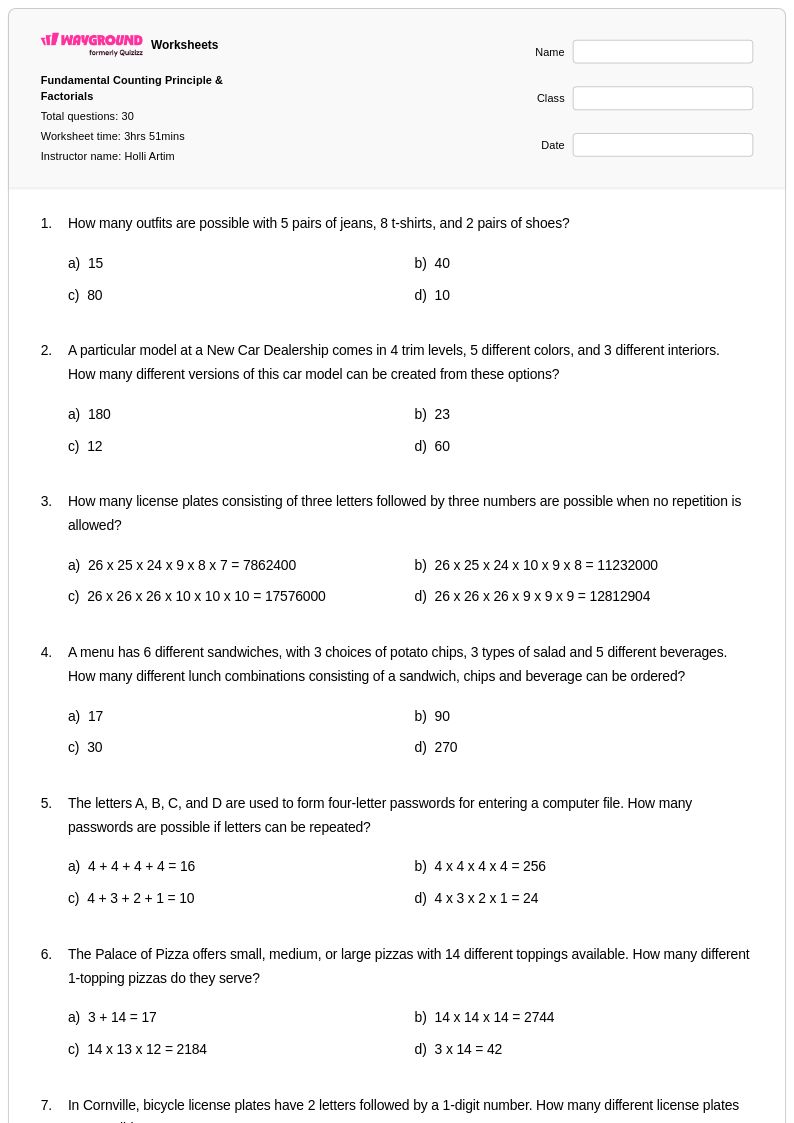
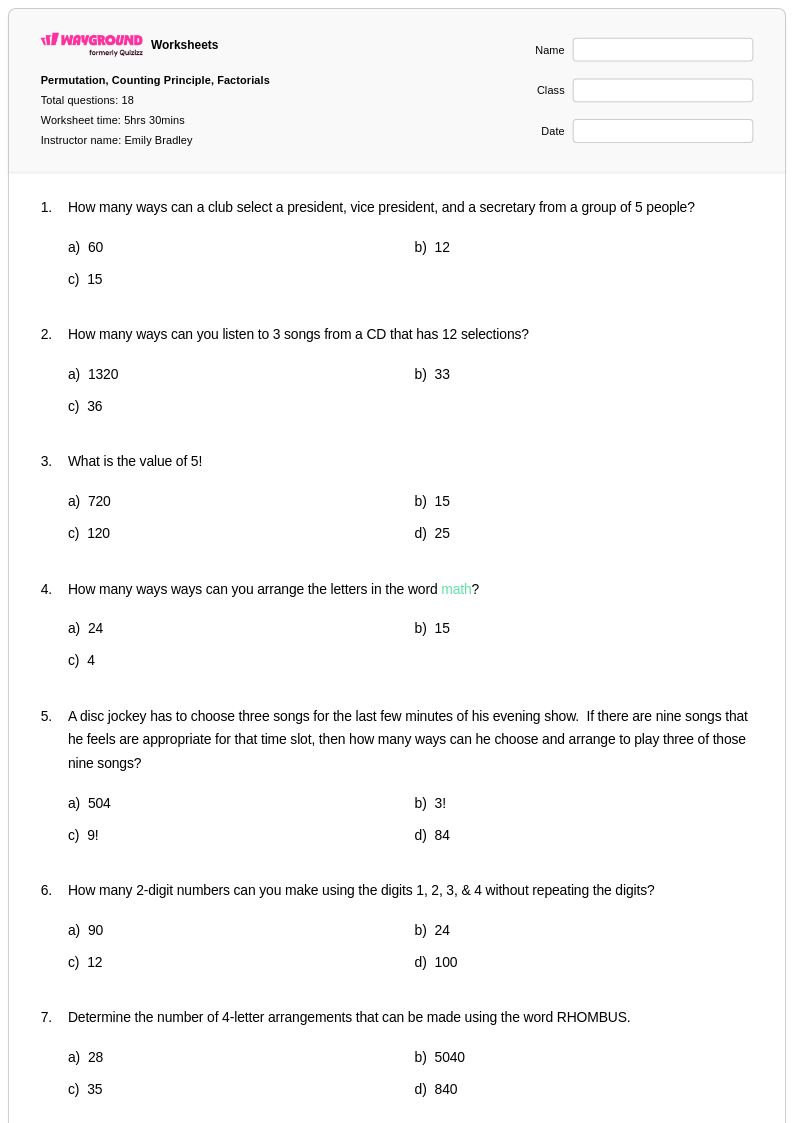
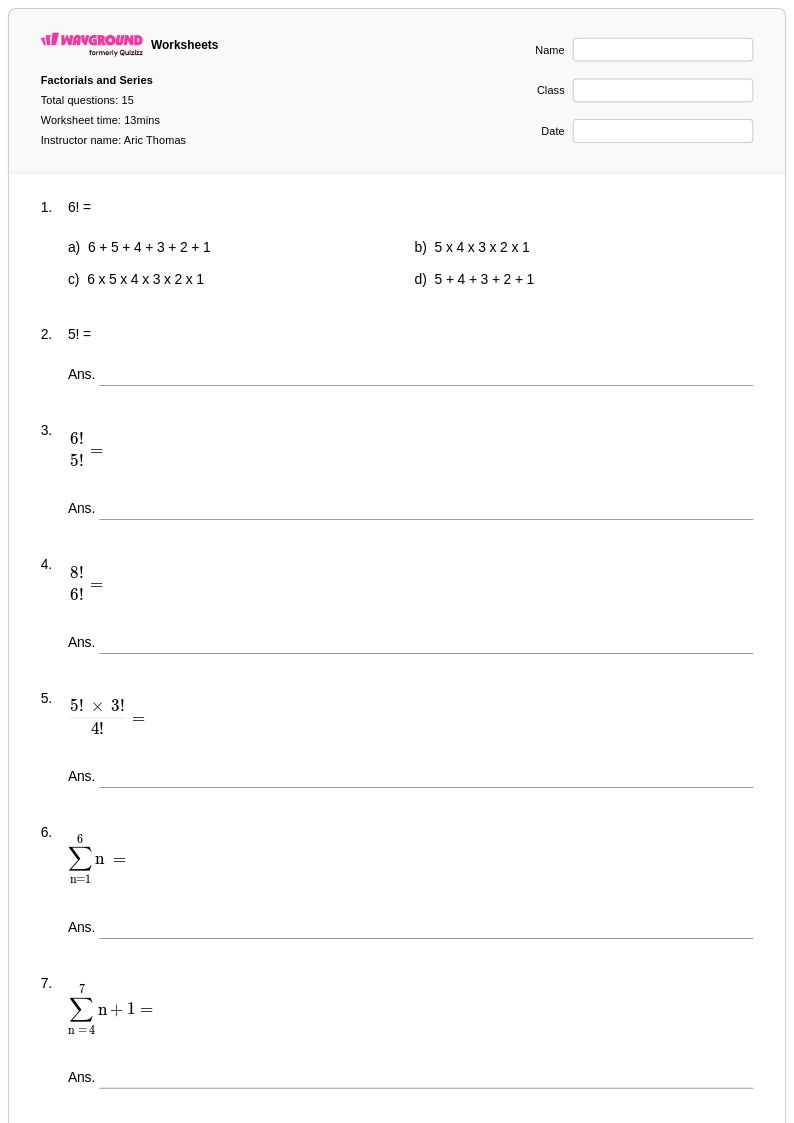
The most useful practice moves in three stages: straight computation (evaluate 6!, simplify 8!/6!), pattern recognition (what happens to n! as n grows? what is 0!?), and applied problems where factorials appear inside permutation or combination formulas. Skipping straight to applications before students are fluent with the arithmetic tends to create confusion about whether errors are factorial mistakes or formula mistakes.
What mistakes do students commonly make when working with factorials?
Three errors come up repeatedly. First, students treat 0! as 0 rather than 1 — worth addressing directly and early. Second, when simplifying expressions like 8!/5!, students expand both factorials fully and multiply everything out instead of canceling the shared terms (8 × 7 × 6 × 5!/5!). Third, in permutation and combination problems, students misidentify which value goes in the factorial — confusing n and r, or forgetting to subtract.
How do I use Wayground's factorial worksheets in my class?
Each worksheet comes with a complete answer key, so you're not building one from scratch. For digital use, you can host the worksheet as a quiz on Wayground and assign it directly to students. If you prefer paper, download the printable PDF and distribute it in class — then use the Wayground for Teachers app to scan and grade student submissions without manual scoring. Both routes work from the same worksheet.
How do factorials fit into the broader math curriculum?
In Common Core-aligned progressions, factorials aren't a standalone topic — they emerge as a tool when students begin working with counting principles, permutations, and combinations, typically after a solid foundation in multiplication and exponent rules. Factorials then carry forward into binomial expansions and probability distributions in later courses. The key progression step is moving from 'I can compute n!' to 'I can simplify factorial expressions without expanding everything,' which is what makes later combinatorics work manageable.
How can I differentiate factorial practice for students at different levels?
For students still building fluency, reduce cognitive load by focusing on single-digit factorials and providing a reference table for values like 4! through 7!. For students ready for more, push into simplifying factorial ratios and embedding factorials inside permutation problems. On Wayground, you can apply reduced answer choices for students who need it, or adjust font size and spacing to create a cleaner layout — small changes that make the same worksheet more accessible without creating an entirely separate assignment.