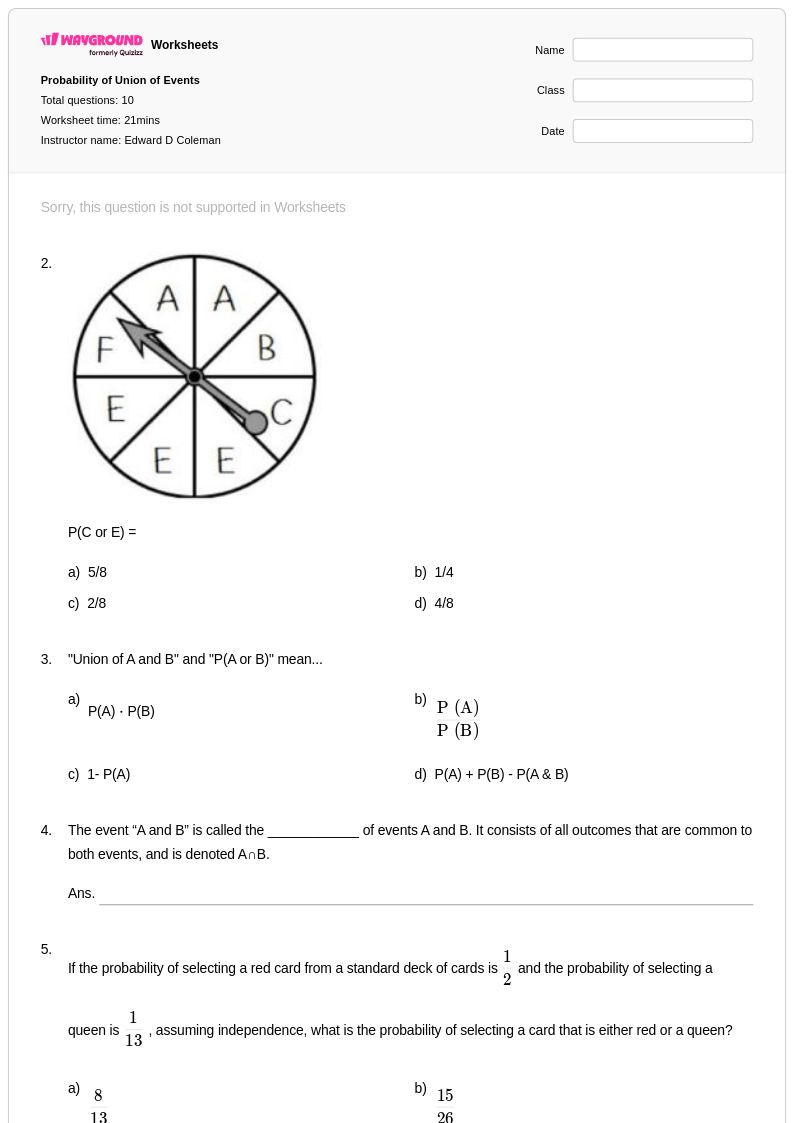
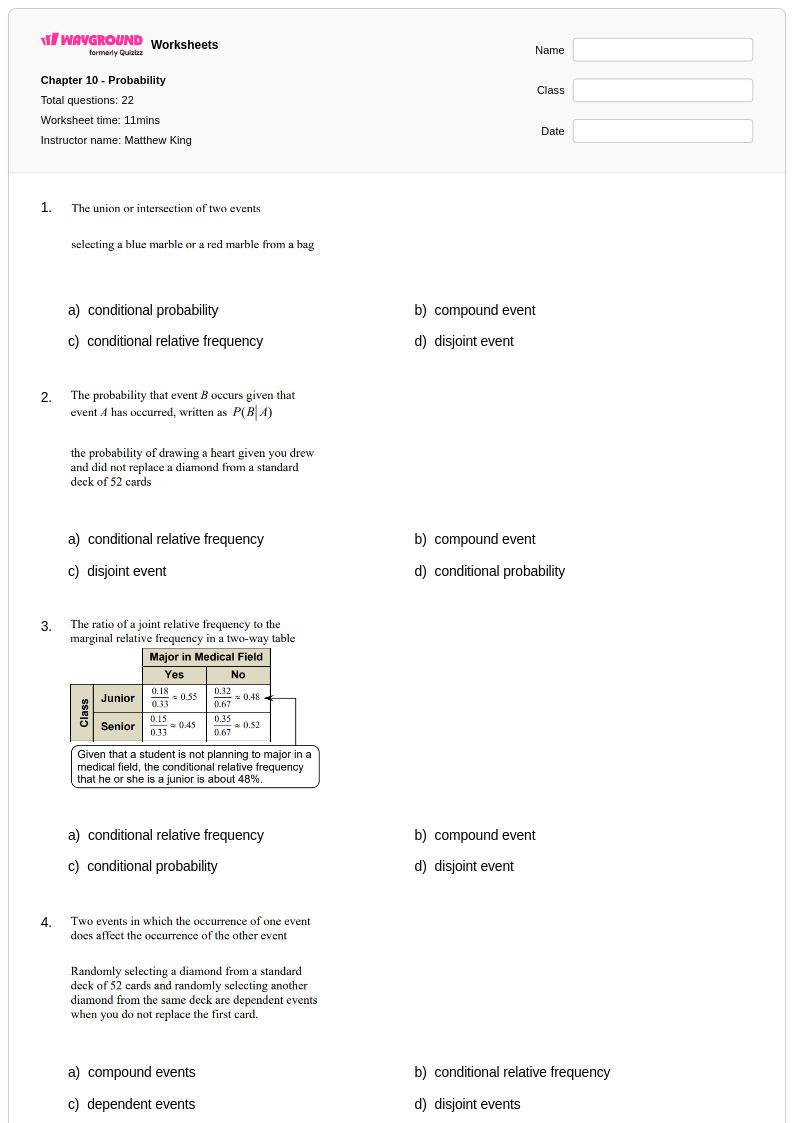
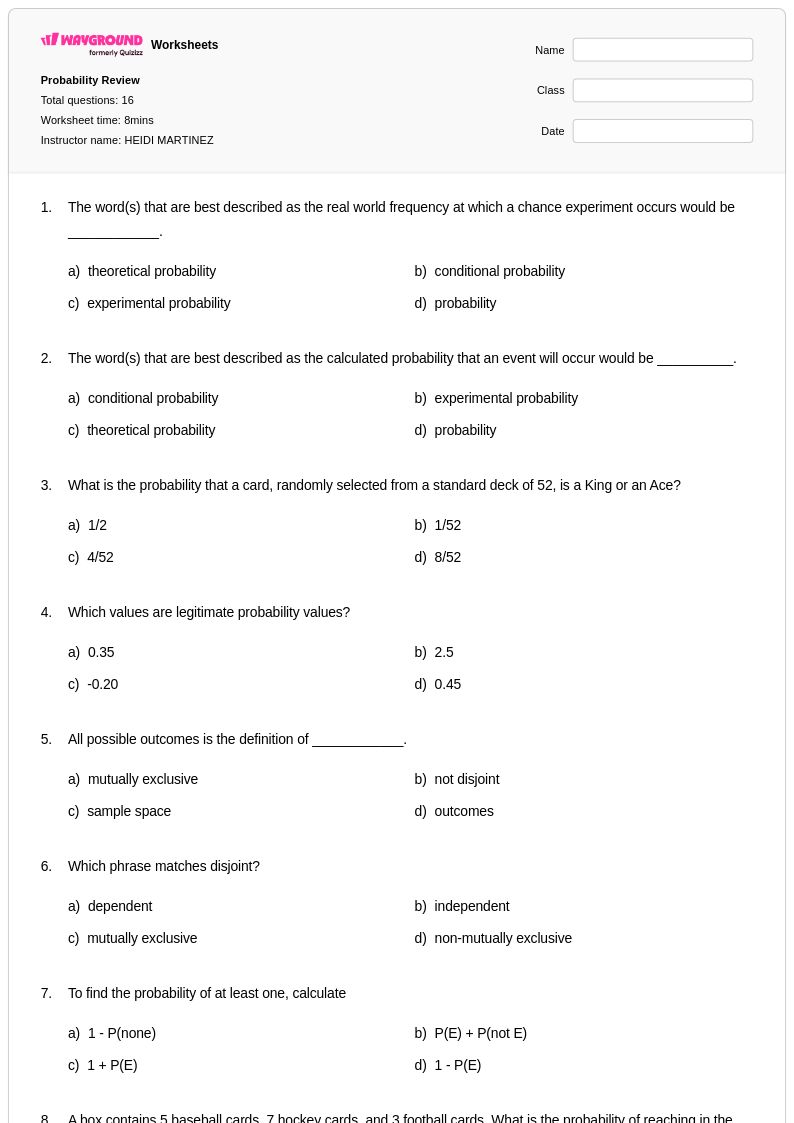
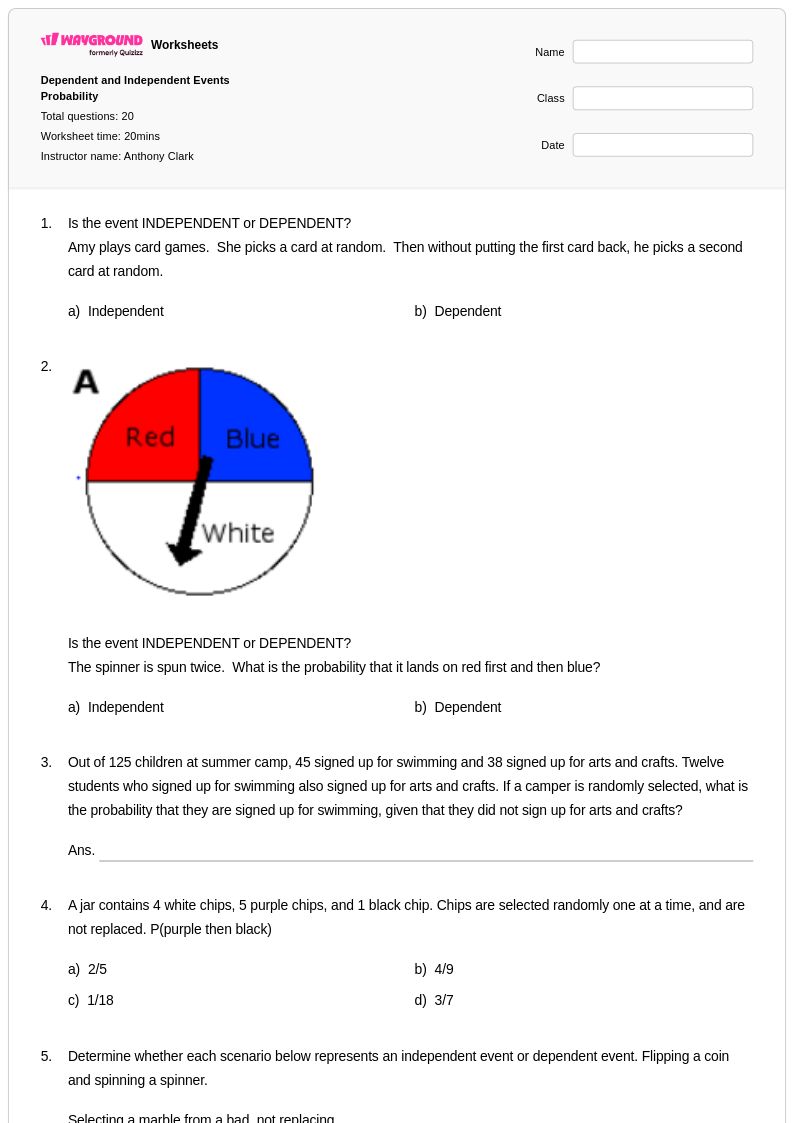
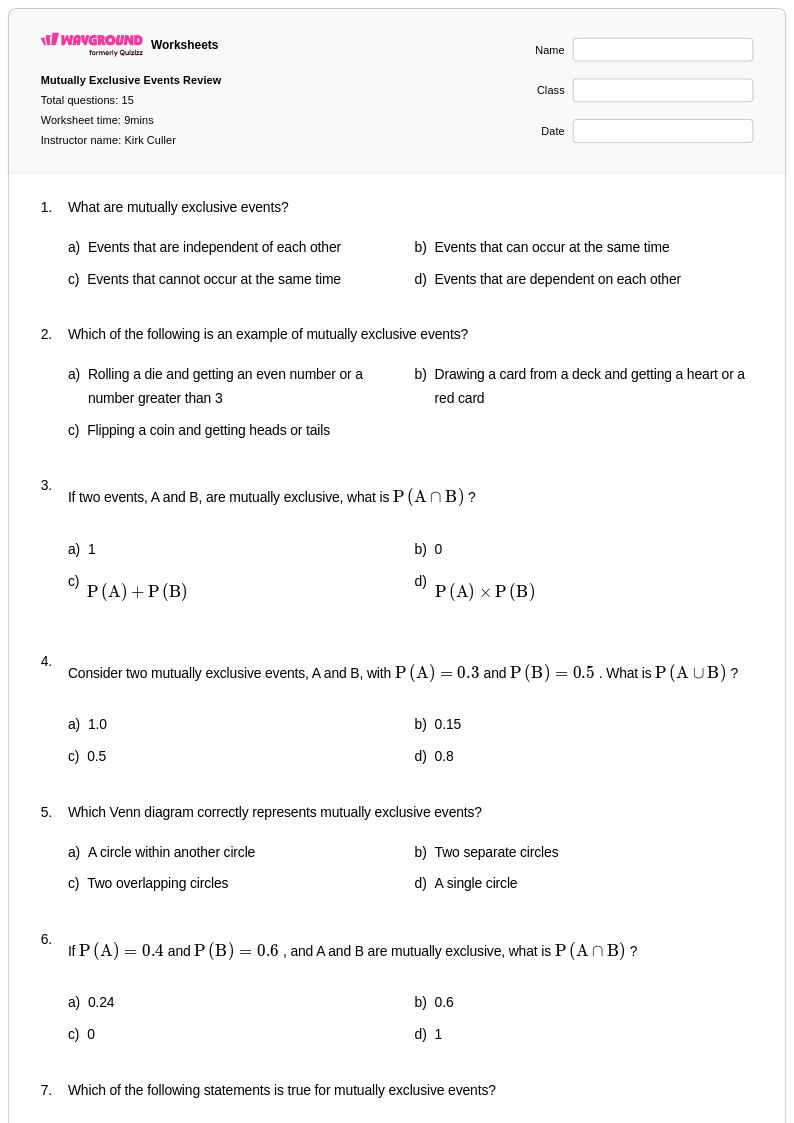
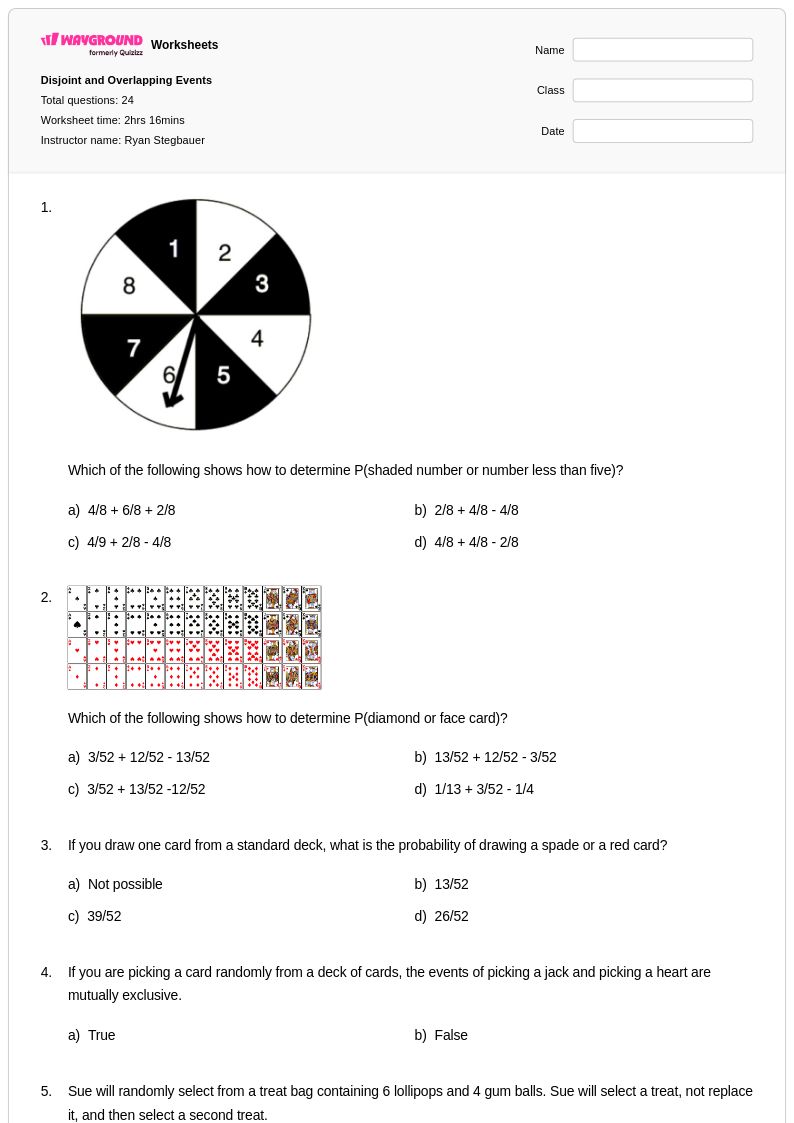
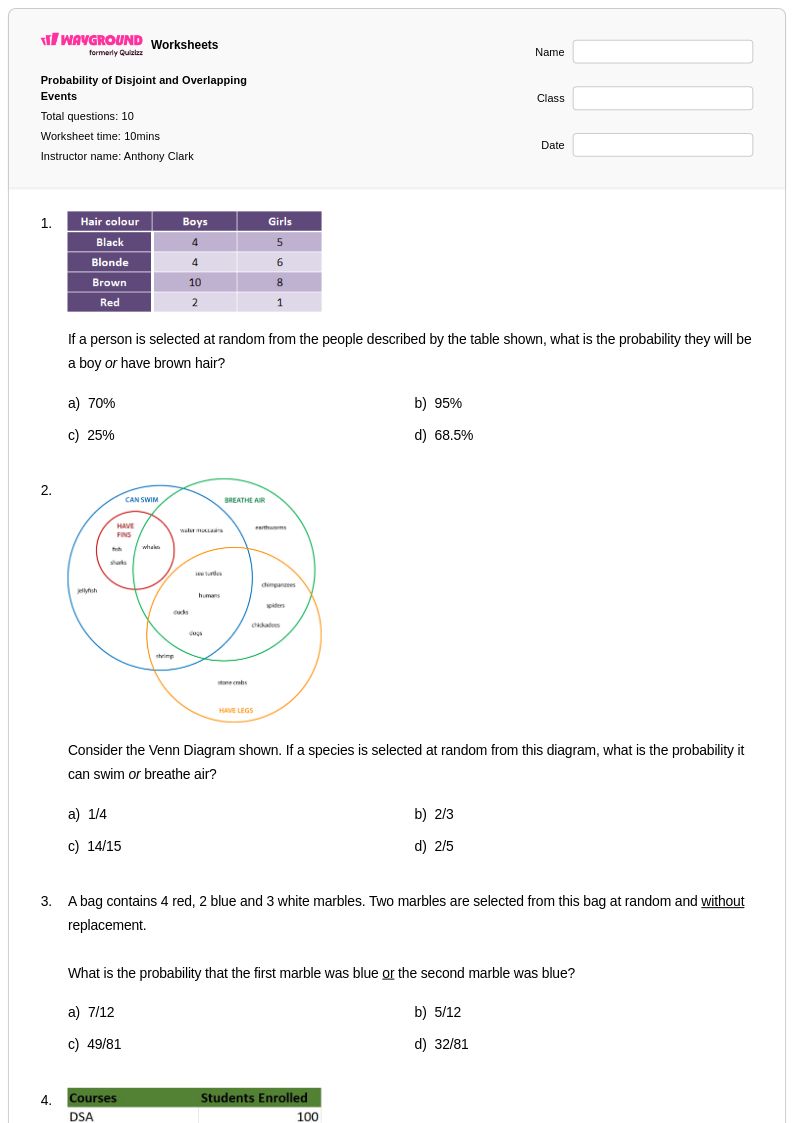
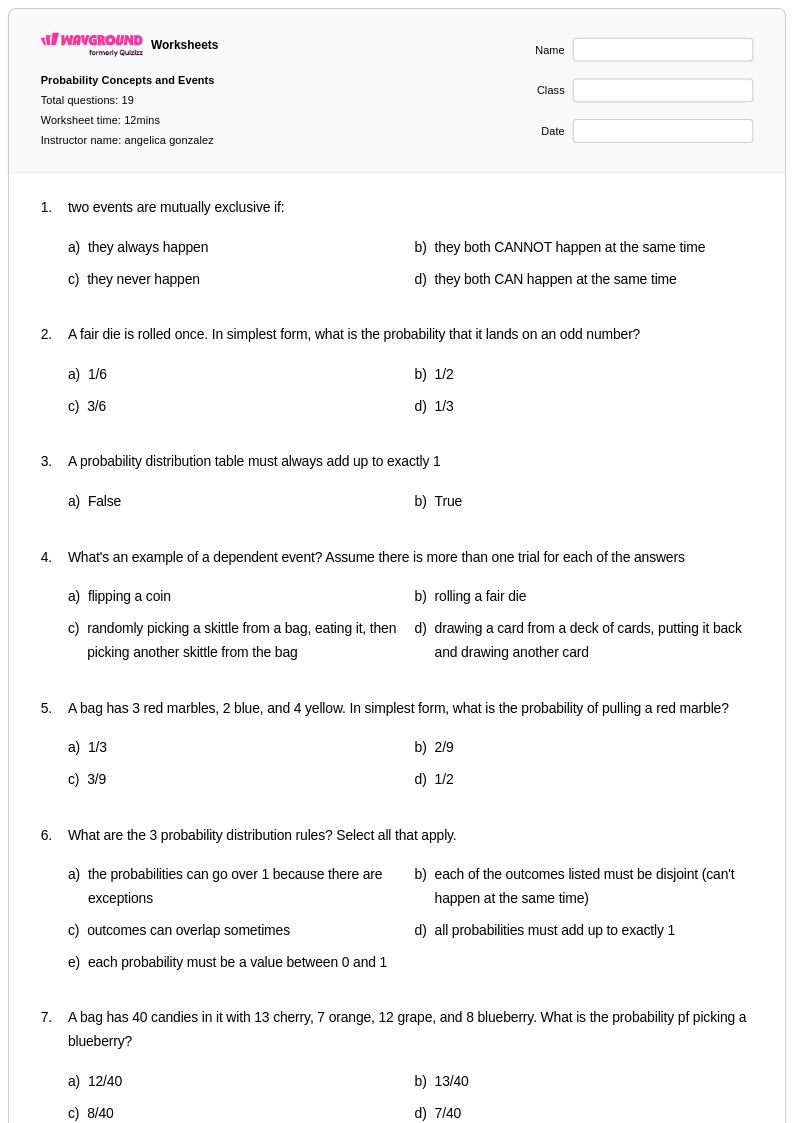
Explore Wayground's comprehensive collection of non-disjoint events worksheets and printables that help students master overlapping probability concepts through engaging practice problems, free PDFs, and detailed answer keys.
Non-disjoint events worksheets available through Wayground (formerly Quizizz) provide comprehensive practice materials that help students master one of the most challenging concepts in probability theory. These expertly designed resources focus on events that share common outcomes, enabling learners to calculate probabilities using the addition rule and inclusion-exclusion principle. The worksheets strengthen critical mathematical reasoning skills through carefully structured practice problems that progress from basic overlapping event identification to complex multi-step probability calculations. Each resource includes detailed answer keys and step-by-step solutions, with free printable pdf formats that make these materials accessible for both classroom instruction and independent study.
Wayground (formerly Quizizz) supports mathematics educators with an extensive collection of teacher-created resources specifically tailored for probability and statistics instruction. The platform's robust search and filtering capabilities allow instructors to quickly locate worksheets that align with specific curriculum standards and learning objectives for non-disjoint events. Teachers can leverage powerful differentiation tools to customize difficulty levels, modify problem sets, and create targeted interventions for students who need additional support with probability concepts. These flexible resources are available in both printable and digital formats, including downloadable pdfs, enabling seamless integration into lesson planning, homework assignments, remediation sessions, and enrichment activities that reinforce understanding of overlapping probability scenarios.
FAQs
How do I teach the concept of non-disjoint events?
Start with a concrete, visual example. Use a standard deck of cards and ask for the probability of drawing a heart or a king. Students will count 13 hearts and 4 kings, but realize the King of Hearts was counted twice. This illustrates the 'overlap' and the need to subtract the intersection, which is the core of the inclusion-exclusion principle for non-disjoint events.
What exercises help students practice calculating probability for non-disjoint events?
Effective practice moves from concrete identification to abstract calculation. Start with exercises using Venn diagrams to visually identify the overlapping region. Then, introduce word problems involving surveys, student groups, or card draws that require students to first identify the events and their intersection before applying the addition rule.
What is a common mistake students make with non-disjoint events?
The most frequent error is forgetting to subtract the probability of the intersection. Students often calculate P(A or B) by simply adding P(A) and P(B), which double-counts the overlapping outcomes. This is often called 'naive addition' and highlights a misunderstanding of the inclusion-exclusion principle.
How can I use this non-disjoint events worksheet?
This worksheet is available as a printable PDF for offline practice or as an interactive digital assignment on the Wayground platform. The printable version allows students to show their work on paper, which you can then grade quickly using the Wayground for Teachers app. Every worksheet, in either format, includes a complete answer key.
How does this topic fit into the math curriculum?
This concept is a key part of the Common Core State Standards for probability. It typically follows lessons on simple probability and mutually exclusive (disjoint) events. Mastering non-disjoint events is a critical step before students move on to more advanced topics like conditional probability and independence in later grades.
How can I differentiate instruction for non-disjoint events?
For students who struggle, use Venn diagrams as a mandatory first step to visualize the problem. On Wayground's digital version, you can provide accommodations like reduced answer choices to lower cognitive load or extended time for calculations. For advanced learners, challenge them with problems involving three overlapping events.