Free Printable John F. Kennedy Worksheets for Class 12
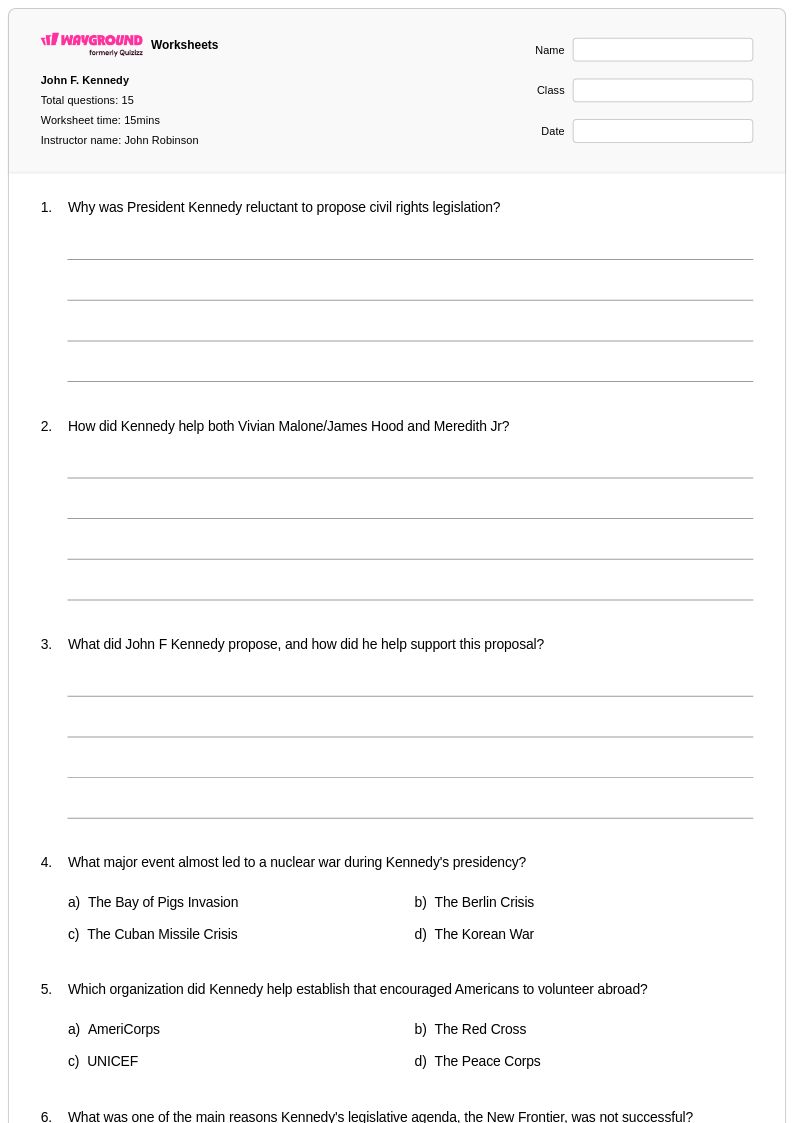
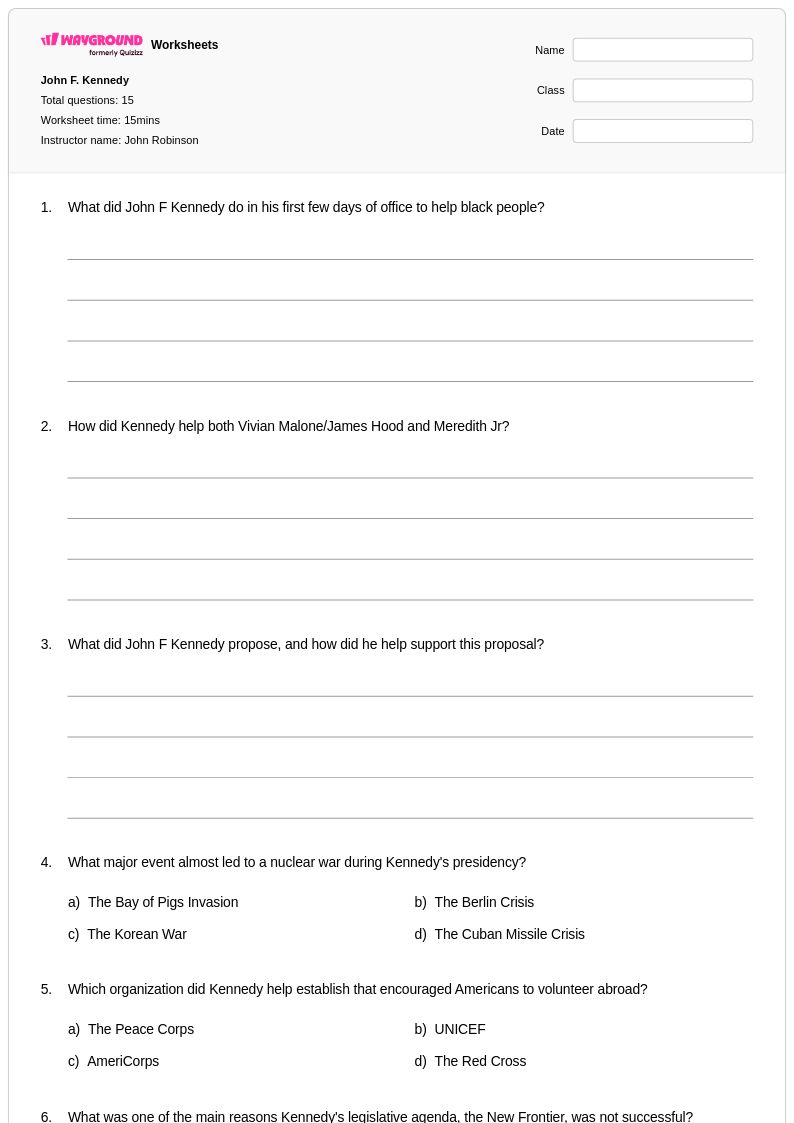
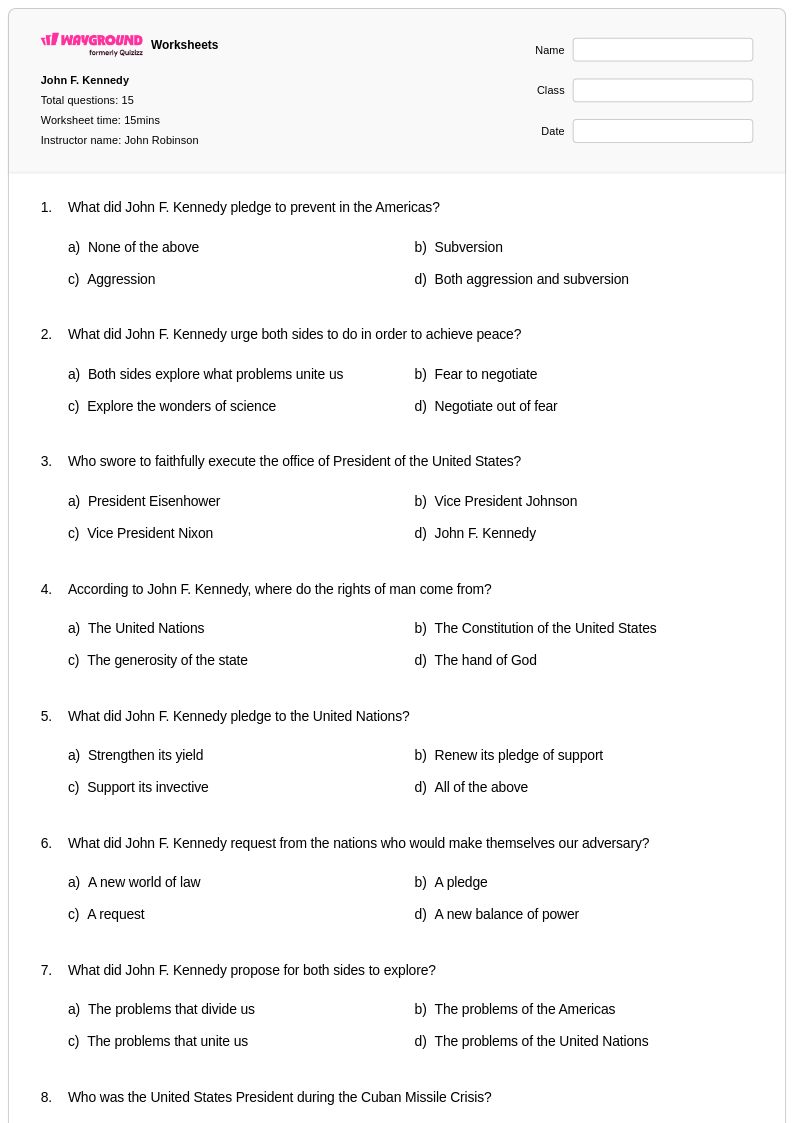
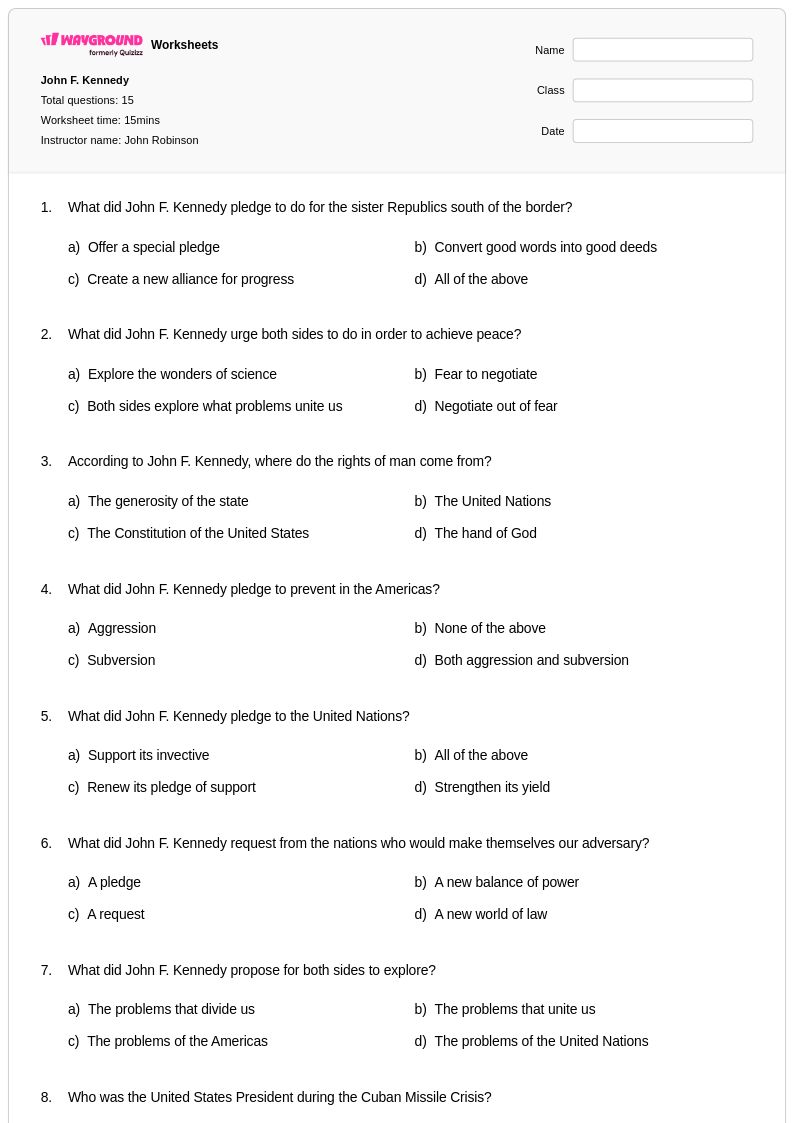
Class 12 students can explore John F. Kennedy's presidency and legacy through Wayground's comprehensive collection of free Social Studies worksheets, featuring printable PDFs with practice problems and answer keys.
Explore printable John F. Kennedy worksheets for Class 12
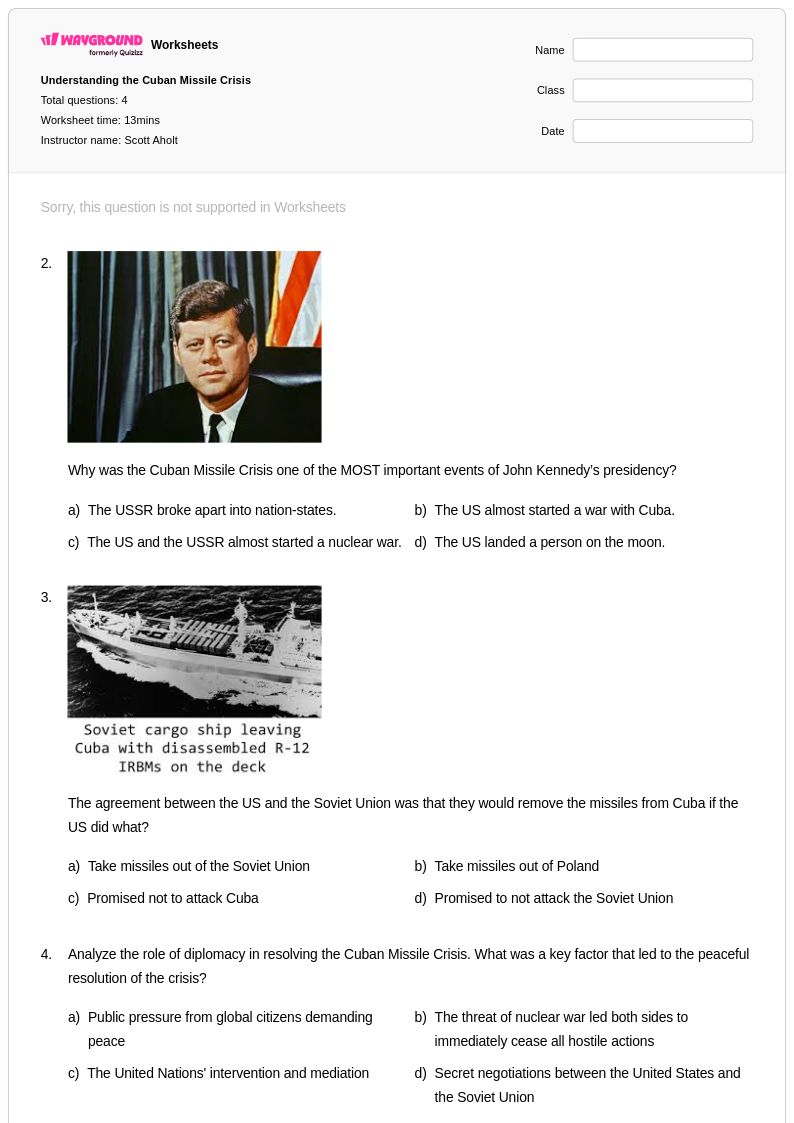
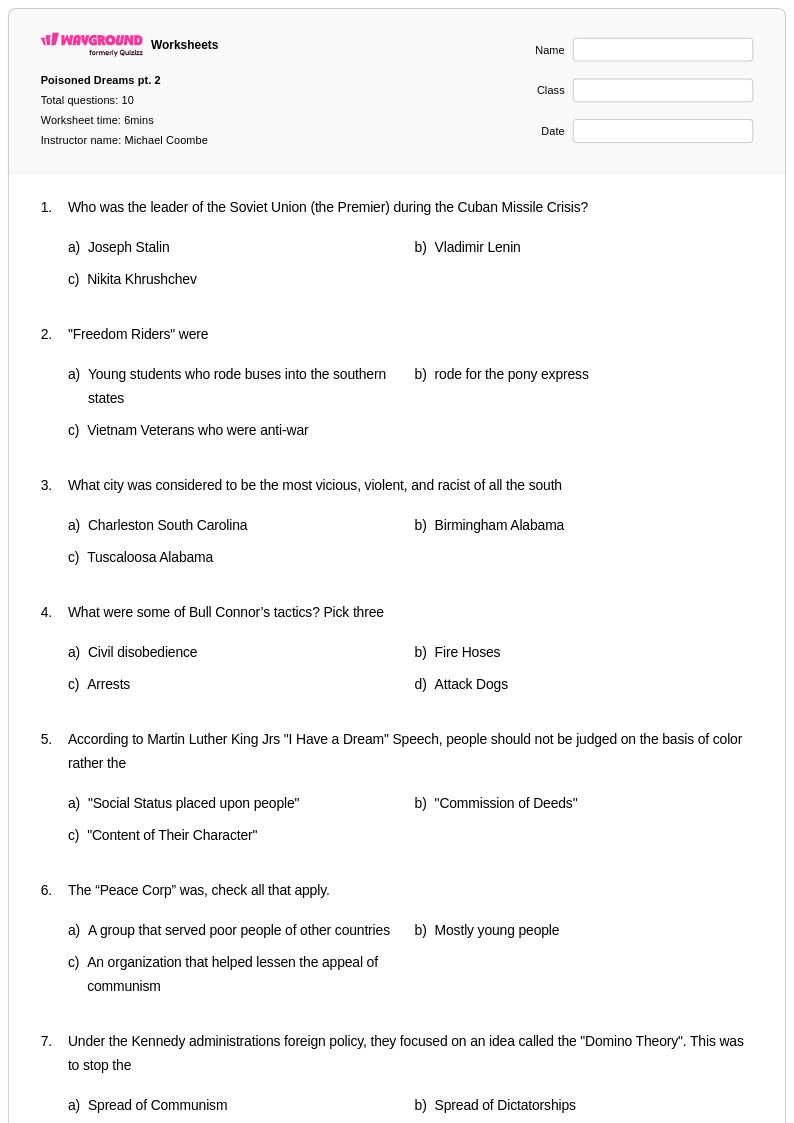
John F. Kennedy worksheets for Class 12 students available through Wayground (formerly Quizizz) provide comprehensive exploration of the 35th president's life, presidency, and lasting impact on American history. These expertly crafted educational materials strengthen critical thinking skills by examining Kennedy's domestic policies, foreign policy challenges including the Cuban Missile Crisis and Space Race, and his role in advancing civil rights during the early 1960s. Students engage with primary source documents, analyze political cartoons, and evaluate historical interpretations through carefully structured practice problems that encourage deep historical analysis. The collection includes detailed answer keys that support both independent study and classroom discussion, while printable pdf formats ensure accessibility for various learning environments. These free resources enable students to develop sophisticated understanding of Cold War dynamics, presidential leadership during crisis situations, and the complex social and political landscape of Kennedy's brief but influential administration.
Wayground (formerly Quizizz) empowers educators with an extensive library of millions of teacher-created John F. Kennedy resources specifically designed for Class 12 U.S. History instruction. The platform's advanced search and filtering capabilities allow teachers to quickly locate materials aligned with curriculum standards while accessing differentiation tools that accommodate diverse learning needs within their classrooms. These flexible worksheet collections support comprehensive lesson planning by offering customizable content that can be adapted for remediation, enrichment, or targeted skill practice depending on individual student requirements. Available in both printable and digital pdf formats, these resources seamlessly integrate into traditional and technology-enhanced learning environments, enabling teachers to provide consistent, high-quality instruction about this pivotal period in American history. The platform's robust organizational features help educators efficiently manage their Kennedy-focused units while ensuring students receive academically rigorous content that meets grade-level expectations for historical analysis and critical reasoning.
FAQs
How do I teach John F. Kennedy's presidency to middle or high school students?
Teaching JFK's presidency is most effective when anchored in specific events that illustrate broader Cold War tensions and domestic challenges. Start with Kennedy's election and the first televised presidential debates, then move into key policy moments like the Cuban Missile Crisis, the New Frontier agenda, and his stance on civil rights. Using primary source documents alongside timeline activities helps students connect events chronologically and understand cause-and-effect relationships across his presidency.
What are the most important topics to cover when teaching about JFK?
Core topics include the Cuban Missile Crisis as a defining moment of Cold War brinkmanship, Kennedy's New Frontier domestic agenda, his role in the early civil rights movement, the space program and the race to the moon, and the circumstances and impact of his assassination in 1963. Teachers should also address Kennedy's foreign policy approach more broadly, including the Bay of Pigs invasion, to give students a complete picture of his presidency's challenges and decisions.
What exercises help students practice and analyze JFK's historical impact?
Primary source document analysis is one of the most effective exercises for this topic, as Kennedy's speeches, executive orders, and correspondence offer rich material for close reading. Timeline construction activities help students sequence events across his presidency and connect them to the broader Cold War context. Critical thinking questions that ask students to evaluate Kennedy's decision-making during crises like the Cuban Missile Crisis also develop analytical reasoning skills central to history education.
What common misconceptions do students have about John F. Kennedy?
Students often overestimate the scope of Kennedy's civil rights achievements during his presidency, not recognizing that much of the landmark legislation came after his assassination under President Johnson. Another common misconception is viewing the Cuban Missile Crisis as a straightforward American victory rather than a tense negotiated resolution that involved significant compromise. Students also sometimes conflate Kennedy's charisma and cultural legacy with policy effectiveness, which makes it important to evaluate his record on its own terms.
How can I use John F. Kennedy worksheets in my classroom?
John F. Kennedy worksheets on Wayground are available as printable PDFs for traditional classroom use and in digital formats for technology-integrated environments, making them flexible for both in-person and remote instruction. Teachers can assign them as structured independent practice, use them to guide whole-class discussion, or host them as a quiz directly on the Wayground platform. The included answer keys allow for efficient grading and make the materials equally useful for homework assignments or test preparation.
How do I differentiate JFK lessons for students with different learning needs?
For students who need additional support, reducing the complexity of primary source documents or pairing them with guiding questions can lower the barrier to entry without removing rigor. On Wayground, teachers can apply individual accommodations such as read aloud, extended time, and reduced answer choices to specific students, so each learner engages with the material in a way that suits their needs. These settings can be saved and reused across future sessions, making differentiation sustainable rather than a one-time adjustment.