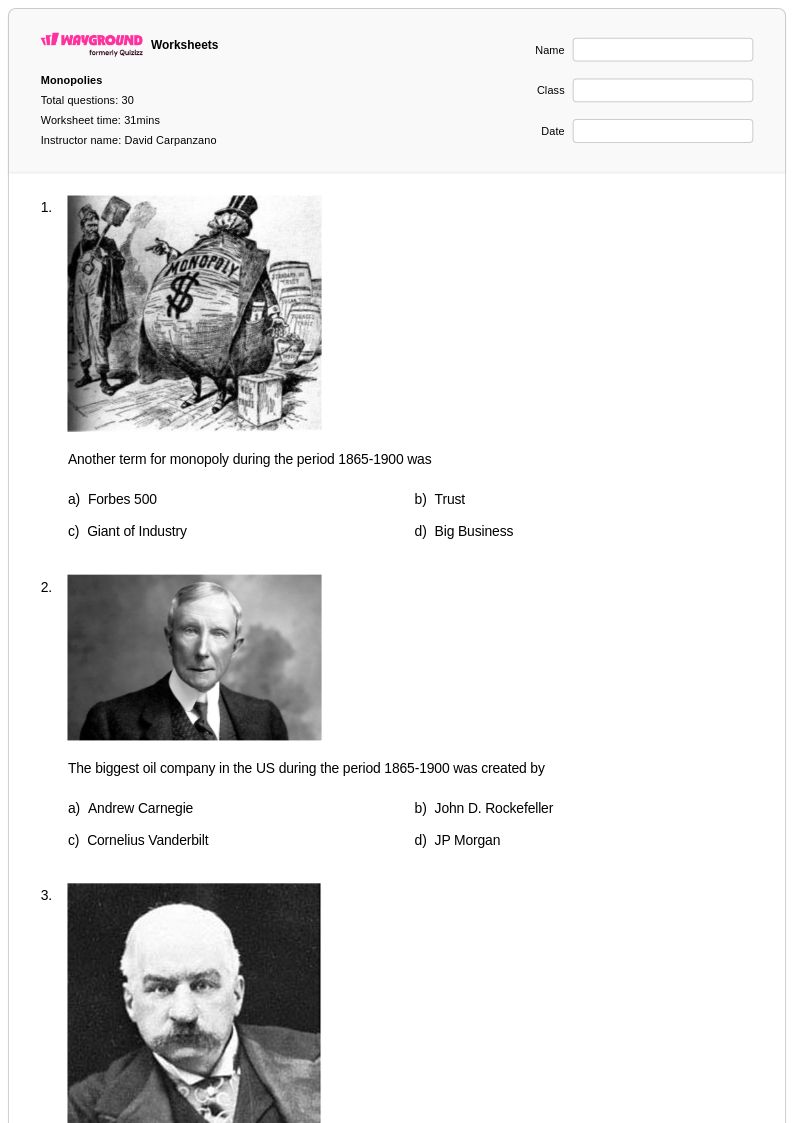
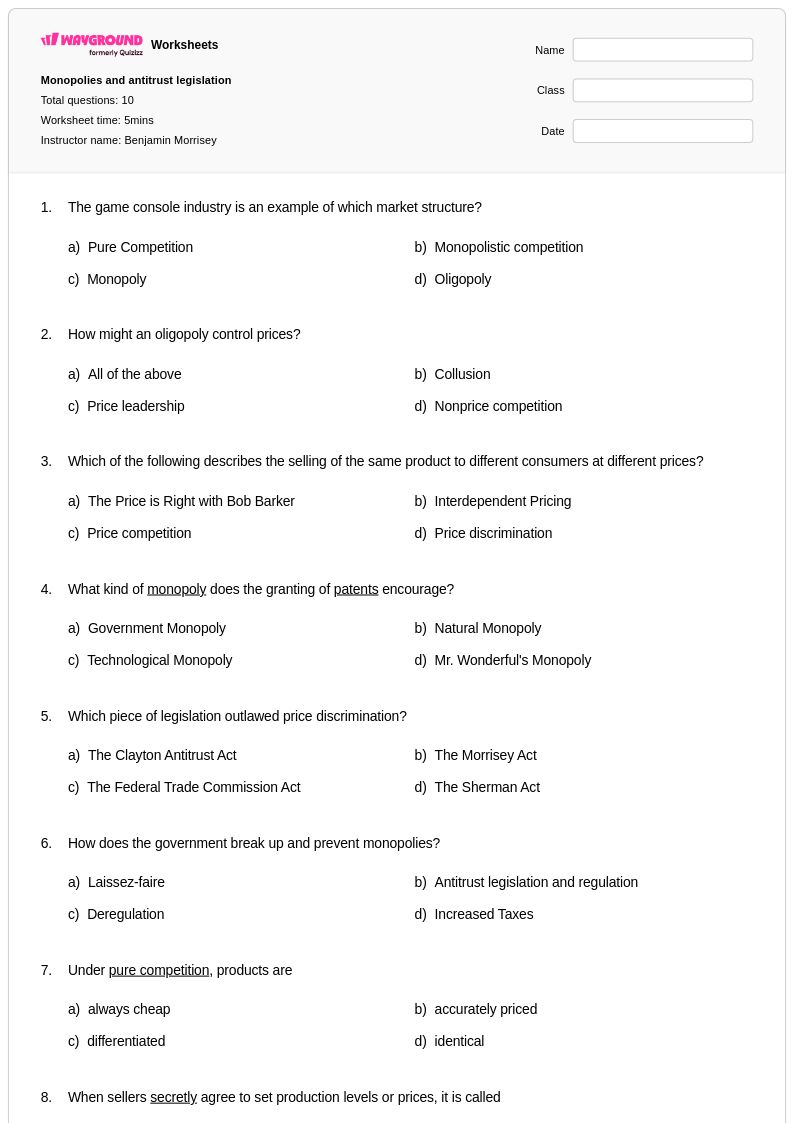
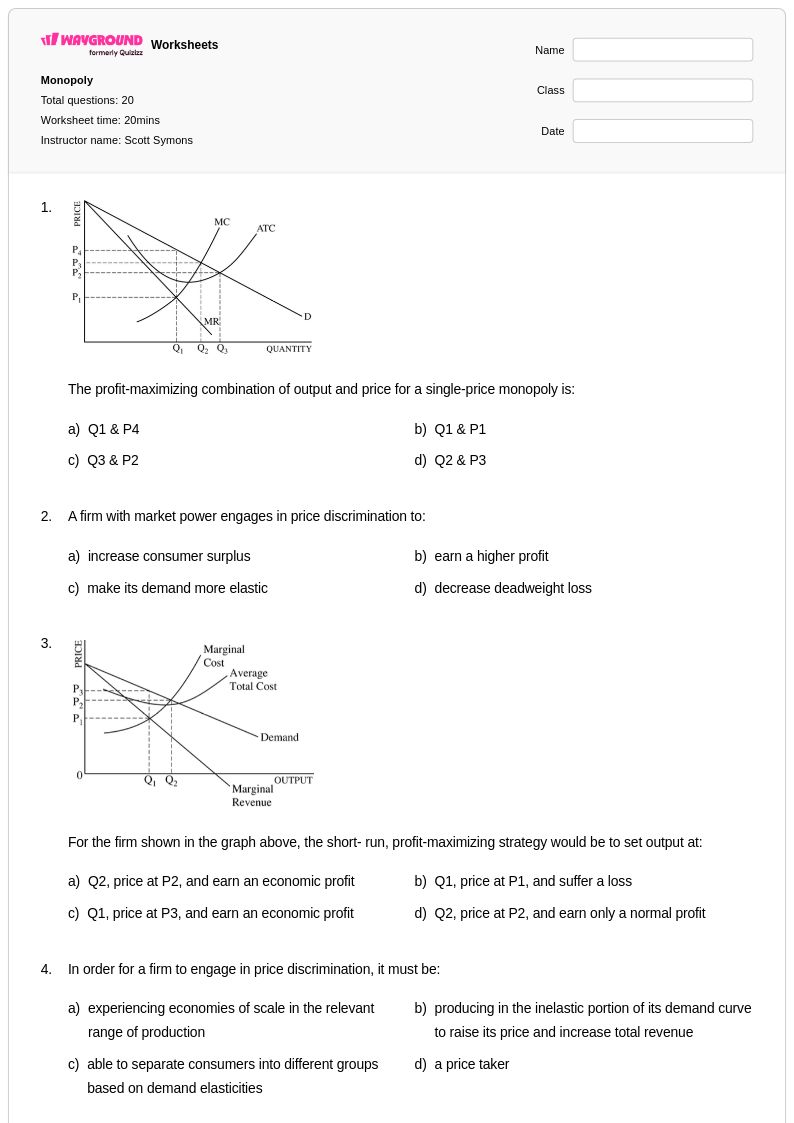
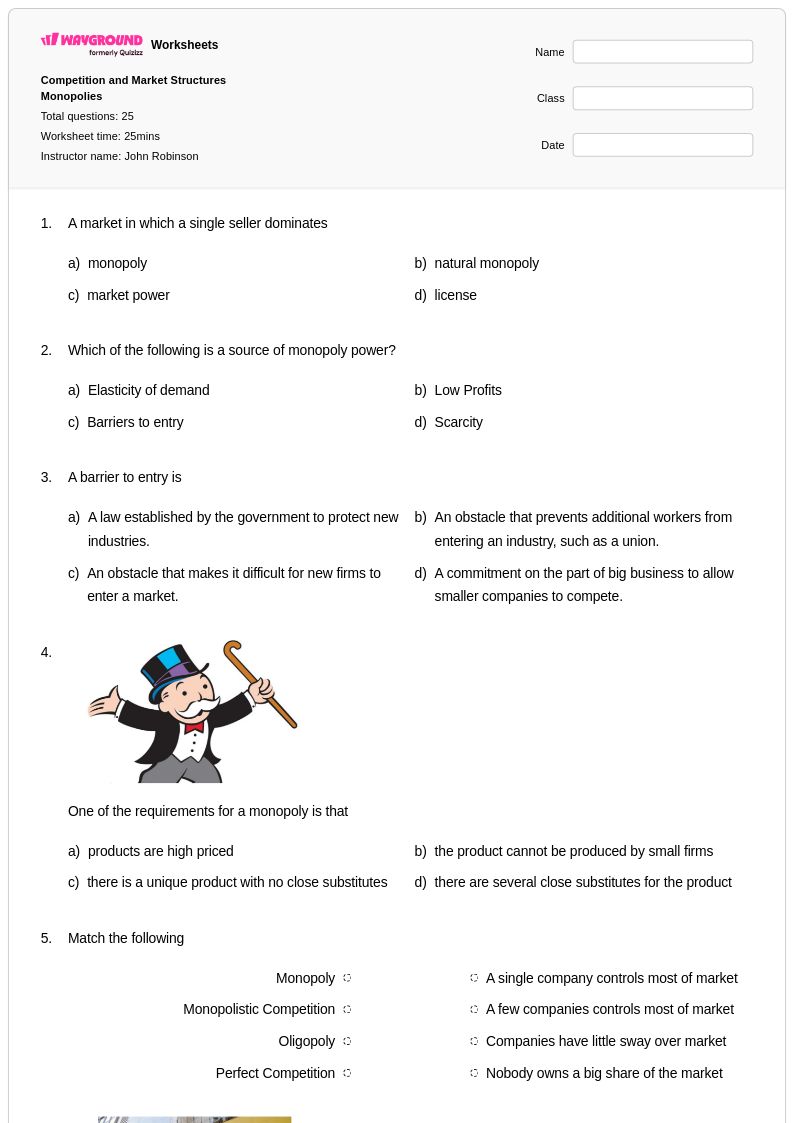
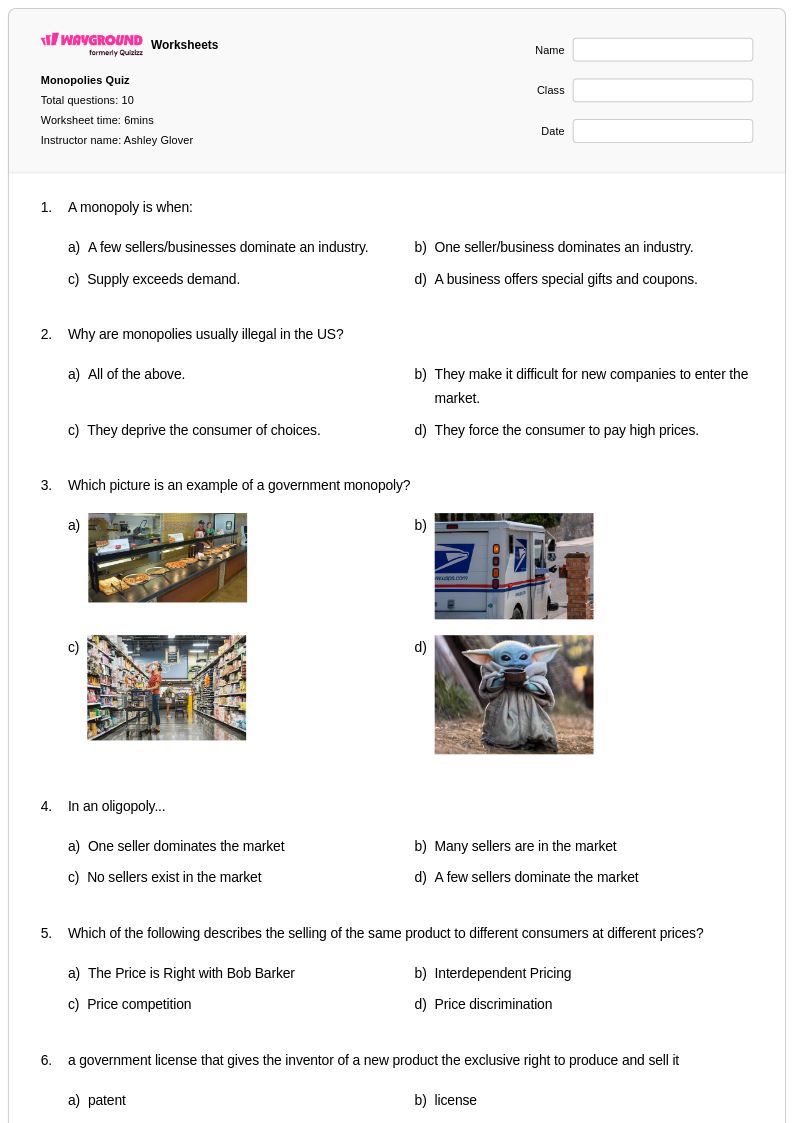
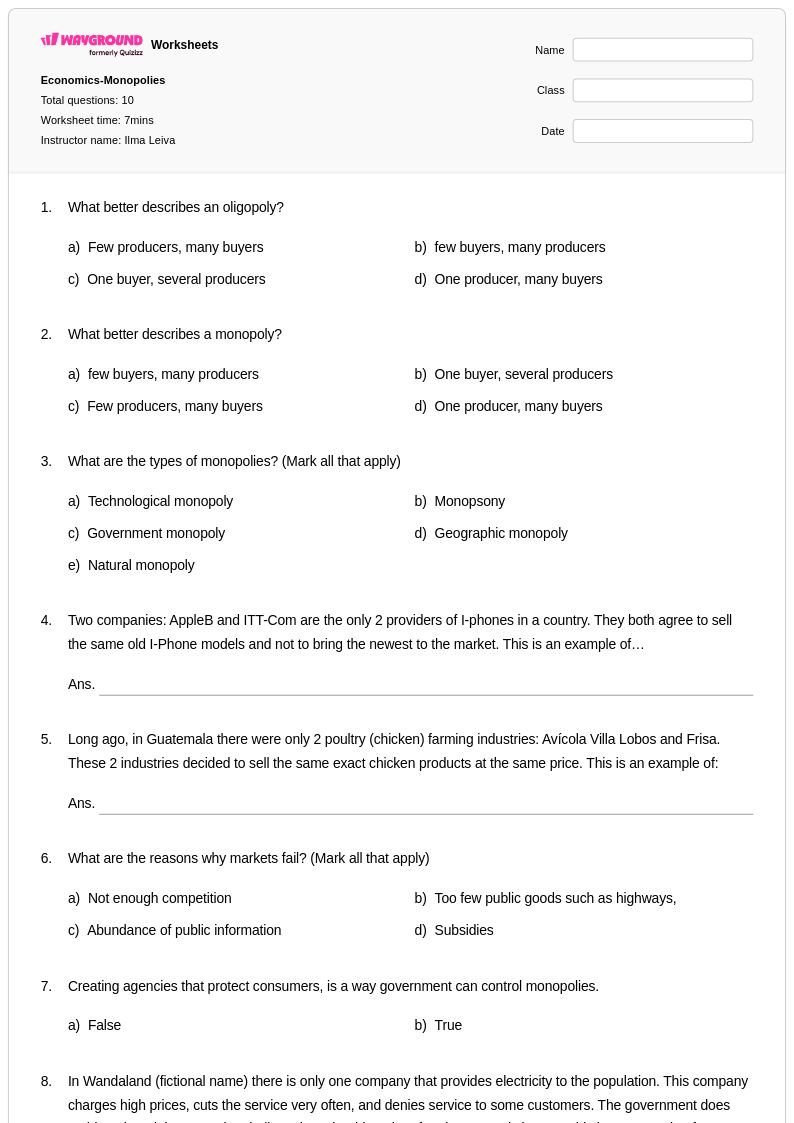
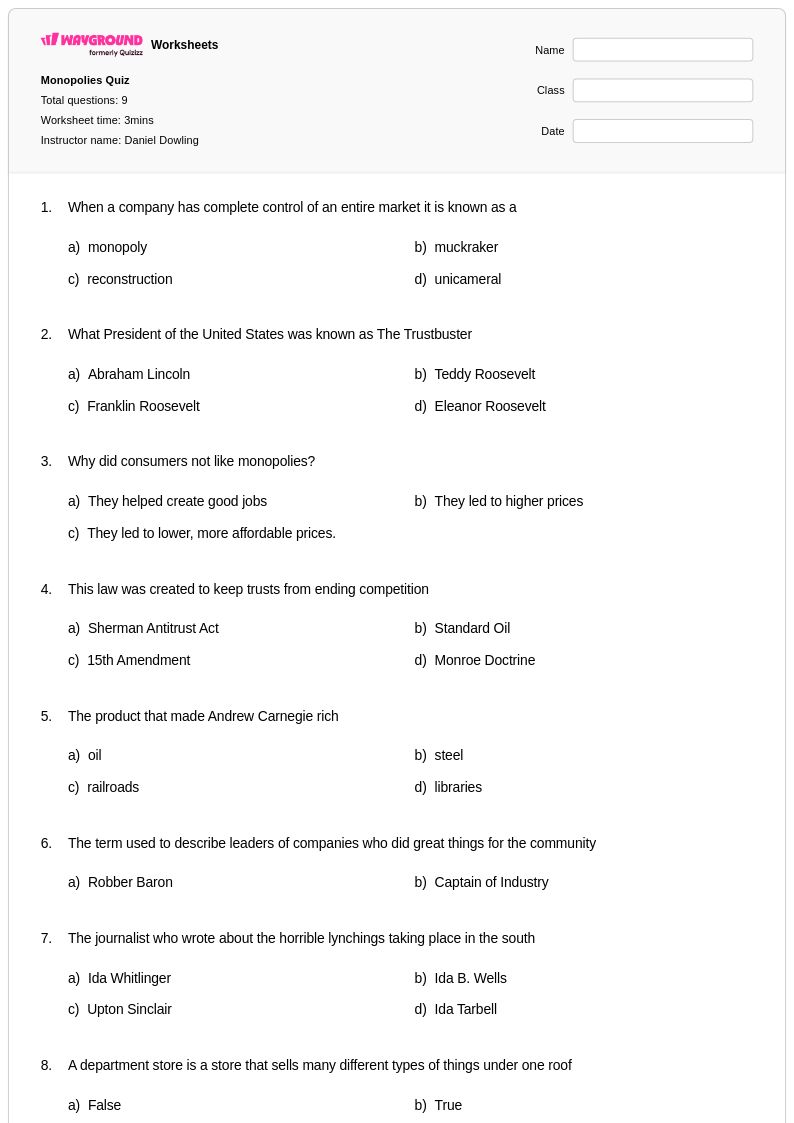
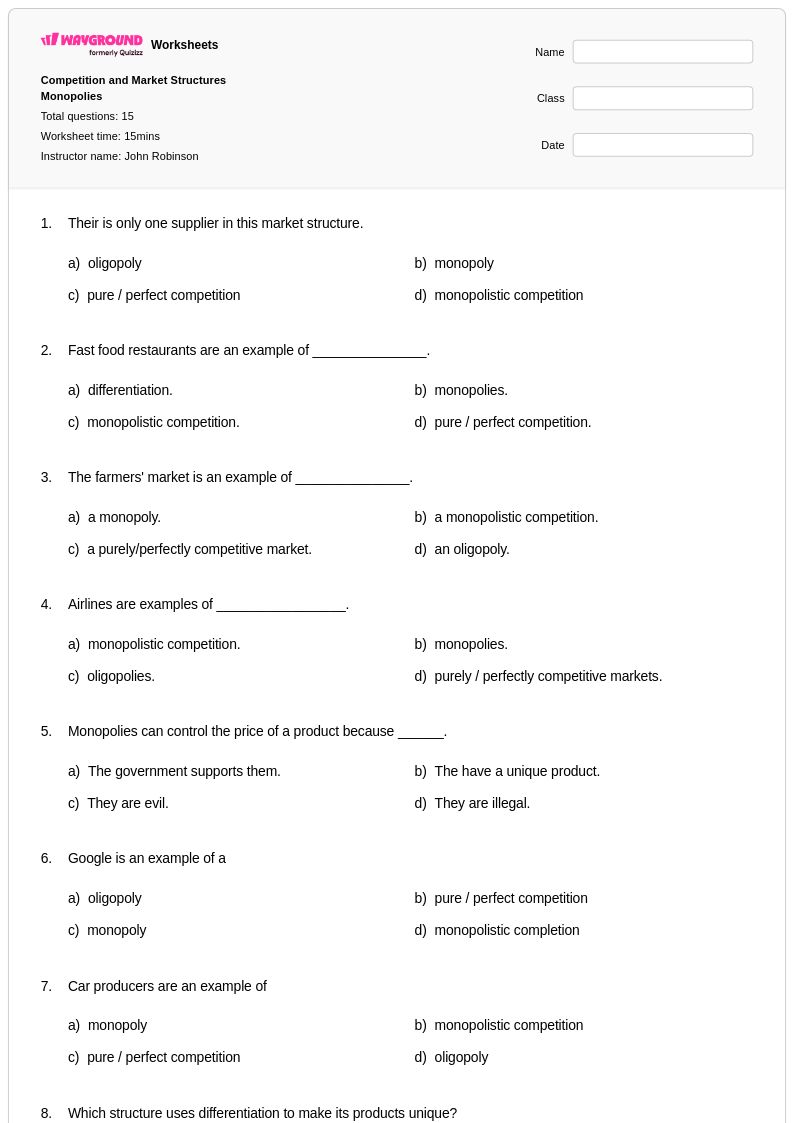
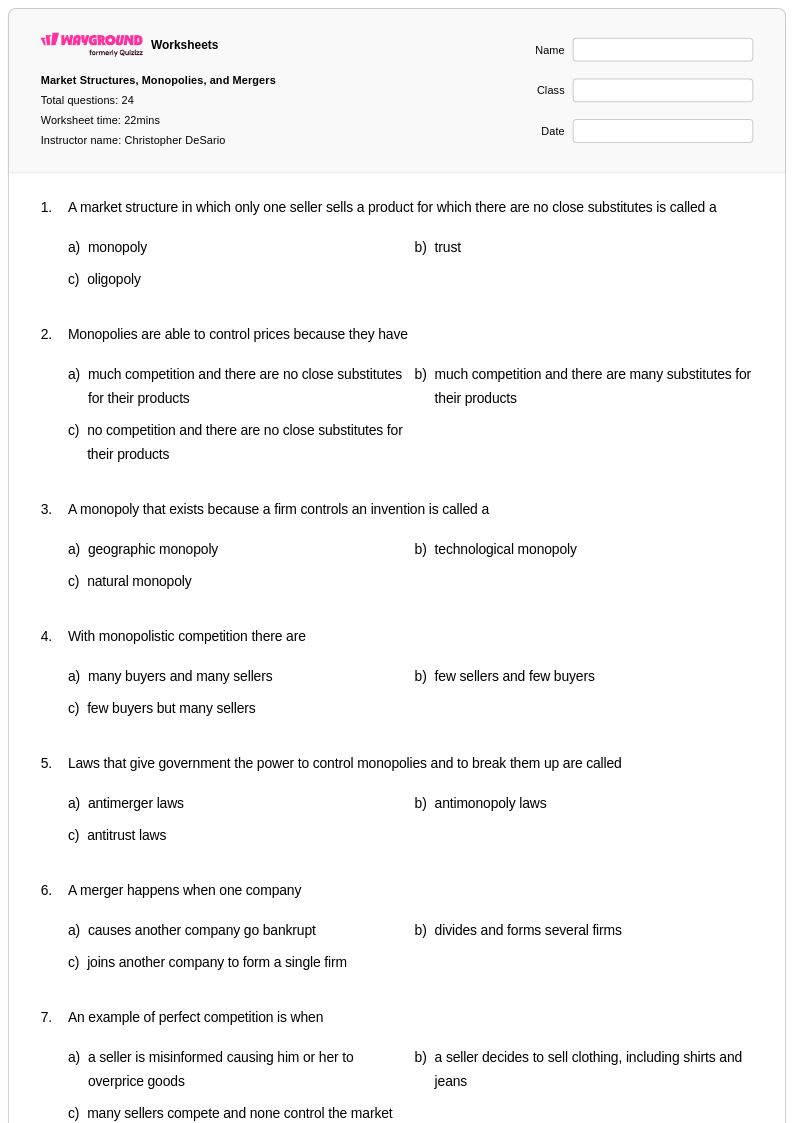
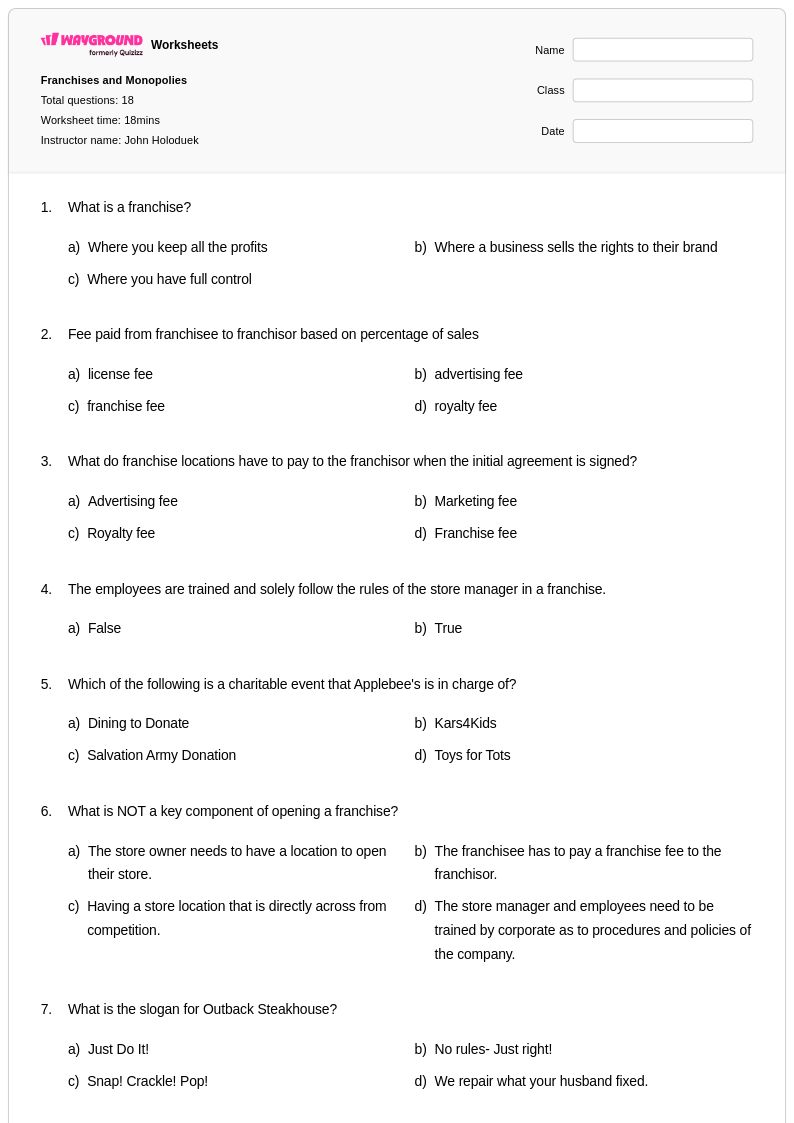
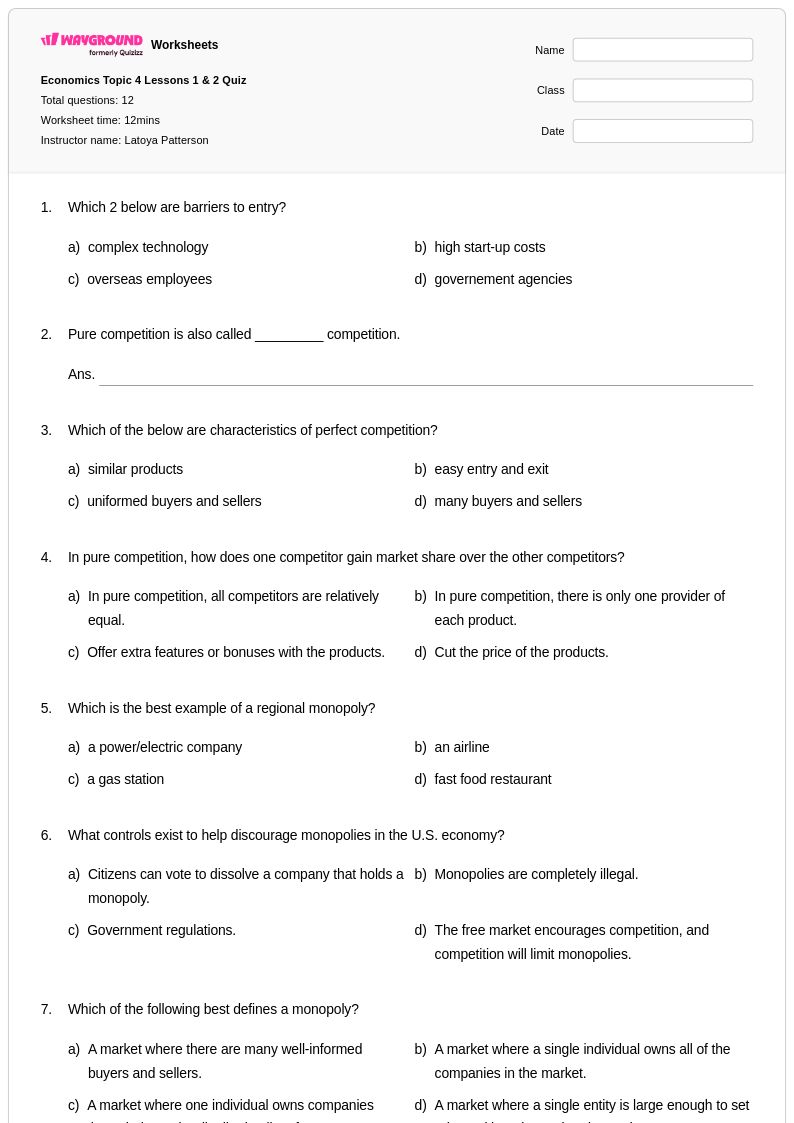
Explore Wayground's Class 12 monopolies worksheets featuring free printables and practice problems that help students master market structures, pricing strategies, and economic regulation concepts with comprehensive answer keys.
Explore printable Monopolies worksheets for Class 12
Monopolies represent one of the most complex and impactful market structures that Class 12 students encounter in their advanced economics coursework, and Wayground's comprehensive worksheet collection provides essential resources for mastering this challenging concept. These carefully designed worksheets guide students through the fundamental characteristics of monopolistic markets, including barriers to entry, price discrimination strategies, deadweight loss calculations, and the economic inefficiencies that arise when single firms control entire markets. Students engage with practice problems that require them to analyze real-world monopoly examples, calculate profit maximization points using marginal revenue and marginal cost curves, and evaluate the consumer welfare implications of monopolistic pricing strategies. Each worksheet includes detailed answer keys that help students verify their understanding of complex economic principles, while the free printable format ensures accessibility for all learners seeking to strengthen their analytical skills in market structure analysis.
Wayground's robust platform, formerly known as Quizizz, empowers educators with access to millions of teacher-created resources specifically designed for advanced economics instruction, featuring sophisticated search and filtering capabilities that allow teachers to locate monopoly worksheets aligned with specific curriculum standards and learning objectives. The platform's differentiation tools enable teachers to customize worksheet difficulty levels and content focus areas, ensuring that students receive appropriate challenges whether they need foundational skill practice, remediation support, or enrichment opportunities in advanced market analysis. Teachers can seamlessly distribute these resources in both printable and digital formats, including downloadable PDF versions that maintain professional formatting and mathematical precision essential for economics problem-solving. This flexibility supports diverse instructional approaches, from traditional classroom assignments to remote learning environments, while the comprehensive answer keys and detailed explanations facilitate efficient grading and targeted feedback that helps students master the intricate relationships between market power, consumer surplus, and economic efficiency that define monopolistic market structures.
FAQs
How do I teach monopolies to economics students?
Start by contrasting monopolies with competitive markets so students can see how the absence of competition changes pricing and output decisions. Use real-world examples like utility companies or pharmaceutical patents to ground abstract concepts in familiar contexts. From there, walk students through profit maximization using marginal revenue and marginal cost analysis, and introduce deadweight loss as a way to visualize economic inefficiency. Connecting theory to government regulation cases helps students understand why antitrust policy exists.
What practice problems help students understand monopoly pricing and profit maximization?
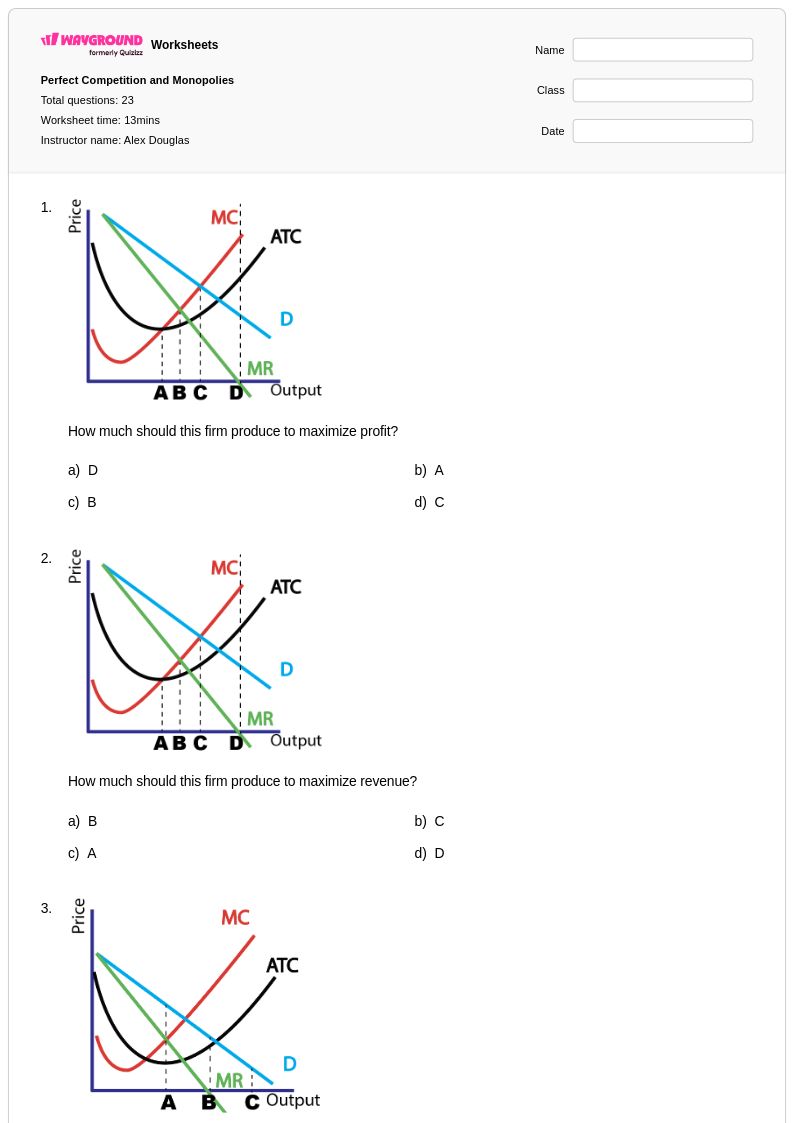
Effective practice problems ask students to calculate a monopolist's profit-maximizing output by finding where marginal revenue equals marginal cost, then determine the price using the demand curve. Problems that require students to compare monopoly outcomes with competitive equilibrium, including consumer surplus and deadweight loss, build deeper analytical skills. Graphing exercises that have students draw demand, marginal revenue, average total cost, and marginal cost curves together are especially useful for reinforcing how all these elements interact.
What mistakes do students commonly make when analyzing monopolies?
The most common error is assuming a monopolist charges the highest possible price on the demand curve rather than the profit-maximizing price, which is determined by the MR = MC rule. Students also frequently confuse the demand curve facing a monopolist with the demand curve facing a competitive firm, not recognizing that a monopolist is the sole market supplier and therefore faces a downward-sloping demand curve. Another recurring mistake is treating monopoly profit as guaranteed, without accounting for cost structures that can result in losses even without competition.
How do monopolies differ from oligopolies and perfectly competitive markets?
A monopoly has a single seller with no close substitutes, giving it full price-making power, whereas a perfectly competitive market has many sellers offering identical products and no individual firm can influence price. Oligopolies fall in between, with a small number of large firms that are interdependent in their pricing and output decisions. Understanding these structural differences is essential for students learning market structure analysis, as each type has distinct implications for consumer welfare, pricing behavior, and regulatory policy.
How can I use monopoly worksheets to support students who are struggling with market structure concepts?
Monopoly worksheets that scaffold from conceptual definitions to applied problems are effective for students who need remediation before tackling graphs or calculations. Breaking the material into smaller steps, such as identifying monopoly characteristics before moving to pricing analysis, helps struggling learners build confidence. On Wayground, teachers can assign worksheets digitally and apply accommodations like read aloud for students who need text-to-speech support, or reduced answer choices to lower cognitive load for students who find multiple-choice formats overwhelming.
How do I use Wayground's monopoly worksheets in my classroom?
Wayground's monopoly worksheets are available as printable PDFs for traditional classroom use and in digital formats for technology-integrated environments, giving teachers flexibility depending on their setup. Digital versions can be hosted as a quiz directly on Wayground, allowing teachers to track student performance in real time. All worksheets include complete answer keys, which streamlines grading and makes the materials practical for both independent practice and guided instruction.