Free Printable Patterns of Inheritance Worksheets for Class 11
Class 11 patterns of inheritance worksheets offer comprehensive printables and practice problems to help students master genetic principles, featuring detailed answer keys and free PDF resources for effective biology learning.
Explore printable Patterns of Inheritance worksheets for Class 11
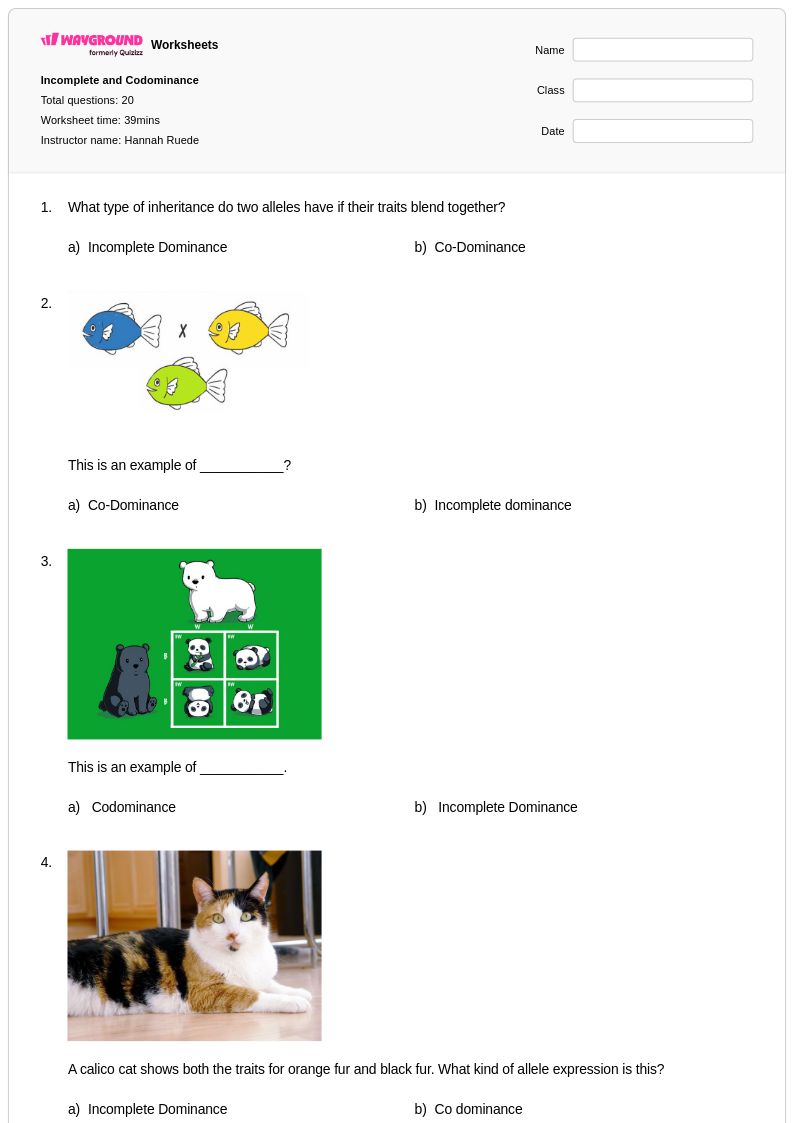
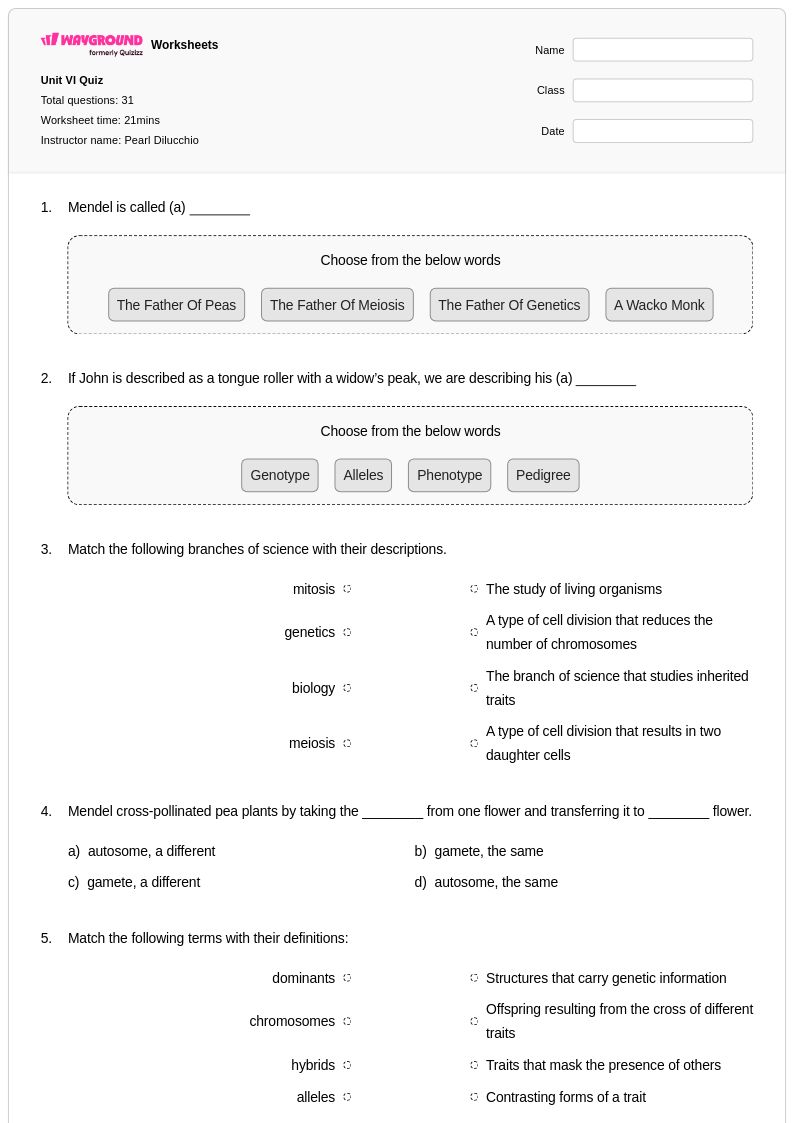
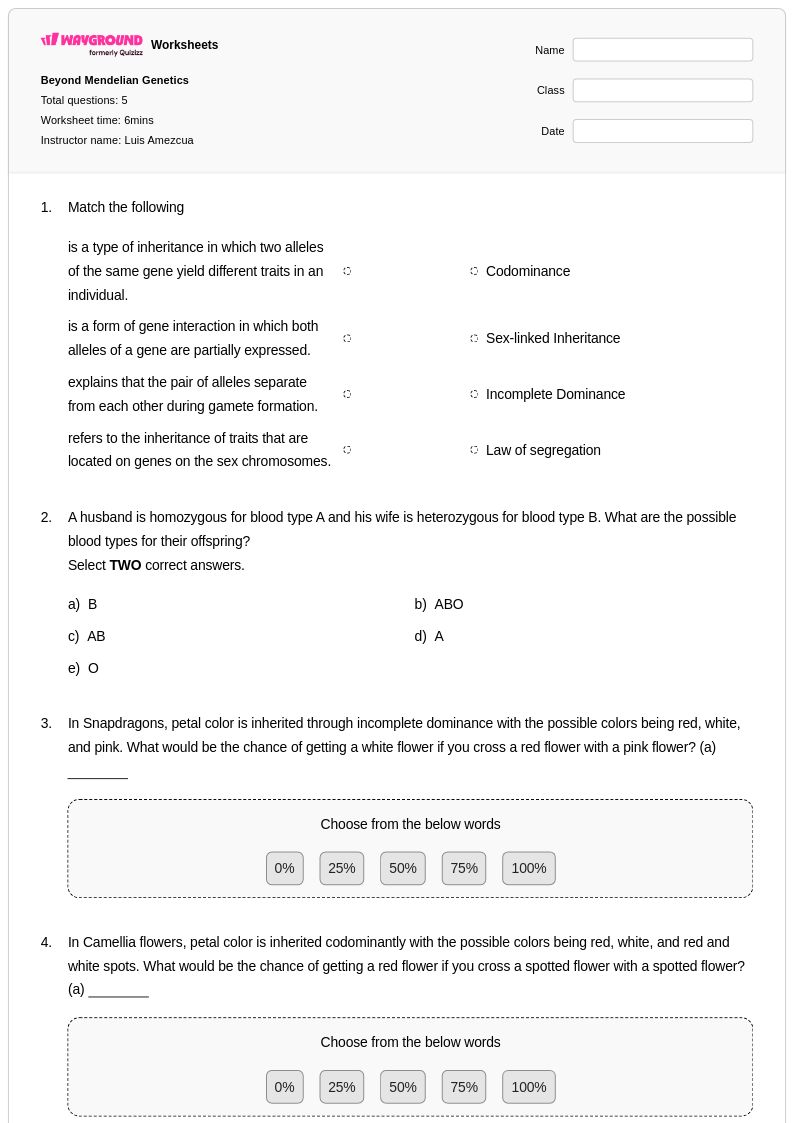
Patterns of Inheritance worksheets for Class 11 students available through Wayground (formerly Quizizz) provide comprehensive coverage of heredity principles that form the foundation of modern genetics. These educational resources focus on essential concepts including Mendelian inheritance, dominant and recessive alleles, Punnett squares, codominance, incomplete dominance, sex-linked traits, and polygenic inheritance patterns. Students develop critical analytical skills by working through practice problems that require them to predict offspring phenotypes and genotypes, calculate probability ratios, and interpret pedigree charts. The worksheet collections include detailed answer keys that facilitate self-assessment and independent learning, while printable pdf formats ensure accessibility for both classroom instruction and home study. These free resources strengthen students' ability to apply mathematical reasoning to biological phenomena and understand the molecular basis of trait transmission across generations.
Wayground (formerly Quizizz) supports educators with an extensive library of millions of teacher-created resources specifically designed for Class 11 Patterns of Inheritance instruction. The platform's robust search and filtering capabilities allow teachers to quickly locate worksheets that align with state and national science standards, ensuring curriculum coherence and meeting specific learning objectives. Advanced differentiation tools enable instructors to customize difficulty levels and modify content to accommodate diverse learning needs, from remediation for struggling students to enrichment activities for advanced learners. These resources are available in both printable and digital formats, including downloadable pdfs, providing flexibility for various classroom environments and teaching styles. Teachers can efficiently plan lessons, assign targeted skill practice, and implement formative assessments that help students master complex inheritance patterns while building confidence in genetic problem-solving techniques.
FAQs
How do I teach patterns of inheritance to biology students?
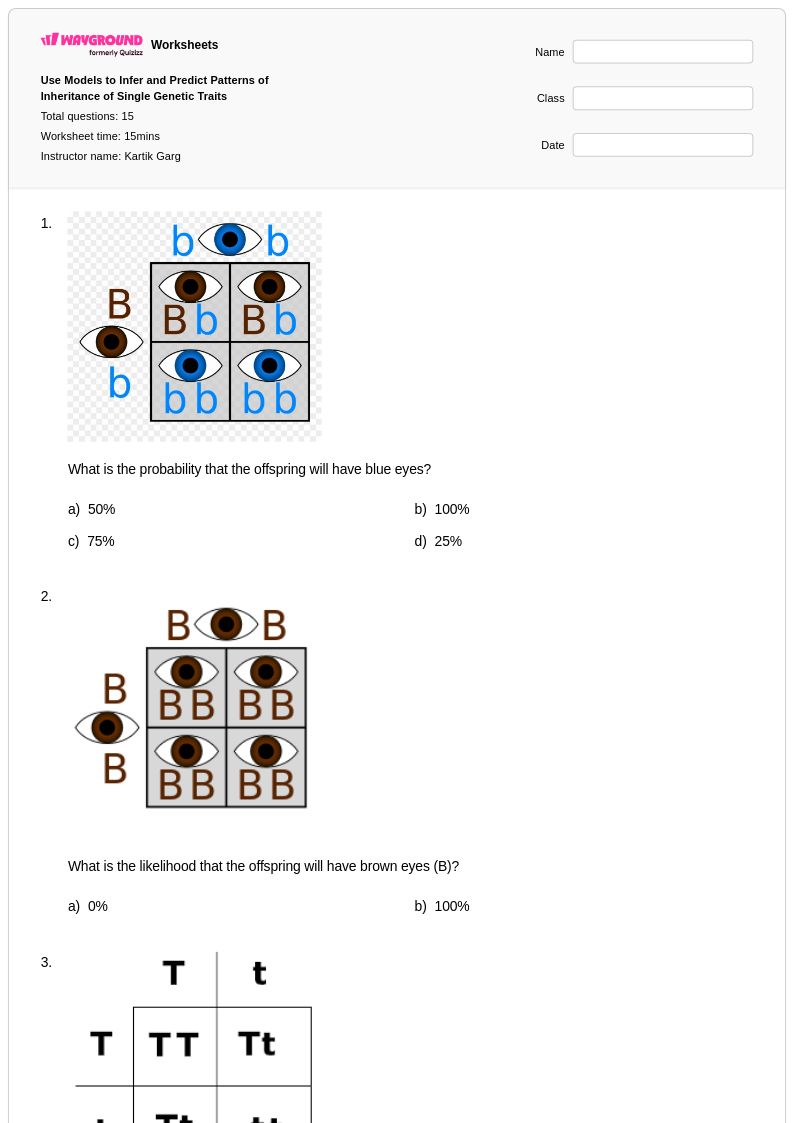
Start by grounding students in Mendelian genetics — dominant and recessive alleles, genotype vs. phenotype, and simple monohybrid crosses — before introducing more complex patterns like codominance, incomplete dominance, and sex-linked inheritance. Using Punnett squares as a visual scaffold helps students build a concrete procedural foundation before they tackle dihybrid crosses or pedigree analysis. Layering complexity gradually and returning to worked examples keeps students from conflating the different inheritance models.
What types of practice problems help students master genetic crosses and Punnett squares?
Students benefit most from problems that require them to set up crosses independently, predict offspring phenotype and genotype ratios, and then explain their reasoning — not just fill in a grid. Effective practice includes monohybrid and dihybrid cross problems, incomplete dominance and codominance scenarios, and pedigree chart interpretation questions that ask students to determine inheritance patterns from family data. Varying the entry point of problems (some giving genotypes, others giving phenotype ratios to work backward from) strengthens flexible thinking.
What mistakes do students commonly make when working with patterns of inheritance?
The most persistent misconception is conflating incomplete dominance with codominance — students often assume any blended phenotype means codominance rather than distinguishing whether both alleles are fully or partially expressed. Students also frequently misapply dominant/recessive logic to sex-linked traits, forgetting that males only carry one X-linked allele and cannot be heterozygous carriers. Another common error is incorrectly calculating dihybrid cross ratios by treating the two gene loci as dependent rather than applying the law of independent assortment.
How do I differentiate patterns of inheritance instruction for students at different skill levels?
For struggling students, focus on monohybrid crosses and clear visual tools like labeled Punnett squares before introducing additional inheritance patterns. Advanced students can be pushed toward dihybrid crosses, epistasis, polygenic inheritance, and pedigree analysis that requires working backward to determine parental genotypes. On Wayground, teachers can assign reduced answer choices to students who need additional scaffolding, reducing cognitive load while still engaging them with the core genetic concepts.
How do I use Wayground's patterns of inheritance worksheets in my classroom?
Wayground's patterns of inheritance worksheets are available as printable PDFs for traditional classroom use and in digital formats for technology-integrated learning environments, and can also be hosted as a quiz directly on Wayground. Each worksheet includes a detailed answer key, making them practical for independent practice, homework, or in-class problem-solving sessions. The platform's search and filtering tools allow teachers to pinpoint materials targeting specific concepts — from basic Mendelian principles to advanced topics like sex-linked inheritance — so you can match resources precisely to your current unit objectives.
How do I use pedigree charts to teach inheritance patterns?
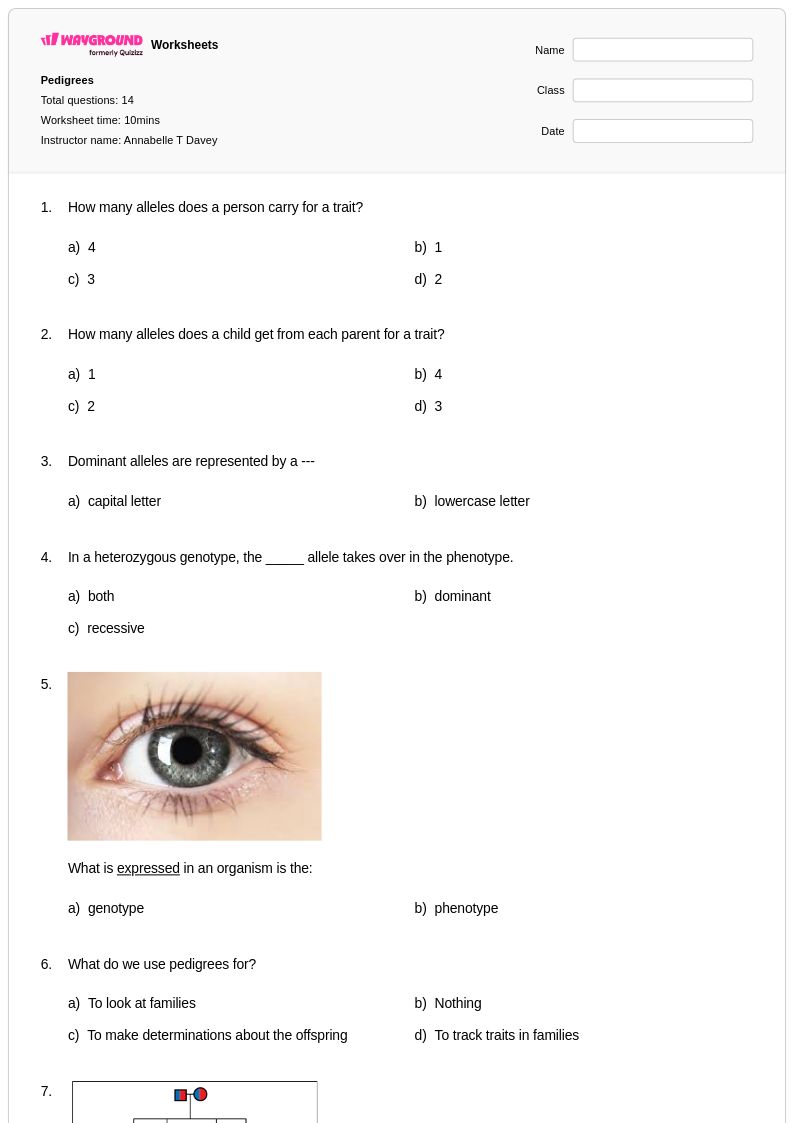
Pedigree charts are most effective when students are first taught to read the symbols and then asked to trace a single trait across generations before drawing any conclusions about inheritance pattern. Have students practice identifying whether a trait is dominant or recessive, autosomal or sex-linked, by systematically eliminating possibilities based on the pedigree data. Pairing pedigree interpretation with Punnett square verification — where students confirm their predicted genotypes match the observed pattern — reinforces both skills simultaneously.