Free Printable Volume of Liquids Worksheets for Class 6
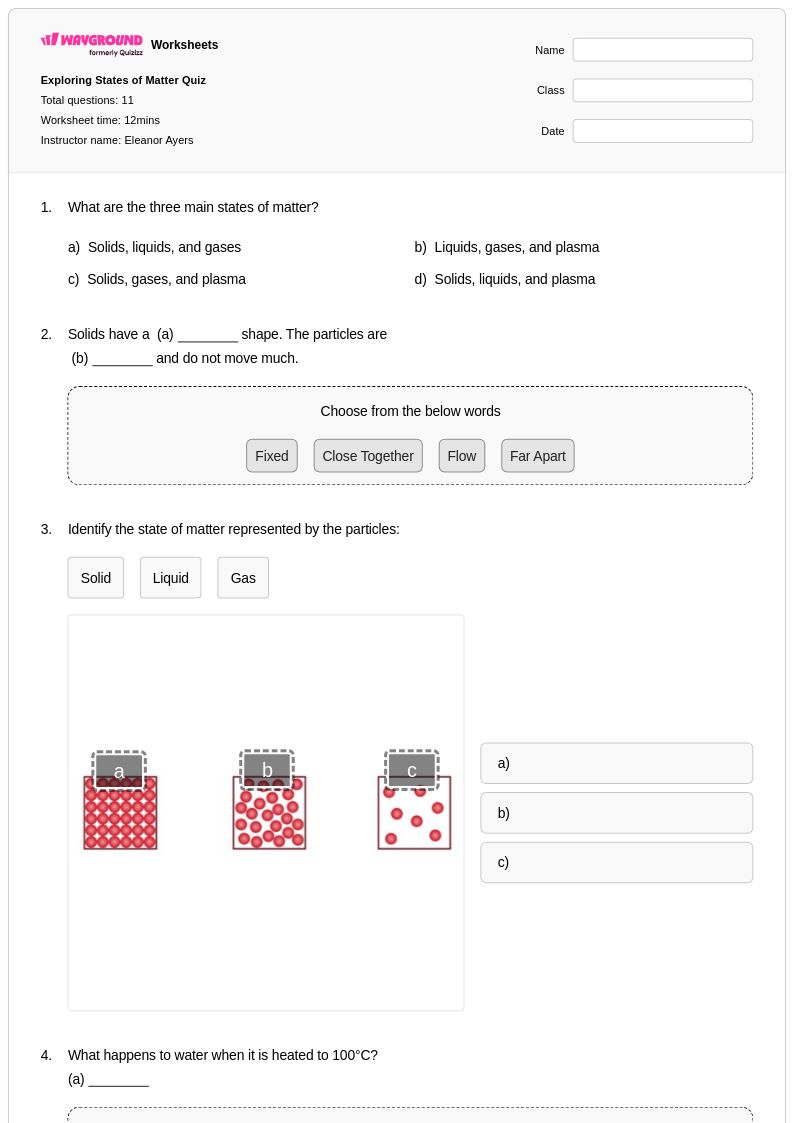
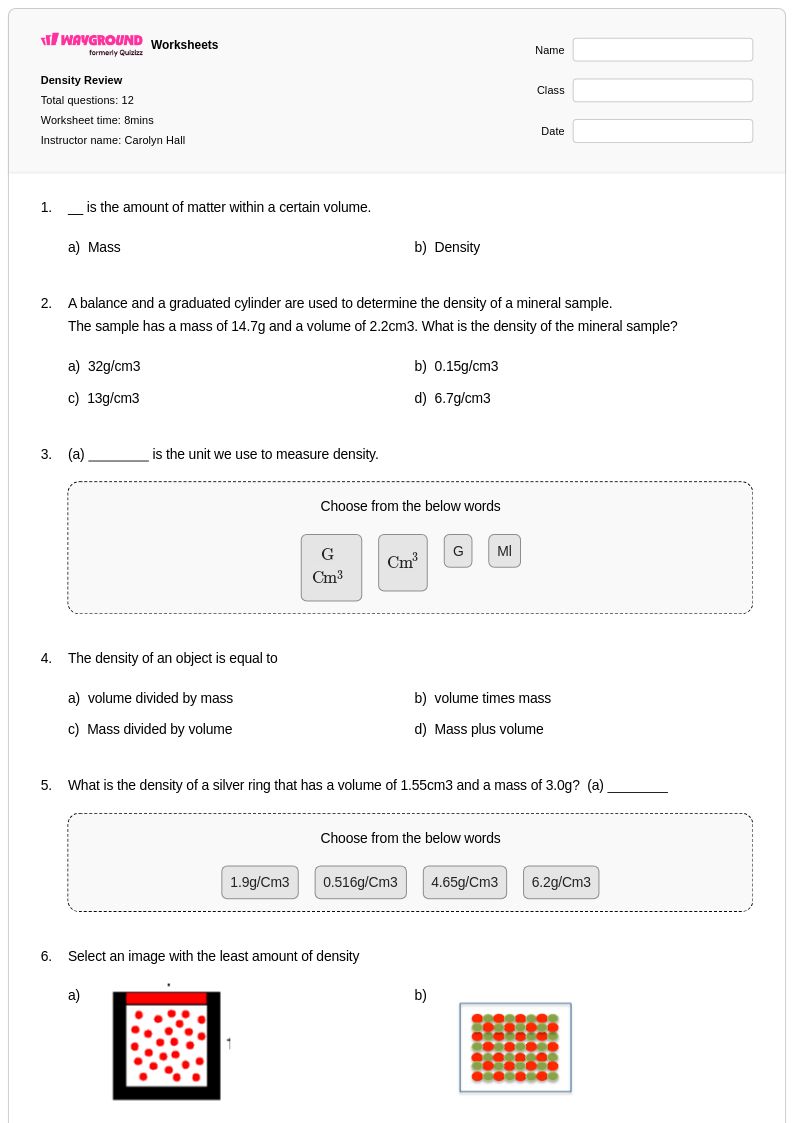
Class 6 volume of liquids worksheets from Wayground help students master liquid measurement concepts through engaging printables, practice problems, and comprehensive answer keys available as free PDF downloads.
Explore printable Volume of Liquids worksheets for Class 6
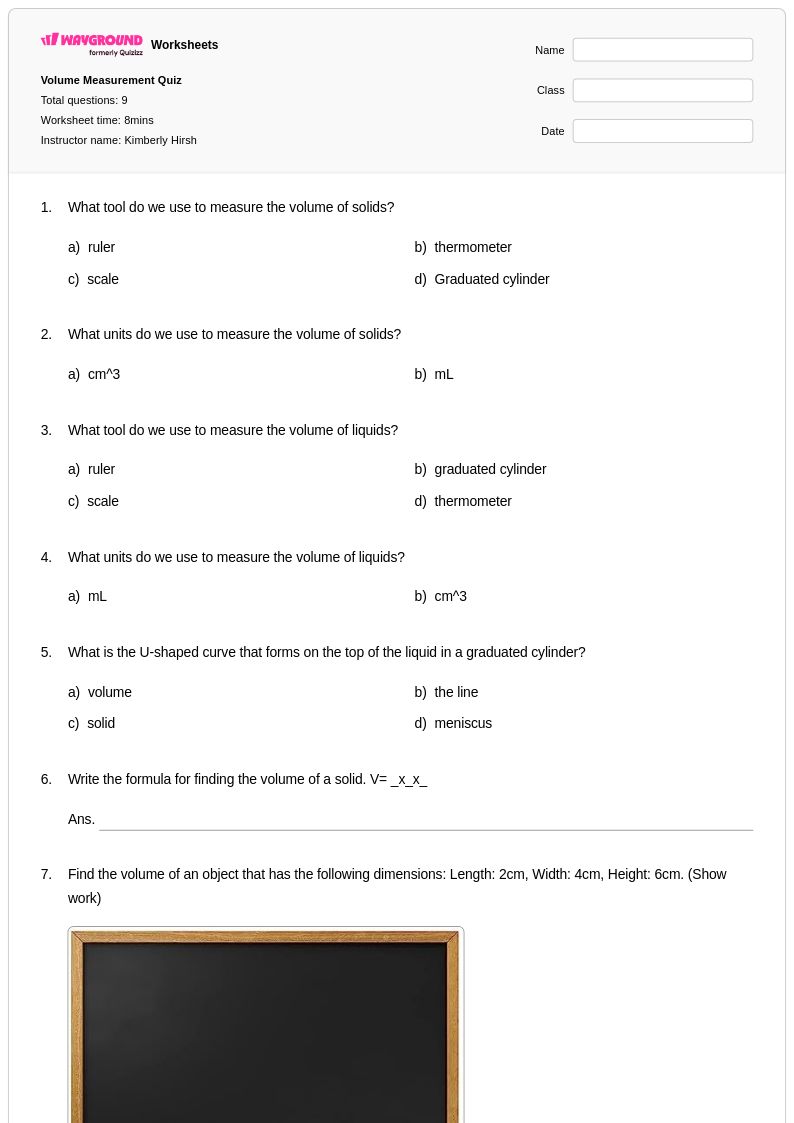
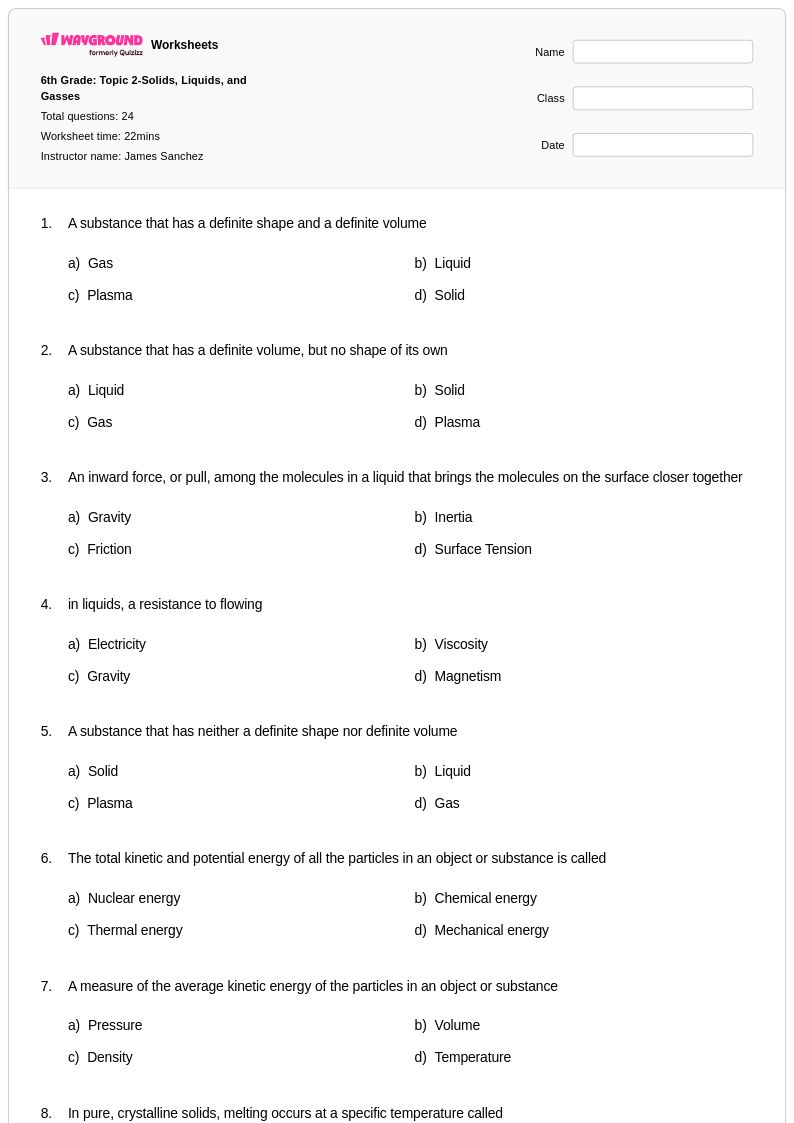
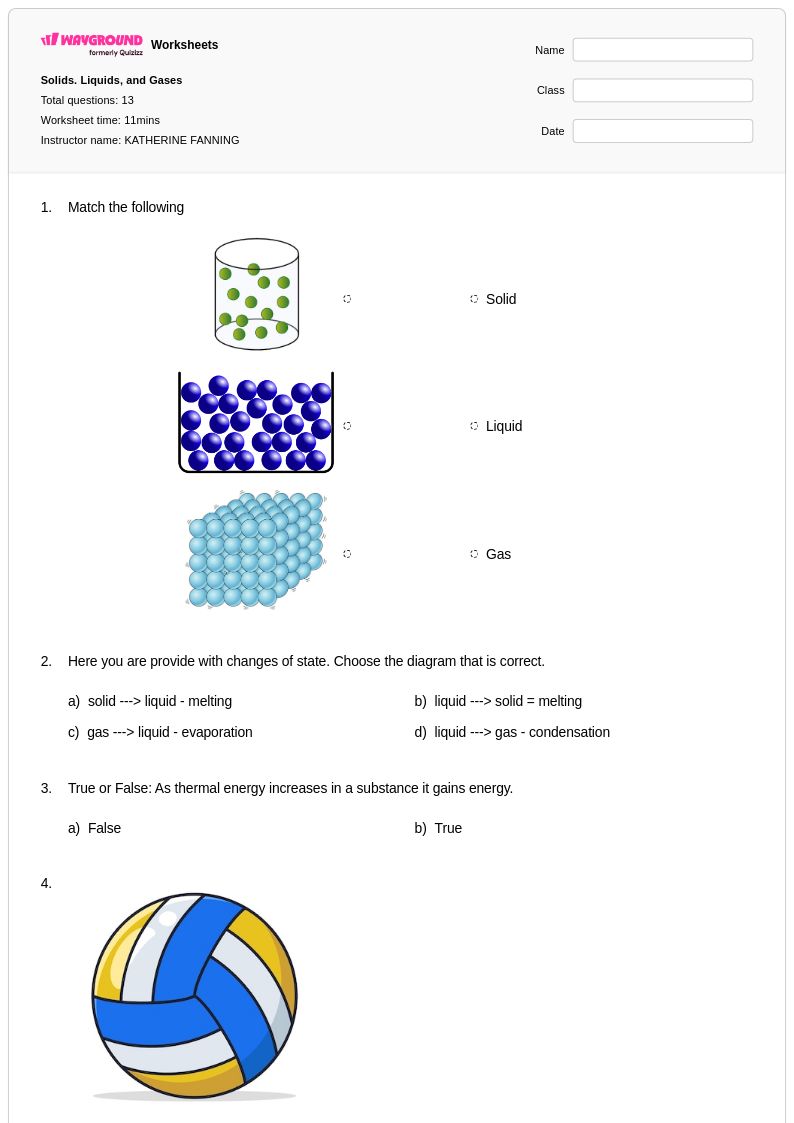
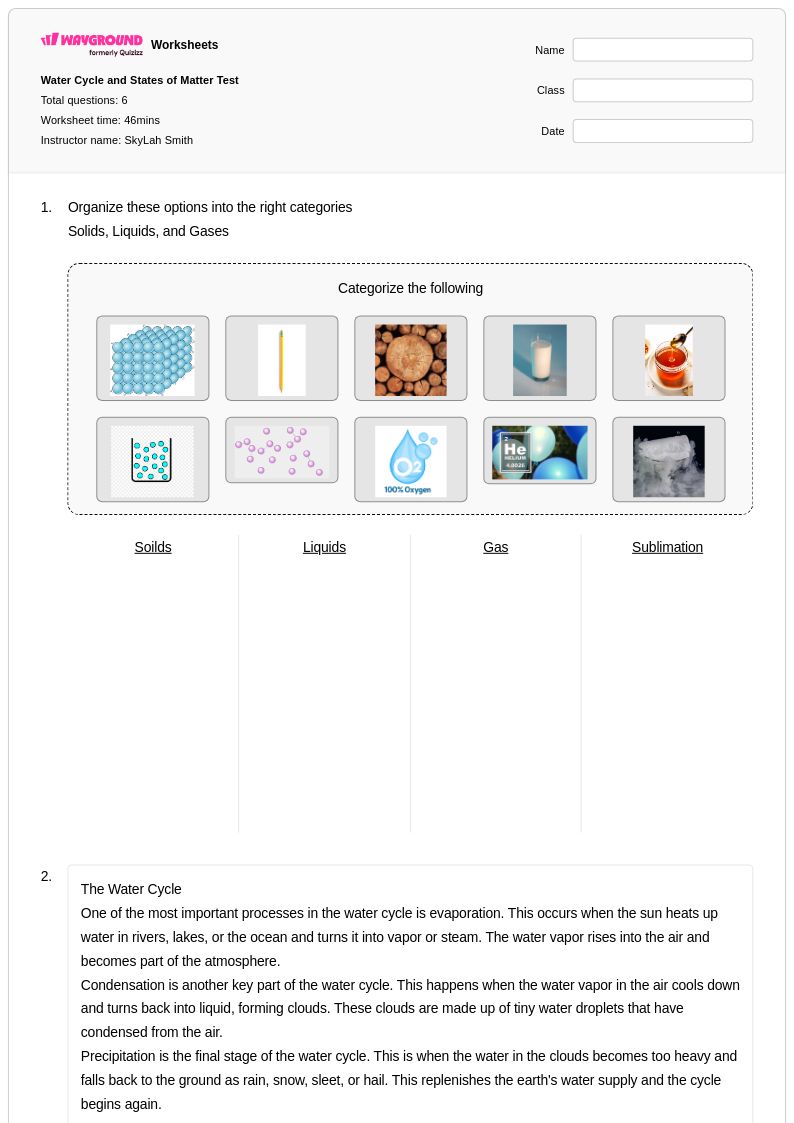
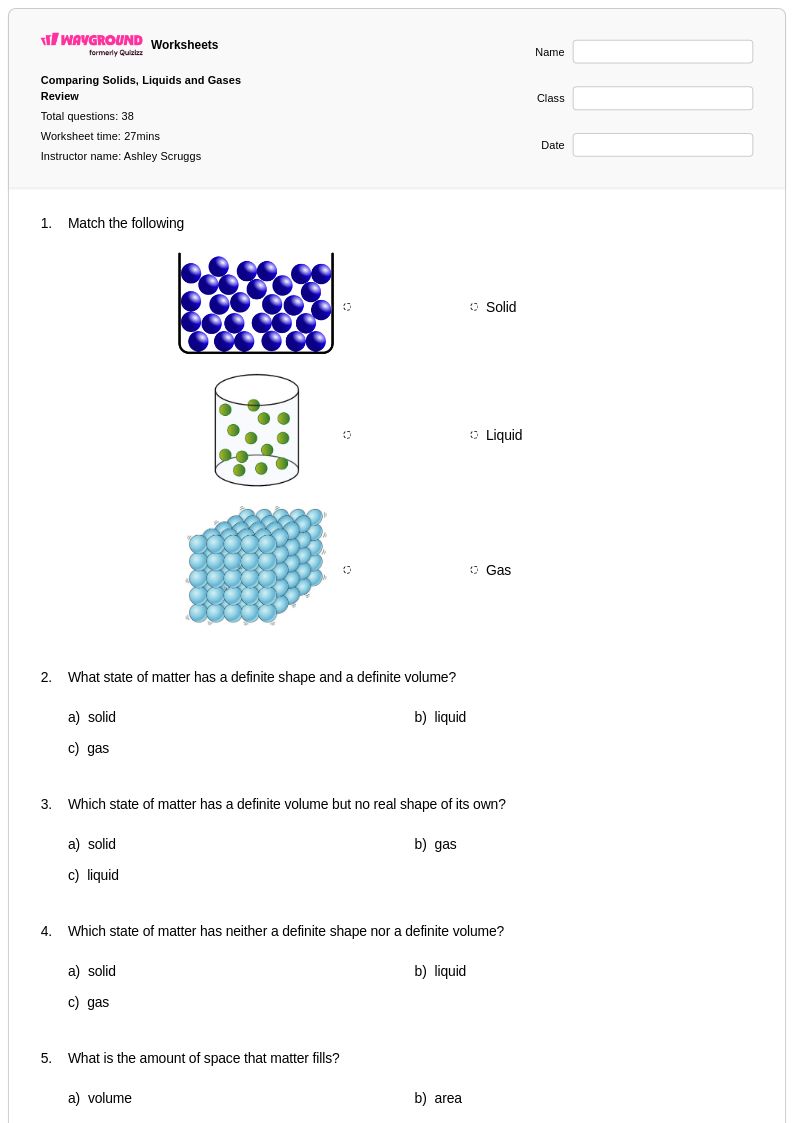
Volume of liquids worksheets for Class 6 students available through Wayground (formerly Quizizz) provide comprehensive practice in measuring and calculating liquid volumes using standard and metric units. These educational resources strengthen essential mathematical and scientific skills including reading graduated cylinders and beakers, converting between milliliters and liters, estimating liquid volumes in real-world contexts, and solving word problems involving liquid measurements. Students develop proficiency in precise measurement techniques while building conceptual understanding of volume as a three-dimensional property of matter. The collection includes diverse practice problems with accompanying answer keys, offering both structured exercises and open-ended challenges that reinforce measurement accuracy and unit conversion skills. These free printable resources serve as valuable tools for developing scientific literacy and mathematical reasoning in Class 6 science curricula.
Wayground (formerly Quizizz) empowers educators with millions of teacher-created volume of liquids worksheets that support differentiated instruction and standards-aligned learning objectives for Class 6 science classrooms. The platform's robust search and filtering capabilities enable teachers to quickly locate resources matching specific skill levels, measurement ranges, and unit systems, while customization tools allow for modifications to suit individual student needs and learning goals. Available in both printable pdf formats and interactive digital versions, these worksheet collections facilitate flexible lesson planning, targeted remediation for students struggling with measurement concepts, and enrichment opportunities for advanced learners ready to explore complex volume calculations. Teachers can seamlessly integrate these resources into laboratory activities, homework assignments, and assessment preparation, ensuring students develop confidence and competency in liquid volume measurement techniques essential for scientific inquiry and mathematical problem-solving.
FAQs
How do I teach students to read a graduated cylinder accurately?
Teach students to place the graduated cylinder on a flat surface and bring their eyes level with the liquid. The key concept is reading the meniscus — the curved surface of the liquid — at its lowest point for water-based liquids. Consistent practice with labeled diagrams and real or illustrated graduated cylinders helps students internalize this technique before applying it to measurement problems.
What exercises help students practice measuring volume of liquids?
Effective practice includes reading measurements from illustrated graduated cylinders and measuring cups, converting between milliliters and liters, and solving applied problems set in contexts like cooking or chemistry experiments. Worksheets that progress from basic volume identification to estimation and precision tasks help students build confidence incrementally. Varied problem formats ensure students can transfer skills beyond a single tool or unit.
What mistakes do students commonly make when measuring liquid volume?
The most frequent error is reading the meniscus incorrectly — students often read the top of the curve rather than the bottom, leading to consistently high measurements. Another common mistake is misidentifying the scale intervals on a graduated cylinder, especially when each marking represents 2 mL or 5 mL rather than 1 mL. Students also frequently confuse milliliters and liters when converting, particularly when moving between small and large quantities.
How do I help struggling students understand the difference between milliliters and liters?
Anchor instruction in familiar real-world examples — a teaspoon holds about 5 mL, a standard water bottle holds about 500 mL, and a large juice carton holds about 1 liter. This helps students develop intuitive benchmarks before tackling unit conversion. For students who need additional support, Wayground's reduced answer choices accommodation can lower cognitive load during digital practice, and extended time settings allow struggling learners to work at a pace that supports comprehension.
How can I use volume of liquids worksheets to prepare students for lab work?
Worksheets that include graduated cylinder reading problems and measurement precision exercises directly prepare students for the procedural expectations of laboratory settings. Use them as pre-lab primers to ensure students can interpret scales and record accurate measurements before handling real equipment. Following up with post-lab reflection problems reinforces the connection between paper practice and hands-on scientific technique.
How do I use Wayground's volume of liquids worksheets in my classroom?
Wayground's volume of liquids worksheets are available as printable PDFs for traditional classroom use and in digital formats for technology-integrated environments, including the option to host them as a quiz directly on Wayground. Teachers can assign worksheets for skill practice, remediation, or formative assessment, and each worksheet includes a complete answer key to support self-assessment and efficient grading. Digital formats also allow teachers to apply student-level accommodations such as read aloud, extended time, or reduced answer choices for learners with diverse needs.