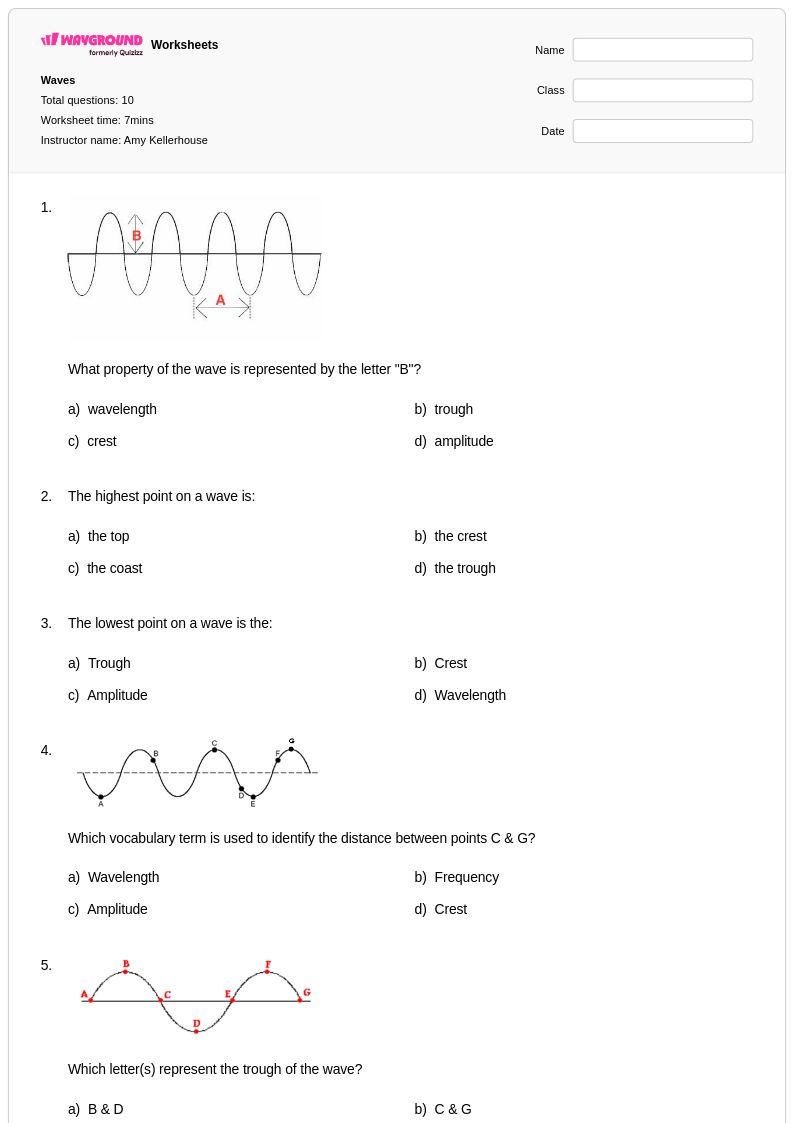
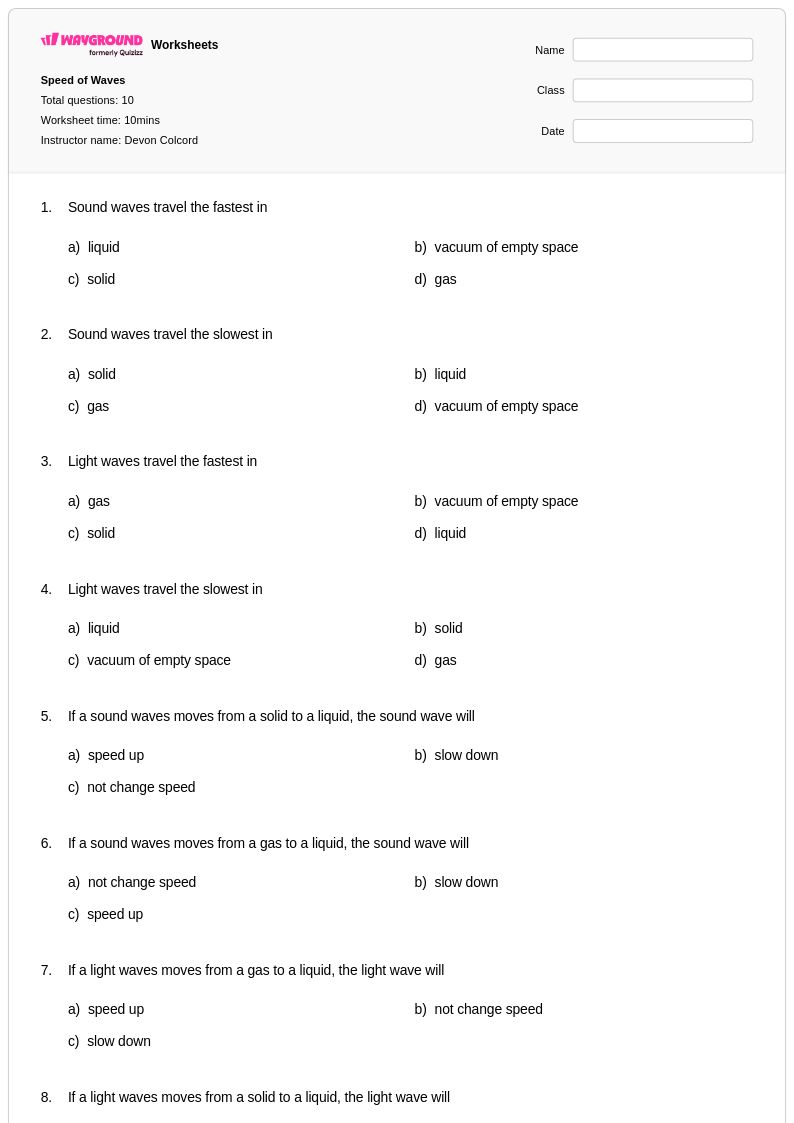
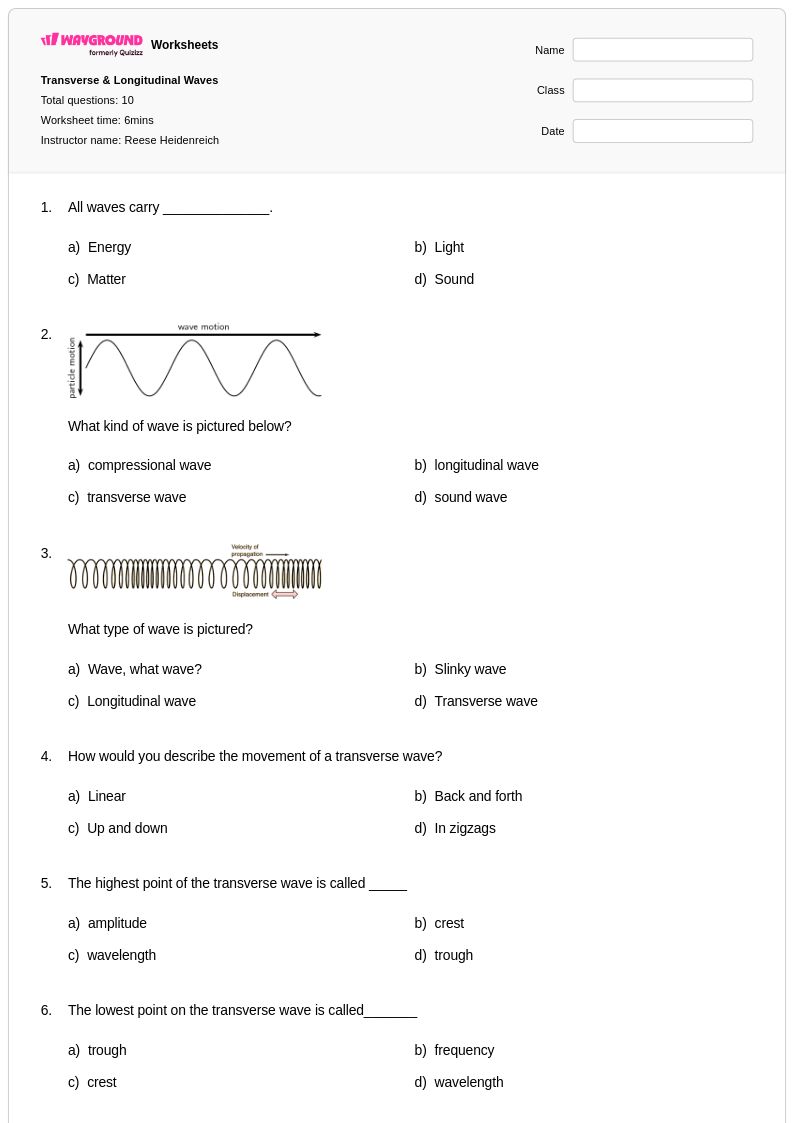
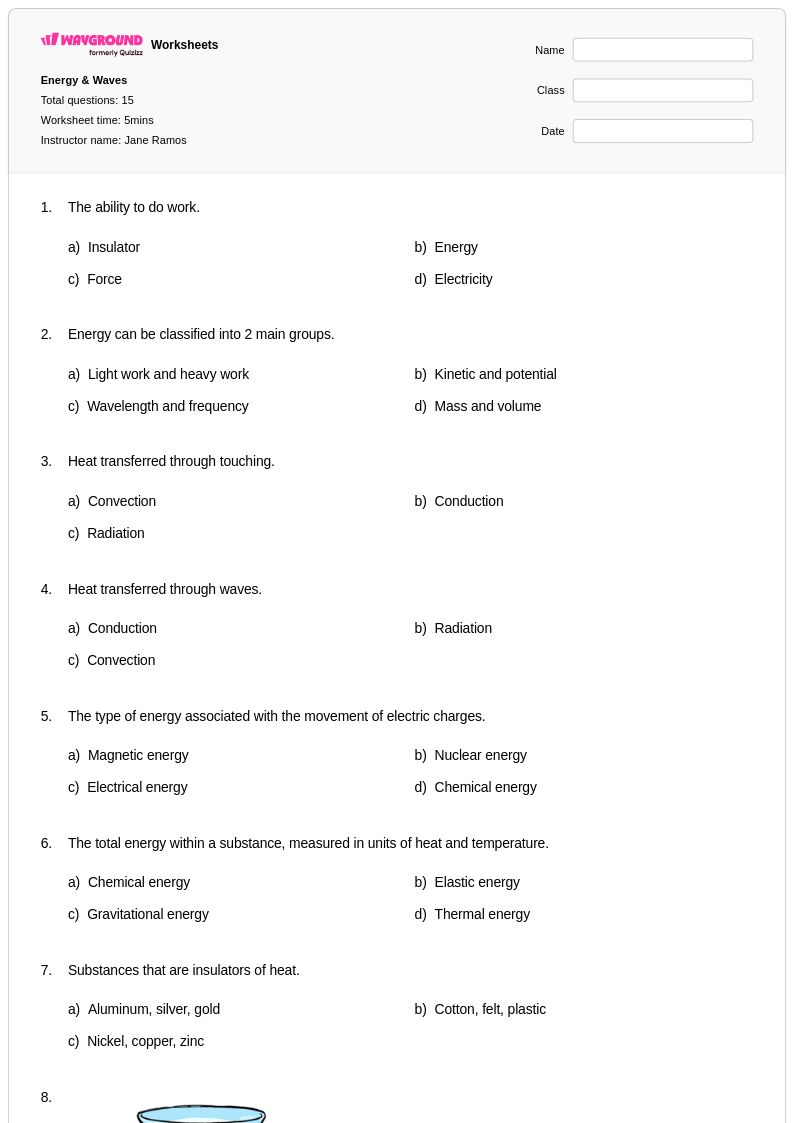
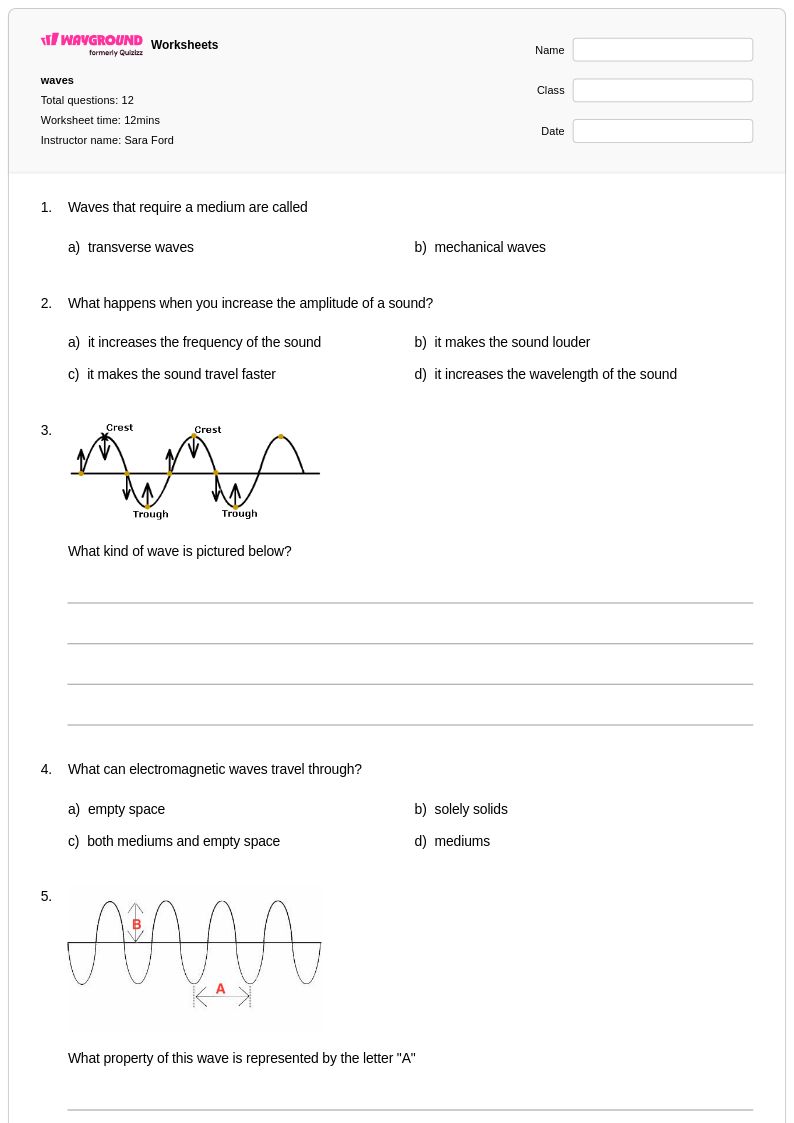
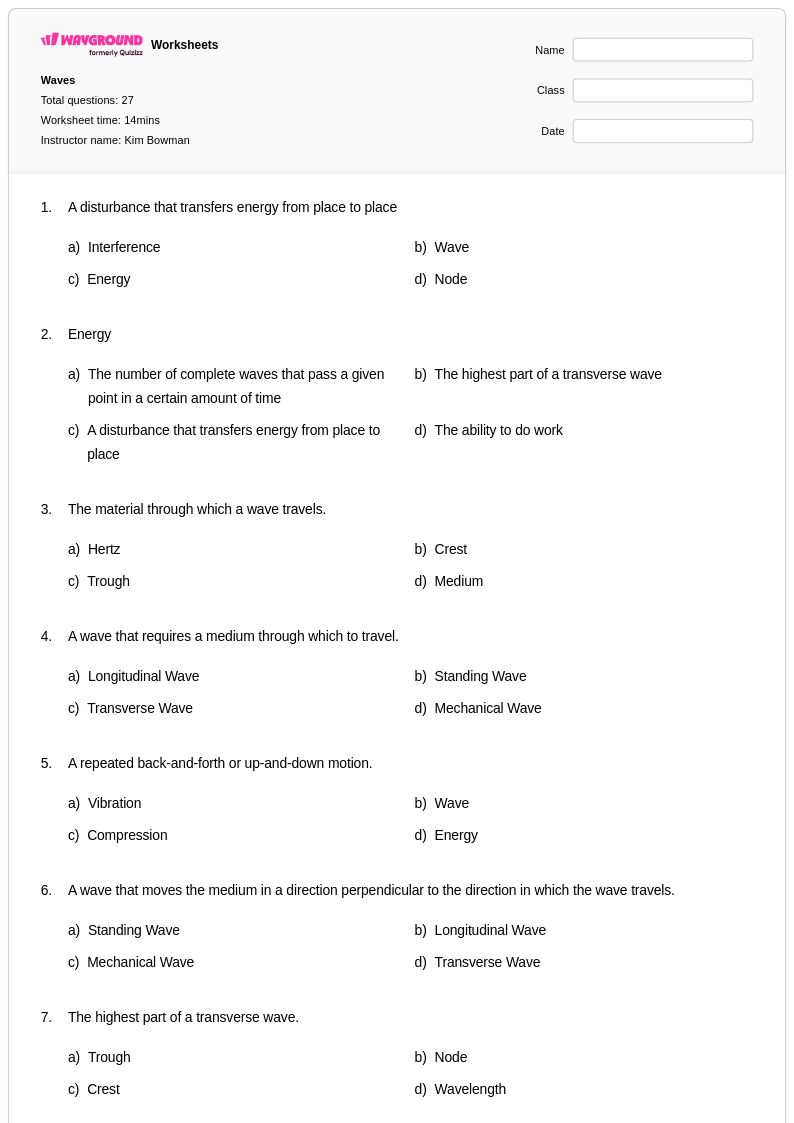
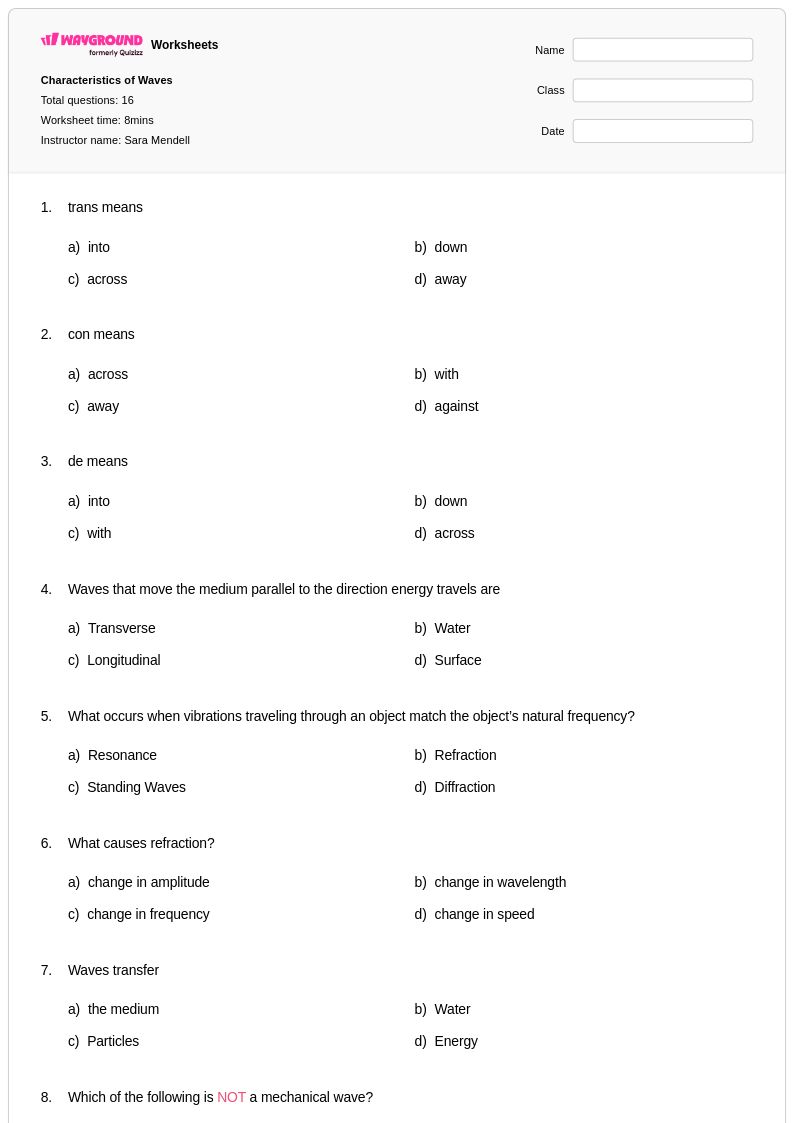
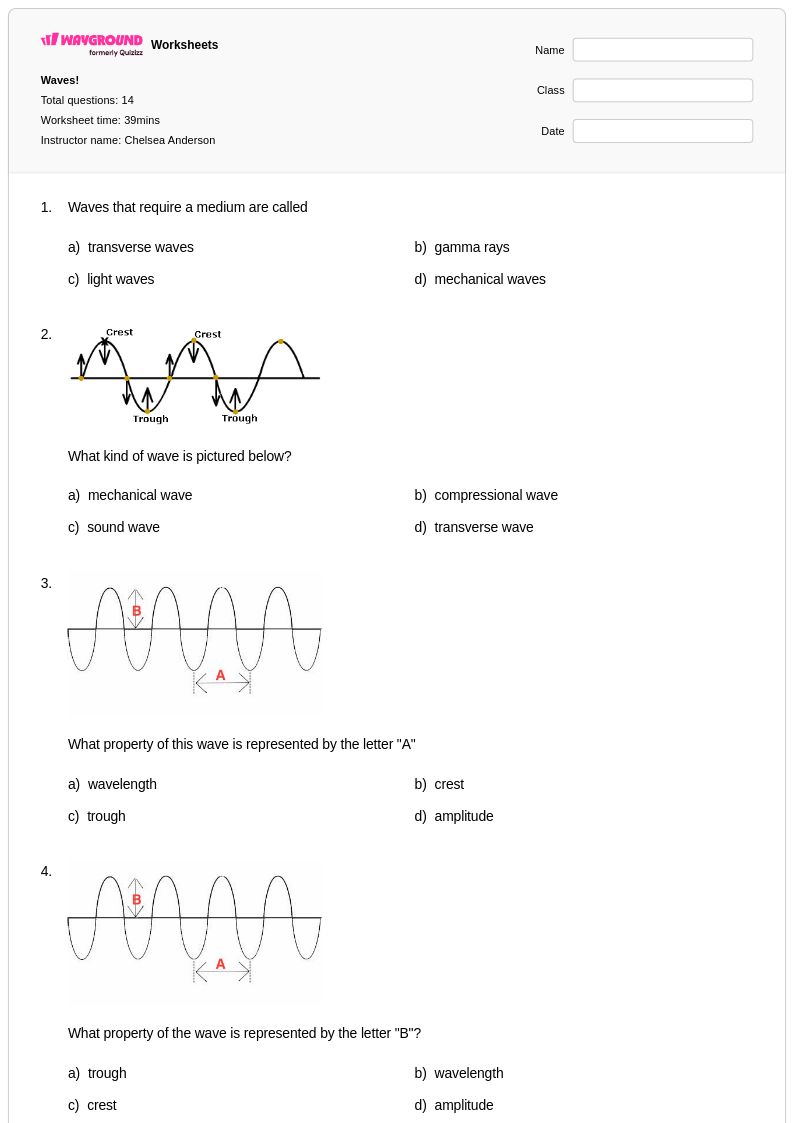
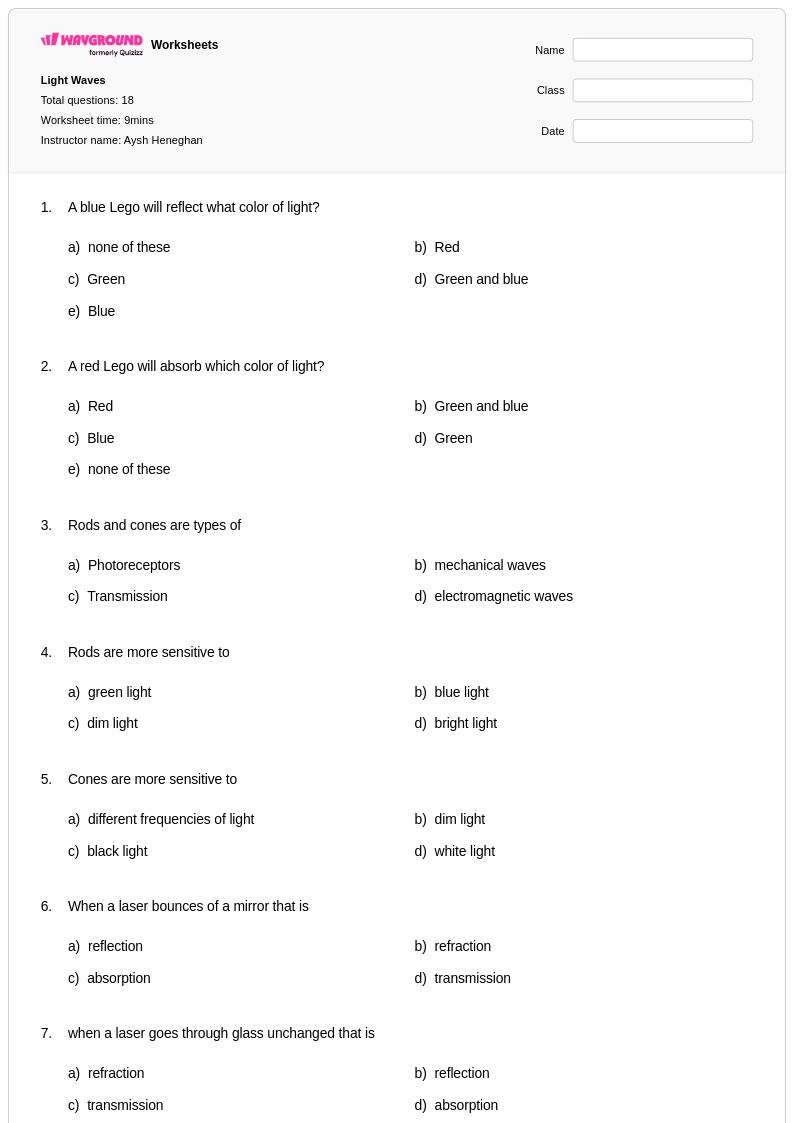
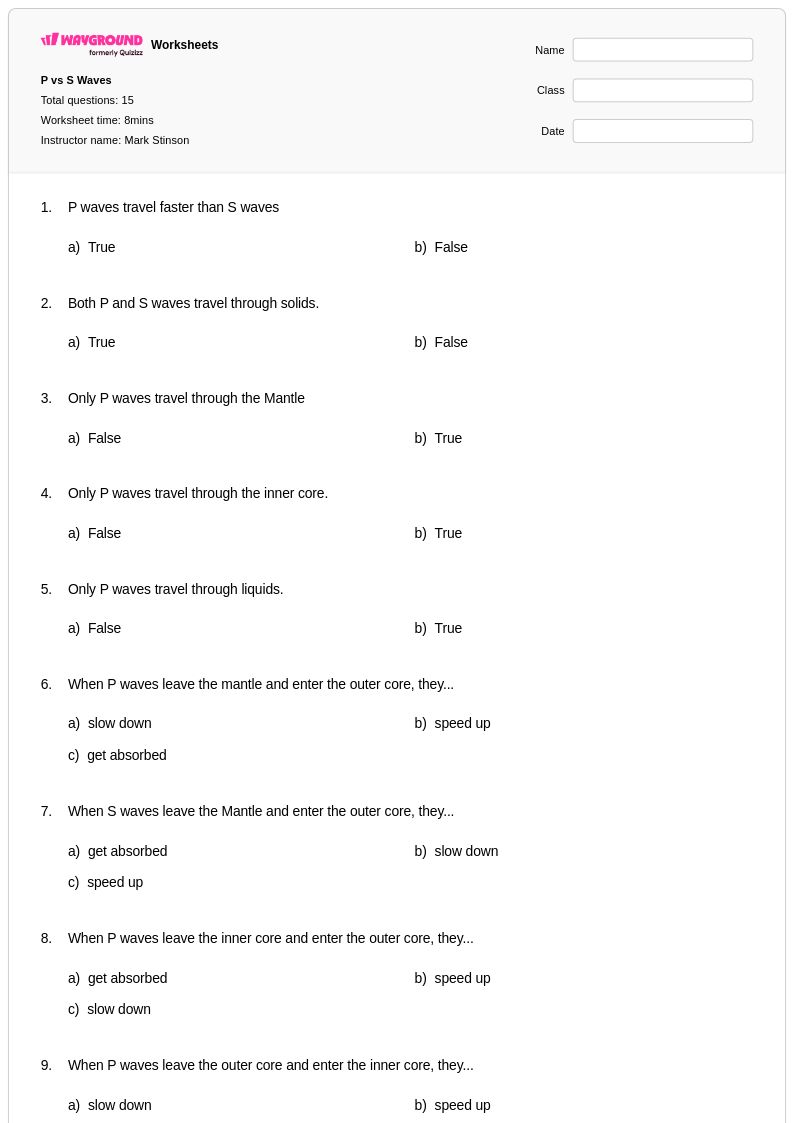
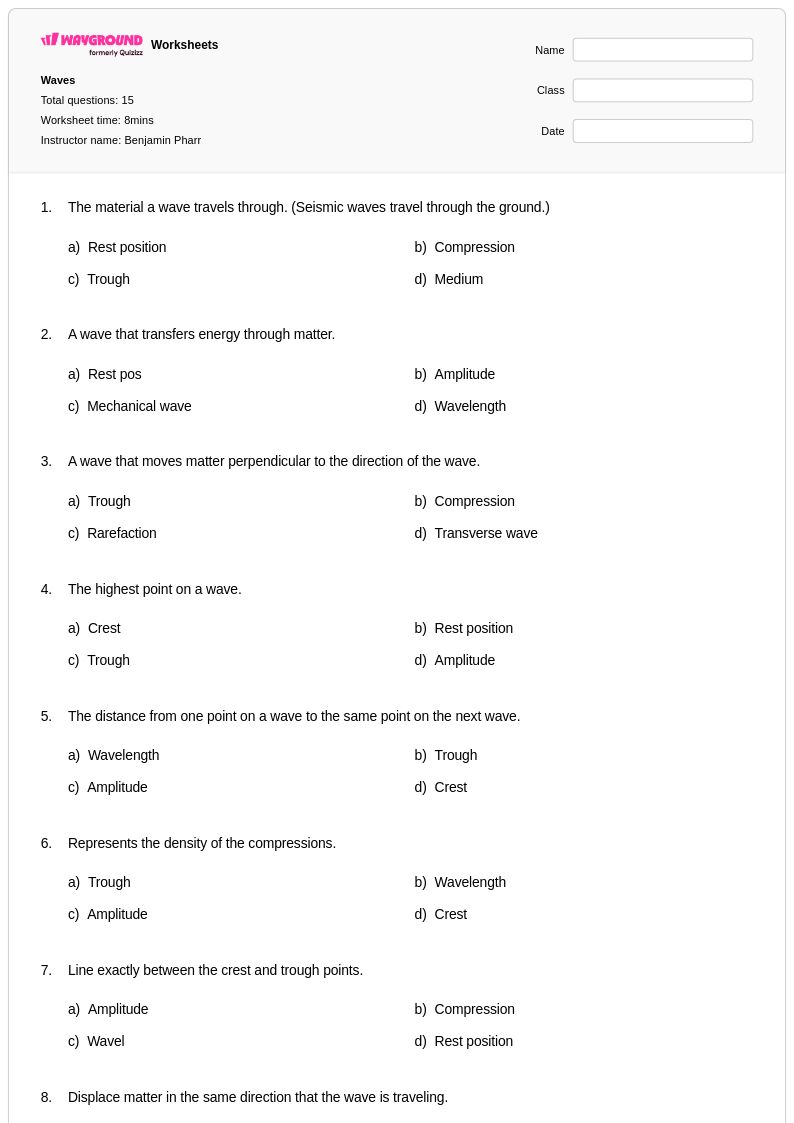
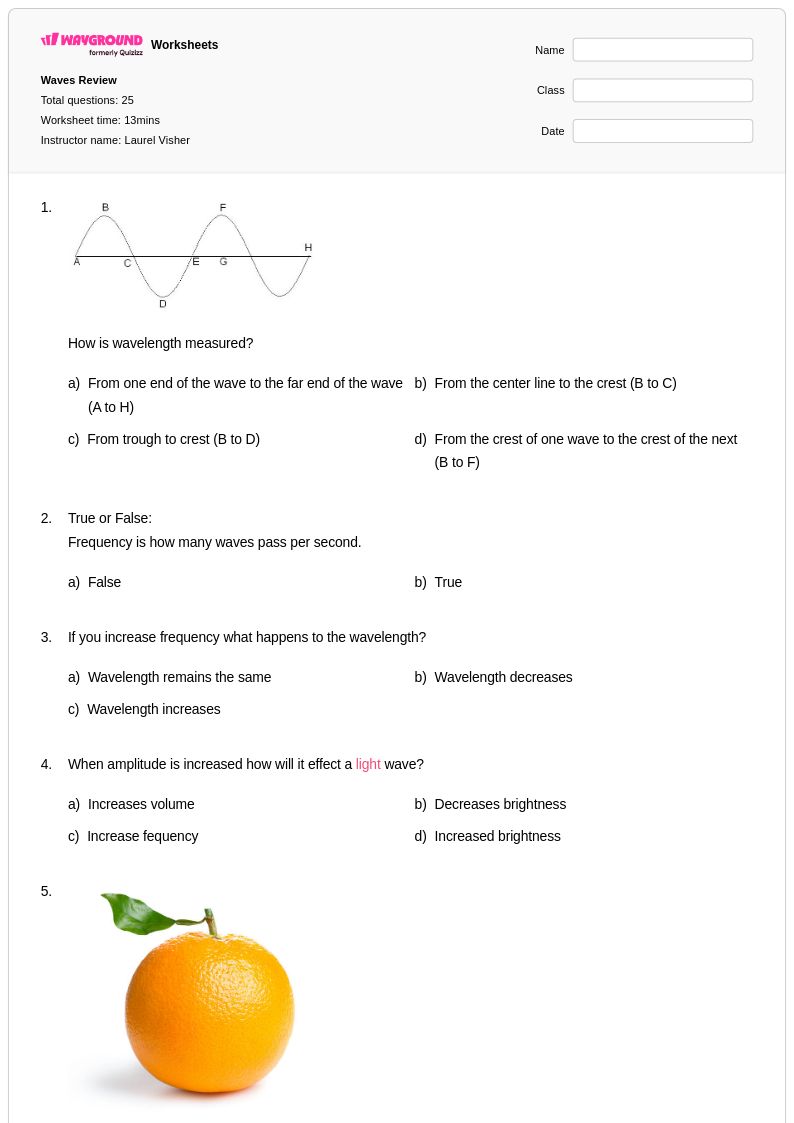
Explore Wayground's free Class 7 waves physics worksheets and printables that help students master wave properties, frequency, amplitude, and wave behavior through engaging practice problems with complete answer keys.
Class 7 waves worksheets available through Wayground (formerly Quizizz) provide comprehensive coverage of fundamental wave concepts that form the cornerstone of physics education at the middle school level. These expertly crafted resources help students master essential wave properties including amplitude, frequency, wavelength, and wave speed through systematic practice problems that reinforce theoretical understanding. The worksheets strengthen critical scientific skills such as interpreting wave diagrams, calculating wave measurements, distinguishing between mechanical and electromagnetic waves, and analyzing real-world wave phenomena like sound and light. Each printable resource includes detailed answer keys that support both independent study and classroom instruction, with free pdf formats ensuring accessibility for diverse learning environments while maintaining the rigorous academic standards necessary for building strong foundational knowledge in wave physics.
Wayground (formerly Quizizz) empowers educators with millions of teacher-created wave physics resources that streamline lesson planning and enhance instructional effectiveness for Class 7 science classrooms. The platform's robust search and filtering capabilities allow teachers to quickly locate worksheets aligned with specific curriculum standards and learning objectives, while built-in differentiation tools enable seamless customization for varied student ability levels and learning styles. These comprehensive worksheet collections are available in both printable and digital pdf formats, providing flexibility for traditional classroom instruction, remote learning, or hybrid educational models. Teachers utilize these resources for targeted skill practice, remediation support for struggling learners, enrichment activities for advanced students, and formative assessment opportunities that inform instructional decisions and promote mastery of wave concepts essential for continued success in physical science education.
FAQs
How do I teach wave properties like amplitude, frequency, and wavelength to high school physics students?
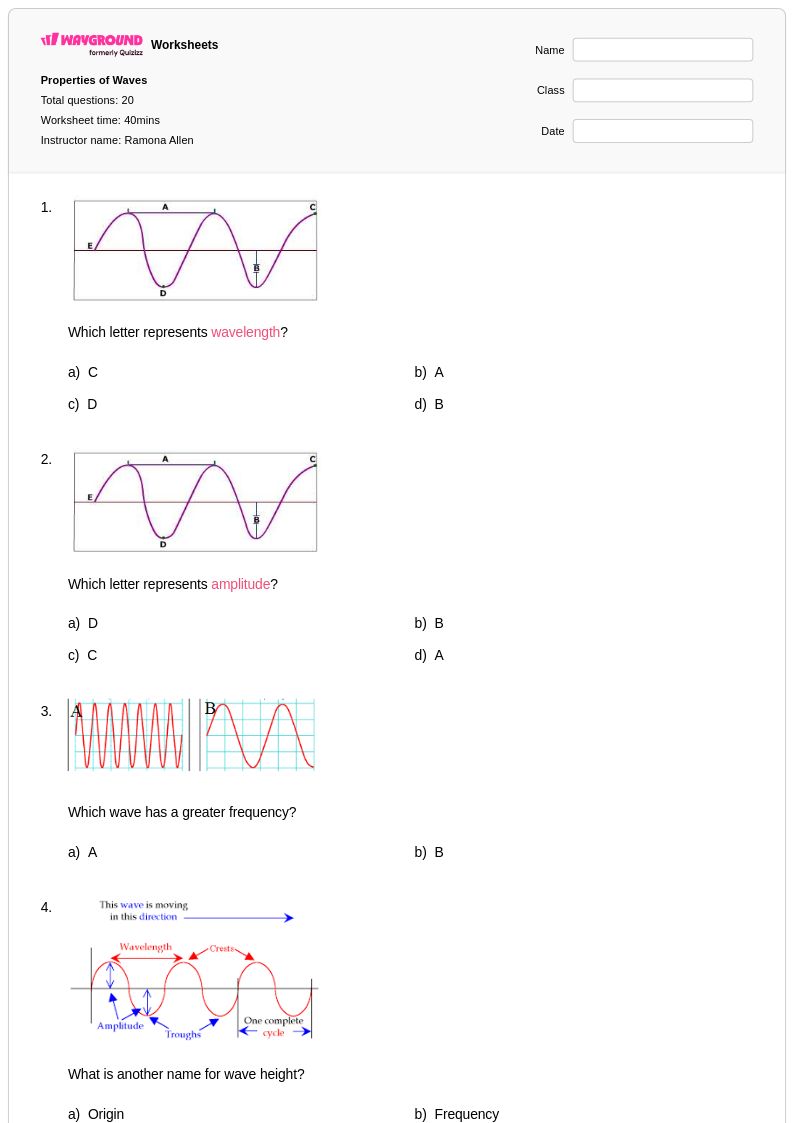
Begin with concrete, observable examples such as water waves or a vibrating rope before introducing formal definitions of amplitude, frequency, and wavelength. Use diagrams to show how each property is measured directly from a wave diagram, and connect frequency to period mathematically early on. Once students can identify and measure these properties visually, introduce wave speed calculations using v = fλ to build quantitative reasoning. Grounding abstract concepts in physical demonstrations before moving to problem-solving significantly reduces early misconceptions.
What types of practice problems help students get better at solving wave equations?
Students benefit most from problems that require them to rearrange the wave speed equation (v = fλ) to solve for different unknowns, rather than always solving for the same variable. Including problems that span mechanical waves, sound, and electromagnetic radiation helps students generalize the concepts across contexts. Mixed problem sets that combine diagram interpretation with calculation reinforce both conceptual understanding and procedural fluency. Systematic practice with varied problem types is more effective than repeated drilling of a single format.
What mistakes do students commonly make when working with wave diagrams and calculations?
One of the most common errors is misidentifying wavelength on a diagram, specifically confusing half a wavelength with a full wavelength when reading crests and troughs. Students also frequently conflate amplitude with wavelength, particularly when both are shown on the same diagram. In calculations, a common mistake is inverting the relationship between frequency and period, leading to incorrect wave speed results. Targeted practice with annotated wave diagrams and unit-checking routines can help students catch and correct these errors.
How do I differentiate waves instruction for students who are struggling versus those who are ready for more challenge?
For struggling students, start with single-property identification tasks, such as labeling amplitude or counting wavelengths on a diagram, before introducing multi-step calculations. Wayground supports accommodations including Read Aloud for students who need questions read to them, reduced answer choices to lower cognitive load, and extended time settings that can be configured per student. Advanced learners can be pushed toward wave interference problems, real-world application scenarios, or tasks that require them to compare behavior across different media. These differentiation strategies ensure all students build mastery at an appropriate pace.
How do waves worksheets on Wayground work, and can I use them digitally or as printables?
Waves worksheets on Wayground are available as printable PDFs for traditional classroom and homework use, as well as in digital formats for technology-integrated environments. Teachers can host worksheets as a quiz directly on Wayground, allowing students to complete them online with instant feedback. Each worksheet includes a detailed answer key, supporting both self-assessment by students and efficient grading by teachers. This flexibility makes the worksheets usable across in-person, hybrid, and remote learning settings.
How do I help students understand the difference between mechanical waves and electromagnetic waves?
The key distinction is medium dependence: mechanical waves such as sound and water waves require a physical medium to propagate, while electromagnetic waves such as light and radio waves can travel through a vacuum. A useful classroom anchor is asking students why sound cannot travel in space but light from the sun reaches Earth. Once this conceptual line is drawn clearly, students can apply wave property calculations to both types without conflating their physical requirements. Returning to this distinction when introducing wave speed in different media reinforces long-term retention.