
How do you Check for Understanding: 15 Strategies that actually work
You teach the lesson, students nod along, and then the unit test arrives and reveals that a third of the class never grasped a foundational concept. It is one of the most frustrating patterns in teaching, and it is almost always a data problem: you did not have enough real-time evidence of student thinking while there was still time to act on it.
Check for understanding strategies are brief, low-stakes techniques teachers use during and after lessons to gauge whether students have grasped key concepts. These formative checks give educators real-time evidence of student progress, enabling immediate instructional adjustments. Research from Black and Wiliam (1998) shows formative assessment produces effect sizes of 0.4 to 0.7, among the highest of any teaching intervention.
This guide covers 15 specific strategies organized by format and timing, along with guidance on when to deploy each type and how to act on the data you collect.
Why Checking for Understanding Matters
A well-worn teacher question, "Does everyone understand?" produces almost no useful information. Students who are confused often say nothing because they do not want to appear lost, or because they genuinely do not know what they do not know. Effective checking requires techniques that surface evidence from every student, not just the most confident few.
The research case is compelling. Paul Black and Dylan Wiliam reviewed more than 250 studies and found that formative assessment produces effect sizes of 0.4 to 0.7 on standardized tests, larger than almost any other educational intervention (Black and Wiliam, 1998). The effect was most pronounced for low-achieving students, suggesting that regular formative checks can help close achievement gaps, not just raise average scores.
John Hattie's meta-analysis of classroom feedback found an average effect size of 0.73 under the right conditions, placing timely formative feedback among the highest-impact teaching practices available (Hattie, 2009). A separate meta-analysis by Frontiers in Psychology (2022) confirmed that formative assessment significantly improves K-12 outcomes when teachers use evidence to adjust instruction, reporting an effect size of 0.41 for teacher-directed formative practices.
Barak Rosenshine's Principles of Instruction add a practical note: effective teachers check the responses of all students, not a sample, to help them practice new information and connect it to prior knowledge. Calling on three volunteers does not tell you what the other 27 students understand.
Checking for understanding is fundamentally different from summative assessment. Summative assessments evaluate learning after instruction is complete. Formative checks happen during learning, while there is still time to adjust. They are ungraded, low-pressure, and focused on informing the teacher's next instructional move rather than generating a score.
When to Use Check for Understanding Strategies
Effective checking happens at three distinct points in a lesson.
Before instruction: Pre-lesson checks activate prior knowledge and expose existing misconceptions. When you know what students already believe, you can address errors before they become entrenched.
During instruction: Mid-lesson checks are the most time-sensitive. If students have misunderstood a foundational concept, continuing to build on it only compounds the confusion. A two-minute check mid-lesson can reveal whether the class is ready to move forward or needs a different approach.
After instruction: End-of-lesson checks close the learning loop. They give students a chance to consolidate what they have learned and give teachers data to plan the next session.
Research supports using multiple short checks across a lesson rather than relying on a single end-of-class assessment. As Jay McTighe notes, quick learning pulse checks during and after lessons can powerfully improve student learning precisely because they create adjustment opportunities throughout instruction, not just at the end.
15 Check for Understanding Strategies
The strategies below are organized by format. Each type suits different moments in a lesson and different teacher preferences. Having a repertoire means selecting the right tool for each moment rather than defaulting to one technique regardless of context.
Quick Nonverbal Checks
1. Thumb Signals and Fist to Five
What it is: Students show their understanding level using a physical signal. Fist to Five uses zero fingers (no understanding) through five fingers (fully confident). A simpler thumbs up, sideways, or down works equally well.
How to implement:
- Pause at a key transition point in the lesson.
- Ask students to close their eyes to reduce social pressure and improve honesty.
- On your count, students show their signal simultaneously.
- Note the distribution, then call on a confident student to explain and an uncertain student to name their specific confusion.
Best for: Any grade level, during instruction, under one minute. Works well immediately after introducing a new concept before moving to practice.
2. Color Cards and Traffic Light
What it is: Students use green, yellow, and red cards to signal comprehension in real time. Green signals readiness to continue, yellow signals partial confusion, and red signals the need for help before moving on.
How to implement:
- Give each student a set of three cards at the start of the year or unit.
- Pause periodically and ask students to display the card matching their current understanding.
- Scan the room for red and yellow cards and adjust pacing accordingly.
Best for: Elementary through high school, during instruction and self-paced work. Cards kept visible on desks can function as a running comprehension signal throughout a work period.
3. Hand Signals with a Follow-Up Probe
What it is: A hand signal check that does not end at the signal. After students indicate their confidence level, the teacher calls on one confident student to explain and one uncertain student to describe their specific confusion.
How to implement:
- After a short explanation, ask students to signal their confidence level.
- Call on a high-confidence student: "Explain this in your own words."
- Call on an uncertain student: "What part is unclear for you right now?"
- Address the specific confusion before proceeding.
Best for: Middle school and high school, during instruction. The follow-up probe converts a passive signal into active processing.
Verbal and Discussion-Based Checks
4. Cold Calling with Wait Time
What it is: The teacher poses a question, waits 5-7 seconds, and calls on a student who has not raised their hand. This ensures broad engagement rather than relying on the same group of volunteers.
How to implement:
- Ask the question to the whole class.
- Signal that all students should think silently for at least five seconds.
- Call on a student by name. If they are uncertain, offer a think prompt: "What part of the question can you start with?"
- Invite another student to add to or correct the answer.
Best for: All grade levels, during instruction. Research shows that extending wait time from under one second to three to five seconds significantly increases response length and accuracy (Rowe, 1986).
5. Think-Pair-Share
What it is: Students think about a question independently, discuss with a partner, and then share with the whole class. The pair discussion step reduces anxiety and increases the quality of whole-class responses.
How to implement:
- Pose a question requiring reasoning, not just recall.
- Give students 60-90 seconds to think and jot a brief response.
- Have pairs discuss for one to two minutes.
- Cold-call pairs rather than individuals to share what they discussed.
Best for: Any grade level, during or after instruction. Especially effective for questions with multiple valid answers or topics where students bring different background knowledge.
6. Misconception Check
What it is: Present students with a common error and ask them to identify the flaw and correct it. This requires deeper processing than recalling a correct answer.
How to implement:
- Write a common student error on the board (e.g., "A student wrote that 1/2 + 1/3 = 2/5. Is this correct? If not, explain what went wrong.").
- Give students one to two minutes to analyze the statement independently.
- Discuss as a class: What is the error? Why does it happen? What is the correct process?
Best for: Math, science, and social studies at all grade levels, during or after instruction. Addressing misconceptions directly is more effective than simply restating correct information.
Written Checks
7. Exit Tickets
What it is: A brief written check completed at the end of the lesson. Students respond to one to three questions targeting the lesson's main objective before leaving class.
How to implement:
- Write 1-3 questions that directly assess the lesson's learning target, not prior material.
- Reserve the last three to five minutes of class.
- Have students respond on slips, index cards, or a digital platform.
- Sort responses into three groups before the next session: understands, partial understanding, needs reteaching.
- Open the next class by addressing the most common errors directly.
Best for: All grade levels, end of lesson. The exit ticket is only as useful as what you do with the data. Close the loop explicitly with students: let them see that their responses shaped the next lesson.
Digital exit ticket tools like Wayground let teachers send a check-for-understanding question to every student's device simultaneously and view class-wide response data in real time, removing the paper-sorting bottleneck.
8. The 3-2-1 Prompt
What it is: Students write three things they learned, two things they found interesting or surprising, and one question they still have. The format surfaces both learning gains and lingering confusion.
How to implement:
- Display the prompt at the end of the lesson.
- Give students three to four minutes to write.
- Collect responses or have students share their remaining questions with a partner.
- Use the "one question" column to identify the most common lingering confusions.
Best for: All grade levels, end of lesson. The 3-2-1 works especially well for content-heavy sessions where students have absorbed a lot of new information and benefit from structured reflection.
9. One-Sentence Summary
What it is: Students distill the main idea of the lesson into a single sentence. This requires genuine comprehension rather than rote recall.
How to implement:
- After instruction, give students 90 seconds to write one sentence summarizing the central idea.
- Ask two or three students to share their sentence aloud.
- Discuss as a class what a strong summary includes and what it omits.
Best for: Reading comprehension, social studies, and science at all grade levels, end of lesson. Works well as a low-stakes writing check that develops summary skills alongside content knowledge.
10. Muddiest Point
What it is: Students identify the single most confusing part of the lesson. This directs teacher attention to the highest-priority misconceptions rather than spreading reteaching across the entire lesson.
How to implement:
- Ask students to write: "The muddiest thing for me right now is..."
- Collect responses and tally the most common confusions.
- Address the top two or three at the start of the next lesson.
Best for: All grade levels, end of lesson. The muddiest point is particularly useful after complex instruction because it focuses reteaching effort where it is most needed.
Interactive and Technology-Based Checks
11. Mini Whiteboards or Paper Response
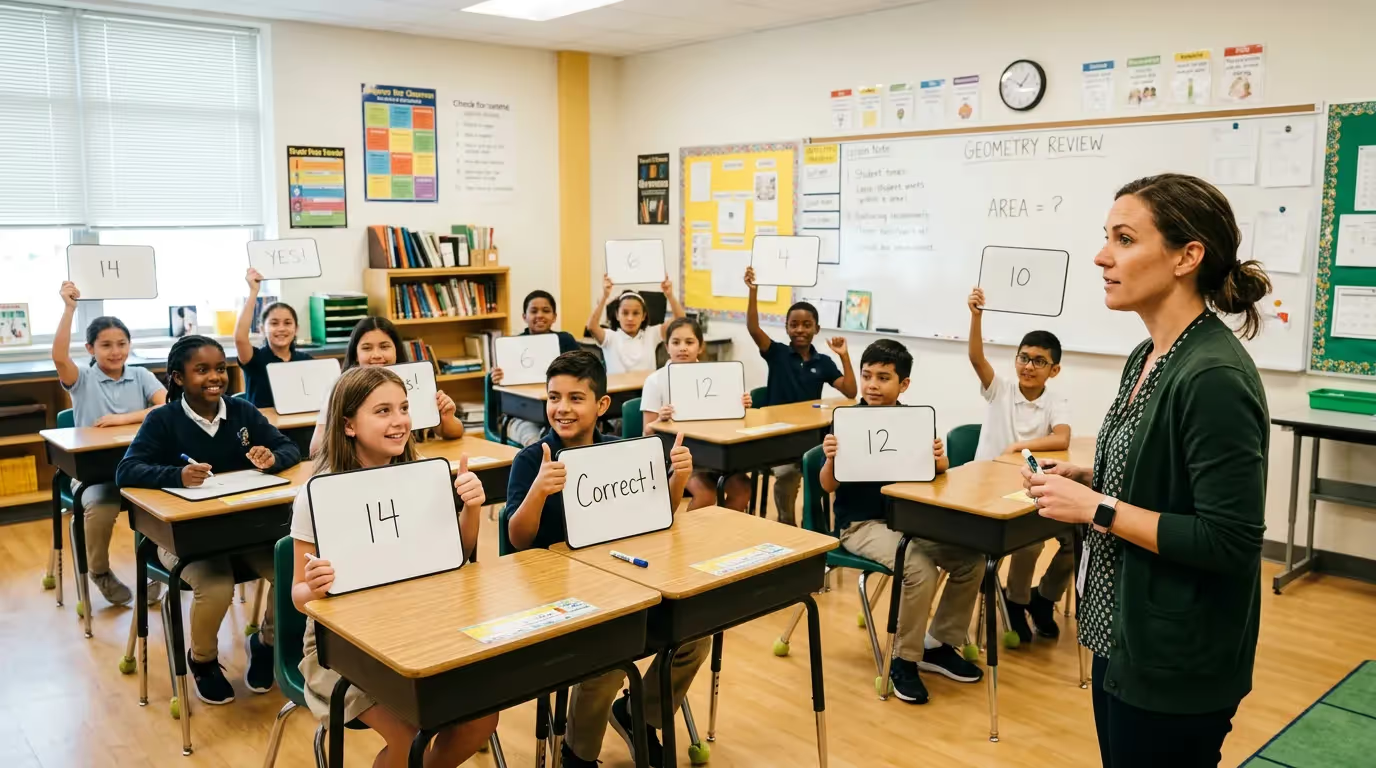
What it is: Students write a brief response on mini whiteboards (or paper held up) and display it simultaneously. This gives the teacher instant visual data on class-wide understanding.
How to implement:
- Pose a question: factual recall, a short equation, a vocabulary definition.
- Give students 30-60 seconds to write.
- On your signal, all students hold up boards at the same time.
- Scan for errors and address the most common mistake before students erase.
Best for: Elementary through high school, math and science particularly. The simultaneous reveal is critical: calling on boards one at a time loses the class-wide data that makes this strategy valuable.
12. Live Polling and Digital Exit Checks
What it is: Teachers send questions to student devices mid-lesson or at the end of class. Students respond individually and teachers see aggregate results immediately.
How to implement:
- Prepare one to two poll questions targeting common misconceptions or key decision points in the lesson.
- Launch the poll at a natural transition point mid-lesson.
- Display aggregate results, not individual responses, to reduce pressure.
- Discuss what the distribution reveals: "About a third of you chose B. Let's look at why that answer is appealing and what is different about C."
Best for: Any classroom with device access, all grade levels. Wayground's live session mode lets teachers send formative questions during instruction and see class-wide results in real time, enabling on-the-spot instructional adjustments without disrupting lesson flow.
13. Digital Exit Ticket Platforms
What it is: Technology-based exit tickets that collect individual student responses and automatically aggregate class data.
How to implement:
- Design questions targeting the lesson's specific learning objective.
- Include one recall question and one application question.
- Review aggregate results immediately and identify which students or concepts need follow-up.
Best for: All grade levels with device access, end of lesson. Digital platforms remove the manual data-sorting step from paper exit tickets, making it practical to check for understanding every day rather than occasionally.
Collaborative Checks
14. Student-Generated Questions
What it is: Students write their own quiz questions about the lesson material. Generating questions requires a deeper level of processing than answering them.
How to implement:
- Ask students to write two or three quiz questions about the lesson, including an answer key.
- Have pairs exchange questions and attempt to answer each other's.
- Discuss any questions that reveal confusion or contain factual errors.
Best for: Middle school and high school, end of unit or after complex instruction. Reviewing student-generated questions also gives teachers diagnostic information about which concepts students understand well enough to assess.
15. Concept Mapping
What it is: Students create a visual diagram showing how key concepts connect. This reveals whether students understand relationships between ideas, not just isolated facts.
How to implement:
- Give students a central concept to place in the middle of the page.
- Ask them to add five to seven related concepts as branches, with labeled arrows indicating how they connect.
- Review maps for missing links, inaccurate connections, or significant gaps.
Best for: Middle school and high school, science and social studies particularly. Concept maps take more time than other checks but reveal structural understanding in a way that short-answer checks cannot.
How to Act on Check for Understanding Data
Collecting data without acting on it is the most common failure mode in formative assessment. The check for understanding is only as valuable as the instructional decision it drives.
A practical decision framework based on class response patterns:
- More than 70% correct: Move forward. The class is ready. Call attention to the most common error before proceeding.
- 40-70% correct: Pause and re-teach the specific concept causing confusion. Do not re-teach the entire lesson.
- Fewer than 40% correct: Stop and reteach before moving on. Consider a different approach, not just a repetition of the original explanation.
The specific re-teaching response matters as much as the decision to reteach. If students misunderstood because of a vocabulary gap, address the vocabulary. If they misunderstood the procedure, model it again with a different example. Matching the intervention to the diagnosis is what makes formative checking effective.
Quick Reference: 15 Strategies at a Glance
Conclusion
Checking for understanding is not a single technique. It is a teaching habit built from a repertoire of strategies deployed at the right moments throughout a lesson. The 15 strategies above represent a range of formats and time investments, from a 30-second thumb signal to a 20-minute concept map, so you can match the check to the moment.
The three principles that connect all of them:
- Check before, during, and after instruction, not only at the end of a unit
- Use techniques that require visible responses from every student, not just volunteers
- Act on what you find: adjust pacing, reteach, or pull a small group before gaps compound
If you are looking to streamline the data-collection side of checking for understanding, Wayground's formative quiz mode and real-time response tools are built specifically for K-12 classrooms, letting teachers move from check to instructional decision without the lag of paper-based collection.
Find your way forward
FAQs
How do you check for understanding in the classroom?
Use brief, low-stakes techniques like exit tickets, thumb signals, or quick polls. The key is checking during and after instruction, not only at the end of a unit, so you can adjust teaching while it still matters. Aim for at least one check per lesson phase.
What are strategies to check for understanding?
Effective strategies include exit tickets, 3-2-1 prompts, think-pair-share, digital polls, whiteboard responses, misconception checks, fist-to-five signals, and student-generated questions. A mix of verbal, written, and nonverbal checks suits different lesson types and grade levels.
Why is checking for understanding important?
Research from Black and Wiliam (1998) shows formative assessment produces effect sizes of 0.4 to 0.7, among the largest of any teaching intervention. Without regular checks, teachers may continue past material students have not grasped, allowing gaps to compound over time.
How often should teachers check for understanding?
At minimum, include one check per lesson phase: before, during, and after instruction. Barak Rosenshine's Principles of Instruction recommend checking the responses of all students during teaching, not just sampling a few, to make the data representative.
What is the difference between checking for understanding and summative assessment?
Checking for understanding is formative, ongoing, and diagnostic. It guides instructional decisions in real time and is typically ungraded. Summative assessments evaluate mastery at the end of a unit or course. The key distinction is timing: formative checks happen while instruction can still be adjusted.
How can technology help teachers check for understanding?
Digital tools allow teachers to collect responses from every student simultaneously rather than sampling a few volunteers. Live polls, quick quizzes, and response systems surface class-wide data instantly, making it easier to identify where the class stands and act within the same lesson.
What is a quick check for understanding that takes under 3 minutes?
Thumb signals take under one minute. A one-sentence summary takes about two minutes. Color card responses take one minute. A single-question digital poll takes two minutes. These techniques are minimally disruptive to lesson flow and generate immediate, actionable evidence.
How do you use exit tickets effectively?
Design 1-3 questions that directly address the lesson objective, not general review. Review responses before the next class and use the data to group students, address common errors, or decide whether to reteach. Close the loop with students: let them know what you found and how it shaped the following lesson.