
20 Classroom Management Strategies That Actually Work: A Research-Backed Guide for K-12 Teachers
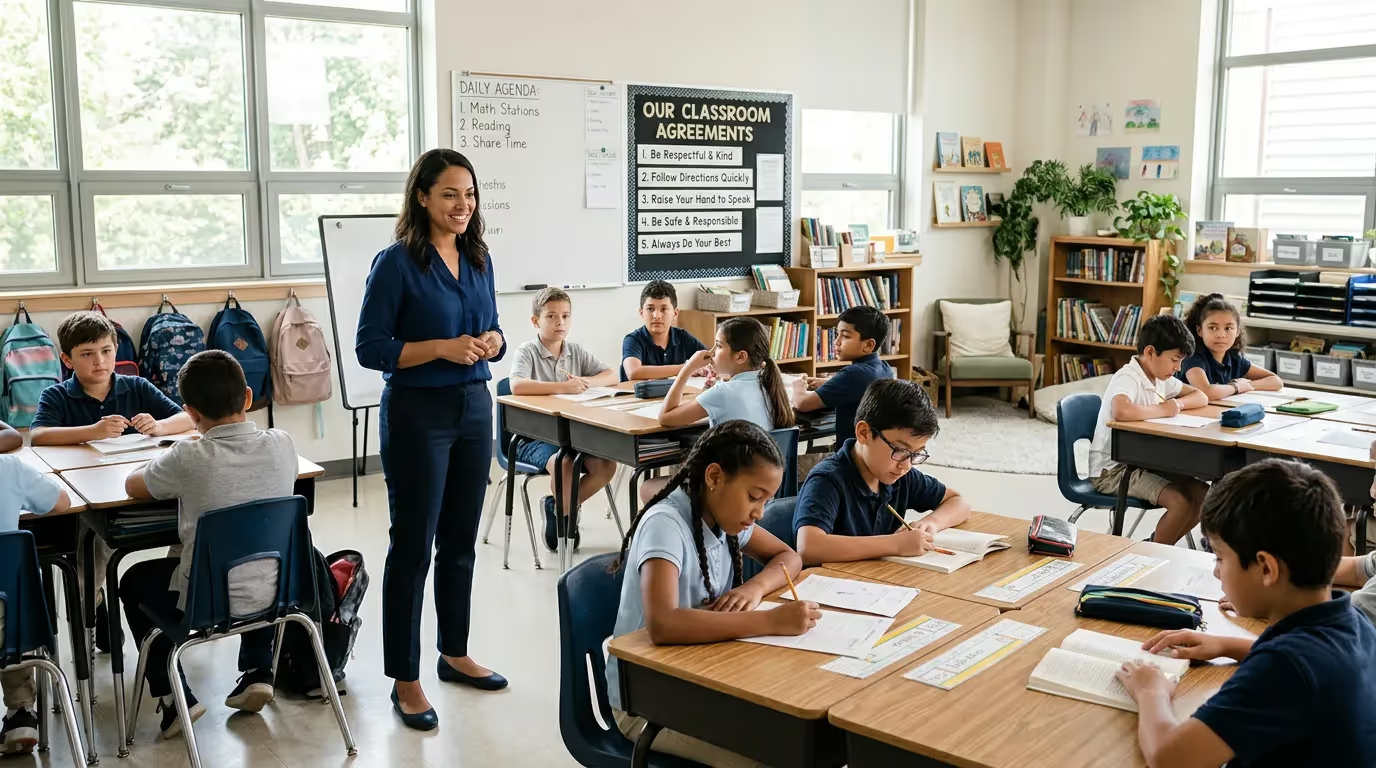
Fifty-eight percent of teachers report dealing with behavioral issues every single day (Pew Research Center, 2024). The average teacher loses 144 minutes of instructional time per week to disruptions, according to the EdWeek Research Center. That is nearly an entire class period, every week, that never gets back to learning.
What makes this harder is that 39% of K-12 educators say they never received explicit classroom management instruction during teacher preparation (EdWeek Research Center, 2024). Most teachers learn on the job, often through trial and error in front of 30 students who are watching closely.
This guide presents 20 classroom management strategies organized into four research-backed categories: proactive prevention, relationship-building, behavioral intervention, and engagement. Each strategy includes implementation steps and real classroom context. Whether you are in year one or year twenty, these techniques are immediately applicable.
What Is Classroom Management?
Classroom management strategies are proactive techniques teachers use to create structured, positive learning environments where students stay engaged and behavioral issues are minimized. These strategies range from setting clear expectations and building relationships to using structured digital activities. Research shows effective classroom management can improve student achievement by up to 20% (Marzano et al., 2003).
Effective classroom management is not about control. It is about creating conditions where learning is the natural default. Robert Marzano's landmark meta-analysis of over 100 studies found that teachers with quality student-teacher relationships had 31% fewer classroom management issues. The research points consistently in one direction: when students feel safe, respected, and actively engaged, behavioral problems decline significantly.
Two broad approaches shape classroom management practice:
- Proactive management: Designing the environment, routines, and expectations to prevent problems before they occur
- Reactive management: Responding effectively when disruptions do happen
The most effective teachers invest heavily in proactive strategies so that reactive interventions are rarely necessary.
Proactive Strategies: Prevent Problems Before They Start
The most powerful classroom management work happens before students walk through the door. These six strategies address the structural conditions that allow behavioral issues to take hold.
1. Establish Clear Expectations from Day One
Ambiguity invites testing. When students are unsure what is expected, some will fill that gap with behavior that challenges you to define it for them.
Set explicit, observable behavioral expectations during the first week. Do not simply post rules on a wall. Model what each expectation looks like in practice, rehearse them with students, and revisit them after breaks and holidays. Keep expectations simple and framed in positive terms. "Respect others and their space" is more actionable than a list of twelve prohibitions. When you reinforce behavior, name the expectation directly: "I noticed you followed our focus expectation throughout that activity."
2. Design Your Physical Space Intentionally
Room arrangement shapes how students move, interact, and focus. Jacob Kounin's foundational research on classroom management identified withitness (the teacher's awareness of everything happening in the room) as a key predictor of fewer disruptions. Physical layout directly affects withitness.
Practical guidelines:
- Ensure clear sightlines to every student from your primary instruction area
- Minimize high-traffic bottlenecks where students cluster and lose focus
- Create designated spaces for transitions (turn-in bins, supply stations) to reduce aimless wandering
- Consider flexible seating that can shift for different activity formats
3. Greet Students at the Door
This strategy has strong research support. A 2018 study found that positive greetings at the door increased academic engagement by 20 percentage points and decreased disruptive behavior by 9 percentage points. That is a significant return on a three-minute investment.
Standing at the door also lets you read the energy students bring in, catch early signs of distress, and establish a warm, personal tone before instruction begins. A student who feels noticed before class starts is less likely to act out during it.
4. Use Consistent Routines and Transitions
Transitions are one of the most reliable sources of behavioral disruption. The gap between structured activity and the next instruction is an open invitation for off-task behavior.
Build your transitions explicitly:
- Have a "do now" or bell-ringer on the board when students arrive
- Count down transitions ("you have 90 seconds to move to your groups")
- Use a consistent attention signal (raised hand, specific phrase, chime) and practice it until it is automatic
Routines reduce cognitive load for both students and teachers. When the procedure is clear, energy flows to learning rather than navigation.
5. Give Students Structured Roles
Students who carry meaningful responsibilities feel ownership over the classroom community. Assign rotating roles: materials manager, discussion facilitator, timekeeper, note-taker. These roles create purpose and build social accountability.
Structured roles are particularly effective for students who frequently seek attention or challenge authority. When social needs for status and visibility are met through legitimate channels, the drive to seek them through disruptive behavior often diminishes.
6. Build in Brain Breaks
Extended passive instruction is a behavioral risk factor. A 2021 brain imaging study found that 4-6 minute brain breaks improved neural activity efficiency in children, increasing on-task behavior afterward.
Build movement, pair-shares, or brief reflective pauses into any lesson lasting more than 20 minutes. This is especially important for younger students and those with attention challenges. Brain breaks are not lost time. They recover the cognitive capacity needed for sustained engagement in what follows.
Relationship-Building Strategies
Marzano's meta-analysis found that academic engagement increased by 33% and disruptive behavior decreased by 75% in classrooms where teachers prioritized genuine relationships with students (Edutopia). No structural strategy substitutes for this foundation.
7. Learn Every Student's Name and Story
This sounds obvious, but it is frequently underprioritized, especially in secondary schools where teachers may see 150 students a day. Students notice in week three when a teacher still does not know their name.
Go beyond names. Know something about each student: a sport, a sibling, a subject they care about, a challenge they are navigating. This information is your relationship capital. Use it. Students who feel genuinely known behave differently than students who feel anonymous.
8. Use Positive Behavior Reinforcement
Behavioral research is clear: behavior that is reinforced increases. Effective classroom management leans heavily on catching students doing things right and naming it specifically.
Avoid generic praise ("good job"). Be specific: "Marcus, I noticed you stayed focused through the entire independent work block, even when others were off-task. That is exactly the kind of commitment we are building here." Specific reinforcement teaches students what success looks like and motivates repetition. Research from the What Works Clearinghouse supports targeting a 4:1 ratio of positive to corrective interactions as a benchmark for healthy classroom climate.
9. Conduct Regular Check-Ins
Brief, consistent check-ins are among the highest-leverage tools available. A 30-second conversation at the start of class, a quick mood check at the door, or the 2x10 strategy (two minutes per day for ten consecutive days with a struggling student) can produce measurable results.
The 2x10 strategy has shown dramatic behavioral improvements for students who are frequent sources of disruption. The total investment is 20 minutes over two weeks. The relationship signal it sends is far more powerful than the time invested.
10. Hold Student-Teacher Conferences
When a student's behavior is a recurring concern, a brief private conversation is almost always more effective than repeated public correction. Public correction can escalate rather than resolve, particularly with adolescents for whom social status is a primary concern.
Frame the conference around curiosity rather than accusation: "I want to understand what is happening for you during class." This approach surfaces information you cannot get from observation alone and signals that you view the student as a person, not a problem.
11. Develop a Growth Mindset Classroom Culture
Carol Dweck's research on growth mindset has direct classroom management implications. Students who believe abilities are fixed ("I am just not good at this") disengage faster and are more likely to disrupt as a face-saving strategy when work feels difficult.
Build growth mindset language into daily instruction: normalize effort and struggle, celebrate revision and improvement, frame mistakes as information rather than failure. A classroom where "I cannot do this yet" is legitimate and respected is a classroom where students stay engaged rather than opt out into disruption.
Behavioral Intervention Strategies
Even well-managed classrooms experience disruptions. These four strategies help teachers respond effectively without escalating the situation.
12. Use Proximity and Non-Verbal Cues
Before saying anything, move toward a student who is off-task or beginning to disrupt. Physical proximity alone often redirects behavior because it communicates awareness without drawing attention to the student in front of peers.
Non-verbal cues (sustained eye contact, a hand on the desk, a brief head shake) work for the same reason. They signal "I see you" without interrupting instruction or provoking a power struggle. Teachers who rely primarily on verbal correction from the front of the room miss a significant de-escalation tool.
13. Apply the Least-Intrusive Intervention First
This principle, drawn from behavior support frameworks, holds that you should always try the lowest-intensity intervention before escalating. The sequence:
- Non-verbal cue (proximity, eye contact)
- Private, quiet verbal prompt ("Let us get back on track")
- Brief check-in or conference
- Structured consequence with choice framing
- Administrative or family involvement
Teachers who skip immediately to step four or five tend to generate more conflict, not less. The least-intrusive approach preserves the relationship while addressing the behavior.
14. Implement Logical Consequences (Not Punishments)
Punishments are unrelated to the behavior and feel arbitrary to students. Logical consequences are directly connected to the behavior and delivered calmly, without judgment.
If a student misuses lab equipment, the logical consequence is temporarily losing access to that equipment, not a detention. If phone use disrupts the class, the logical consequence is losing phone access for that period. Logical consequences teach students to connect behavior with outcome, which is the actual goal of behavioral intervention.
15. Create a Calm-Down Protocol
Every classroom needs a clearly defined, destigmatized process for students who need to regulate before they can learn. This might be a quiet corner with a visual prompt, a brief structured hallway break, or a breathing card at the desk.
The key is that the calm-down space is not a punishment. It is a resource. Students who know they have permission to take a regulated break are less likely to reach the point of explosive disruption. This is especially critical for students with trauma histories or significant emotional regulation challenges.
Engagement and Digital Tool Strategies
The strongest predictor of behavioral issues is disengagement. Students who are actively participating do not have bandwidth to be disruptive. These five strategies use structured engagement, including digital tools, to remove the conditions that cause behavioral problems.
16. Use Active Learning Structures Every Lesson
Active learning structures (think-pair-share, jigsaw, problem-solving protocols, structured discussion) keep students cognitively engaged. Unlike passive listening, they require students to do something with information, which sustains attention and reduces behavioral drift.
Research by Wang, Haertel, and Walberg (1993) identified classroom climate and student engagement as among the strongest predictors of student achievement, stronger than home environment and student demographics. Active structures produce both.
17. Deploy Live Quizzes and Polls to Maintain Attention
One of the most effective ways to manage a classroom is to ensure every student is active and accountable at the same time. Live quizzes and polls accomplish this: every student answers every question, participation is visible, and the pace keeps students engaged.
Wayground's live session mode turns any assessment into a whole-class activity where every student participates simultaneously. Teachers see real-time response data while students stay focused because they know they are accountable through the activity structure, not through arbitrary cold-calling. The behavioral implication is straightforward: passive students become active participants, and active participation is the most effective behavioral prevention strategy available.
18. Use Real-Time Engagement Data to Intervene Early
Disengagement precedes disruption. If you can see which students are not responding, hesitating, or consistently guessing incorrectly, you can intervene before those students become behavioral concerns.
Wayground's real-time participation dashboard gives teachers this visibility mid-lesson. Rather than waiting for a student to act out, teachers can redirect, re-explain, or adjust the activity in response to what the data shows. This is proactive classroom management supported by technology.
19. Reduce Transition Time with Structured Digital Activities
Transition time is behavioral risk time. One reliable way to eliminate it is to have a structured digital activity always ready to deploy: a quick quiz, a review game, a reflection prompt. Students open their devices, the activity launches, and the transition is complete in 90 seconds.
Pre-built activity templates reduce the preparation burden for teachers and create recognizable routines. When students know that the bell means "get your device and open the activity," the ambiguous gap that invites off-task behavior closes.
20. Implement Exit Tickets for Accountability
Exit tickets create low-stakes accountability at the end of every lesson. When students know they will demonstrate understanding before leaving, attention during instruction tends to increase. Exit tickets also give teachers actionable data for the next lesson, closing the feedback loop between teaching and learning.
Keep exit tickets brief: one to three questions, five minutes maximum. The goal is a data snapshot, not a mini-assessment. Digital exit tickets streamline collection and make results immediately visible without manual grading.
Quick Reference: All 20 Strategies at a Glance
Building a Classroom That Manages Itself
The phrase "classroom management" can suggest a battle of wills between teacher and student. The research tells a different story. The most effectively managed classrooms are those where students are consistently engaged, genuinely connected to their teacher and peers, and so invested in the learning that there is little room for behavioral issues to grow.
The 20 strategies in this guide share a common thread: they all work by improving conditions rather than simply reacting to symptoms. Clear expectations remove ambiguity. Genuine relationships reduce the drive for attention-seeking behavior. Active learning structures fill the engagement gaps where disruption lives. Real-time data lets teachers intervene before problems escalate.
Key takeaways:
- Start with proactive strategies: physical space, clear expectations, and consistent transitions address root causes, not symptoms
- Invest in relationships before behavioral problems arise; Marzano's data shows a 31% reduction in issues for teachers with strong student connections
- Match intervention intensity to the behavior: the least-intrusive approach that works is always the right choice
- Engagement is prevention: students who are active and accountable have less capacity and motivation to disrupt
- Consistency matters more than the specific strategy chosen; any of these approaches requires sustained implementation to show results
Choose one or two strategies from this guide and apply them consistently for two to three weeks. Notice what shifts. Then add another. Effective classroom management is not a single solution. It is a layered practice built gradually across a school year.
If you want to bring structured, engagement-driven activities into your classroom, explore how Wayground's live session modes and participation tools transform passive instruction into whole-class activity, so students stay active and on-task from the moment class begins.
References
Marzano, R.J., Marzano, J.S., & Pickering, D. (2003). Classroom Management That Works: Research-Based Strategies for Every Teacher. ASCD.
Pew Research Center (2024). Challenges in the Classroom. https://www.pewresearch.org/social-trends/2024/04/04/challenges-in-the-classroom/
NCES (2023-24). Teachers' Reports of Disruptive Student Behaviors and Staff Rule Enforcement. https://nces.ed.gov/programs/coe/indicator/a11
EdWeek Research Center. Teacher Time Loss to Behavioral Disruptions.
Oliver, R.M., Wehby, J.H., & Reschly, D.J. (2011). Teacher classroom management practices: Effects on disruptive or aggressive student behavior. Campbell Systematic Reviews.
Wang, M.C., Haertel, G.D., & Walberg, H.J. (1993). Toward a knowledge base for school learning. Review of Educational Research, 63(3), 249-294.
Dweck, C.S. (2006). Mindset: The New Psychology of Success. Random House.
Tekir, S. (2025). Strategies for Effective Classroom Management in Online Teaching: A Post-Pandemic Review. SAGE Journals.
What Works Clearinghouse. Positive Behavior Interventions and Supports.
Find your way forward
FAQs
What is classroom management and why does it matter?
Classroom management is the set of strategies teachers use to create structured, safe, and engaging learning environments. It matters because it is directly linked to student outcomes. Marzano’s meta-analysis of over 100 studies found that effective classroom management can improve student achievement scores by up to 20%. NCES data from 2023-24 shows that 75% of school leaders report student inattention has a moderate or severe negative impact on learning.
What are the most effective classroom management strategies for new teachers?
For new teachers, the highest-leverage starting points are establishing clear expectations in the first week, learning every student’s name quickly, greeting students at the door daily, and building a consistent routine for transitions. These four strategies address the structural and relational foundations that everything else depends on.
How do I handle disruptive students without escalating conflict?
Start with the least-intrusive intervention: proximity, a quiet non-verbal cue, or a brief private prompt. Avoid public correction whenever possible, especially with adolescents, because it can activate social self-defense responses. If disruption persists, a brief private conference framed around curiosity ("I want to understand what is happening for you in class") is almost always more effective than escalating to consequences immediately.
What is the difference between proactive and reactive classroom management?
Proactive classroom management focuses on preventing behavioral issues through environment design, clear expectations, consistent routines, and strong relationships. Reactive management addresses disruptions after they occur. Effective teachers use both approaches, but invest most heavily in proactive strategies so that reactive interventions remain infrequent.
How can digital tools help with classroom management?
Digital tools help by increasing engagement and eliminating the passive instruction gaps where behavioral issues most often emerge. Live quizzes, polls, and structured digital activities give every student an active role at the same time. Real-time participation data lets teachers spot disengagement early and intervene before it becomes disruption.
How do I create a positive classroom environment?
A positive classroom environment combines clear structure with genuine relationships. It is built through consistent routines, explicit behavioral expectations, a high ratio of positive to corrective interactions, and a culture where students feel known and respected. Carol Dweck’s growth mindset research shows that classrooms where effort and improvement are valued have higher engagement and fewer behavioral issues overall.
What should be in a classroom management plan?
A classroom management plan should include: behavioral expectations (three to five, positively framed and observable), classroom routines for common transitions, a behavioral intervention protocol from least to most intensive, a family communication plan, and a system for recognizing positive behavior. Revisit and adjust the plan each semester based on what is and is not working.
How do I manage a classroom with diverse learning needs?
Universal Design for Learning (UDL) principles apply directly to classroom management: provide multiple means of engagement, reduce sensory and cognitive overload, and build flexibility into your routines. Students with learning differences often respond better to visual cues, choice, and movement integration. A calm-down protocol available to all students (not only those with IEPs) reduces stigma and increases appropriate use.
What classroom management strategies work best for middle and high school students?
Adolescents are particularly sensitive to public correction, perceived fairness, and autonomy. Effective strategies for middle and high school include private conferencing rather than public correction, giving students structured agency and choice within lessons, using logical consequences rather than punishments, and building relationships that signal genuine respect for developing independence.
How long does it take for classroom management strategies to work?
Proactive strategies, particularly consistent routines and clear expectations, show results within two to three weeks when applied consistently. Relationship-based strategies such as the 2x10 check-in show measurable behavioral changes within two to four weeks. The most common failure mode is inconsistent application: strategies used only when problems peak will not produce lasting change.