
10 Cooperative Learning Strategies That Build Teamwork and Boost Achievement
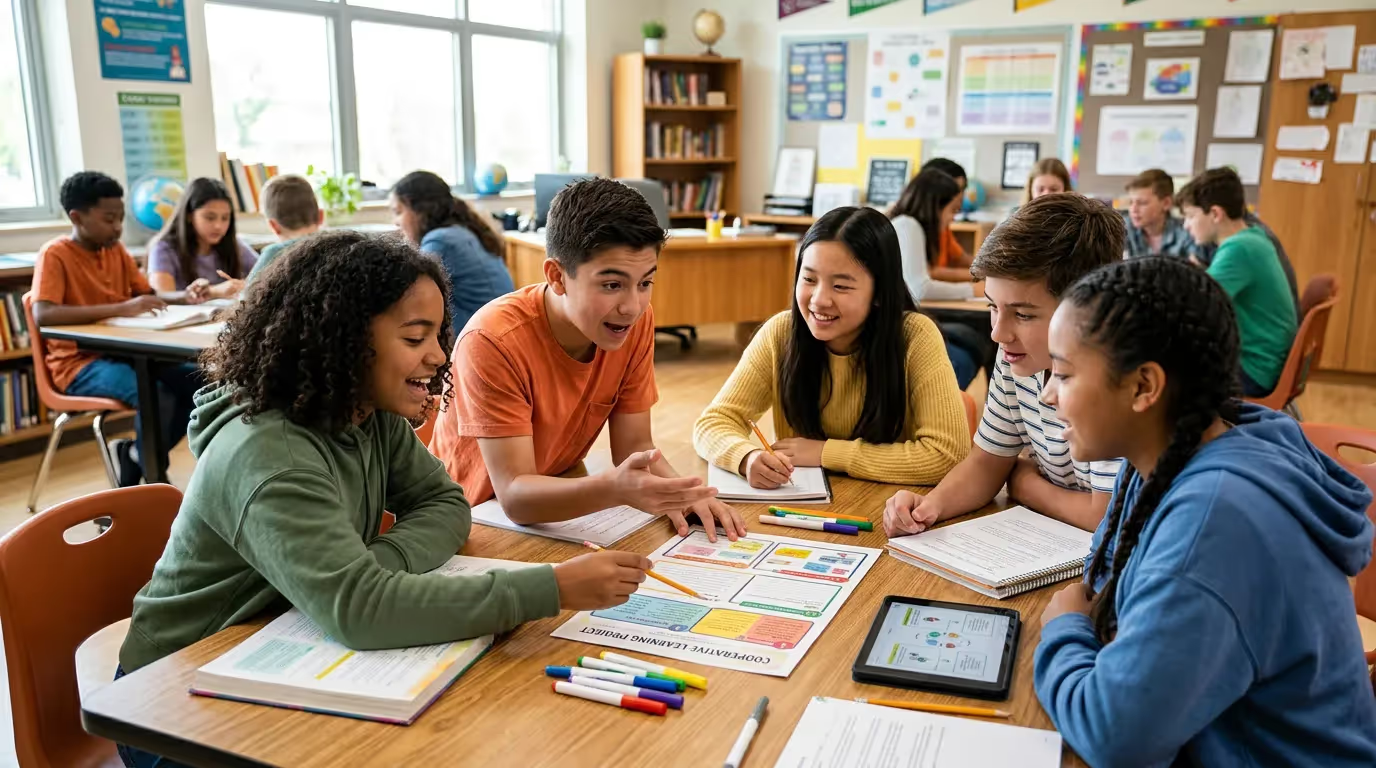
You set up a group activity, step back, and watch three students do all the work while one checks their phone and another waits for someone else to start. If that scenario sounds familiar, the problem is not your students. The problem is structure.
Cooperative learning strategies are structured instructional techniques in which students work in small groups toward shared academic goals. These approaches improve achievement by building in positive interdependence, individual accountability, and face-to-face interaction. Research across 575 experimental studies confirms that cooperative learning produces considerably greater achievement than competitive or individualistic learning (Johnson & Johnson, 1989).
This guide covers 10 evidence-based cooperative learning strategies for K-12 classrooms, practical guidance on forming and managing groups, solutions to common challenges, and a framework for fair assessment. Each strategy includes step-by-step implementation and classroom examples you can adapt today.
What Is Cooperative Learning and Why It Works
Cooperative learning is not synonymous with telling students to work in groups. It is a deliberately designed instructional approach that guarantees every student contributes and every student learns.
Cooperative vs. Collaborative Learning
Teachers often use these terms interchangeably, but the distinction matters for classroom design. Collaborative learning describes any joint learning situation, often with minimal structure. Cooperative learning is a specific, structured subset with assigned roles, defined interdependence, and individual accountability built into the task design.
The practical implication: if you want consistent results, use cooperative learning's structures rather than hoping unstructured group work produces collaboration organically.
The Five Elements of Effective Cooperative Learning
David Johnson and Roger Johnson at the University of Minnesota identified five elements that distinguish cooperative learning from ordinary group work (Johnson & Johnson, 1989):
- Positive Interdependence: Students succeed only when the group succeeds. Each member's contribution is necessary.
- Individual Accountability: Every student is assessed individually. No one hides behind the group.
- Promotive Interaction: Students actively help each other learn by explaining concepts, sharing resources, and giving feedback.
- Social Skills: Students practice communication, conflict resolution, and decision-making as part of the task.
- Group Processing: Groups regularly reflect on how well they are working together and identify improvements.
A 2022 meta-analysis in ERIC confirmed a statistically significant effect size of Hedges' g = 0.46 across K-12 subjects, meaning students in cooperative learning structures consistently outperform peers in traditional settings (EJ1338907, 2022). Vygotsky's Zone of Proximal Development provides the theoretical explanation: when students work with peers who are slightly ahead, they reach understanding beyond what independent work allows (Vygotsky, 1978).
10 Cooperative Learning Strategies for K-12 Classrooms
A meta-analysis of 164 studies found that all eight cooperative learning methods examined produced a significant positive impact on student achievement (Kyndt et al., cited in ERIC, 2023). The following 10 strategies represent the most research-supported and classroom-tested approaches available.
1. Think-Pair-Share
What it is: Students think individually about a question, discuss with a partner, then share with the class.
Research basis: Think-Pair-Share reduces anxiety by letting students test an answer with one peer before speaking to the whole class, increasing participation across ability levels (Kagan, 1994).
How to implement:
- Pose an open-ended question or prompt
- Allow 60-90 seconds of individual silent thinking
- Students turn to a designated partner and discuss for 2-3 minutes
- Invite 3-4 pairs to share their thinking with the class
Example: Before a 2nd-grade science experiment on density, a teacher asks, "Which of these objects do you predict will float, and why?" Students think silently, share predictions with a partner, then the class compares predictions before testing them.
Best for: All grade levels and subjects. Works as a lesson opener, comprehension check, or discussion starter.
2. Jigsaw Method
What it is: Each student becomes an expert on one topic and teaches that content to their home group.
Research basis: Developed by Elliot Aronson in 1971 and validated in hundreds of subsequent studies, the jigsaw method creates genuine positive interdependence because each student holds a piece of content the group cannot access without them (Slavin, 1995).
How to implement:
- Divide unit content into 4-5 equal sections
- Assign students to "expert groups," one section per group
- Expert groups study their section in depth (10-15 minutes)
- Students return to "home groups" and teach their section to peers
- Close with an individual quiz or reflection covering all sections
Example: In a 10th-grade history class on the Civil Rights Movement, students become experts on one topic each: the Montgomery Bus Boycott, the March on Washington, the NAACP's role, the Civil Rights Act of 1964, or the philosophy of nonviolent protest. Home groups reconstruct the full picture through peer instruction.
Best for: Grades 4-12. Content-heavy units in history, science, and ELA.
3. Student Teams-Achievement Divisions (STAD)
What it is: Students work in heterogeneous teams to master content, then take individual quizzes. Team scores are calculated from each member's personal improvement, not their raw score.
Research basis: Developed by Robert Slavin at Johns Hopkins University, STAD is one of the most extensively studied cooperative learning methods. Improvement-based scoring motivates students at all achievement levels because every student can contribute maximum points by improving from their own baseline (Slavin, 1995).
How to implement:
- Deliver direct instruction on new content (10-15 minutes)
- Place students in heterogeneous groups of 4
- Groups study and practice together using worksheets or problem sets
- Each student takes an individual quiz
- Calculate improvement scores: points are earned based on gain from each student's prior quiz score
- Recognize the highest-improving teams publicly
Example: A 7th-grade math teacher uses STAD for adding fractions with unlike denominators. After instruction, groups practice together with higher-achieving students coaching peers through steps. A student who improved from 60% to 75% contributes more points than one who moved from 94% to 96%.
Best for: Grades 3-12. Particularly effective in math and science where individual mastery is measurable.
4. Round Robin and Round Table
What it is: Students take turns contributing ideas one at a time around the group. Round Robin is oral; Round Table has each student write one idea before passing the paper.
Research basis: Structured turn-taking eliminates dominance by vocal students and ensures equitable participation, a core feature of Spencer Kagan's structural approach to cooperative learning (Kagan, 1994).
How to implement:
- Pose a brainstorming or review question
- Designate a starting student and a direction (clockwise)
- Each student contributes one idea or writes one response before passing
- Set a 3-5 minute time limit for the full round
- Groups categorize or prioritize their combined list during debrief
Best for: Grades 2-12. Strong choice for brainstorming, vocabulary review, and pre-writing activities.
5. Numbered Heads Together
What it is: Each student in a group is assigned a number. After group discussion, the teacher calls a number at random and that student responds for the entire group.
Research basis: Numbered Heads Together builds individual accountability into collaborative discussion because every student must be prepared to speak for the group, not just the student who usually volunteers (Kagan, 1994).
How to implement:
- Assign numbers 1-4 (or 1-5) within each group
- Pose a question, factual or analytical
- Groups discuss and ensure every member can answer (2-3 minutes)
- Teacher calls a number randomly
- Students with that number from each group share their answers
Example: During a 5th-grade review of the water cycle, the teacher calls, "Number 3s, explain what causes condensation." Every student in every group has had to prepare that answer.
Best for: Grades 1-12. Reviewing content and checking for understanding mid-lesson.
6. Group Investigation
What it is: Student groups choose a subtopic within a larger unit, investigate independently, and present findings to the class.
Research basis: Developed by Shlomo Sharan, Group Investigation is among the most cognitively demanding cooperative strategies. It promotes intrinsic motivation by giving students agency over their inquiry, producing deeper engagement than assigned tasks (Sharan, 1980, cited in Slavin, 1995).
How to implement:
- Frame an overarching inquiry question for the unit
- Groups of 3-5 select a subtopic to investigate
- Each group plans their research: what to study, how, and how to present
- Groups conduct research across several class periods
- Groups present findings; the class synthesizes across all presentations
Best for: Grades 5-12. Project-based learning units in science, social studies, and ELA.
7. Team-Based Learning (TBL)
What it is: Students complete individual pre-work, take a team readiness quiz together, then apply concepts to complex problems as a team.
Research basis: Developed by Larry Michaelsen, Team-Based Learning has strong evidence in secondary contexts. Teams solve application problems requiring synthesis rather than recall, producing conceptual understanding that outlasts the lesson (Michaelsen & Sweet, 2011).
How to implement:
- Assign pre-reading or preparatory material before class
- Students take an individual readiness quiz
- The same quiz is taken as a team; teams discuss and reach consensus on each answer
- Teams apply knowledge to a complex real-world problem
- Teams present and defend their solutions to the class
Example: In a high school biology class, student teams analyze a case study on antibiotic resistance, apply their knowledge of natural selection to propose a containment strategy, and defend it against questions from other teams.
Best for: Grades 9-12. STEM subjects and AP courses requiring higher-order application.
Wayground's live session mode supports TBL by enabling real-time team readiness quizzes where each team submits a consensus answer, making it straightforward to facilitate this structure in digital and hybrid classrooms.
8. Peer Tutoring Pairs
What it is: Students are paired, with one acting as tutor and the other as tutee. Roles rotate.
Research basis: Peer tutoring benefits both participants. Explaining content to another person requires retrieval and deeper processing, strengthening the tutor's own understanding through what researchers call the "protege effect." Hattie (2012) found effect sizes for peer tutoring ranging from 0.55 to 0.75 in his Visible Learning synthesis.
How to implement:
- Pair students based on complementary skill levels (consider learning style and rapport, not only ability)
- Define the task clearly for both the tutor and tutee
- Provide the tutor with guiding prompts or a structured practice set
- Rotate roles after 10-15 minutes or between sessions
- Close with a brief individual exit question to check both students' understanding
Best for: Grades K-12. Skill practice in reading, mathematics, and language acquisition.
9. Gallery Walk
What it is: Student groups rotate through stations posted around the room, responding to, adding to, or building on each other's work.
Research basis: Gallery walks build conceptual knowledge through repeated, multimodal engagement with content. Physical movement also sustains attention during longer class periods (Promethean World, 2024).
How to implement:
- Post 4-6 charts or prompts around the room, one concept or question per chart
- Assign groups to starting stations
- Groups rotate every 3-4 minutes, adding ideas, questions, or responses in a different color
- On a final rotation, each group reviews one chart and prepares a 30-second summary
- Debrief as a class by reviewing the accumulated responses
Example: In a 4th-grade science unit on ecosystems, the teacher posts six charts with vocabulary terms. Groups rotate, adding definitions, drawings, and real-world examples. By the end of the walk, each term has been processed multiple times through reading, writing, and discussion.
Best for: Grades 2-12. Vocabulary development, pre-assessment, and unit review.
10. Cooperative Scripted Pairs
What it is: Partners take turns summarizing sections of text. One student summarizes while the other listens and corrects errors or adds missing information, then they switch.
Research basis: Based on reciprocal teaching research by Palincsar and Brown, Cooperative Scripted Pairs has an effect size of 0.74 on reading comprehension in Hattie's Visible Learning synthesis, well above the 0.40 threshold for meaningful educational impact (Hattie, 2009).
How to implement:
- Assign a shared text or section of text to both partners
- Partner A reads the first passage (3-5 minutes of text) and summarizes aloud
- Partner B listens, then corrects, clarifies, or adds to the summary
- Partners switch roles for the next passage
- Pairs share one key insight with the class after completing the reading
Best for: Grades 3-12. Reading comprehension in ELA, social studies, and science.
Quick Reference: Cooperative Learning Strategies at a Glance
How to Group Students Effectively
Grouping decisions shape whether cooperative learning succeeds or fails. Research supports several key principles for K-12 teachers.
Heterogeneous grouping is the default recommendation. Groups with mixed readiness levels, backgrounds, and learning approaches allow higher-achieving students to reinforce their understanding by teaching, while lower-achieving students benefit from peer modeling that is often more accessible than teacher explanation. Heterogeneous grouping combined with improvement-based scoring produces particularly strong results (Slavin, 1995).
Group size matters considerably. The research consensus points to groups of 3-5 students as optimal. Groups of 2 work well for paired strategies like Think-Pair-Share and Peer Tutoring. Groups of 4 are ideal for most structured strategies like STAD and Jigsaw: large enough for diverse perspectives, small enough that every student must contribute. Groups larger than 5 tend to produce unequal participation and make individual accountability harder to maintain.
Assigning roles prevents social loafing by giving every student a defined contribution. Four roles that work across grade levels:
- Facilitator: Keeps the group on task and manages time
- Recorder: Documents the group's ideas or answers
- Reporter: Shares the group's conclusions with the class
- Materials Manager: Handles supplies and resources
Rotate roles across activities so students develop the full set of collaborative competencies. For primary grades (K-2), start with two roles and add others gradually as students build independence.
Changing groups regularly (every 2-4 weeks) prevents clique formation and builds students' ability to collaborate with a range of peers. For project-based activities spanning multiple weeks, keeping groups stable for the duration builds the trust needed to produce quality work.
One note on research and grade level: cooperative learning has a stronger effect on achievement for middle and high school students than for younger children (Kyndt et al., 2023). This does not mean avoiding cooperative structures in elementary school; it means setting realistic expectations and focusing early efforts on building social skills that make later, more complex structures possible.
Common Challenges and How to Solve Them
A meta-analysis on implementation barriers found that 63% of perceived challenges in cooperative learning are attributable to teacher, learner, curriculum, and administrative factors rather than the strategy itself, meaning most barriers respond to deliberate design decisions (ERIC, EJ1382687, 2023).
Social loafing. When one or two students do most of the work, the task has failed to create genuine positive interdependence. Fix this with three design changes: assign distinct, non-overlapping roles; use improvement-based scoring (as in STAD) so every student's contribution is visible; and require individual deliverables alongside the group product. The Jigsaw method is particularly effective here because each student literally holds content the rest of the group cannot access without them.
Off-task behavior. Groups drift when the task is too easy, too vague, or lacks urgency. Provide clear time limits. Post specific group goals on the board. Circulate deliberately rather than staying at your desk. Brief mid-activity check-ins ("Groups, five minutes left, recorders should have at least three responses documented") reset focus without interrupting momentum.
Conflict between group members. Some conflict is productive because it surfaces different perspectives and deepens reasoning. Destructive conflict is different. Teach conflict resolution protocols explicitly at the start of the year: use sentence starters such as "I think we should try this approach because..." and assign the facilitator role specifically to manage disagreements. Establish a clear class norm that disagreeing with ideas is expected, but personal comments are not.
Grading fairly. A single group grade feels inequitable to students who contributed more. Use a combined approach: a shared grade for the group product plus an individual grade for a personal reflection, quiz, or contribution log. Peer evaluation rubrics, where students rate each other's contributions on a simple 4-point scale, add a further accountability layer without requiring significant teacher time.
How to Assess Cooperative Learning
Assessment is the most underaddressed aspect of cooperative learning implementation, yet it determines whether teachers sustain the approach or abandon it after a few rocky sessions.
Individual accountability checks should accompany every group activity. Options include a brief individual quiz after group practice (as in STAD), a personal exit ticket at the end of class, or a written individual reflection on what the student contributed and what they learned. These checks give you data on individual mastery, not just group performance, and signal to students that everyone is expected to learn, not just produce a shared artifact.
Peer evaluation rubrics help students take collaborative skills seriously. A simple rubric can ask peers to rate on a 4-point scale: Did this group member contribute ideas? Did they listen respectfully? Did they help keep the group focused? Peer ratings should inform rather than solely determine individual grades, and students benefit from seeing the criteria before the activity, not only after.
Group product assessment works when the task genuinely requires all members' contributions. If the group product could have been completed by one strong student working alone, the task needs redesign. Strong group products require synthesis across multiple roles or sections, which is why Jigsaw and Group Investigation consistently produce higher-quality work than generic "collaborate on this" assignments.
Wayground's group quiz mode surfaces both individual and team-level performance data simultaneously. You can see which students are contributing correct answers and which teams may need reteaching before papers are graded or before the next lesson begins.
Conclusion
Cooperative learning does not require a complete redesign of your teaching. It starts with one well-structured activity, a clear accountability system, and the expectation that every student has something the group cannot succeed without.
Here is what to carry forward from this guide:
- Start with Think-Pair-Share or Numbered Heads Together: both work in any lesson within minutes and build the habit of student-to-student discussion
- Design for genuine interdependence, not just proximity: the task structure determines whether cooperation is real or optional
- Assign roles and rotate them so every student develops the full range of collaborative skills
- Include individual accountability checks alongside every group activity so you can see who has actually learned
- The research is consistent: cooperative learning raises achievement across grade levels, subjects, and student populations (Johnson & Johnson, 1989; ERIC, 2022)
Choose one strategy from this guide and try it this week. Notice how even a brief structure, a Think-Pair-Share at the start of a lesson or Numbered Heads Together for a review question, shifts student engagement and surfaces new information about who understands the content.
To support cooperative learning with digital tools, explore Wayground's collaborative learning features, including team quiz modes and live sessions designed for K-12 cooperative activity.
References
Hattie, J. (2009). Visible Learning: A Synthesis of Over 800 Meta-Analyses Relating to Achievement. Routledge.
Hattie, J. (2012). Visible Learning for Teachers: Maximizing Impact on Learning. Routledge.
Implementation challenges meta-analysis, ERIC (2023). EJ1382687. Retrieved from https://files.eric.ed.gov/fulltext/EJ1382687.pdf
Johnson, D.W., & Johnson, R.T. (1989). Cooperation and Competition: Theory and Research. Edina, MN: Interaction Book Company.
Johnson, D.W., & Johnson, R.T. (2009). An educational psychology success story: Social interdependence theory and cooperative learning. Educational Researcher, 38(5), 365-379.
Johnson, D.W., Johnson, R.T., & Stanne, M.B. (2000). Cooperative Learning Methods: A Meta-Analysis. University of Minnesota.
Kagan, S. (1994). Cooperative Learning. Kagan Publishing.
Kyndt, E., et al. (2023). Effects of cooperative learning on student achievement: A meta-analysis of randomized controlled trials. Retrieved from https://www.researchgate.net/publication/370401155
Meta-analysis of cooperative learning, ERIC (2022). EJ1338907. Retrieved from https://files.eric.ed.gov/fulltext/EJ1338907.pdf
Michaelsen, L.K., & Sweet, M. (2011). Team-based learning. New Directions for Teaching and Learning, 2011(128), 41-51.
Roseth, C.J., Johnson, D.W., & Johnson, R.T. (2008). Promoting early adolescents' achievement and peer relationships: The effects of cooperative, competitive, and individualistic goal structures. Psychological Bulletin, 134(2), 223-246.
Slavin, R.E. (1995). Cooperative Learning: Theory, Research, and Practice (2nd ed.). Allyn & Bacon.
Systematic review on cooperative math learning (2025). ScienceDirect. Retrieved from https://www.sciencedirect.com/science/article/pii/S2590291125009775
Vygotsky, L.S. (1978). Mind in Society. Harvard University Press.
Find your way forward
FAQs
What are the 5 elements of cooperative learning?
Johnson and Johnson identified them as positive interdependence, individual accountability, promotive interaction, social skills, and group processing. All five must be present for group work to qualify as cooperative learning rather than simple group activity.
What is the difference between cooperative learning and collaborative learning?
Cooperative learning is a structured approach with assigned roles, defined interdependence, and individual accountability built into the design. Collaborative learning is a broader concept describing any joint learning activity. Cooperative learning is a specific, research-validated form of collaboration with clearer implementation guidelines.
What are the best cooperative learning strategies for K-12?
Think-Pair-Share works at every grade level and requires no preparation. Jigsaw suits content-heavy units in grades 4-12. STAD is the most-researched strategy for math and science. For high school, Team-Based Learning and Group Investigation develop higher-order thinking alongside collaboration skills.
How do you prevent social loafing in group work?
Design tasks requiring genuine interdependence, where no single student can complete the work alone. Use individual accountability measures: personal quizzes, exit tickets, and improvement-based scoring. Assign rotating roles with distinct responsibilities, and include peer evaluation as a component of the grade.
How do you grade group work fairly?
Use a combined approach: a shared grade for the group product plus an individual grade for a personal quiz, reflection, or contribution log. STAD's improvement-based scoring model is particularly equitable because every student earns points by improving from their own baseline, regardless of their starting level.
How do you implement the jigsaw method step by step?
Divide content into equal sections, one per student. Assign all students with the same section to an expert group to study together. Students return to their home groups and teach their section to peers. Close with an individual assessment covering all sections to confirm comprehension.
What group size works best for cooperative learning?
Groups of 3-5 produce the strongest outcomes. Groups of 4 are optimal for most strategies because roles can be clearly distributed and every student must contribute. Groups of 2 work well for paired strategies. Avoid groups larger than 5, where some students can become passive.
Can cooperative learning be used in hybrid or digital classrooms?
Yes. Think-Pair-Share, Numbered Heads Together, and Peer Tutoring translate directly to video conferencing with breakout rooms. Team-based quiz tools support STAD and Team-Based Learning in fully digital settings. The core principles of positive interdependence and individual accountability apply regardless of the learning environment.
What are cooperative learning strategies for math?
STAD is the most researched strategy for mathematics. A 2025 systematic review found a pooled effect size of Hedges' g = 0.71 for cooperative learning on mathematics achievement (ScienceDirect, 2025). Numbered Heads Together and Peer Tutoring Pairs also work well for procedural practice and problem-solving.
How long does a cooperative learning activity typically take?
Quick strategies like Think-Pair-Share and Numbered Heads Together take 5-15 minutes and fit within any lesson. Jigsaw and STAD typically need a full 45-60 minute class period. Group Investigation spans multiple class periods or a full project cycle. Start with shorter strategies to build student collaboration skills before scaling to longer ones.