
Inquiry-Based Learning: A Teacher's Guide to Implementation in K-12
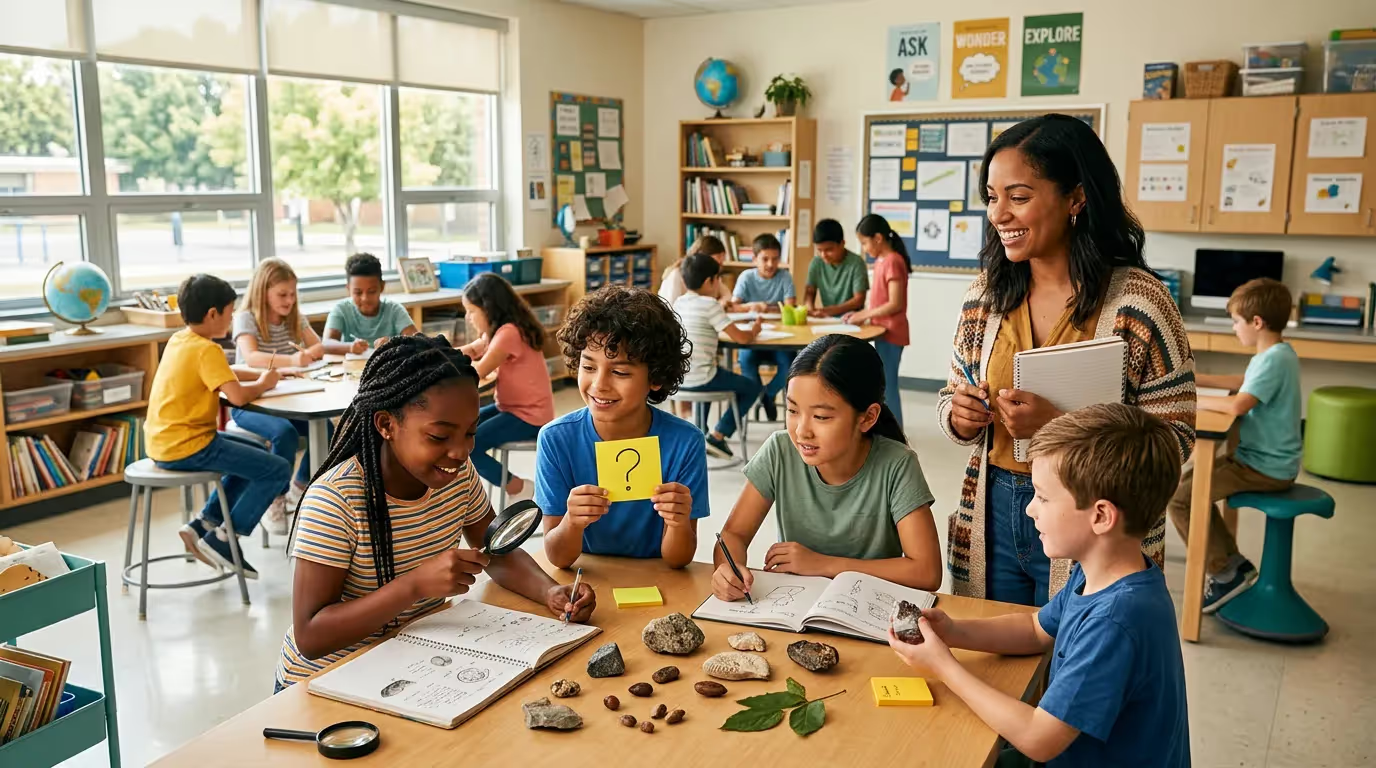
Students who can ask better questions learn more deeply than students who can only answer them. Yet most traditional instruction leaves little room for students to formulate, investigate, and pursue their own questions. That gap is exactly what inquiry-based learning is designed to close.
Inquiry-based learning is an instructional approach in which students build knowledge by posing questions, investigating solutions, and constructing understanding through exploration and reflection. Rooted in constructivist learning theory, it shifts students from passive receivers of content to active architects of their own understanding. A meta-analysis of 138 studies published in the Review of Educational Research found IBL produced an average effect size of 0.50 over traditional instruction, roughly equivalent to moving a student from the 50th to the 69th percentile.
This guide covers what inquiry-based learning is, the four types teachers use across grade levels, the four-phase inquiry cycle with specific teacher actions at each stage, grade-band implementation strategies, a comparison with project-based learning, and practical solutions to the most common implementation barriers.
What Is Inquiry-Based Learning?
Inquiry-based learning is grounded in constructivist theory: the idea that learners build knowledge through experience and interaction rather than absorbing it passively. Jean Piaget's research on cognitive development and Lev Vygotsky's concept of the zone of proximal development both inform this approach. Students learn best when they are slightly challenged, supported by a knowledgeable guide, and given space to make sense of new information on their own terms.
In practice, IBL means structuring learning around authentic questions, real problems, or observable phenomena that require students to investigate before arriving at conclusions. The teacher's role shifts from primary knowledge-transmitter to question architect and inquiry facilitator.
One important clarification: IBL does not replace direct instruction. The two approaches work best in combination. Direct instruction equips students with the vocabulary and conceptual grounding to ask sharper questions. IBL provides the environment where those questions lead somewhere meaningful. Many effective IBL units open with a short direct instruction segment precisely because students need baseline knowledge before they can investigate effectively.
The 4 Types of Inquiry-Based Learning
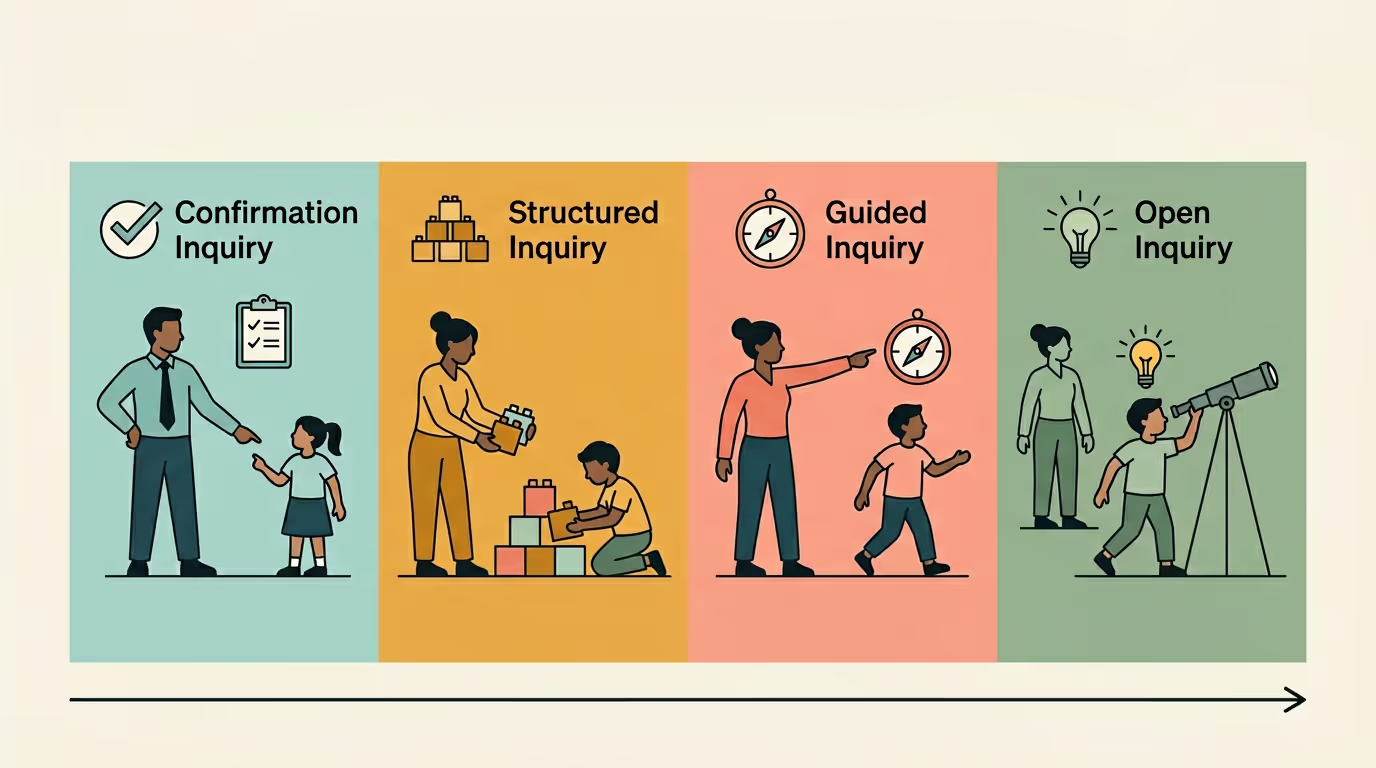
IBL exists on a spectrum of student autonomy. Researchers Heather Banchi and Randy Bell identified four distinct types in their widely cited 2008 framework. The four types below represent different points on that spectrum, from fully teacher-directed to fully student-directed. Matching the right type to student readiness is more important than matching it to grade level alone.
1. Confirmation Inquiry
The teacher provides the question, the procedure, and the expected outcome. Students follow the steps and confirm that the result matches what is predicted. This type is not exploratory — its purpose is to deepen understanding of a concept students have already been introduced to, and to build comfort with the mechanics of inquiry before introducing genuine open-endedness.
Example: A 5th-grade science teacher asks, "Does adding salt to water raise its boiling point?" She provides the materials, procedure, and tells students the result they should observe. Students carry out the experiment, confirm the outcome, and discuss why it occurs. The inquiry is in the processing and discussion, not the discovery.
Confirmation inquiry is often underused. It is the appropriate entry point for any class new to IBL, and it remains useful at any grade level when introducing a new subject area or unfamiliar investigation format.
2. Structured Inquiry
The teacher selects the guiding question and provides the materials and resources. Students investigate and answer within a defined framework. This type is well-suited to younger students and to any class encountering IBL for the first time.
Example: A 3rd-grade teacher presents the question "Why do some objects sink and others float?" She provides water, containers, and a set of everyday objects. Students test, record observations, and draw conclusions using a teacher-designed data sheet.
3. Guided Inquiry
The teacher provides the essential question but students choose how to research it and how to demonstrate their understanding. This type works well for middle school and early high school students who have enough self-direction to manage a multi-step investigation.
Example: An 8th-grade social studies teacher asks, "How does a country's economic system affect its citizens' quality of life?" Students select their own countries, choose their sources, and present findings in a format they determine.
4. Open Inquiry
Students generate their own questions, select their resources, and design their summative product. This approach most closely mirrors professional research and is appropriate for advanced students or upper high school classes with established inquiry habits.
Example: An 11th-grade biology student develops the question "How do epigenetic factors influence disease risk across generations?" She designs a research plan, identifies peer-reviewed sources, and presents a structured argument to a panel of classmates and a school counselor.
A high school class new to IBL should start with confirmation or structured inquiry. A motivated group of 5th graders working on a science project can handle elements of guided inquiry. The appropriate type depends on where students are, not just the number on their classroom door.
The 4 Phases of the Inquiry Cycle
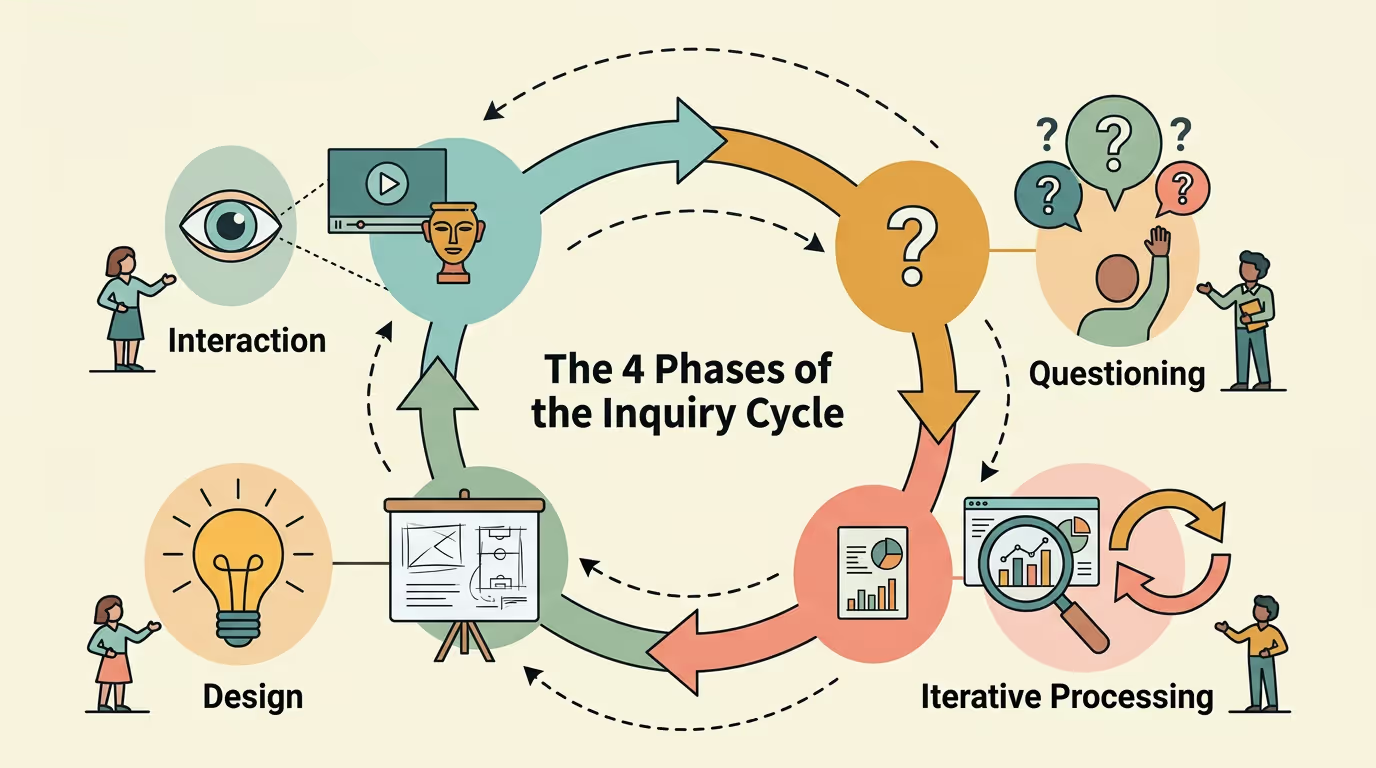
Regardless of which type of inquiry a teacher uses, the process generally follows four recursive phases. Recursive is the key word: students often loop back to earlier phases as their understanding deepens. That is not a problem. It is the process working as designed.
Phase 1: Interaction
Students engage with a carefully chosen stimulus to spark curiosity and surface prior knowledge. The stimulus might be a short documentary clip, a primary source document, a real-world data set, a scientific phenomenon, or a local community problem.
Teacher action: Choose a stimulus compelling enough to generate genuine questions. A poorly chosen stimulus produces compliance, not curiosity. Before class, test the stimulus yourself: does it raise questions you cannot immediately answer? If yes, it will likely work with students too.
Phase 2: Questioning
Students formulate questions based on their interaction with the stimulus. The teacher facilitates question refinement, helps students distinguish between recall questions (easily answered with a quick search) and analytical ones (requiring real investigation), and surfaces misconceptions before they take root.
Teacher action: Use Bloom's Taxonomy question stems to scaffold upward. Recall questions ("What is...?") are entry points, not destinations. Push students toward questions at the Analyzing and Evaluating levels: "What evidence supports...?" and "How would the outcome change if...?" Digital tools like those available in Wayground allow teachers to collect student-generated questions in real time and identify which students need support moving from surface-level to deep inquiry before the investigation begins.
Phase 3: Iterative Processing
Students investigate, analyze data, and revise their thinking in repeated cycles. A student researching the causes of urban food deserts may gather initial data, encounter a contradicting statistic, revise her framing, and investigate again. Each revision deepens understanding.
Teacher action: Build in structured check-ins at the midpoint of this phase. Brief formative questions help teachers identify students who are stuck, pursuing unproductive paths, or drawing unsupported conclusions. A 2019 study found that classrooms using inquiry-based instruction at least four days per week produced significantly stronger outcomes than traditional comparison classrooms. Consistency and monitoring together drive those results. Wayground's formative check-in tools allow teachers to monitor where students are in the questioning and processing phases in real time, reducing the need for one-on-one interruptions during investigation.
Phase 4: Design
Students design solutions, construct arguments, or create products that apply what they have learned. They also plan next steps, asking what questions this investigation opened rather than closed.
Teacher action: Facilitate structured reflection at the end of this phase. Ask students to articulate not just what they found but how their thinking changed. This metacognitive step deepens retention and transfers to future inquiry work.
Why Inquiry-Based Learning Works: The Research
Teachers deserve evidence before committing to an instructional shift. Here is what the research shows consistently across multiple study types and grade levels.
- Learning outcomes. The 138-study meta-analysis from the Review of Educational Research found IBL produced an average effect size of 0.50 compared to traditional instruction. The National Research Council found IBL generates approximately 30% higher achievement gains specifically when measuring higher-order thinking skills.
- Critical thinking. A meta-analysis published in the European Journal of Mathematics, Science and Technology Education (EJMSTE) found IBL had a standardized mean difference of 1.45 for critical thinking skills. This is a large effect, representing significant improvement in analytical and scientific reasoning beyond what traditional instruction typically produces.
- Long-term and equity impact. Stanford researchers examined 20 years of classroom evidence and concluded that IBL practices have a more significant effect on student performance than any other variable studied, including student background and prior achievement (Stanford Education Research, 2008). A literature review from the Galileo Educational Network found IBL narrowed the achievement gap between high and low-performing students from elementary through high school.
- Bloom's Taxonomy alignment. IBL naturally scaffolds through Bloom's cognitive levels. The inquiry cycle moves students from Remembering (engaging with the stimulus) through Understanding and Applying (building initial connections) to Analyzing and Evaluating (iterative processing) and finally Creating (the design phase). Students practice higher-order cognitive moves across every phase, not just at the end of a unit. That distributed practice is a primary reason IBL produces stronger results on assessments measuring complex thinking.
- Frequency and consistency. The 2019 ERIC study found outcomes improved most in classrooms where IBL was used consistently, at least four days per week, rather than as an occasional enrichment activity. IBL used once a month as a special project delivers limited results. IBL integrated into regular practice delivers the outcomes the research documents.
How to Implement Inquiry-Based Learning by Grade Band
IBL looks different in a 2nd-grade classroom than in a 10th-grade one. The principles remain consistent. The scaffolding, cycle length, and degree of student autonomy should shift based on where students are developmentally.
Elementary (K-5)
Younger students benefit most from structured inquiry: the teacher controls the question and provides clear supports including sentence frames, graphic organizers, observation sheets, and whole-class reflection routines. Research published in Frontiers in Education (2025) recommends 3 to 5 weeks for primary-grade IBL cycles.
Practical starting points:
- Begin in science and social studies, where questions naturally arise from observable phenomena or community topics.
- Use anchor charts to document the class's growing questions and collective findings.
- Build a brief daily whole-class reflection into the routine: "What did we learn today? What new questions does that raise?"
- Keep individual investigation short and favor collaborative inquiry, where the class investigates together, over independent research.
Example: A 2nd-grade class investigating "What makes soil good for growing plants?" tests three soil types with bean seeds over two weeks, records daily observations, and compiles findings on a class anchor chart. The teacher provides the question and materials. The investigation belongs to the students.
Middle School (6-8)
Middle school students can handle guided inquiry with proper scaffolding. They benefit from teacher-provided essential questions but have sufficient metacognitive awareness to evaluate sources, manage multi-step investigations, and make meaningful choices about how to demonstrate understanding. Cycles of 6 to 8 weeks work well at this level.
Practical starting points:
- Use Socratic seminars to structure the questioning phase, with discussion norms and question stems provided before students enter the seminar.
- Assign a researcher's notebook where students log questions, sources, findings, and how their thinking has changed over time.
- Build peer feedback sessions into the iterative processing phase. Students often identify gaps in each other's reasoning that they miss in their own work.
- Connect inquiry to interdisciplinary units where possible. A question about local water quality spans science, social studies, data literacy, and persuasive writing.
Example: A 7th-grade humanities teacher poses the question "How have pandemics shaped the politics of the cities where they struck?" Each student selects a different pandemic and city, identifies primary and secondary sources, and presents a 10-minute historical argument with supporting evidence. The teacher provides the question and the rubric. Students determine everything else.
High School (9-12)
High school students are ready for guided or open inquiry with meaningful stakes. Effective IBL at this level connects to authentic contexts and gives students genuine agency over their investigation. Research from Frontiers in Education (2025) recommends 6 to 10 weeks for secondary IBL cycles.
Practical starting points:
- Co-construct the guiding question with students in advanced or honors courses.
- Teach source evaluation explicitly before the investigation phase, giving students concrete criteria for distinguishing credible from unreliable sources.
- Use regular brief check-ins, one-on-one or in small groups, to help students sharpen or refocus their questions as the investigation progresses.
- Design the Phase 4 output for an authentic audience: a community panel, a peer-reviewed class journal, a policy memo, or a public presentation.
Example: An AP Environmental Science class investigates "What policies have been most effective at reducing particulate air pollution in comparable cities?" Each student or pair selects two cities, compares policy timelines with air quality data, and presents findings at a mock city council hearing to teachers and invited community members.
A note on blending approaches: many effective IBL units open with a short direct instruction segment. Students need enough conceptual vocabulary to ask informed questions. Ten minutes of targeted instruction before the questioning phase is not a compromise. It is good design.
Inquiry-Based Learning vs. Project-Based Learning
These terms appear together frequently, and teachers sometimes use them interchangeably. They are related but distinct, and understanding the difference helps teachers use each more intentionally.
The most useful framing: PBL is one form of IBL, oriented toward a specific deliverable. IBL cycles build the questioning and investigative habits that make PBL work better.
When to use IBL: When the goal is conceptual depth, disciplinary thinking, or building students' capacity to ask better questions. IBL is the right choice when understanding the why matters more than producing a deliverable — in science, history, literature analysis, and mathematics reasoning.
When to use PBL: When the goal is applied skill development, cross-disciplinary integration, or authentic community impact. PBL works best when students already have enough conceptual grounding to make decisions about design, audience, and product quality.
When to sequence them: Teachers who want both can use IBL to build conceptual knowledge and sharpen student questions, then channel that inquiry into a PBL project where students apply what they have learned to create something for a real audience. The IBL cycle answers "what do we know and what do we still need to understand?" The PBL project answers "what will we do with that understanding?"
Student-driven quiz and discussion tools that support formative questioning, such as those available in Wayground, give teachers data at key milestones in both IBL cycles and PBL projects without interrupting student-led investigation.
Common Challenges and How to Overcome Them
IBL has real implementation barriers. The following four are the most frequently cited by teachers, along with practical approaches to each.
Challenge 1: Curriculum pacing and testing pressure.
Standards-based schedules leave little room for multi-week inquiry units. The practical solution is strategic integration rather than wholesale replacement. Choose one or two units per semester where IBL is the primary approach. Use structured inquiry for shorter two-to-three-week cycles when time is tight. Frame IBL as a vehicle for standards mastery: well-designed inquiry units align directly with grade-level standards while building the higher-order thinking skills that assessments also require.
Challenge 2: Insufficient teacher preparation.
IBL requires a different skill set than direct instruction. Teachers new to the approach often struggle with releasing control, managing open-ended investigation, and providing feedback that moves thinking forward without giving answers away. Professional development focused on facilitation skills and formative questioning is the strongest predictor of successful IBL implementation. If formal PD is not available, start with structured inquiry, where the teacher retains more control, and increase student autonomy gradually as both teacher and students grow more comfortable.
Challenge 3: Superficial adoption.
A common failure mode is activity-based learning that looks like IBL on the surface but does not deliver its cognitive benefits. Students are engaged and busy but not intellectually stretched. The root cause is almost always in Phase 2: if students' questions are shallow or purely factual, the investigation will be too. Invest significant time in question formulation. Teach the difference between a recall question and an analytical one, and model it explicitly. Trevor MacKenzie, an educator and author known for his IBL implementation frameworks, recommends asking students to sort their initial questions by Bloom's level as a self-editing step before beginning investigation.
Challenge 4: Classroom management during open investigation.
When students pursue different questions or investigation paths, the classroom can feel difficult to monitor. Establish clear structures from the start: researcher's notebooks, visible inquiry boards showing each student's current question and stage, and scheduled peer feedback sessions. These routines give students accountability and give teachers visibility into where each student is in the cycle without requiring constant individual check-ins.
Putting It Into Practice
Inquiry-based learning asks teachers to rethink their role: less answer-giver, more question architect. That shift is meaningful, particularly in schools where curriculum pacing and standardized testing drive most instructional decisions.
The research makes a clear case for investing in that shift. An effect size of 0.50 over traditional instruction. A 30% boost in higher-order thinking outcomes. Critical thinking gains with a standardized mean difference of 1.45. Measurable narrowing of the achievement gap across grade levels. These are not marginal improvements — and they hold across grade bands, subject areas, and student backgrounds.
Start with one unit this semester where the content naturally invites student questions. Use confirmation or structured inquiry to keep the process manageable while students and teacher build inquiry habits together. Build formative check-ins into the Questioning and Iterative Processing phases so you can see where students are and intervene before small confusions become fixed misconceptions. Platforms like Wayground include live questioning and formative check-in tools designed for exactly this purpose, allowing teachers to monitor student thinking in real time and adjust during the inquiry cycle rather than after it.
The goal is not to run every lesson as an inquiry cycle. The goal is to give students enough genuine practice with questioning, investigation, and reflection that these habits become part of how they learn.
References
Galileo Educational Network. (n.d.). Focus on inquiry: A teacher's guide to curriculum design. Retrieved from https://galileo.org/focus-on-inquiry-lit-review.pdf
Banchi, H., & Bell, R. (2008). The many levels of inquiry. Science and Children, 46(2), 26–29.
EJMSTE. (n.d.). The effect of inquiry-based learning on students' critical thinking skills in science education: A meta-analysis. Eurasia Journal of Mathematics, Science and Technology Education. Retrieved from https://www.ejmste.com/download/the-effect-of-inquiry-based-learning-on-students-critical-thinking-skills-in-science-education-a-15988.pdf
Frontiers in Education. (2025). IBL intervention duration research. Retrieved from https://www.frontiersin.org/journals/education/articles/10.3389/feduc.2025.1512274/full
ERIC. (2019). Study on inquiry-based and problem-based learning frequency. Retrieved from https://files.eric.ed.gov/fulltext/EJ1350231.pdf
Al-Ishlah Journal. (n.d.). Review of Educational Research meta-analysis (138 studies). Retrieved from https://journal.staihubbulwathan.id/index.php/alishlah/article/view/7061
MacKenzie, T. (n.d.). Bringing inquiry-based learning into your class. Edutopia. Retrieved from https://www.edutopia.org/article/bringing-inquiry-based-learning-into-your-class-trevor-mackenzie/
Edutopia. (n.d.). Blending direct instruction with inquiry-based learning. Retrieved from https://www.edutopia.org/article/blending-direct-instruction-inquiry-based-learning/
Find your way forward
FAQs
What is inquiry-based learning?
Inquiry-based learning is an instructional approach in which students build knowledge by asking questions, investigating solutions, and constructing understanding through exploration and reflection. It is rooted in constructivist learning theory and is used across all K-12 grade levels and subject areas.
What are the 4 phases of inquiry-based learning?
The four phases are Interaction (engaging with a stimulus to spark curiosity), Questioning (formulating and refining questions), Iterative Processing (investigating, analyzing, and revising thinking), and Design (applying understanding and planning next steps). These phases are recursive, not strictly linear.
What are examples of inquiry-based learning in the classroom?
Examples include a 3rd-grade class investigating why objects sink or float, an 8th-grade student researching how economic systems affect quality of life across different countries, and an 11th-grade biology student designing an original research project on epigenetic factors. The common thread is that students formulate and pursue genuine questions rather than completing teacher-directed tasks.
How does inquiry-based learning differ from project-based learning?
IBL focuses on the process of inquiry and builds knowledge and understanding. PBL focuses on producing a tangible outcome and developing skills. PBL is a form of inquiry learning but is oriented toward a specific deliverable. Teachers often blend both: IBL builds the conceptual foundation, while PBL channels inquiry into a concrete product.
What are the four types of inquiry-based learning?
The four types, identified by Banchi and Bell (2008), are confirmation inquiry (teacher-provided question, procedure, and expected outcome — students verify a known result), structured inquiry (teacher-chosen question and materials, student-directed investigation), guided inquiry (teacher-provided essential question, student-chosen resources and format), and open inquiry (student-generated questions, resources, and assessment design). The appropriate type depends on student readiness and experience with inquiry, not grade level alone.
How long should an inquiry-based learning unit last?
Research published in Frontiers in Education (2025) recommends 3 to 5 weeks for primary-grade students and 6 to 10 weeks for secondary students. Shorter structured inquiry cycles of two to three weeks can work when curriculum pacing is a constraint.
How does inquiry-based learning improve critical thinking?
IBL requires students to formulate questions, evaluate evidence, identify contradictions, revise hypotheses, and draw evidence-based conclusions. A meta-analysis published in EJMSTE found IBL improved critical thinking skills with a standardized mean difference of 1.45, representing a large and significant effect. Students practice higher-order cognitive skills across every phase of the inquiry cycle.
How can teachers implement inquiry-based learning alongside direct instruction?
Direct instruction and IBL are complementary. Many effective IBL units begin with targeted direct instruction that gives students the vocabulary and conceptual grounding they need to ask better questions. Think of direct instruction as equipping students for inquiry rather than as competing with it. As students become comfortable with inquiry structures, the balance can shift: more student-led investigation, with direct instruction used to address common misconceptions identified during formative check-ins.