
Student Engagement Strategies: 20 Proven Techniques for K-12 Classrooms
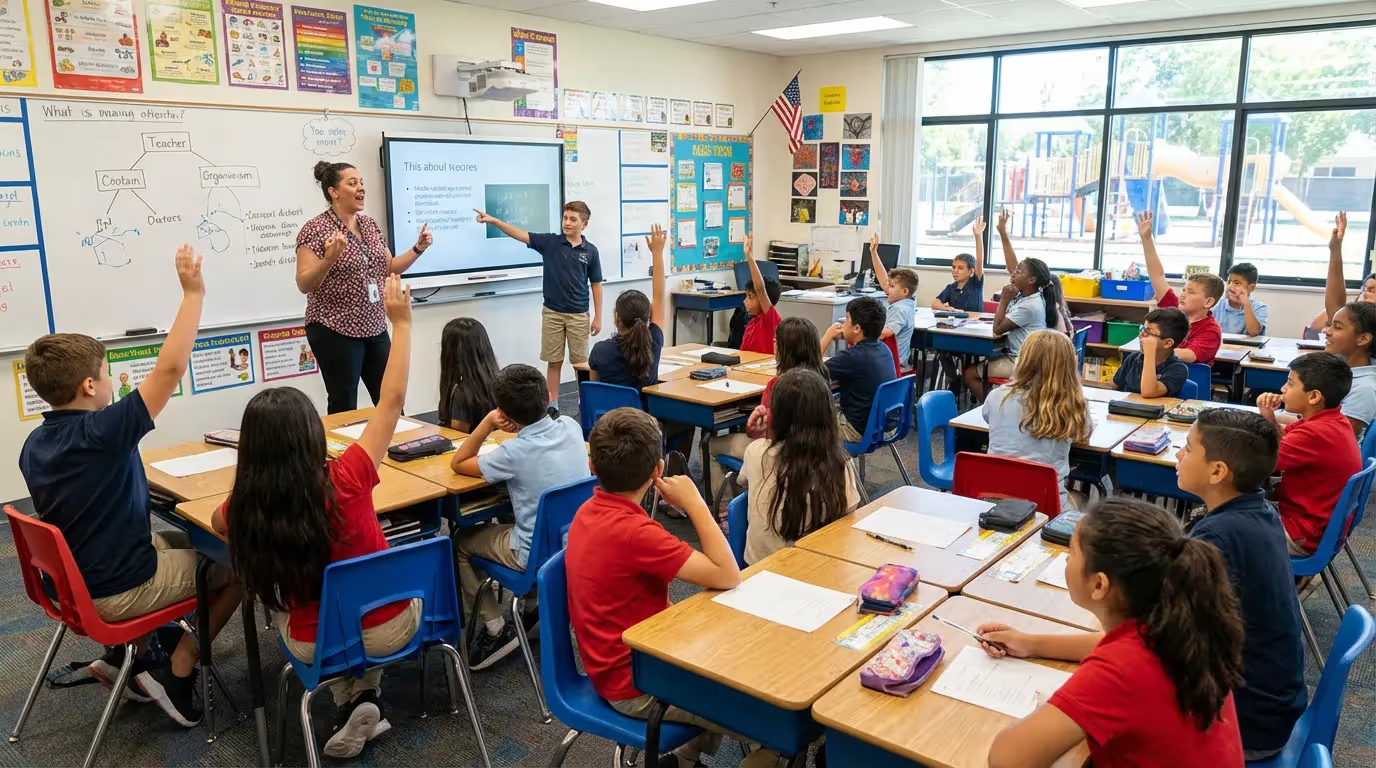
Student engagement strategies are research-backed techniques that increase student participation, motivation, and learning across behavioral, cognitive, and emotional dimensions. Effective strategies include active learning, gamification, real-time feedback, student choice, and collaborative activities. Research shows students in active learning environments score 54% higher on tests and are 1.5x less likely to fail compared to traditional lecture-based instruction (Engageli, 2025).
Fewer than 2 in 10 Gen Z students strongly agree that what they learn in school feels important, interesting, or challenging (Gallup, 2025). Yet 93% of educators identify student engagement as a critical predictor of academic achievement (Discovery Education, 2025). That gap between what students experience and what educators know matters represents both the challenge and the opportunity.
This guide presents 20 evidence-based student engagement strategies organized by category: active learning, gamification, real-time feedback, student voice and autonomy, and relationship-building. Each strategy includes implementation steps and classroom examples you can apply immediately.
Why Student Engagement Matters (and Why It Is Declining)
Student engagement is not a single behavior. Researchers identify three distinct dimensions that must work together for lasting academic impact:
- Behavioral engagement: Students follow directions, participate in activities, and stay on task.
- Cognitive engagement: Students invest effort in their learning, tackle challenges willingly, and think critically.
- Emotional engagement: Students feel a sense of belonging, connection to their teacher and peers, and positive feelings toward learning.
Research published by Edutopia in October 2024 confirms that addressing all three dimensions simultaneously produces the strongest academic outcomes. When only behavioral compliance is prioritized and cognitive investment or emotional connection is neglected, students may appear engaged without actually learning deeply.
The stakes are real. Gallup research shows that between 25% and 54% of students report they are not having key engaging experiences at school, including feeling that what they learn matters or connects to their future. Engagement also declines as students move from elementary through high school, making proactive strategies essential at every grade level.
Teachers hold significant influence here. Six in ten Gen Z students say that when they are most interested in a subject, it is because their teacher made the material interesting and exciting (Gallup, 2025). The 20 strategies below give you a concrete framework to do that.
Active Learning Strategies (Strategies 1-5)
Active learning shifts students from passive recipients of information to active constructors of knowledge. Studies show active learning produces 54% higher test scores and twice the learning gains compared to traditional lecture formats (Engageli, 2025).
1. Think-Pair-Share
Think-Pair-Share is a structured discussion technique where students first think independently about a question, then discuss with a partner, then share with the class. It builds cognitive engagement through individual reflection and emotional engagement through peer connection.
How to implement:
- Pose an open-ended question tied to the lesson objective.
- Give students 60-90 seconds of individual thinking time.
- Pair students for 2-3 minutes of discussion.
- Select 2-3 pairs to share their thinking with the class.
Classroom example: After introducing a math concept, ask: "In your own words, explain when you would use this method. Think of a real situation where this calculation matters." Pairs discuss, then report out. You gauge understanding without a formal quiz.
2. Collaborative Group Work
Structured group work increases both cognitive and emotional engagement by creating conditions for peer learning and social belonging. Cooperative learning research consistently shows higher achievement and stronger motivation compared to individual seat work.
How to implement:
- Assign roles within groups: facilitator, recorder, reporter, timekeeper.
- Give groups a problem that requires multiple perspectives.
- Set a clear time limit of 10-15 minutes.
- Require each group to produce a deliverable: a written summary, whiteboard diagram, or verbal report.
Classroom example: In a science class, each group receives a different dataset from a climate study. Groups analyze their data, draw conclusions, and present findings to the class. Each group holds unique information, making every student's contribution essential.
3. Problem-Based Learning
Problem-based learning places students in realistic scenarios that require applying content knowledge to solve genuine challenges. Nearly 46% of Gen Z students say hands-on learning drives their interest, and 35% report greater engagement when content connects to the real world (Gallup, 2025).
How to implement:
- Design a scenario tied to real-world context: a local community issue, a current event, or a career-relevant problem.
- Present the problem before teaching the content, so students develop curiosity before formal instruction begins.
- Guide discovery rather than delivering answers directly.
- Close with a reflection: "What did you learn? What questions do you still have?"
Classroom example: Before a percentages unit, present this problem: "Your school cafeteria wants to reduce food waste by 20%. Using last week's data, design a plan." Students see a reason to learn percentages before you teach the formal skills.
4. Flipped Classroom
In a flipped model, direct instruction moves outside class through pre-recorded video or reading, freeing class time for application, discussion, and collaborative practice. This increases cognitive engagement by prioritizing higher-order thinking during shared time.
How to implement:
- Record 5-10 minute instructional videos or assign short readings for home review.
- Start class with a brief accountability check: a quick quiz or written reflection.
- Use class time for collaborative problem-solving, not re-teaching.
- Reserve direct instruction for addressing misconceptions surfaced by the accountability check.
Practical note: Flipped instruction requires reliable home internet access. For students without consistent connectivity, provide printed summaries or schedule school computer lab time.
5. Socratic Seminars and Discussion Circles
Socratic seminars are structured discussions where students respond directly to each other's ideas using evidence from texts, data, or prior knowledge. This format builds all three engagement dimensions: behavioral participation, cognitive reasoning, and emotional belonging through voice and dialogue.
How to implement:
- Assign a common text, case study, or primary source in advance.
- Open with a central question that has no single correct answer.
- Establish norms: cite evidence, build on others' ideas, ask follow-up questions.
- Take a minimal facilitation role, allowing student voices to drive the conversation.
Classroom example: For a history class on the causes of a major conflict, students read three primary sources representing different perspectives. The seminar question: "Which perspective is most persuasive, and why?" Students engage directly with each other's arguments rather than deferring to the teacher.
Gamification Strategies (Strategies 6-9)
Gamification applies game design elements, including points, badges, levels, and challenges, to non-game learning contexts. A 2024 meta-analysis in the British Journal of Educational Technology, drawing on 22 studies, found a moderately positive effect on academic performance (Hedges' g = 0.782). A longitudinal study in MDPI Education Sciences found gamified learning produced a 19% higher success rate and 25% higher average grades compared to traditional instruction.
6. Points, Badges, and Leaderboards
Reward mechanics tap into extrinsic motivation by making progress visible and providing frequent positive reinforcement. Students report higher engagement, enjoyment, and knowledge gains when these mechanics are present.
How to implement:
- Define clear criteria for earning points: completion, accuracy, effort, participation.
- Award badges for milestone achievements, not only final outcomes.
- Update leaderboards regularly so rankings feel dynamic and competitive.
- Balance competition with collaboration by using team leaderboards alongside individual ones.
Platforms like Wayground include built-in gamification features, including points, badges, and class leaderboards, allowing teachers to implement these mechanics without building custom reward systems from scratch.
Note: Use leaderboards thoughtfully. For students who consistently rank at the bottom, public ranking can decrease motivation. Personal-best leaderboards, where students compete against their own previous scores, maintain engagement across all ability levels.
7. Game-Based Quizzes and Formative Challenges
Live quiz competitions transform review and formative assessment into engaging classroom events. Research consistently finds that game-based formative quizzes increase participation, knowledge retention, and class energy, particularly for review sessions that might otherwise feel repetitive.
How to implement:
- Design 10-15 question quizzes targeting the current lesson or unit.
- Run the quiz as a live class competition with visible pacing and results.
- Pause after questions where class accuracy is low to re-teach before continuing.
- Use results to identify which students need additional support before summative assessment.
Classroom example: A 10-minute game-based quiz at the end of every Friday serves as both a review activity and a data check. Students look forward to the competition, and teachers leave the week knowing exactly which concepts need attention on Monday.
8. Progress Tracking and Achievement Systems
Visible progress tracking gives students agency over their own learning. Ryan and Deci's Self-Determination Theory identifies competence, the experience of growing mastery, as one of three fundamental psychological needs driving intrinsic motivation. When students can see their growth, motivation increases.
How to implement:
- Create visual progress trackers: wall charts, digital dashboards, or individual goal sheets.
- Set both unit-level goals and daily micro-goals.
- Celebrate progress, not only final achievement. Acknowledge improvement over time.
- Review progress data with students in brief individual check-ins.
9. Collaborative Challenges and Team Competitions
Team-based challenges combine the motivational power of competition with the engagement benefits of collaborative learning. Students who are not intrinsically motivated by academic content often engage more deeply when competing alongside peers they feel connected to.
How to implement:
- Form teams strategically, mixing ability levels to prevent dominant-and-passive dynamics.
- Design challenges where each team member's contribution is required.
- Rotate team compositions regularly so students build connections across the class.
- Recognize effort and improvement, not only the winning team.
Real-Time Feedback and Formative Assessment Strategies (Strategies 10-13)
Immediacy is the most critical variable in feedback effectiveness. Studies show that technology-enhanced real-time feedback increases student attention, engagement, and follow-through compared to delayed feedback (Wooclap, 2025). When students receive immediate information about their understanding, they can adjust their thinking while content is still active in working memory.
10. Live Polling and Exit Ticket Tools
Live polling surfaces student understanding during a lesson, rather than revealing gaps after a test has been graded. Exit tickets at the end of class confirm whether the day's learning objective was met.
How to implement:
- Design 1-3 questions targeting the core concept of the lesson.
- Pose the poll or exit ticket in the last 5-7 minutes of class.
- Review responses immediately and share class-wide results with students.
- Make a visible instructional decision based on the data: "Based on your responses, we will revisit this concept tomorrow."
- Follow up at the start of the next class to demonstrate that student feedback made a difference.
Wayground's live session feature allows teachers to run real-time polls, exit checks, and comprehension questions during instruction, surfacing student understanding before misconceptions solidify. Students see aggregate class results immediately, which increases engagement by making learning visible as a shared experience.
11. Peer Feedback Protocols
Structured peer feedback builds both cognitive engagement (students must evaluate someone else's work critically) and emotional engagement through respectful, collaborative dialogue. Ryan and Deci's Self-Determination Theory identifies relatedness, connection with others, as a fundamental driver of motivation. Peer feedback creates that relational context within academic work.
How to implement:
- Model effective feedback using a sample before asking students to give feedback themselves.
- Provide a rubric or feedback sentence starters: "Something you did well is... One specific way to strengthen this is..."
- Pair students strategically, mixing ability levels when possible.
- Set a time limit of 5-7 minutes per partner review.
- Debrief by asking students which feedback was most helpful and why.
12. Student Self-Assessment Strategies
Metacognitive self-assessment builds student ownership of learning and supports the autonomy component of Self-Determination Theory. When students regularly evaluate their own understanding, they develop the ability to identify gaps before teachers do.
Implementation options:
- Traffic light self-assessment: Students mark green (confident), yellow (somewhat confident), or red (confused) on exit slips.
- I can/I need help reflection: Students complete sentence frames: "I can now..." and "I still need help with..."
- KWL charts: Know, Want to know, Learned. Used at the start and end of a unit to make learning visible.
- Progress goal checks: Students rate their progress toward unit goals on a 1-4 scale with written justification.
13. Spaced Practice and Retrieval Quizzes
Cognitive science research shows that frequent low-stakes quizzes produce significantly stronger long-term retention than massed study or infrequent high-stakes tests. For student engagement, retrieval quizzes reduce test anxiety while building confidence through visible competence gains.
How to implement:
- Design brief 5-question quizzes covering content from the previous lesson, previous week, and previous month.
- Use these as zero-stakes warm-ups, not graded events.
- Review answers immediately, explaining why common incorrect responses occurred.
- Track quiz data over time to monitor long-term retention across the class.
Student Voice and Autonomy Strategies (Strategies 14-16)
Ryan and Deci define autonomy as a sense of initiative and ownership over one's learning. When students have meaningful choices about how they learn and demonstrate understanding, engagement increases because learning becomes self-directed rather than externally imposed.
14. Student Choice Boards
Choice boards present students with a grid of activity options, all targeting the same learning objective, and allow students to select how they demonstrate mastery. This approach respects different learning strengths without sacrificing academic standards.
How to implement:
- Create a 3x3 or 4x4 grid of tasks targeting the same standard: write an analysis, create a diagram, record a brief explanation video, teach a peer.
- Require students to complete a set number of tasks (for example, 3 of 9), but allow them to choose which ones.
- Include tasks that vary in modality: written, visual, verbal, creative.
- Provide clear success criteria for each task so students can self-assess quality.
15. Co-Creating Class Norms and Goals
When students help define the rules and expectations of their classroom, they feel greater ownership of the learning environment and are more likely to uphold those norms. Edutopia recommends having students collaboratively design a classroom plan that meets their emotional needs, keeps learning central, and is inclusive and culturally responsive.
How to implement:
- At the start of the year or unit, ask: "What does a classroom need to be a good place to learn? What do you need from your teacher? What do you need from each other?"
- Document responses and create 5-7 class commitments together.
- Post the commitments visibly and refer back to them when norms are not upheld.
- Revisit and revise midway through the year with student input.
16. Project-Based Learning with Student-Chosen Topics
Project-based learning gives students significant control over the topic, format, and process of a substantial piece of work. Student-chosen topics combine the motivation of autonomy with the engagement driver of personal relevance.
How to implement:
- Define the learning standards the project must address and the required deliverable format.
- Allow students to propose their own topic or context within those constraints.
- Build in checkpoints: proposal approval, progress conferences, peer review.
- Scaffold the process explicitly for students who find open-ended tasks overwhelming.
Relationship and Environment Strategies (Strategies 17-20)
Emotional engagement, the sense of belonging, connection, and care that students feel at school, is the dimension most directly tied to daily teacher interactions. Six in ten Gen Z students report that teacher enthusiasm is the primary driver of their interest in learning (Gallup, 2025). The strategies below address the relational and environmental conditions that sustain engagement over time.
17. Morning Meeting and Community Circles
Morning meetings and community circles create structured time for relationship-building before academic content begins. Regular community rituals build the belonging and emotional safety that students need to take cognitive risks during learning.
Elementary implementation: A daily 10-15 minute opening meeting with greeting, sharing, a brief activity, and morning message. Rotate leadership roles so every student has a visible contribution.
Secondary implementation: A weekly community circle of 20 minutes addressing current events, class challenges, or student-generated topics. Use a talking piece to ensure equitable participation.
18. Culturally Responsive Instruction
Culturally responsive instruction connects academic content to students' backgrounds, experiences, and communities. When students see themselves and their lives reflected in what they study, emotional engagement increases because learning feels personally relevant rather than abstract.
How to implement:
- Audit your curriculum for whose perspectives are represented and whose are absent.
- Intentionally include primary sources, authors, and case studies that reflect your student population.
- Design assignments inviting students to connect content to their own family or community experiences.
- Ask: "How would someone from this background approach this problem?"
19. Teacher Enthusiasm and Active Modeling
Research confirms that teacher enthusiasm is the single most frequently cited driver of student engagement among Gen Z learners. Enthusiasm is not about performance or high energy. It means demonstrating genuine curiosity, sharing authentic interest in the subject, and modeling the intellectual behaviors you want students to develop.
Practical approaches:
- Share what genuinely interests you about the current topic, including what surprised you or what you found difficult when you first learned it.
- Model curiosity by saying "I don't know the answer to that yet. Let's find out together."
- Connect content to current events, pop culture, or student interests when those connections are authentic.
- Show that mistakes are expected and valuable by thinking aloud as you work through problems.
20. Strategic Timing and Instructional Variety
Research published by Edutopia in October 2024 recommends mixing direct instruction with collaborative or active tasks every three to six minutes to maximize student achievement and replenish cognitive energy. For elementary students, engagement typically begins to decline once a single activity exceeds 10 minutes (Edutopia, citing 2016 study). Building variety into lesson design is among the most practical and immediately applicable engagement strategies available.
How to implement:
- Map your lesson plan in 5-8 minute blocks, alternating between teacher-led instruction and student activity.
- Vary activity types within a lesson: individual reflection, partner work, whole-class discussion, hands-on task.
- Use transitions as re-engagement moments: "Stand up, turn to a partner, and explain what we just covered in one sentence."
- Reserve the first and last 8 minutes of class for the highest-engagement activities. Research shows these bookend moments have an outsized impact on what students retain.
Quick Reference: 20 Student Engagement Strategies at a Glance
How to Choose the Right Engagement Strategies for Your Classroom
With 20 strategies available, the most important next step is not implementing all of them. It is choosing one or two that match your students, your teaching context, and your available time.
Consider these factors when selecting strategies:
- Grade level: Elementary students benefit most from shorter activity cycles, community-building rituals, and game-based approaches. Secondary students respond strongly to autonomy strategies, real-world relevance, and peer collaboration.
- Class size: Large classes (30 or more students) work well with structured pair and small-group activities. Socratic seminars work better with groups under 20.
- Technology access: Strategies 6-10 are most effective when students have device access. Strategies 1-5, 11-16, and 17-20 work in low- or no-tech classrooms.
- Where engagement is breaking down: If behavioral engagement is the challenge, start with gamification or active learning. If emotional engagement is the issue, prioritize relationship and community strategies first.
For teachers looking to combine active learning, gamification, and real-time feedback in a single workflow, Wayground's live session tools integrate these strategies into one classroom experience, allowing you to run game-based quizzes, collect live polls, and track engagement data without managing multiple platforms.
Start with one new strategy per week. Implement it consistently for two weeks before adding another. Engagement does not transform overnight, but deliberate, sustained effort compounds across a semester.
Conclusion
Student engagement is not a fixed trait that students either have or lack. It is a dynamic condition shaped by instructional design, classroom relationships, and the learning environment teachers build every day. Research consistently shows that when teachers use active learning, provide real-time feedback, incorporate gamification thoughtfully, and invest in genuine student relationships, engagement increases and so do academic outcomes.
The 20 strategies in this guide offer a starting point, not a mandate to overhaul everything at once. Here is what matters most:
- Start with one strategy from each engagement dimension: behavioral, cognitive, and emotional.
- Implement each strategy consistently for two weeks before adding another.
- Use student data from exit tickets or polls to identify where engagement is strongest and where it needs support.
- Recognize that teacher enthusiasm and cultural responsiveness are not add-ons. They are foundational conditions.
If you are looking for tools that bring active learning, gamification, and real-time engagement data together in one platform built for K-12 classrooms, explore Wayground's live session and engagement tools designed to support these strategies.
References
- Discovery Education / Education Insights 2025-2026. "New Research Highlights Both the Importance and Challenges of Student Engagement in K-12 Education." https://www.discoveryeducation.com/details/new-research-highlights-both-the-importance-and-challenges-of-student-engagement-in-k-12-education/
- Gallup. "K-12 Schools Struggle to Engage Gen Z Students." https://news.gallup.com/poll/648896/schools-struggle-engage-gen-students.aspx
- Engageli. "Active Learning Statistics: Benefits for Education and Training in 2025." https://www.engageli.com/blog/active-learning-statistics-2025
- Zeng et al. "Exploring the impact of gamification on students' academic performance: A comprehensive meta-analysis of studies from 2008 to 2023." British Journal of Educational Technology, 2024. https://bera-journals.onlinelibrary.wiley.com/doi/full/10.1111/bjet.13471
- MDPI Education Sciences. "Impact of Gamification on Students' Learning Outcomes and Academic Performance: A Longitudinal Study." 2024. https://www.mdpi.com/2227-7102/14/4/367
- Edutopia. "Cognitive, Emotional, and Behavioral Engagement Strategies That Work." October 2024. https://www.edutopia.org/article/student-engagement-dimensions/
- Edutopia. "Research-Backed Strategies to Keep Students on Task." https://www.edutopia.org/article/research-backed-strategies-keep-students-on-task/
- Ryan, R.M., and Deci, E.L. Self-Determination Theory: Basic psychological needs in motivation, development, and wellness. Foundational framework on autonomy, competence, and relatedness.
- Edutopia. "To Increase Student Engagement, Focus on Motivation." November 2022. https://www.edutopia.org/article/to-increase-student-engagement-focus-on-motivation
- Edutopia. "Building and Sustaining Student Engagement." May 2023. https://www.edutopia.org/article/building-sustaining-student-engagement/
Find your way forward
FAQs
How do you increase student engagement in the classroom?
Increase student engagement by addressing all three dimensions: behavioral, cognitive, and emotional. Start with active learning structures like Think-Pair-Share or collaborative group work to increase participation. Add real-time feedback tools to make progress visible. Build relational practices, including morning meetings, peer feedback, and student voice opportunities, to sustain engagement over time.
What are the most effective student engagement strategies for K-12?
Research points to active learning (54% higher test scores compared to lectures), gamification (Hedges' g = 0.782 effect size in 2024 meta-analysis), real-time feedback (most effective when immediate), and teacher enthusiasm (cited by 6 in 10 Gen Z students as the primary driver of their interest). The most effective approaches combine strategies across all three engagement dimensions.
How does gamification improve student engagement?
Gamification improves engagement by activating extrinsic motivation through reward mechanics such as points, badges, and leaderboards, and by creating a visible sense of progress and achievement. A 2024 meta-analysis in the British Journal of Educational Technology found a moderately large positive effect on academic performance (Hedges' g = 0.782). Gamification is most effective when feedback is immediate and criteria for earning rewards are clear and fair.
What does research say about student engagement?
Research from Gallup (2025) shows fewer than 2 in 10 Gen Z students find school material important or interesting. Edutopia identifies three engagement dimensions (behavioral, cognitive, emotional) that must be addressed together. Active learning research shows 54% higher test scores compared to traditional lectures. Ryan and Deci's Self-Determination Theory identifies autonomy, competence, and relatedness as the three fundamental drivers of student motivation.
What is the difference between behavioral, cognitive, and emotional engagement?
Behavioral engagement refers to observable participation: following directions, completing tasks, and staying on task. Cognitive engagement refers to intellectual investment: thinking critically, tackling challenges, and connecting new learning to prior knowledge. Emotional engagement refers to students' feelings about school: sense of belonging, relationships with teachers and peers, and positive orientation toward learning. Effective engagement strategies address all three dimensions together.
How can teachers use technology to boost student engagement?
Technology supports engagement most effectively when it enables active participation through live polling and game-based quizzes, makes learning visible through real-time feedback and progress tracking, and provides student choice through digital choice boards and varied media formats. Classroom response systems and live quiz tools increase participation, improve student attitudes, and positively impact academic performance. The key is using technology in service of pedagogy rather than as a substitute for it.
Why is student engagement declining in K-12 schools?
Gallup research indicates that engagement declines as students advance through K-12, with secondary students showing the lowest levels. Fewer than 2 in 10 Gen Z students feel school content is important, interesting, or aligned with their interests. Contributing factors include curriculum that lacks real-world relevance, limited student voice and choice, and instructional approaches that favor passive over active learning. The strategies in this guide directly address these root causes.
How long should a single classroom activity run to maintain engagement?
Research recommends alternating between instructional modes every three to six minutes to maximize student achievement and cognitive energy (Edutopia, 2024). For elementary students, engagement typically drops once a single activity exceeds 10 minutes. For secondary students, transitions every 8-12 minutes tend to maintain focus. Building variety into lesson planning, rather than relying on any single activity for an extended period, is the most research-supported approach to sustaining engagement throughout a class period.