
Student Self Assessment: A Complete Guide for K-12 Teachers
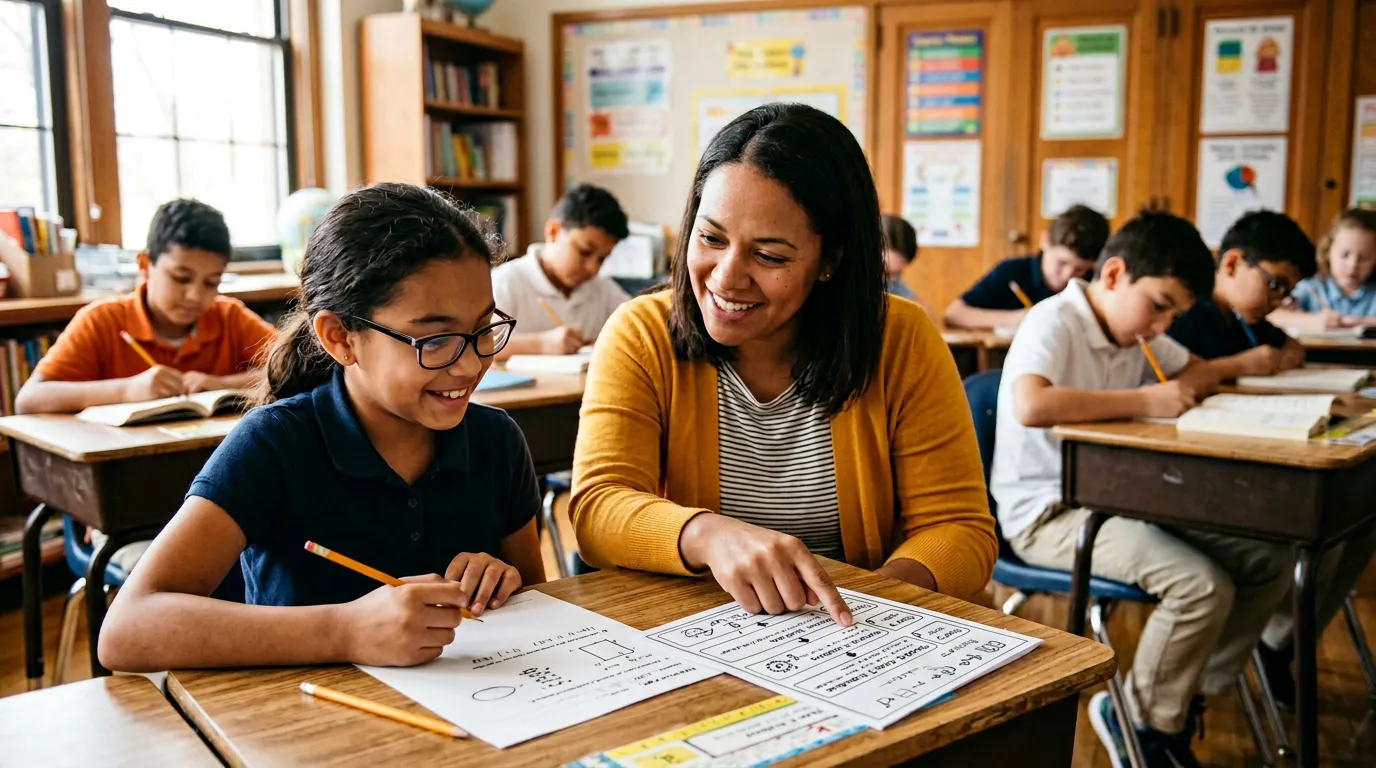
Your students just submitted their essays. You grade them, write detailed feedback, return them — and next week they make the same mistakes. Sound familiar? The missing piece is often not more teacher feedback. It is students who can evaluate their own work before handing it in.
Student self assessment is a reflective practice where learners evaluate their own understanding, skills, and progress against clear learning goals. Research shows that when students regularly self assess, they develop metacognitive skills that improve academic outcomes and reduce dependence on teacher feedback (Black and Wiliam, 1998; Hattie, 2012).
This guide explains what student self assessment is, why the research supports it, and how to implement it at every grade level from kindergarten through 12th grade. You will find six practical strategies, grade-level guidance, 15 ready-to-use reflection prompts, advice on keeping self assessment honest, and a comparison table to help you choose where to start.
What Is Student Self Assessment?
Student self assessment is the process by which students examine their own work or understanding against defined criteria, then make judgments about what they have mastered and what still needs attention.
It is distinct from two related practices. Peer assessment involves a classmate evaluating your work. Teacher assessment involves the educator making that judgment. In self assessment, the student is the evaluator, which is exactly the point. Shifting that cognitive work to the student is what makes this practice so effective.
The underlying mechanism is metacognition: thinking about one's own thinking. When a student asks "Do I understand this well enough to explain it?" or "Where did my reasoning break down?", they are doing the internal monitoring that accelerates learning. Barry Zimmerman's research on self-regulated learning (2002) identifies self-monitoring as a core component of high academic achievement across subjects and grade levels.
A 2025 meta-review of five decades of self-assessment research found that the field has grown substantially in K-12 contexts, with increasing attention to both the cognitive and affective benefits of regular self-evaluation beyond just performance outcomes (Tandfonline, 2025). The evidence base for this practice is broad and continues to strengthen.
Why Student Self Assessment Improves Learning Outcomes
The Research Foundation
John Hattie's Visible Learning meta-analysis of over 800 studies found that self-reported grades, a form of self assessment in which students predict and evaluate their own performance, have an effect size of 1.33, one of the highest of any teaching intervention (Hattie, 2009). To put that in context: the average teaching intervention has an effect size of around 0.40. Self assessment nearly triples that benchmark when implemented well.
Black and Wiliam's landmark review of over 250 studies established that formative assessment practices, including student self assessment, can move a class from the 25th to the 65th percentile in achievement (Black and Wiliam, 1998). Their work is foundational to everything we understand about feedback-driven learning.
The Education Endowment Foundation synthesized evidence from 51 studies involving over 64,000 students and found that metacognition and self-regulation strategies, the broader family of skills that includes self assessment, add an average of seven additional months of learning per year (EEF, 2023).
A 2022 meta-analysis by Yan and colleagues found a positive overall effect of self assessment on academic performance (g = 0.585), while also noting that 22.79% of self assessment interventions showed negative effects. The critical moderator: implementation quality. Self assessment works when it is taught explicitly and supported with clear criteria.
What Self Assessment Does for Students
When students self assess regularly, two things happen. First, they build metacognitive habits that transfer across subjects. A student who learns to ask "What do I still not understand?" in math class will eventually bring that habit to science, history, and beyond. Second, they begin to monitor their own understanding in real time rather than waiting for the teacher to catch their errors.
Research from the Learner-Centered Collaborative (2024) found that when students self assess against clear criteria, they are more likely to set higher goals and demonstrate more perseverance. Self assessment is not just a feedback tool. It is a motivation tool.
What Self Assessment Does for Teachers
When students identify misconceptions before submitting work, teachers spend less time diagnosing and correcting the same errors repeatedly. Self assessment redistributes some of the cognitive labor of feedback from teacher to student, where long-term it belongs. Teachers still provide feedback, but that feedback becomes more targeted and efficient because students have already done the first pass.
6 Practical Student Self Assessment Strategies
1. Self Assessment Rubrics
A self assessment rubric gives students explicit criteria for evaluating their own work. Instead of "How did I do?", a rubric asks "Did my argument include evidence? Was that evidence specific? Did I explain the connection?"
Why it works: Rubrics externalize the standards in the teacher's head and make them visible and consistent. Research by Heidi Andrade found that students who use rubrics before submitting work produce higher-quality drafts because they revise against the standard rather than just completing the task (Andrade and Valtcheva, 2009).
How to implement:
- Design or adapt a rubric with 3-4 criteria and 3-4 performance levels: not yet meeting, approaching, meeting, exceeding.
- Distribute the rubric at the start of the assignment, not only at grading time.
- Before submission, require students to rate each criterion and write one sentence explaining their rating.
- After you grade, return the rubric with your ratings alongside theirs. Over time, calibration between student and teacher ratings improves.
2. Traffic Light Self Check
Students indicate their current level of understanding with a color: green (I understand this well), yellow (I am partially sure), or red (I need more help).
Why it works: It lowers the barrier to honest disclosure. Many students will not raise their hand to admit confusion, but marking a card red or clicking a button feels far less public. The visual signal also lets teachers scan the room and redirect instruction immediately without calling on individual students.
How to implement:
- Provide red, yellow, and green cards, or use a digital polling tool with color choices.
- At a natural pause in the lesson, ask students to display the color matching their current understanding.
- Use the response to differentiate immediately: greens move to an application task, yellows work with a partner, reds receive direct teacher support or a worked example.
- Return to the traffic light at the end of the lesson to document progress.
3. Confidence Ratings
After completing a problem or activity, students rate how confident they feel on a scale from 1 to 5 (or 1 to 3 for younger students). Confidence ratings are particularly useful when paired with feedback, because students can see the gap between their confidence and their actual performance.
Why it works: A student who scores 30% but rated their confidence at 5 has a different instructional need than a student who scores 85% but rated their confidence at 1. Confidence ratings surface that distinction without extra diagnostic effort.
How to implement:
- After a quiz or practice set, ask students to circle a number from 1 (not confident) to 5 (very confident).
- Collect the data and compare confidence to accuracy. High confidence with low accuracy signals overestimation. Low confidence with high accuracy signals anxiety.
- Use patterns across the class to decide whether to reteach, extend, or move on.
Wayground's confidence rating feature allows students to rate their certainty after each quiz question, giving teachers immediate data on where understanding breaks down without requiring manual review of every individual response.
4. Learning Journals and Reflection Prompts
Students respond to structured prompts about their learning in a notebook or digital document, building both writing skills and metacognitive habits over time.
Why it works: Zimmerman's research on self-regulated learning (2002) demonstrates that self-regulatory writing, including goal setting and progress monitoring, improves academic performance across grade levels. Journals also create a running record that helps students notice patterns in their own learning.
How to implement:
- Choose 2-3 prompts that connect to your lesson objective (see the Ready-to-Use Reflection Prompts section below).
- Build 5 minutes into the end of the lesson or end of the week for journal entries.
- Do not grade every entry. Review journals periodically and leave brief written or verbal responses on selected entries.
- Ask students to review past entries at the start of a new unit to connect prior learning to new content.
5. Portfolio-Based Self Assessment
Students collect samples of their work over a defined period and write reflections comparing early and recent work, identifying growth and naming next goals. Portfolios work best at the end of a unit or semester.
Why it works: Portfolios make progress visible in concrete, undeniable terms. Students who struggle with day-to-day performance often respond differently to seeing clear evidence of their own improvement. The comparison process develops a more longitudinal sense of self as a learner (Paulson, Paulson, and Meyer, 1991).
How to implement:
- Establish what students will collect: specific assignment types, a defined number of pieces, or student choice.
- At the end of the collection period, ask students to write a reflection comparing their earliest and most recent work on the same task type.
- Provide sentence starters if needed: "At the beginning of this unit, I struggled with... Now I can... My next goal is..."
- Use portfolio reflections as the basis for student-led conferences or goal-setting conversations with families.
6. Exit Ticket Self Checks
Exit tickets combine a brief content question with a self assessment component. Students answer 1-2 questions about the lesson and rate their confidence or name one thing they still need to review.
Why it works: Exit tickets are a natural end-of-lesson routine that generates data with minimal time investment. Adding a self assessment layer, even a single confidence rating, turns the exit ticket from a teacher-only feedback tool into a student-facing metacognitive moment.
How to implement:
- Design the exit ticket with two layers: one content question and one self assessment question (example: "Rate your understanding today: 1, 2, or 3. What is one thing you are still unsure about?").
- Reserve the last 3-5 minutes of class.
- Review responses before the next lesson to identify which students need follow-up.
In Wayground, teachers can embed open-ended reflection questions directly into quizzes, so self assessment happens in the same workflow as practice, reducing friction for both teachers and students.
Quick Reference: Strategies at a Glance
Grade-Level Implementation Guide
K-2: Early Elementary
Young learners are still building self-awareness, so self assessment tools need to be concrete and visual. Abstract numerical scales are not developmentally appropriate at this stage.
Effective approaches include thumbs up (I got it), thumbs sideways (I mostly got it), and thumbs down (I need help). Smiley face, neutral face, and frowning face cards work similarly. "I can / I need help" T-charts with pictures alongside words are useful for literacy tasks.
Keep self assessment brief, under a minute, and always connected to a specific task. "Show me a thumbs up or down for how well you understood the story today" is more appropriate than asking for written reflection. The goal at this stage is building the habit of checking in with oneself at all.
Grades 3-5: Upper Elementary
Students in grades 3-5 can handle slightly more structured tools, including checklists with clear criteria, short written sentence prompts, and traffic light cards as a regular class routine.
Effective approaches include checklist self assessment ("Check each box if you included it in your writing: topic sentence, at least two details, a concluding sentence"), traffic light cards used consistently, and short sentence frames ("One thing I understood well today was... One thing I am still unsure about is...").
At this stage, begin introducing the vocabulary of learning levels. Students can use terms like "mastered," "still practicing," and "not yet" rather than only colors or symbols.
Grades 6-8: Middle School
Middle schoolers can engage meaningfully with structured rubrics, learning journals, and digital confidence rating tools. They are also old enough to examine patterns across assignments and identify recurring errors in their own work.
Effective approaches include rubric self assessment with teacher comparison and debrief, learning journals with 2-3 prompts per week, digital confidence ratings after practice sets, and error analysis on returned work. For error analysis, ask students to categorize their mistakes: conceptual misunderstanding, careless error, or didn't follow directions. Each category points to a different next action.
At this grade band, take time to explain what good self assessment looks like and why it matters. Students who understand the purpose of metacognition are more likely to engage with it honestly.
Grades 9-12: High School
High school students are capable of sophisticated self assessment, including portfolio reflection, student-led conferences, and goal setting tied to academic identity.
Effective approaches include semester portfolios with written reflections comparing growth over time, student-led conferences where students present evidence of their learning to a teacher or family member, and peer calibration exercises. For peer calibration, students independently rate a sample piece of work using the class rubric, then discuss their ratings as a group. This builds shared vocabulary for what "meeting the standard" actually looks like, which makes individual self assessment more accurate.
15 Ready-to-Use Reflection Prompts for Student Self Assessment
These prompts work as exit ticket questions, journal starters, or discussion openers. Adjust language complexity for your grade level.
Academic Understanding Prompts
- In your own words, explain the main concept from today's lesson. Where does your explanation feel incomplete?
- What is the most important thing you learned this week, and why does it matter?
- Rate your understanding of today's lesson from 1 to 5. What specific part are you most uncertain about?
- Write one question you still have about today's material.
- If you were teaching today's concept to a younger student, what would you say? What part would be hard to explain
Effort and Process Prompt
- How much effort did you put into this assignment? What would you do differently if you had more time?
- What strategy did you use to work through this problem? Did it work? Why or why not?
- Where did you get stuck today? What did you try in order to work through it?
- What is one thing you did well in this assignment? What is your evidence?
- Compare your effort on this task to your effort on the last similar task. What changed?
Next Steps Prompts
- What is one specific thing you want to understand better before the next test?
- What will you do differently on your next assignment based on what you learned from this one?
- What is your learning goal for the next two weeks? How will you know when you have reached it?
- Compare your work from the beginning of this unit to your most recent work. What has improved? What still needs attention?
- What kind of help or practice would benefit you most right now?
How to Ensure Students Self Assess Honestly
One of the most common teacher concerns about self assessment is accuracy. Students sometimes overrate themselves to appear confident or to avoid being assigned extra work. Others underrate themselves due to anxiety or low confidence. Both distortions undermine the practice.
Why Students Misrate Themselves
Overrating tends to happen when students associate self assessment with grades and want to protect their standing, when they lack clear criteria for distinguishing performance levels, or when they conflate effort with achievement ("I tried hard, so I must have done well").
Underrating tends to happen when students have high subject anxiety, when they confuse partial understanding with no understanding, or when they fear appearing arrogant for rating themselves highly.
Strategies for Building Accurate Self Assessment
Separate self assessment from grades. When students know their self assessment will not lower their grade, they are more willing to be honest. Grade the reflection process, not the accuracy of the self rating.
Teach calibration explicitly. Give students a sample piece of work and ask them to rate it using the class rubric. Compare their ratings to yours and discuss where and why they differed. Repeat this process until students develop a shared sense of what each performance level actually looks like (Andrade and Valtcheva, 2009).
Use anonymous digital tools. When students rate confidence digitally, rather than on paper with their name attached, they report more honest responses. Showing anonymous aggregate data, "60% of the class rated this concept as unclear," also normalizes admission of confusion.
Show students their own data over time. After several assessment cycles, share data comparing each student's confidence ratings to their actual performance. Students who see a consistent pattern ("You rate yourself as a 2 but typically score in the top third") develop more accurate self-monitoring because the evidence is personal and concrete.
Model uncertainty as a teacher. Say "I am not sure about the best approach here" or "I made a mistake earlier and want to correct it." Students follow the norms you establish. A classroom where uncertainty is normal is one where honest self assessment can take root.
A 2023 systematic review found that students' willingness to self assess honestly was strongly linked to whether they had received explicit training in how to do it (Educational Psychology Review, 2023). The practice is a skill, not an instinct.
Using Digital Tools for Student Self Assessment
Paper-based self assessment is effective, but digital tools offer two practical advantages: they make data collection automatic, and they can embed self assessment into the existing practice workflow rather than adding it as a separate step.
In a typical digital self assessment workflow, students complete a practice set, rate their confidence on each question or on the overall activity, and optionally respond to a reflection prompt. The teacher receives aggregate data showing which questions students felt least confident about and which students showed the widest gap between confidence and actual performance. That combination of behavioral data (correct or incorrect) and metacognitive data (confident or uncertain) provides a richer picture than correctness alone.
In Wayground, teachers can embed open-ended reflection questions directly into quizzes, so self assessment happens in the same workflow as practice, with no separate step required. A teacher running a review session does not need to pause and distribute exit tickets. The reflection prompt appears in the same interface students are already using.
During live Wayground sessions, reflection prompts can also be embedded between question sets. This creates a deliberate metacognitive pause: a moment built into instruction where students check in with their own understanding before the lesson moves forward.
The goal of any digital tool for self assessment is not to replace teacher judgment. It is to make the practice more consistent and less time-consuming. When self assessment is woven into the existing workflow, students do it every session. That consistency is what produces the cumulative metacognitive gains the research documents.
Getting Started with Student Self Assessment
Student self assessment is one of the highest-leverage practices available to K-12 teachers. The research is consistent: students who monitor their own understanding learn faster, set more ambitious goals, and rely less on teacher feedback for every decision.
You do not need to redesign your classroom to begin. Start with one strategy this week. A traffic light check at the end of a lesson takes under two minutes. A single reflection prompt added to your existing exit ticket requires no new materials. A rubric self check before submission asks students to do the evaluative work they should be doing anyway.
Key takeaways:
- Self assessment develops metacognition, one of the highest-impact skills in education research, adding up to seven additional months of progress per year.
- Effective implementation requires explicit teaching, clear criteria, and separation from grades.
- Grade-level differentiation matters: concrete visual tools for younger students, structured rubrics and digital tools for older ones.
- Honesty and accuracy improve gradually through calibration practice and a classroom culture that normalizes uncertainty.
- Digital tools make self assessment a consistent, low-friction part of every lesson rather than an occasional add-on.
Start with one strategy, observe what it reveals about your students' self-awareness, and build from there. The goal is not perfect self assessment on day one. The goal is a classroom where students develop the habit of asking, before you do: "How well do I understand this, and what do I need to do next?"
To explore how digital tools can make self assessment a regular, low-effort part of your classroom workflow, visit Wayground's assessment resources for K-12 educators.
References
Andrade, H., and Valtcheva, A. (2009). Promoting Learning and Achievement through Self-Assessment. Theory Into Practice, 48(1), 12-19.
Black, P., and Wiliam, D. (1998). Inside the Black Box: Raising Standards Through Classroom Assessment. Phi Delta Kappan, 80(2), 139-148.
Education Endowment Foundation. (2023). Teaching and Learning Toolkit: Metacognition and Self-Regulation. https://educationendowmentfoundation.org.uk/education-evidence/teaching-learning-toolkit/metacognition-and-self-regulation
Hattie, J. (2009). Visible Learning: A Synthesis of Over 800 Meta-Analyses Relating to Achievement. Routledge.
Hattie, J. (2012). Visible Learning for Teachers: Maximizing Impact on Learning. Routledge.
Learner-Centered Collaborative. (2024). Support Learner Self-Assessment. https://learnercentered.org/strategies/support-learner-self-assessment/
Paulson, F. L., Paulson, P. R., and Meyer, C. A. (1991). What makes a portfolio a portfolio? Educational Leadership, 48(5), 60-63.
Tandfonline. (2023). Students' experiences in self-assessment: training, processes and feedback use in secondary and higher education. Assessment and Evaluation in Higher Education. https://www.tandfonline.com/doi/full/10.1080/0969594X.2023.2284630
Tandfonline. (2025). Student self-assessment: a meta-review of five decades of research. Assessment and Evaluation in Higher Education. https://www.tandfonline.com/doi/full/10.1080/0969594X.2025.2510211
Yan, Z., et al. (2022). The effect of self-assessment on academic performance and the role of explicitness: a meta-analysis. Assessment and Evaluation in Higher Education. https://www.tandfonline.com/doi/full/10.1080/02602938.2021.2012644
Zimmerman, B. J. (2002). Becoming a self-regulated learner: An overview. Theory into Practice, 41(2), 64-70.
Find your way forward
FAQs
What is student self assessment and why does it matter?
Student self assessment is the process of learners evaluating their own understanding, skills, and performance against defined learning goals. It matters because it develops metacognition, the ability to monitor and direct one's own learning, which is among the highest-impact skills in education research. Regular self assessment shifts students from passive recipients of feedback to active agents in their own learning.
What does research say about the impact of self assessment on learning?
Hattie's Visible Learning meta-analysis found an effect size of 1.33 for self-reported grades, one of the highest of any teaching approach (Hattie, 2009). Black and Wiliam's foundational review showed that formative practices including self assessment can move students from the 25th to the 65th percentile in achievement. The EEF estimates these strategies add an average of seven additional months of progress per year (EEF, 2023).
How do I introduce self assessment to students for the first time?
Start with a concrete, low-stakes tool like a thumbs-up signal or a 1-3 confidence rating. Model the process explicitly using a sample piece of work, show students how to evaluate it against the criteria, and practice together before asking them to self assess individually. Research confirms that explicit training in how to self assess is the primary predictor of whether students find the practice useful (Educational Psychology Review, 2023).
What are the most effective student self assessment strategies?
Rubric-based self assessment, traffic light checks, confidence ratings, learning journals, portfolio reviews, and exit ticket self checks are the most research-supported approaches. The most effective strategy for your class is the one you can implement consistently, because regularity matters more than any single technique.
How do self assessment rubrics work?
A self assessment rubric lists the criteria for a task and describes what performance looks like at each level. Students use the rubric to rate their own work on each criterion before submitting it. Effective rubrics use concrete, observable language rather than vague descriptors.
What are confidence rating scales and how do I use them?
A confidence rating scale asks students to indicate how certain they feel about their understanding, typically on a 1-5 or 1-3 scale. Use them after practice problems or quizzes and compare confidence scores to accuracy scores. High confidence with low accuracy signals overestimation. Low confidence with high accuracy suggests anxiety that may be limiting performance. Both patterns guide specific next actions.
How do I know if students are self-assessing honestly?
Separate self assessment from grades, teach calibration using sample work, and use anonymous digital tools for initial confidence ratings. Over time, show students data comparing their confidence ratings to their actual outcomes. Honest self assessment develops gradually through consistent practice and a classroom culture that treats uncertainty as normal, not as failure.
What are good reflection prompts for student self assessment?
Effective prompts target understanding ("What specific part are you most uncertain about?"), process ("What strategy did you use and did it work?"), and next steps ("What will you do differently on the next assignment?"). The 15 prompts in this article are ready to use across grade levels and subjects.
How does student self assessment differ from peer assessment?
Self assessment involves a student evaluating their own work. Peer assessment involves a student evaluating a classmate's work. Both develop evaluative thinking and metacognition, but self assessment builds personal accountability and self-regulation, while peer assessment builds communication and analytical skills. The two approaches complement each other and are most effective when used together.
What self assessment approaches work best by grade level?
Younger students (K-2) need concrete visual tools: thumbs signals, smiley face cards, and simple "I can / I need help" charts. Upper elementary (grades 3-5) can use checklists, traffic light cards, and short sentence frames. Middle schoolers (grades 6-8) are ready for structured rubrics, learning journals, and digital confidence tools. High school students (grades 9-12) can handle portfolio reflection, student-led conferences, and peer calibration exercises.