
Think-Pair-Share: Complete Guide to Making It Work
You ask a question. Three hands go up. The same three students. The other 27 students look away, waiting for the moment to pass. This is one of the most common frustrations in classroom instruction, and it points to a deeper problem: most students never get enough time to actually think before they're expected to respond.
Think-pair-share is a cooperative learning strategy where students think individually about a question, discuss their ideas with a partner, then share insights with the whole class. Developed by Frank Lyman at the University of Maryland in 1981, this three-phase structure increases student participation by 73%, reduces anxiety through peer rehearsal, and improves achievement by 0.73 standard deviations compared to traditional instruction (Azlina, 2010; Johnson & Johnson, 1989).
This guide covers everything you need to use think-pair-share effectively: the research behind it, step-by-step implementation for each phase, subject-specific examples, troubleshooting solutions, and adaptations for diverse classrooms. Whether you're new to cooperative learning or refining your practice, you'll leave with strategies you can use this week.
What Is Think-Pair-Share?
Think-pair-share is a structured cooperative learning strategy built on a simple insight: students think better when they have time to process individually before speaking publicly. Rather than asking a question and calling on whoever raises a hand first, think-pair-share distributes thinking time across all students.
The three phases work together:
Think: Students reflect individually on a question or prompt for 30 seconds to 5 minutes depending on grade level and complexity. No talking occurs. Students write notes, sketch ideas, or think quietly. This individual processing time is what separates think-pair-share from ordinary class discussion.
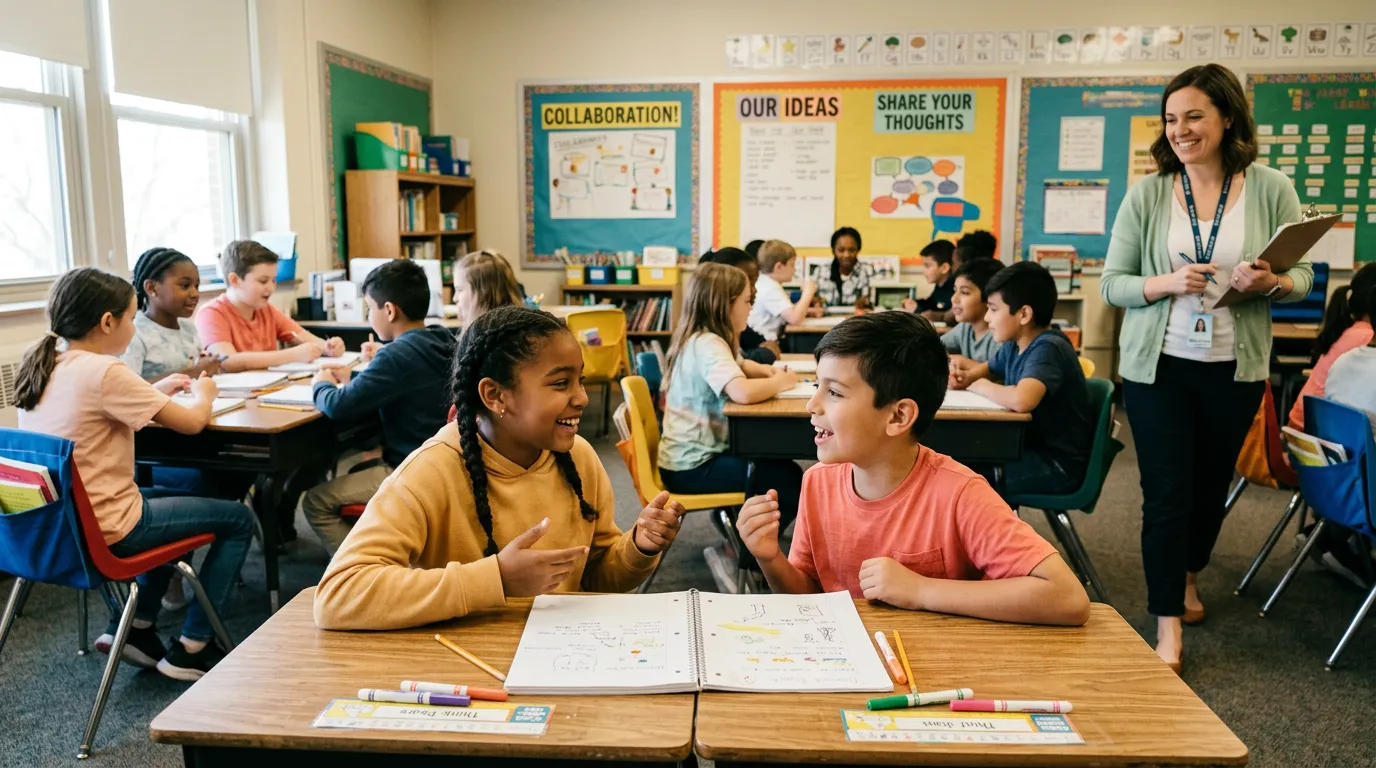
Pair: Students discuss their thinking with a partner for 2-5 minutes. Partners share ideas, ask clarifying questions, and build on each other's reasoning. This low-stakes conversation lets students rehearse ideas before the higher-stakes whole-class discussion.
Share: The teacher facilitates whole-class discussion by calling on pairs to contribute. Multiple pairs share, and the teacher connects ideas, probes deeper, and synthesizes key insights.
Why does this structure work? Research on wait time shows that giving students 3-5 seconds to think before responding increases depth and accuracy of responses by 400% (Rowe, 1986). Students who need more processing time, including English language learners and students with learning differences, benefit especially from built-in think time. The pairing phase adds a layer of rehearsal that reduces anxiety. According to the National Training Laboratories' Learning Pyramid, students retain 90% of what they teach others, which makes peer discussion a powerful consolidation tool.
Example: In a 7th-grade science class studying ecosystems, the teacher asks: "How would removing one species affect an entire food web?" Students jot notes for 90 seconds, then pair to compare predictions for 3 minutes. When pairs share, the class hears sophisticated analysis about cascading effects and interdependence. That depth rarely surfaces when only three hands go up.
The Research Behind Think-Pair-Share
Think-pair-share has one of the stronger evidence bases among cooperative learning strategies. Understanding this research helps you implement it more deliberately and explain its value to colleagues and administrators.
Kaddoura (2013) found that students using think-pair-share showed significant gains in critical thinking scores compared to traditional lecture-based instruction. The strategy's structure, requiring students to analyze, evaluate, and explain ideas to a partner, directly supports higher-order thinking.
Bamiro (2015) compared think-pair-share to guided discovery methods in chemistry classes and found higher achievement in the think-pair-share group. The researchers attributed this to increased engagement and the scaffolded structure that supports diverse learners without lowering expectations.
Azlina (2010) documented a 73% increase in student participation when using collaborative digital tools with think-pair-share. Participation gains this significant rarely come from curriculum changes alone.
Two additional data points are worth keeping in mind:
- Cooperative learning strategies increase achievement by 0.73 standard deviations compared to individual learning (Johnson & Johnson, 1989). At that effect size, a student performing at the 50th percentile moves to approximately the 77th percentile.
- Students retain 90% of what they teach others versus roughly 5% from passive listening (National Training Laboratories). The pairing phase is not just social. It is the consolidation mechanism.
Spencer Kagan, a leading cooperative learning researcher, notes that think-pair-share is most effective when combined with accountability structures that ensure equal participation. Maryellen Weimer, Professor Emerita at Penn State, adds that the pairing phase "reduces anxiety and allows students to rehearse ideas before public sharing," making the strategy valuable for students who hesitate in whole-class discussions.
The evidence points consistently in the same direction: think-pair-share increases participation, deepens thinking, improves achievement, and creates more equitable discussion. That combination is rare in low-prep strategies.
How to Implement Think-Pair-Share Step-by-Step
Effective implementation requires deliberate planning for each phase. Here is how to structure all three.
Phase 1: Think (Individual Reflection)
Pose a question that requires analysis, not just recall. Effective prompts are open-ended and invite diverse answers. "What is the definition of osmosis?" is a recall question. "Based on today's lab results, what can you infer about how cells respond to different salt concentrations?" is a think prompt.
Set a timer appropriate to grade level and complexity:
- Elementary (K-2): 30-60 seconds
- Elementary (3-5): 1-2 minutes
- Middle school: 2-3 minutes
- High school: 3-5 minutes
Enforce silence during think time. This is the most critical and most frequently skipped step. Ask students to write at least three ideas, draw a diagram, or write a short response in their notes. Written accountability ensures students process individually rather than waiting for their partner to think for them.
Subject-specific prompt examples:
- Math: "Explain why your solution method works. What mathematical principle are you applying?"
- English/Language Arts: "What evidence in the text best supports your interpretation of this character's motivation?"
- Science: "Based on our lab results, what patterns do you notice? What might explain them?"
- Social Studies: "What factors led to this historical event? Which factor do you believe was most significant, and why?"
Phase 2: Pair (Partner Discussion)
Pairing strategy affects outcomes. Three approaches to consider:
- Random pairing: Clock partners, playing card matches, or counting off ensures variety and builds classroom community over time.
- Strategic pairing: Partner students with complementary skills for specific tasks, such as pairing a strong writer with a strong analyst for a literary discussion.
- Flexible pairing: Vary your approach based on learning goals rather than defaulting to one method.
Allow 2-5 minutes for discussion. For brief concept checks, 2 minutes is sufficient. For complex analysis, extend to 5 minutes. Provide sentence stems for students who need support structuring academic discussion:
- "I think... because..."
- "My evidence is..."
- "I agree/disagree because..."
- "Can you explain what you mean by...?"
Circulate actively during pair time. Proximity keeps pairs on task. More importantly, listening to pair conversations gives you real-time formative assessment data. You will hear misconceptions forming before they calcify, and you can address them during the share phase.
Phase 3: Share (Whole-Class Discussion)
Call on pairs, not individuals. This distributes responsibility and reduces anxiety since both students have already rehearsed the answer together. Use phrases like: "What did your pair conclude?" or "Share one insight from your conversation."
Use random selection to maintain engagement and equity. Options include popsicle sticks with student names, a digital spinner, or random number assignment. When any pair might be called on, all pairs stay engaged.
Build connections between responses. After one pair shares, ask: "Did another pair reach a different conclusion?" or "How does what Marcus and Jasmine shared connect to what we heard from the first pair?" This builds coherent class discussion rather than a series of disconnected answers.
Vary sharing formats periodically:
- Popcorn: Pairs volunteer in any order
- Round-robin: Each pair shares briefly in turn
- Fishbowl: Two or three pairs discuss while others observe, then respond
- Gallery walk: Pairs record ideas on chart paper and tour each other's thinking
Probe for depth with follow-up questions. Do not accept the first response as complete. Ask students to explain reasoning, provide evidence, or consider alternative perspectives.
Think-Pair-Share Across Subjects
Think-pair-share works in every content area. Subject-specific framing helps you design prompts that generate productive discussion.
Math
Use think-pair-share for problem-solving explanations, not just answer-finding. Students who can explain why a method works understand mathematics at a deeper level than students who only apply procedures correctly.
Prompt: "Solve this equation two different ways. Explain to your partner which method you prefer and why."
English/Language Arts
Apply think-pair-share to text analysis, character discussion, vocabulary development, and argument evaluation. The strategy supports close reading by giving students processing time before discussion.
Prompt: "What evidence from the text best supports the author's central argument? Be ready to explain why you chose that evidence over other options."
Science
Integrate think-pair-share into hypothesis formation, data interpretation, and concept application. The structure aligns naturally with the scientific process of observation and inference.
Prompt: "Look at the data table from our experiment. What patterns do you notice? What could explain these results?"
Social Studies
Use think-pair-share for perspective-taking, source analysis, cause-effect reasoning, and current events. The strategy helps students develop evidence-based arguments rather than unsupported opinions.
Prompt: "Rank the top three factors that led to the American Revolution. Compare your ranking with your partner and be ready to defend your choices."
Elementary Classrooms
In K-5 classrooms, use shorter think times, visual prompts, and age-appropriate phrasing. "Turn and tell your partner" is functionally identical to think-pair-share and feels developmentally natural.
Prompt: "Tell your partner one new thing you learned today and why it surprised you or connected to something you already knew."
Quick Reference: Think-Pair-Share by Subject
Troubleshooting Common Challenges
Most implementation problems are predictable and solvable. Here are solutions to the six most common obstacles.
Students Talk During Think Time
Require written reflection before pairing. Students who must write three ideas before discussing are genuinely processing individually. Use clear visual signals such as a displayed timer or a silent hand signal to mark phase transitions. Explain to students why silent think time exists: when everyone processes first, the conversation is richer for everyone.
Pairs Go Off-Task
Give structured prompts rather than open instructions. Instead of "discuss with your partner," say: "Explain your reasoning to your partner using evidence from the text, then ask your partner one clarifying question." Set a visible timer. Circulate. Proximity is your most effective management tool. Building the norm that any pair might be called on keeps most pairs focused.
Same Students Always Share
Use random selection consistently. Call on pairs using popsicle sticks or a digital randomizer, and require both partners to be ready since either may be asked to speak. Implement a "no repeats" rule: once a pair shares, others contribute before they share again. The think-pair-square variation, where two pairs join to share with each other, also broadens participation before whole-class sharing.
Not Enough Time
A complete think-pair-share cycle does not need to take 15 minutes. Elementary classrooms can run a 3-4 minute cycle: 45 seconds think, 90 seconds pair, 2 minutes share. Build the routine so transitions are efficient. Over time, students move through phases quickly with minimal direction. For complex prompts, think-pair-share often saves time by reducing the repetitive re-explaining that follows mass confusion.
Unproductive Pairings
Rotate partners regularly, whether weekly, by unit, or by lesson. Explicitly teach collaboration norms: active listening, building on partner ideas, respectful disagreement. For persistent pairing problems, try trio configurations where a third student provides social buffer. Vary between assigned and student-choice pairing depending on the task and your knowledge of classroom dynamics.
Can't Assess Individual Learning
Follow think-pair-share with individual exit tickets that ask each student to summarize the key insight in two to three sentences. Take observation notes during pair conversations to document specific student contributions. In digital environments, platforms like Wayground allow teachers to collect individual responses during the think phase alongside collaborative discussion, giving you both individual assessment data and the benefits of peer learning.
Adapting Think-Pair-Share for Different Contexts
Remote and Hybrid Classrooms
Think-pair-share translates well to digital environments with deliberate design. During think time, students use shared documents, digital annotation tools, or discussion boards to record initial thinking. For pairing, assign breakout rooms with specific time limits and provide discussion prompts in the chat. During the share phase, use polling, chat responses, or digital whiteboards to capture contributions from all pairs.
Wayground's real-time collaboration workspace supports hybrid think-pair-share by enabling shared document work during the think phase and structured breakout discussions during pairing. When asynchronous schedules make real-time pairing difficult, a discussion-board version works: students post initial thinking, respond to a designated partner's post, then engage in synchronous whole-class discussion of themes that emerged.
English Language Learners
Provide sentence stems for all three phases. Extend think time by 50-100% to allow for processing in a second language. Consider allowing brief first-language discussion during pairing when it leads to richer thinking. Pair ELL students strategically, sometimes with a language peer for comfort, sometimes with a strong English speaker for language modeling. Provide written copies of prompts with any unfamiliar vocabulary pre-taught.
Students with Special Needs
Offer graphic organizers to structure thinking during the individual phase. Provide extended think time. Allow students to draw or diagram instead of write when that better represents their thinking. Brief instructional aide support during pair time can help some students engage more productively. Pre-teach vocabulary and provide prompts in writing as well as verbally.
Gifted Students
Raise the cognitive demand of prompts for advanced thinkers. Ask them to consider counterarguments, evaluate the strength of evidence, or connect the current concept to a broader principle. Use the think-pair-square variation and ask these students to synthesize across perspectives rather than simply share their own view. Position their contributions during the share phase to push whole-class thinking forward.
Grade-Level Time Recommendations
Variations and Extensions
Once the basic structure feels routine, these variations add depth and address different instructional goals.
Write-Pair-Share: Students write a full response during think time rather than just taking notes. This produces an artifact you can collect for formative assessment and ensures deeper individual processing.
Think-Pair-Square: After pairs discuss, two pairs join to form groups of four and share their best insights. Students hear twice as many perspectives before whole-class sharing, and the additional rehearsal builds confidence.
Think-Pair-Share-Compare: Two pairs compare their conclusions directly, identifying agreements, disagreements, and areas of uncertainty. This works especially well for prompts that have multiple defensible answers.
Gallery Walk Pairs: Partners walk together through posted prompts or student work samples, discussing each one. The combination of movement and structured discussion works particularly well for kinesthetic learners and long class periods.
Digital Think-Pair-Share: Students post initial thinking asynchronously on a discussion platform, respond to an assigned partner, then discuss themes synchronously. Carol Ann Tomlinson notes that varying question complexity, pair groupings, and sharing expectations allows think-pair-share to reach students across readiness levels without restructuring the whole lesson (Tomlinson, 2014).
Conclusion
Think-pair-share is deceptively simple. Three phases, a few minutes of structured time, and a meaningful question are all you need. But the mechanism behind those three phases, individual processing, peer rehearsal, public sharing, is one of the most well-documented sequences for deepening thinking and broadening participation.
Key reminders before you start:
- Design prompts that require analysis, not just recall
- Protect silent think time, it is the engine of the strategy
- Use random selection during the share phase to keep all students engaged
- Adapt timing and structure for your grade level and context
- Address challenges directly with accountability structures rather than abandoning the routine
Choose one section of this guide and apply it this week. If think time feels rushed in your classroom, focus on written reflection requirements. If the same students dominate sharing, start with popsicle sticks and a no-repeats rule. Small adjustments to an established routine produce noticeable results.
Looking to support collaborative learning in a digital or hybrid environment? Wayground's tools are designed to complement cooperative strategies like think-pair-share, whether your students are in the room, at home, or both.
References
Azlina, N. A. N. (2010). CETLs: Supporting collaborative activities among students and teachers through the use of think-pair-share techniques. International Journal of Computer Science Issues, 7(5), 18.
Bamiro, A. O. (2015). Effects of guided discovery and think-pair-share strategies on secondary school students' achievement in chemistry. SAGE Open, 5(1). https://doi.org/10.1177/2158244015574774
Johnson, D. W., & Johnson, R. T. (1989). Cooperation and competition: Theory and research. Interaction Book Company.
Kaddoura, M. (2013). Think pair share: A teaching learning strategy to enhance students' critical thinking. Educational Research Quarterly, 36(4), 3-24.
Lyman, F. (1981). The responsive classroom discussion. In A. S. Anderson (Ed.), Mainstreaming Digest (pp. 109-113). College Park, MD: University of Maryland College of Education.
National Training Laboratories. (n.d.). Learning pyramid. Bethel, ME: National Training Laboratories Institute.
Rowe, M. B. (1986). Wait time: Slowing down may be a way of speeding up. Journal of Teacher Education, 37(1), 43-50. https://doi.org/10.1177/002248718603700110
Tomlinson, C. A. (2014). The differentiated classroom: Responding to the needs of all learners (2nd ed.). ASCD.
Find your way forward
FAQs
What is the purpose of think-pair-share?
Think-pair-share increases participation, deepens thinking, and reduces anxiety by building in individual processing time and low-stakes peer discussion before whole-class sharing. It gives every student, not just quick processors or extroverts, time to develop ideas.
Is think pair share a formative assessment?
Yes, think-pair-share is a formative assessment strategy.
It allows teachers to quickly check student understanding during a lesson. As students think individually, discuss with a partner, and share with the class, teachers can observe their reasoning, identify misconceptions, and adjust instruction in real time. This makes think-pair-share an effective informal formative assessment.
How long should each phase take?
Think time ranges from 30 seconds for elementary simple prompts to 3-5 minutes for high school complex analysis. Pair time typically runs 2-5 minutes. Share time varies based on how many pairs contribute. Total cycle: 4-18 minutes depending on grade level and prompt complexity.
How do I ensure all students share, not just the same few?
Call on pairs randomly using popsicle sticks or a digital spinner. Require both partners to be ready since either one may be asked to speak. Use the "no repeats" rule. Think-pair-square also expands sharing by having small groups discuss before whole-class reporting.
Can think-pair-share work in remote or hybrid classrooms?
Yes. Use breakout rooms for pairing, digital annotation tools for think time, and chat or polling for sharing. The structure transfers well to asynchronous formats using discussion boards and designated partner responses.
How do I assess individual understanding when using think-pair-share?
Follow with individual exit tickets, brief written reflections, or observation notes taken during pair conversations. Digital tools that capture individual responses during think time allow you to document both individual understanding and collaborative engagement.
What subjects work best with think-pair-share?
Think-pair-share works across all subjects. It is particularly effective for open-ended questions requiring analysis, evaluation, or synthesis. Recall questions are better suited for quick whole-class checks. Any prompt that benefits from student explanation and multiple perspectives benefits from think-pair-share structure.
How often should I use think-pair-share?
Many teachers use think-pair-share daily as a core instructional routine. The strategy is flexible enough for frequent use without feeling repetitive when you vary prompts, pairing arrangements, and sharing formats. Use it whenever you want to check understanding, promote discussion, or engage all students in deep thinking.
What if students go off-task during pair time?
Provide structured prompts with specific instructions, circulate actively, and set visible timers. Building in accountability by telling students any pair might be called on keeps most students on task. If persistent off-task behavior occurs, examine whether the prompt is engaging and whether students have sufficient scaffolding for productive discussion.