
Turn and Talk: A Quick Guide to Increasing Student Engagement
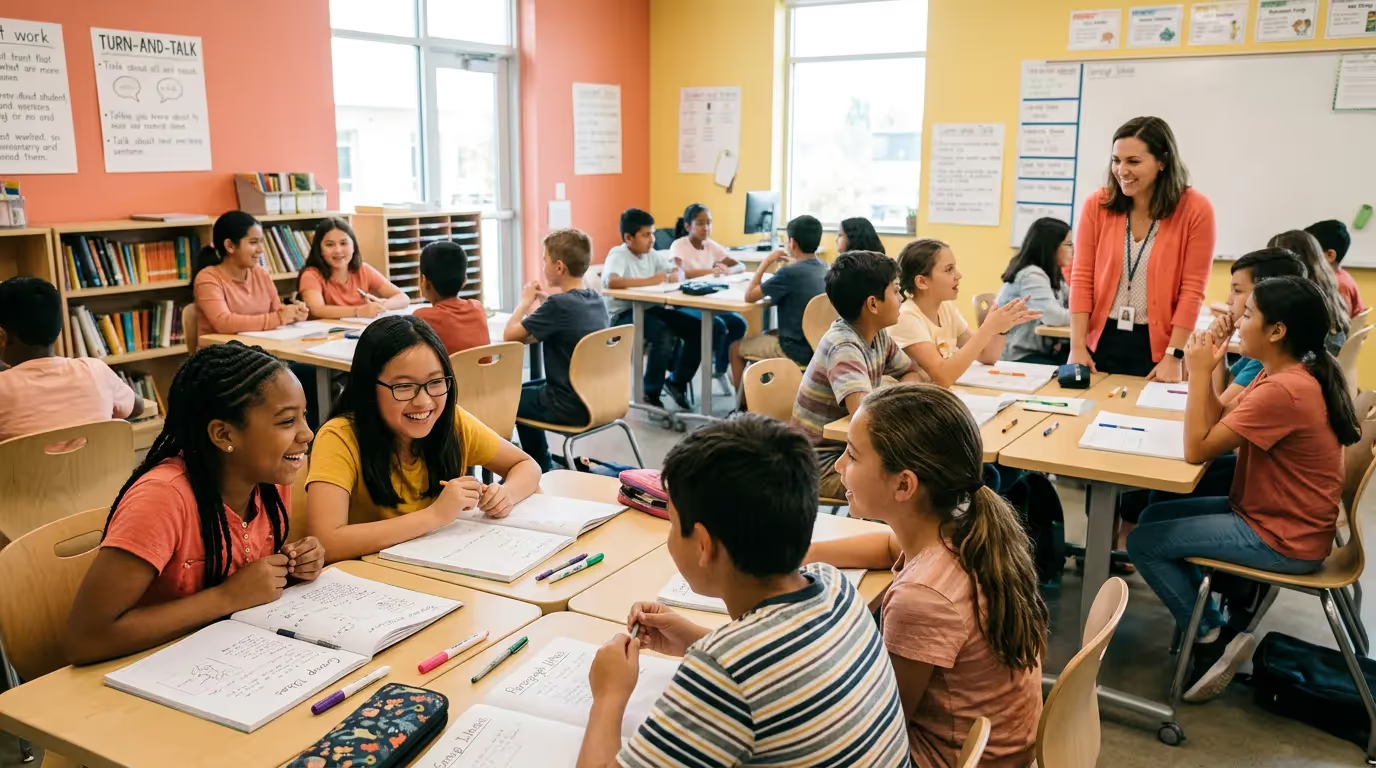
You're mid-lesson when you notice half the class zoning out. How do you re-engage students without derailing your instruction? A simple turn and talk gives every student a voice while keeping your lesson on track.
Turn and talk is a collaborative discussion strategy where students briefly turn to a partner to discuss a specific question or topic. This technique increases engagement, enables peer learning, and gives all students a low-stakes chance to process ideas before whole-class discussion. Research shows structured peer talk can increase academic engagement by 40-60% (McTighe & Lyman, 2011).
This guide explains what turn and talk is, how it differs from similar strategies, step-by-step implementation instructions for any grade level or subject, practical tips for maximizing effectiveness, and solutions to common classroom management challenges. You'll learn how to use this evidence-based technique to transform passive listeners into active learners—starting tomorrow.
What is Turn and Talk?
Turn and talk is a brief, structured conversation between two students in response to a teacher-posed question or prompt. Students physically turn toward a nearby partner, discuss the topic for 1-3 minutes, then return attention to the teacher for debriefing or continued instruction.
This strategy originated from cooperative learning research by Johnson and Johnson (1987), who found that structured peer interaction increases both achievement and positive attitudes toward learning. Spencer Kagan's research on cooperative learning structures identifies turn and talk (also called "Timed Pair Share") as one of the foundational structures for building student engagement and accountability (Kagan, 1994).
Key characteristics of effective turn and talk:
- Brief duration: 1-3 minutes per discussion
- Specific prompt: Clear question or task
- Structured pairs: Pre-assigned or strategic pairing
- Focused purpose: Aligns with lesson objective
- Accountability: Follow-up through share-out or observation
Turn and talk serves multiple instructional purposes. It activates prior knowledge before introducing new content, checks for understanding mid-lesson, provides processing time for complex concepts, generates ideas before writing or problem-solving, and maintains engagement during longer instructional blocks.
Turn and Talk vs. Think-Pair-Share
While similar, turn and talk and think-pair-share have distinct differences. Turn and talk is immediate discussion without individual thinking time, ideal for quick engagement or activating prior knowledge. Think-pair-share includes three phases: individual thinking (30-60 seconds), partner discussion (2-3 minutes), and whole-class sharing.
When to use each strategy:
- Turn and talk: Quick engagement, activating prior knowledge, maintaining momentum
- Think-pair-share: Complex questions, deeper analysis, building toward whole-class discussion
Many teachers use both strategies, choosing based on question complexity and available time.
Why Turn and Talk Works: The Research
Educational research consistently demonstrates the effectiveness of structured peer discussion. When students articulate ideas to peers, they engage in active processing rather than passive reception of information.
Cognitive benefits:
Turn and talk increases engagement and on-task behavior. Students stay focused when they know they'll need to discuss content with a partner. This technique also improves verbal reasoning skills—students practice formulating coherent explanations and defending positions. Additionally, it enhances listening comprehension as students must attend to partner contributions.
Social-emotional benefits:
This strategy builds classroom community through structured interaction. Students develop communication skills and practice turn-taking. For shy speakers, turn and talk provides a low-pressure environment to share before facing the whole class. Research from Webb (1991) shows peer explanation benefits both partners.
Equity benefits:
Turn and talk ensures participation from all students. English language learners practice academic language with peers. Students with processing differences gain extra formulation time. This inclusive structure is central to the Accountable Talk framework (Michaels & O'Connor, 2015).
Fisher and Frey (2014) found that students engaging in regular structured discussion show significant gains in comprehension and critical thinking.
How to Implement Turn and Talk: Step-by-Step
Successful turn and talk requires intentional planning and clear expectations. Follow these steps to implement this strategy effectively in your classroom.
Step 1: Establish Clear Procedures
Before using turn and talk, teach the routine explicitly. Demonstrate what productive partner talk looks and sounds like. Model a turn and talk with a student volunteer, narrating your thinking process. Then show a non-example (off-task talk or one partner dominating) and discuss why it's ineffective.
Essential procedures to establish:
- Voice level: Use "level 1" or "partner voice" (can only be heard by partner)
- Physical positioning: Face partner, knee-to-knee or side-by-side
- Time limit: Display a visible timer and honor the time constraint
- Turn-taking: Both partners speak (not one person doing all talking)
- Return signal: Choose a signal (chime, lights off, raised hand) to regain attention
Practice these procedures several times during the first week of school. Provide specific feedback on what students do well and what needs improvement. For more structured approaches to establishing discussion routines, see Wayground's classroom management strategies for collaborative learning.
Classroom Example:
Ms. Johnson teaches her 3rd graders the routine on day one. She models with her teaching assistant: "Watch how we face each other, knee-to-knee, using partner voices." They demonstrate 30 seconds of discussion, then Ms. Johnson raises her hand as the signal. Both stop immediately. "That's what I expect. Now watch what NOT to do." They model talking over each other and ignoring the signal. Students identify what was wrong. "Exactly! Now you try."
Step 2: Design Effective Prompts
The quality of your prompt determines the quality of student discussion. Avoid yes/no questions that end conversation quickly. Instead, craft open-ended questions that require explanation, analysis, or application.
Prompt frameworks that work:
- Explain why: "Turn and talk: Why do you think the character made that decision?"
- Compare/contrast: "Discuss how this solution compares to yesterday's strategy"
- Apply concepts: "How could you use this formula to solve a real-world problem?"
- Predict: "What do you predict will happen next? Why?"
- Connect: "How does this connect to what we learned last week?"
Avoid vague prompts like "discuss the reading" or "talk about the problem." Students need specific direction to have productive conversations.
Step 3: Strategic Partner Assignment
Partner selection significantly impacts turn and talk effectiveness. Random pairing works occasionally for variety, but strategic pairing produces better learning outcomes.
Pairing strategies:
Homogeneous pairing (similar ability): Use to differentiate prompts by instructional level.
Heterogeneous pairing (mixed ability): Use for peer teaching. Webb (1991) shows pairs work best when students are 1-2 levels apart.
Language considerations: Pair English learners with bilingual peers or strong English models.
Many teachers assign designated partners that rotate weekly or monthly, reducing transition time and building multiple relationships throughout the year.
Step 4: Monitor and Support
While students discuss, circulate purposefully. Listen to multiple pairs briefly rather than staying with one group. This allows you to assess understanding across the classroom and identify misconceptions to address.
What to listen for:
- Are both students participating?
- Are students staying on topic?
- Are explanations accurate?
- What misconceptions are emerging?
- Which ideas are worth sharing with the whole class?
Classroom Example:
Mr. Davis pauses his 7th-grade math lesson on solving two-step equations. "Turn to your partner. Explain the steps you used to solve 3x + 7 = 22. Walk through your thinking." As students discuss, he circulates with his clipboard. He stops briefly at four different pairs, listening for 15-20 seconds each. At the third pair, he overhears Marco saying, "First you subtract 22 minus 7..." Mr. Davis crouches down: "Marco, think about the goal. What are we trying to get x by itself?" Marco pauses: "Oh! Subtract 7 from both sides first, so 22 minus 7 equals 15." "Exactly. Now what?" "Then divide both sides by 3, so x equals 5." Mr. Davis nods and moves to the next pair, making a mental note to review inverse operations during the whole-class debrief.
Intervene strategically when pairs are off-task or stuck. Ask a probing question to redirect thinking: "What evidence from the text supports that idea?" or "How does that connect to the formula we learned?"
Step 5: Debrief Effectively
The debrief connects partner talk back to whole-class learning. Don't skip this step—it provides closure and reinforces key concepts.
Debrief options:
Selective share-out: Call on 2-3 pairs you overheard sharing accurate, interesting ideas.
Partner reporting: "Tell us what your partner said" encourages active listening.
Synthesis: Summarize themes: "I heard many discussing how the character's choice reflected his values."
Quick write: Have students write responses incorporating discussion ideas.
Keep debriefs brief (1-2 minutes) to validate thinking and clarify understanding.
Turn and Talk Across Grade Levels and Subjects
Turn and talk is remarkably versatile, adapting to any grade level or content area.
Elementary School (K-5)
Young students benefit from turn and talk but need extra scaffolding. Kindergarten and first-grade teachers should model extensively and keep discussions very brief (30-60 seconds initially). Use visual supports like conversation cards with sentence starters: "I think...", "I noticed...", "I wonder..."
Elementary examples:
- Reading: "Turn and talk: What do you predict will happen next in the story?"
- Math: "Explain to your partner how you solved this problem"
- Science: "Discuss what you observed during the experiment"
Classroom Example:
Mrs. Thompson reads aloud Charlotte's Web to her 2nd graders. She pauses after Wilbur meets Charlotte: "Turn and talk: How do you think Wilbur is feeling right now? What makes you think that?" Students turn to their carpet partners. She overhears Emma tell her partner: "I think he's scared because he doesn't know Charlotte yet. And she's a spider!" Her partner adds: "Yeah, but she's being nice to him, so maybe he'll be okay." After 45 seconds, Mrs. Thompson chimes her bell. "Eyes on me, partners. Emma, what did you and Marcus discuss?" Emma shares their thinking, and Mrs. Thompson affirms: "You used evidence from the story to understand Wilbur's feelings. That's what good readers do."
Middle School (6-8)
Middle school students can handle more complex prompts and longer discussions (2-3 minutes). They benefit from turn and talk as a way to process social-emotional content and practice argumentation skills.
Middle school examples:
- English Language Arts: "Discuss how the author's word choice creates mood"
- Math: "Debate which strategy is most efficient for this problem type"
- Science: "Compare your hypothesis with your partner's—how are they different?"
- Social studies: "Discuss multiple perspectives on this historical event"
Occasionally let students choose partners (with teacher veto power). Use discussion roles: one partner summarizes, the other asks clarifying questions, then switch.
High School (9-12)
High school turn and talk should push students toward analytical and evaluative thinking. Use this strategy to prepare for Socratic seminars, debates, or synthesis essays.
High school examples:
- Literature: "Analyze how this symbol reinforces the novel's theme"
- Math: "Critique this proof—is it valid? What assumptions were made?"
- Science: "Evaluate the strengths and limitations of this experimental design"
- History: "Argue whether this event was inevitable or contingent on specific decisions"
Extend by having pairs join for "square talk" discussions before whole-class sharing.
Content-Specific Applications
Math: Have students discuss problem-solving approaches after working independently. This reveals multiple solution paths.
Science: Use during experiments, before forming hypotheses, and when analyzing data.
English Language Arts: Prompt predictions, literary analysis, vocabulary discussions, and text connections.
Social Studies: Discuss multiple perspectives, cause-and-effect relationships, and primary sources.
Common Challenges and Solutions
Even experienced teachers encounter turn and talk challenges. Here's how to address the most common issues.
Challenge 1: Students Stay Off-Task
Solutions: Make prompts specific, check for understanding first, circulate and redirect immediately, and use accountable follow-up (random share-outs or written summaries).
Challenge 2: One Partner Dominates
Solutions: Assign discussion roles (Partner A speaks first, then B), use a talking token that exchanges hands, teach sentence starters, and coach dominant students privately.
Challenge 3: Difficulty Regaining Attention
Solutions: Use a distinctive signal (chime, lights) consistently, practice stopping immediately as a game, honor time limits, and use a countdown timer with audible alert.
Challenge 4: Uneven Participation
Solutions: Build in think time first, provide sentence starters, pair reluctant speakers with encouraging partners, and implement "no opt out" (ask students to share what their partner said).
Challenge 5: Surface-Level Discussions
Solutions: Upgrade prompts to analysis and evaluation, model high-quality discussions explicitly
- Teach talk moves: agreeing with evidence, respectfully disagreeing, asking for clarification, building on ideas
- Share exemplary discussions with the class and analyze what made them effective
Enhancing Turn and Talk With Digital Tools
While turn and talk is primarily an in-person strategy, digital tools can support and extend student discussions in meaningful ways.
Digital discussion prompts: Tools like Wayground allow teachers to display discussion questions with embedded images, videos, or graphs that students analyze during turn and talk. This multimedia approach provides rich content to discuss and can level the playing field for visual learners.
Accountability tools: Some teachers use quick digital check-ins after turn and talk. Students respond to a follow-up question on a learning platform, demonstrating their understanding of the discussion topic.
Virtual turn and talk: In remote or hybrid learning environments, breakout rooms serve as digital turn and talk. The same principles apply: clear prompts, brief time limits (1-2 minutes), and purposeful debriefing.
Digital tools should enhance, not replace, face-to-face discussion. The power of turn and talk lies in the immediate, personal connection between partners.
Conclusion
Turn and talk is a simple yet powerful strategy for increasing student engagement, deepening comprehension, and building classroom community. Here's what to remember:
- Start with clear procedures—teach and practice expectations before relying on this strategy
- Design specific, open-ended prompts that require explanation and analysis
- Assign strategic partners based on academic needs, language proficiency, and social dynamics
- Keep discussions brief (1-3 minutes) and monitor actively while students talk
- Debrief purposefully to connect partner discussions back to whole-class learning
Choose one upcoming lesson this week and plan 2-3 turn and talk opportunities at key transition points. Notice how it shifts energy, increases participation, and reveals student thinking.
Ready to build more collaborative learning routines? Explore Wayground's engagement strategies and tools designed to support active learning in K-12 classrooms.
References
Fisher, D., & Frey, N. (2014). Better Learning Through Structured Teaching: A Framework for the Gradual Release of Responsibility (2nd ed.). ASCD.
Johnson, D. W., & Johnson, R. T. (1987). Learning together and alone: Cooperative, competitive, and individualistic learning (2nd ed.). Prentice-Hall.
Kagan, S. (1994). Cooperative Learning. San Clemente, CA: Kagan Publishing.
McTighe, J., & Lyman, F. T. (2011). Cueing thinking in the classroom: The promise of theory-embedded tools. In A. L. Costa (Ed.), Developing Minds: A Resource Book for Teaching Thinking (3rd ed., pp. 243-250). ASCD.
Michaels, S., & O'Connor, C. (2015). Conceptualizing talk moves as tools: Professional development approaches for academically productive discussions. In L. B. Resnick, C. Asterhan, & S. N. Clarke (Eds.), Socializing Intelligence Through Academic Talk and Dialogue (pp. 347-362). American Educational Research Association.
Webb, N. M. (1991). Task-related verbal interaction and mathematics learning in small groups. Journal for Research in Mathematics Education, 22(5), 366-389.
Find your way forward
FAQs
How long should turn and talk discussions last?
Turn and talk discussions typically last 1-3 minutes. The specific duration depends on question complexity and student age. Younger students (K-2) do well with 30-60 seconds, while older students can sustain 2-3 minutes of focused discussion. Keep discussions brief to maintain momentum and prevent off-task behavior.
Should I assign partners or let students choose?
Strategic teacher-assigned partners generally produce better learning outcomes than student choice. Assign partners based on academic compatibility, language needs, and social dynamics. Rotate partnerships regularly (weekly or monthly) to build multiple relationships. Occasionally allowing student choice provides variety and respects social connections.
What if students have nothing to say during turn and talk?
This usually indicates the prompt is too vague or students lack sufficient background knowledge. Check for understanding before initiating turn and talk. Provide sentence starters to scaffold discussion: "I think... because..." or "One thing I noticed was...". If students still struggle, model a sample response or provide think time before partner discussion.
How do I handle students who refuse to participate?
First, investigate why: Is the student shy, lacking confidence, or genuinely oppositional? For shy students, allow written responses first or use strategic pairing with encouraging partners. For confidence issues, provide sentence starters and validate small contributions. For oppositional behavior, use private conversations to understand barriers and establish expectations.
Can turn and talk work with odd numbers of students?
Yes. Create one triad (group of three) when you have an odd number. Assign clear roles in triads: one student shares first, one responds, one synthesizes both ideas. Triads need slightly more time (add 30 seconds) and closer monitoring to ensure all three students participate.
How often should I use turn and talk in a lesson?
Use strategically 2-4 times per lesson at transition points: activating prior knowledge, checking understanding, processing information, and consolidating learning. Avoid overuse.
Does turn and talk work for all subjects?
Yes. In math, students explain problem-solving. In science, they discuss observations. In ELA, they analyze texts. In social studies, they explore perspectives. Craft prompts that require thinking, not just recall.
What's the difference between turn and talk and think-pair-share?
Turn and talk is immediate partner discussion without individual thinking time (1-3 minutes total). Think-pair-share includes three phases: independent thinking, partner discussion, and whole-class sharing (5-8 minutes total). Use turn and talk for quick engagement and think-pair-share for deeper, more complex questions.
How do I assess learning during turn and talk?
Circulate and listen to multiple pairs, noting understanding and misconceptions. After, use strategic call-outs, quick writes, or digital responses to gauge comprehension. This reveals thinking in progress, allowing you to adjust instruction.
Can English language learners benefit from turn and talk?
Absolutely. It provides low-pressure language practice. Scaffold with sentence frames, visuals, and strategic pairing (bilingual peers or strong English models). Allow home language use as needed.