
What Is a Socratic Seminar? A Complete Teacher's Guide to Running Student-Led Discussions
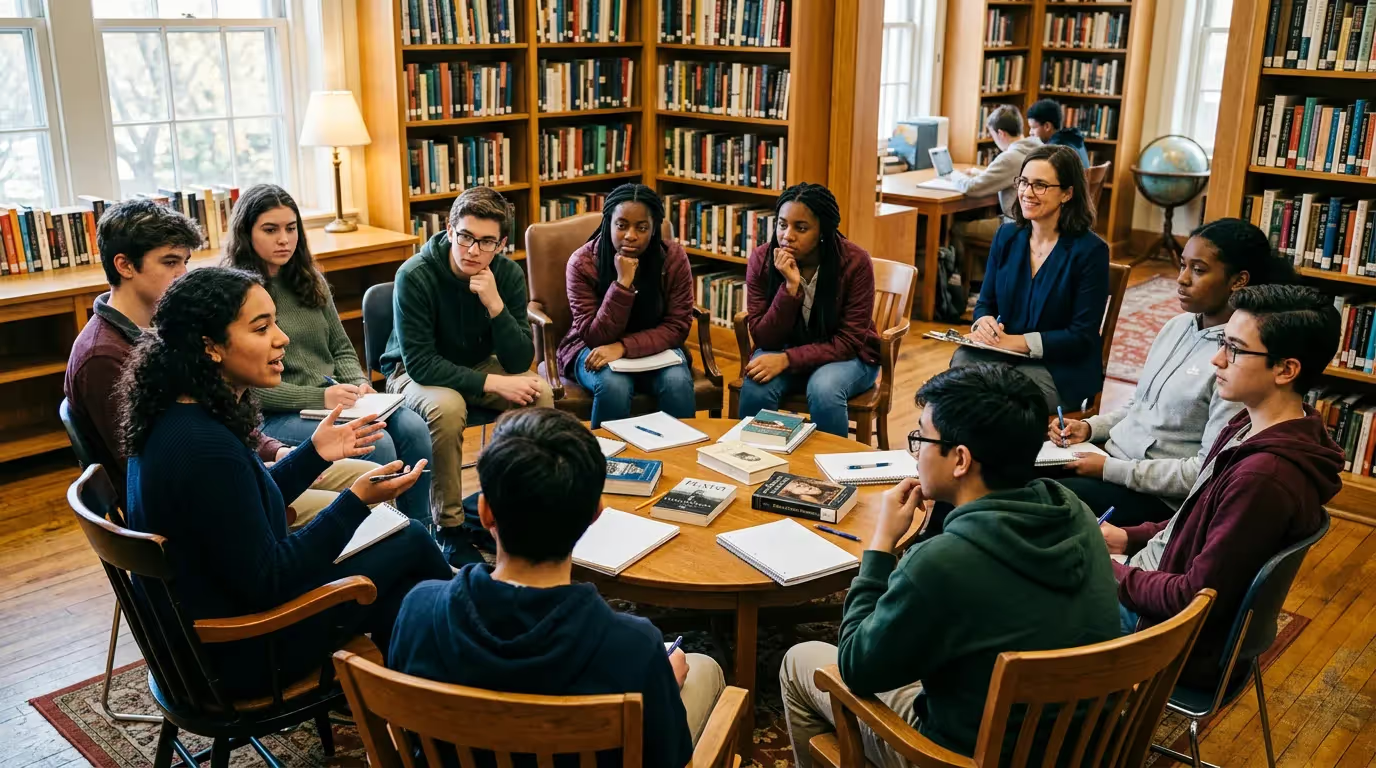
You ask a question. Three hands go up. The same voices fill the room, and 25 other students stare quietly at their desks. Getting students to think deeply, not just answer correctly, is one of the most persistent challenges in K-12 teaching.
A Socratic seminar is a structured discussion method in which students explore a complex text or idea through collaborative dialogue guided by open-ended questions. Rooted in the Socratic method of ancient Greece, it builds critical thinking, close reading, and respectful discourse. Research shows classroom discussion has an effect size of 0.82 on student achievement, nearly double the average educational intervention (Hattie, 2012).
This guide covers everything you need to run a successful Socratic seminar: what it is, why the research supports it, how to structure it step by step, which question stems to use, how to adapt it by grade level, and how to assess it fairly. By the end, you will have a replicable process you can use this week.
What Is a Socratic Seminar? Definition and Origins
A Socratic seminar is a formal discussion protocol built on the ancient Socratic method, the practice of using probing questions to surface assumptions and develop reasoned arguments. Socrates never lectured. He asked questions and pressed students to examine what they actually believed.
The modern K-12 adaptation was formalized by educational philosopher Mortimer Adler in his 1982 Paideia Proposal, which argued that students learn best not by passively receiving content but by wrestling with ideas through structured dialogue. The Paideia National Foundation has since developed and disseminated the format across thousands of schools.
What separates a Socratic seminar from a regular classroom discussion comes down to three features. First, it is always anchored to a specific text that students read and annotate in advance. Second, the questions are open-ended with no single correct answer. Third, students respond to each other rather than directing all comments to the teacher.
"Text" is a broad term here. A seminar text can be a written article, a primary source document, a data set, a poem, a photograph, or a short film clip. The defining requirement is that the source rewards close reading and generates genuine interpretive disagreement.
Socratic Seminar vs. Other Discussion Formats
| Format | Who Drives? | Collaborative? | Text Required? | Goal |
|---|---|---|---|---|
| Socratic Seminar | Students | Yes | Yes | Build shared understanding through inquiry |
| Traditional Discussion | Teacher | Partial | Optional | Cover content efficiently |
| Debate | Students | No (opposing sides) | Optional | Win an argument |
| Fishbowl Discussion | Students (rotating) | Yes | Optional | Include all voices in large groups |
The fishbowl is a specific variation of the Socratic seminar suited to large classes. An inner circle of 6-8 students discusses while an outer circle observes and takes notes, then groups rotate. Both formats share the same underlying principles.
Why Socratic Seminars Work: The Research Behind the Method
The evidence for structured student dialogue is substantial and spans multiple research traditions.
John Hattie's synthesis of over 1,200 meta-analyses, covering approximately 80 million students, found that classroom discussion produces an effect size of 0.82, placing it among the highest-impact instructional practices documented (Hattie, 2012). The average educational intervention has an effect size of 0.40. This means structured discussion is roughly twice as effective as a typical classroom practice.
The gains extend well beyond test scores. Polite and Adams (1996) found that approximately 80% of middle school students engaged in higher-order or metacognitive thinking after their school adopted Socratic seminar methodology. That figure is striking. Most traditional instruction keeps students at the knowledge and comprehension levels of Bloom's Taxonomy. Socratic seminars push them toward analysis, evaluation, and synthesis.
Structured discussion also deepens reading comprehension in ways that independent reading cannot replicate. Fisher, Frey, and Rothenberg (2008) demonstrated that students who participated in structured interactive discussions showed significantly deeper text comprehension compared to peers in non-discussion environments. When students must articulate and defend their interpretations aloud, they read more carefully and think more precisely.
One concern teachers raise is that discussion "wastes time" that could be spent covering content. Oyler and Romanelli (2014) tested this directly, comparing Socratic dialogue to traditional lecture. Students taught through Socratic dialogue outperformed the lecture group on performance outcomes, even though the lecture students initially rated their experience more positively. Covering less can mean retaining more.
The social-emotional benefits are equally well-documented. Concha and colleagues (2021) found that Socratic seminars offer direct pathways to developing all five CASEL SEL competencies: self-awareness, self-management, social awareness, relationship skills, and responsible decision-making. Furthermore, SEL programs that incorporate discussion-based practices improve academic performance by an average of 11 percentile points (CASEL, Durlak et al., 2011). Students practice listening actively, managing intellectual disagreement, and taking cognitive risks. These skills transfer well beyond the classroom walls.
The 4 Core Elements of an Effective Socratic Seminar
Every successful seminar contains four non-negotiable components. Understanding these before implementation prevents the most common first-timer mistakes.
1. A Rich, Complex Text
The text is the foundation. Without a worthy anchor, discussion drifts into unsupported opinion and personal anecdote. A strong seminar text:
- Requires interpretation, not simple recall
- Contains ambiguity, tension, or multiple valid perspectives
- Is grade-level accessible without being so straightforward that annotation is trivial
- Is short enough to read and annotate in one preparation session (typically 1-3 pages)
Good options across content areas: persuasive editorials, primary source documents, poem excerpts, ethical dilemmas in science, data visualizations, philosophical passages, or historical photographs. The requirement is not length or complexity. It is that the text generates genuine questions.
2. Genuine Open-Ended Questions
Question quality drives discussion quality. Open-ended questions have no single correct answer, invite multiple interpretations, and require students to reason from evidence. Closed questions shut down dialogue. "What is the main idea?" ends a conversation. "Whose voice is missing from this argument, and why does that matter?" opens one.
There are three question types to prepare: opening questions to launch the conversation, core questions to push deeper inquiry, and closing questions to synthesize insights. A full question stem library appears in a later section.
3. Student-Centered Facilitation
In a Socratic seminar, the teacher's role shifts from instructor to facilitator. This means resisting the urge to correct, validate, or supply answers. The teacher poses questions, manages the conversational flow, draws in quieter voices, and helps students notice contradictions or unexplored threads. Students are responsible for building on each other's contributions, asking follow-up questions, and disagreeing respectfully.
For most students, this level of autonomy feels unfamiliar at first. Explicitly teaching discussion moves before the first seminar, such as "Instead of saying 'I agree,' try 'Building on what Maya said...'" compresses the learning curve considerably.
4. Norms and Shared Agreements
Psychological safety is a prerequisite for genuine intellectual risk-taking. Before the first seminar, co-create a short list of discussion norms with your class. Norms developed collaboratively are more likely to be honored than norms handed down from the teacher. Common examples include:
- Speak to each other, not to the teacher
- Support your ideas with evidence from the text
- Listen to understand, not just to respond
- Disagree with ideas, not with people
- Invite quieter voices into the conversation
Post the norms visibly and revisit them briefly at the start of each seminar until they become habitual.
How to Run a Socratic Seminar: Step-by-Step
Step 1: Select the Text and Set a Learning Goal
Choose a text connected to your current unit that contains enough interpretive complexity to sustain 20-40 minutes of discussion. Write one learning goal framed around a thinking skill rather than content coverage. For example: "Students will examine how an author's perspective shapes their argument" rather than "Students will identify the main idea."
Step 2: Prepare Students in Advance
Send students home, or give class time, to read and annotate the text. Provide an annotation guide aligned to your questions: underline claims, circle evidence, star surprising ideas, write one question in the margin. A brief written pre-seminar response, completed before class, works well as a participation prerequisite. Students who arrive unprepared cannot contribute meaningfully, and the whole group suffers.
Step 3: Write Three Tiers of Questions
Prepare 2-3 opening questions, 4-6 core questions, and 1-2 closing questions. You will not use all of them. Prepare extras so you can respond to where the conversation actually goes. The question stem library in the next section provides ready-to-use templates organized by function.
Step 4: Arrange the Room
Physical arrangement signals ownership. Move desks into a circle so every participant can see every other participant. For large classes (25+), use a fishbowl: one inner discussion circle of 6-8 students, one outer observation circle. Rotate groups at a defined midpoint, usually the halfway mark.
Step 5: Open the Seminar
Begin with an opening question that is broad enough for every student to have an initial response, yet substantive enough to resist quick resolution. Give 30-45 seconds of silent thinking time before expecting responses. Resist filling silences. Thoughtful silence is a sign of engagement, not failure.
Step 6: Facilitate Without Answering
During the seminar, your primary moves are:
- Asking follow-up questions: "What in the text led you to that conclusion?"
- Inviting quiet voices: "Sam, we haven't heard your thinking yet."
- Surfacing contradictions: "Aisha, that seems in tension with what Darius said. Can you respond?"
- Redirecting to evidence: "Can someone find the specific line that supports that claim?"
What you avoid: agreeing, disagreeing, correcting, or offering your own interpretation. The moment you do, students start directing their answers to you instead of each other.
Step 7: Track Participation
Use a printed seating chart to tally contributions during the seminar. A dot per speaking turn, with a brief note distinguishing textual evidence from personal opinion or a peer reference, gives you enough data for grading and feedback. Wayground's live session participation tracking allows teachers to monitor student contributions in real time, which reduces the cognitive load of simultaneously facilitating and tracking who has spoken.
Step 8: Close with Reflection
Reserve the final 5 minutes for a closing question and individual written reflection. An exit slip asking "What idea from today's seminar has shifted or deepened your thinking?" serves as formative assessment and creates a record of intellectual growth over time.
Step 9: Assess and Debrief
Within 24-48 hours of the seminar, give students feedback on specific contributions, not just a grade. In the next class session, briefly debrief the process: What discussion moves worked? What would the group do differently next time? This metacognitive step accelerates improvement across successive seminars.
Socratic Seminar Questions: Stems and Examples
Question design is the highest-leverage preparation work a teacher does before a seminar. Hattie (2012) found that questioning as a teaching strategy carries an effect size of 0.48 on its own. Socratic seminars amplify that further by giving students ownership of the questioning process itself.
Opening Questions (Launch the Conversation)
Opening questions should be broad enough for every student to enter, yet complex enough to resist quick resolution.
- "What is the central tension in this text, and why does it matter?"
- "What surprised you most, and what does your reaction reveal about your assumptions?"
- "In one sentence, what is the author's core argument? What evidence best supports it?"
- "What question does this text leave unanswered?"
- "What is the most important word or phrase in this passage, and why?"
Core Questions (Deepen the Inquiry)
Core questions push students past surface reactions toward reasoned analysis.
- "What assumptions is the author making? Do you share those assumptions?"
- "Where does the evidence in this text get strongest, and where does it fall short?"
- "How does the idea in this text connect to what we studied in [previous unit]?"
- "If the author's argument is correct, what would have to follow?"
- "Who benefits from this perspective? Whose voice is absent?"
- "Building on [student's name]'s point, where does the text support or complicate that?"
Closing Questions (Synthesize and Reflect)
Closing questions move the group toward provisional conclusions and personal application.
- "What is the most important idea from today's conversation that you want to hold onto?"
- "How has your thinking shifted during this discussion?"
- "What question do you leave with that you didn't arrive with?"
- "What responsibility, if any, does understanding this idea place on us?"
For classes learning to lead seminars independently, assign student-generated questions as homework. Each student writes one opening and one core question before class. This deepens reading engagement and builds genuine ownership of the discussion. Wayground's structured question tools can scaffold this student-generated questioning process, particularly useful for classes developing this skill for the first time.
Adapting Socratic Seminars by Grade Level
One reason Socratic seminars remain underused in K-8 settings is the misconception that they belong exclusively to high school ELA. They work across all grades and subjects when adapted thoughtfully.
Elementary (K-5)
Elementary seminars work best with picture books or short illustrated texts that contain genuine interpretive tension. Keep sessions to 15-25 minutes. Provide visible sentence starters: "I think... because...", "I agree with [name] because...", "I wonder if...". Groups of 8-10 work better than full-class circles. Teachers take a more active facilitation role, modeling discussion moves explicitly before expecting students to use them independently. Even first graders can engage meaningfully with "What do you think the character should have done differently, and why?" when norms are clear and the text is well-chosen.
Middle School (6-8)
Middle school is the prime developmental window for Socratic seminars. Students are capable of sustained inquiry but still benefit from explicit instruction in discussion moves. Introduce the fishbowl format in 6th or 7th grade to manage larger classes and give all students a structured turn. By 8th grade, many students can write their own opening questions and take on facilitation roles. Sessions of 30-40 minutes are appropriate with a strong text. A ScienceDirect (2023) study of secondary students found that Socratic dialogue lessons were rated as motivating by students when connections to real-world relevance were made explicit, a finding particularly applicable to middle schoolers who are acutely sensitive to the question "why does this matter?"
High School (9-12)
High school seminars can be fully student-driven. Assign students to prepare opening, core, and closing questions as homework. Rotate the facilitation role across students over the course of a semester. Expand Socratic seminars across content areas: analyzing primary sources in social studies, examining scientific ethics in biology, comparing proof strategies in math, or exploring ambiguity in literature. Sessions of 40-50 minutes are appropriate for complex texts. Self-assessment rubrics, completed immediately after the seminar, deepen metacognitive development at this level.
How to Grade a Socratic Seminar
Grading discussion is one of the most frequently cited barriers to implementation. Two approaches are worth understanding.
Two Grading Philosophies
Quality-based grading evaluates the depth and analytical sophistication of a student's contributions. A student who speaks once and makes a textual reference that shifts the conversation earns full credit. A student who speaks six times with unsupported opinions does not. This rewards intellectual rigor and discourages filler contributions.
Participation-based grading evaluates whether students contributed meaningfully at least a minimum number of times and demonstrated active listening. This approach suits the beginning of the year, when students are still developing discussion skills and risk-taking requires explicit encouragement.
Neither is inherently superior. Many experienced teachers use participation-based grading for the first two seminars of the year, then shift toward quality-based grading as students develop confidence and fluency.
A Simple 4-Criteria Rubric
| Criterion | Exemplary (4) | Proficient (3) | Developing (2) | Beginning (1) |
|---|---|---|---|---|
| Preparation and text use | References text multiple times with specific evidence | References text at least once accurately | References text vaguely or without specific evidence | Shows no evidence of preparation |
| Quality of contributions | Introduces new ideas, advances analysis, complicates the conversation | Contributes relevant ideas connected to the discussion | Contributes but ideas are surface-level or repeated | Does not contribute, or contributions are off-topic |
| Listening and building | Explicitly builds on peers' ideas, paraphrases accurately | Responds to at least one peer's idea directly | Occasionally acknowledges peers but mostly makes independent points | Speaks without reference to what others have said |
| Respectful discourse | Consistently models respectful disagreement and inclusive language | Generally respectful; follows norms | Occasional lapses in respectful tone | Does not follow discussion norms |
Tracking Participation in Real Time
Tracking who speaks while facilitating is genuinely difficult. A printed seating chart with space for tally marks is the most tested low-tech solution. Mark the speaker after each contribution and add a quick notation: "+text" for textual evidence, "+build" for building on a peer, "?" for a student-generated question.
Wayground's real-time student contribution monitoring provides a digital participation record teachers can review after the seminar rather than trying to capture everything in the moment. Having specific data available during feedback conversations makes those conversations more productive and more equitable, since patterns of silence or dominance are visible rather than approximate.
Get Started This Week
Socratic seminars reward preparation, but they do not require perfection. For a first implementation, choose a text you already know well, write five questions across all three tiers, and run a 25-minute session. Afterward, ask your students two questions: What did the discussion help you understand better? What would make the next one stronger?
Here is what to carry forward from this guide:
- A Socratic seminar is student-led, text-anchored, and built on open-ended questions with no single correct answer
- The research case is strong: effect size of 0.82, higher-order thinking gains, deeper text comprehension, and direct connections to all five CASEL SEL competencies
- The four non-negotiables are a complex text, genuine open-ended questions, student-centered facilitation, and co-created norms
- Adapt format and session length by grade level: shorter and more scaffolded for elementary, fishbowl and growing autonomy for middle school, fully student-driven for high school
- Assess using a rubric that rewards preparation, contribution quality, active listening, and respectful discourse
The goal is not a perfect seminar on the first try. It is building a classroom culture where students do the intellectual heavy lifting, where listening is as valued as speaking, and where genuine curiosity drives the conversation forward.
Wayground's structured question tools and live session participation tracking support both the preparation and facilitation phases, giving you more capacity to focus on the conversation itself rather than the logistics around it. Explore how Wayground's live session features support discussion-based learning in your classroom.
References
- Adler, M. J. (1982). The Paideia Proposal: An Educational Manifesto. Macmillan.
- CASEL. (2011). Meta-analysis of SEL programs (Durlak et al., 2011 underlying study). Collaborative for Academic, Social, and Emotional Learning. https://casel.org/fundamentals-of-sel/
- Concha, C., et al. (2021). Social and Emotional Learning in Socratic Seminars. California State University ScholarWorks. https://scholarworks.calstate.edu/downloads/wp988r99w
- Fisher, D., Frey, N., & Rothenberg, C. (2008). Content-Area Conversations: How to Plan Discussion-Based Lessons for Diverse Language Learners. ASCD.
- Griswold, et al. (2017). Research summary on Socratic seminar effectiveness. ResearchGate. https://www.researchgate.net/publication/350646473_Socratic_Seminar
- Hattie, J. (2012). Visible Learning for Teachers: Maximizing Impact on Learning. Routledge. https://visible-learning.org/hattie-ranking-influences-effect-sizes-learning-achievement/
- Oyler, J., & Romanelli, F. (2014). The fact of ignorance: Revisiting the Socratic method as a tool for teaching critical thinking. American Journal of Pharmaceutical Education, 78(7). https://files.eric.ed.gov/fulltext/EJ1149230.pdf
- Polite, V., & Adams, A. (1996). Improving academic performance through structured classroom discourse. Journal of Negro Education, 65(1).
- ScienceDirect. (2023). Learning to think critically through Socratic dialogue: Evaluating a series of lessons designed for secondary vocational education. Thinking Skills and Creativity. https://www.sciencedirect.com/science/article/pii/S1871187123001906
Find your way forward
FAQs
What is a Socratic seminar?
A Socratic seminar is a structured student-led discussion anchored to a complex text. Students use open-ended questions and evidence-based reasoning to explore ideas collaboratively. The teacher facilitates rather than lectures. Research shows Socratic seminars significantly improve critical thinking, reading comprehension, and social-emotional skills (Hattie, 2012; Polite & Adams, 1996).
How long should a Socratic seminar last?
Most seminars run 25-50 minutes depending on grade level. Elementary students generally sustain 15-25 minutes; middle schoolers 25-40 minutes; high schoolers up to 50 minutes. Including preparation and post-seminar reflection, plan for 70-90 minutes of total instructional time.
What texts work best for a Socratic seminar?
The best texts are complex, interpretive, and short enough to annotate in one sitting. Strong options include persuasive editorials, primary source documents, poem excerpts, ethical dilemmas in science, data visualizations, and philosophical passages. Avoid texts with a single correct answer. The text must generate genuine interpretive disagreement.
How do you write Socratic seminar questions?
Effective questions are open-ended (no single right answer), rooted in the text, and genuinely debatable. Write three tiers: opening questions to launch the conversation, core questions to push deeper, and closing questions to synthesize. Avoid questions answerable with a direct quote or a simple yes/no.
What is the difference between a Socratic seminar and a fishbowl discussion?
A fishbowl is a format variation of the Socratic seminar designed for large classes. An inner circle of 6-8 students discusses while an outer circle observes and prepares to respond, then groups rotate. The Socratic seminar is the broader discussion protocol; fishbowl is one configuration for implementing it.
How do you grade a Socratic seminar?
Use a rubric with 4-5 criteria covering preparation, contribution quality, active listening, and respectful discourse. Two main grading philosophies exist: quality-based (rewards analytical depth regardless of how often a student speaks) and participation-based (rewards meaningful contribution at a minimum frequency). Track contributions during the seminar with a seating chart tally or digital participation tool.
How do you handle students who dominate or stay silent?
For dominant speakers: establish a norm that at least three other people must respond before someone speaks again, or use talking chips (each student has two chips to spend per discussion). For silent students: assign a pre-seminar written response, give think time before opening, or use a round-robin only for the first two minutes. The fishbowl format naturally limits individual speaking time by rotating groups.
Can Socratic seminars work in subjects other than ELA?
Yes. Socratic seminars are well-suited to social studies (examining primary sources, debating historical interpretations), science (discussing research ethics, analyzing data), and math (reasoning through proof strategies, comparing approaches). The key is selecting a text or problem that requires interpretation rather than computation or recall.
How do you run a Socratic seminar with younger students (elementary)?
Use picture books or short illustrated texts. Limit sessions to 15-25 minutes. Provide visible sentence starters and work with smaller groups of 8-10. Take a more active facilitation role and model discussion moves explicitly before the seminar begins. Pre-seminar discussion circles that build background knowledge lower the entry barrier for younger students.
How do you run a virtual Socratic seminar?
Use video conferencing with gallery view so all participants can see each other. Establish a chat channel for students who prefer written contributions. Assign a student to monitor chat and read contributions aloud. Use breakout rooms for a virtual fishbowl. Asynchronous discussion boards work well as pre-seminar preparation or as follow-up for students who could not contribute during the live session.