
How to Create Fill-in-the-Blank Questions for Deeper Learning
.avif)
Key Takeaways:
- Fill-in-the-blank questions are constructed-response items where students supply missing words, numbers, or labels without answer choices.
- Teachers use them for quick checks before, during, and after instruction when prompts and scoring expectations are clear.
- Clear prompts and defined acceptable answers make results easier to interpret, and Wayground’s Quiz Maker lets you enter multiple acceptable answers.
Fill-in-the-blank questions are often used for vocabulary checks, but they can also reduce guessing compared with multiple-choice questions. When prompts are specific and expectations are clear, they can assess more than simple recall.
This article explains what fill-in-the-blank questions are and how teachers use them in middle school classrooms. It includes practical guidance and classroom examples, plus a brief overview of tools that support creation and differentiation.
At a Glance: Fill-in-the-Blank Questions
What Are Fill-in-the-Blank Questions?
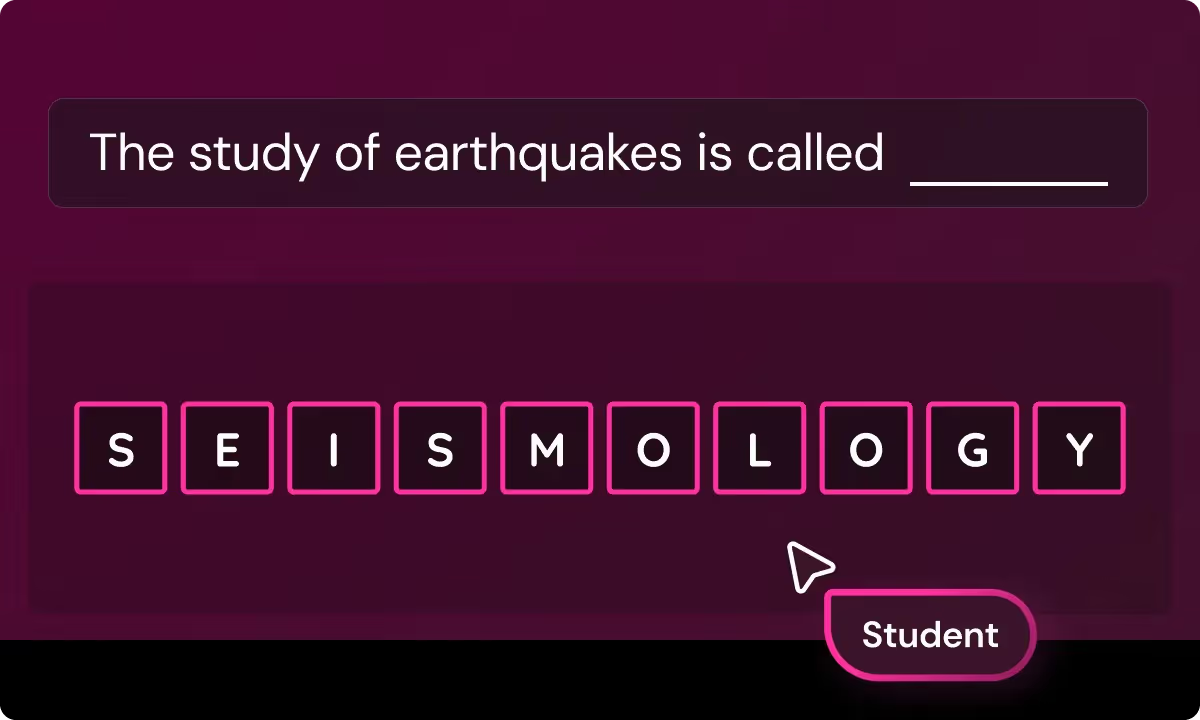
Fill-in-the-blank questions are assessment items where students supply missing words, phrases, numbers, symbols, or labels to complete a sentence, diagram, or data set. They do not include answer choices, so students must generate a response.
Fill-in-the-blank questions:
- are prompts with one or more missing parts
- require students to produce an answer
- can have one correct answers or multiple acceptable answers
They are built around a statement or visual with a blank space that represents the missing information. The blank can appear in a sentence, table, chart, or diagram.
They are a constructed-response format. Students write the missing information instead of selecting from options, which reduces cues from answer choices.
Depending on the prompt, they may have a single expected response or several acceptable variants (for example, symbols, abbreviations, or equivalent terms). The University of Texas notes that this format can limit guessing compared with selected-response items and can be harder to score when more than one correct answer is possible.
Pros and Cons of Fill-in-the-Blank Questions
Fill-in-the-blank questions have clear advantages and limitations. Reviewing both helps you decide when they fit your goal, your learners, and your grading workflow.
Pros
They can check knowledge quickly while requiring students to generate an answer.
- Efficient to write: You can create them without writing distractors, which often takes more time in multiple-choice.
- Supports retrieval practice: Students must produce an answer instead of selecting one, which can reduce guessing and strengthen recall. For repeated retrieval, turn key terms into a quick deck with the Flashcard Maker.
- Flexible for differentiation: You can add learning aids (word banks, sentence starters, visuals) or remove them to increase difficulty without changing the concept being assessed.
- Useful for formative checks: They work well for warm-ups, exit tickets, and short quizzes when you need a fast snapshot of understanding.
Cons
They can be harder to interpret if prompts are vague or scoring rules are not defined.
- Can be unclear: If the prompt allows multiple valid answers or the blank is underspecified, results are harder to interpret.
- May overemphasize recall: If most items target isolated terms, they measure memorization more than understanding or application.
- Can add language load: Multilingual learners and students with reading challenges may be affected by phrasing, spelling, or context demands.
- Scoring can be inconsistent: Open responses often require decisions about spelling, phrasing, and acceptable alternatives.
Many of these challenges can be reduced with clear prompts and defined scoring rules. For print practice, use the Wayground Worksheet Generator to create a quick set students can complete on paper.
How Fill-in-the-Blank Questions Are Used
You can use fill-in-the-blank questions to check what students can recall and apply without answer choices. They work well for short checks during and after instruction.
Use Them to Check Readiness at the Start of a Lesson
Use them as bell ringers or warm-ups to verify prerequisite knowledge before introducing new content. For example, before a lesson on chemical reactions, ask students to complete: “A ____ is a substance present at the start of a chemical reaction, and a ____ is formed as a result.” Review responses to decide whether to reteach key terms or proceed.
Use Them to Monitor Understanding During Instruction
Use them in short checks during guided practice to see whether students are following the concept in real time. Keep blanks tied to the lesson objective so you can quickly identify which step of a process students are missing.
Use Them to Confirm Understanding After Instruction
Use them for exit tickets, station work, and mini-quizzes to confirm learning targets at the end of a lesson or unit segment. For example, after a photosynthesis lesson, an exit ticket might ask: “Plants use ____ from the air and ____ from the soil to make glucose.” Use results to plan review, small-group support, or extension.
Examples of Fill-in-the-Blank Questions
Use these examples as templates. Swap in your current unit content and adjust the blank to match what you want to measure.
Science
- “During photosynthesis, plants take in ____ from the air and release ____.”
- “In the water cycle, liquid water turns into water vapor through ____.”
- “The force that pulls objects toward Earth is called ____.”
- “A closed circuit needs a complete ____ for electricity to flow.”
Math
- “The slope formula is (y₂ − y₁) ÷ (____ − ____).”
- “The area of a rectangle is length × ____.”
- “Solve: 4x = 20. x = ____.”
- “A right triangle satisfies: a² + b² = ____.”
English Language Arts
- “A noun is a word that names a ____.”
- “In the sentence ‘The cat slept,’ the verb is ____.”
- “A synonym is a word with a similar ____.”
- “The author’s main claim is ____.”
Social Studies
- “The first 10 amendments to the U.S. Constitution are called the ____.”
- “One cause of the American Revolution was ____, and one result was ____.”
- “A primary source is an original ____ from the time period being studied.”
- “The Great Depression began in ____.”
World Languages
- “In Spanish, ‘hola’ means ____.”
- “In Spanish, ‘gracias’ means ____.”
- “In French, ‘merci’ means ____.”
- “In German, ‘Guten Morgen’ means ____.”
You can browse ready-made fill-in-the-blank quizzes in the Library.
Create Fill-in-the-Blank Questions with Confidence
Fill-in-the-blank questions work best when prompts are specific and scoring expectations are clear. Teachers use them to check recall, monitor understanding during instruction, and confirm learning at the end of a lesson.
In practice, they appear as warm-ups, quick checks, and short reviews using quizzes, worksheets, or flashcards. If you want to build and assign a set digitally, Wayground’s Quiz Maker is one option. The goal is straightforward: collect clear evidence of what students know so you can decide what to do next.
Find your way forward
Fill-in-the-Blank Questions: Frequently Asked Questions (FAQs)
How many blanks should I include per question for maximum clarity?
Use 1–2 blanks per item. More blanks can increase cognitive load and make it harder to identify what the question is measuring. If you include more than one blank, keep them tied to the same concept and avoid blanks that depend on minor wording choices.
How can I make fill-in-the-blank questions inclusive for multilingual learners?
Use short sentences, familiar sentence structures, and consistent vocabulary. Avoid idioms and cultural references that add meaning beyond the content. Offer supports when the goal is content knowledge (for example, word banks for technical terms or a glossary) and keep expectations consistent across students.
What's the best way to handle alternative correct answers when grading?
Define acceptable variants before students take the assessment (spelling, capitalization, symbols, units, and common synonyms). Use a scoring rule that matches your goal: exact match for precision, or contains/partial rules when wording can vary, but the concept is correct. Wayground supports multiple correct answers for fill-in-the-blank items.
How can I grade fill-in-the-blank questions efficiently without sacrificing fairness?
Grade one question at a time across the class to apply the same criteria to all responses. Review a sample first to identify common correct variants, then finalize the answer key. Use consistent rules for spelling and formatting so students are evaluated on the target concept, not writing conventions.