
How to Write Multiple Choice Questions That Truly Measure Understanding
.avif)
Key Takeaways:
- Effective multiple choice questions are grounded in clear learning targets, bias-free language, and carefully designed distractors.
- Inclusive and accessible question design ensures assessments measure true understanding for all learners, not just reading or test-taking skills.
- Leveraging tools like Wayground's Quiz Maker and AI-supported drafting can streamline the assessment cycle, allowing educators to rapidly create, pilot, revise, and reflect on questions that genuinely support student progress.
Multiple choice questions (MCQ) are one of the most widely used assessment formats in education. They’re familiar, efficient, and easy to score, but they’re also often misunderstood. When written poorly, multiple choice questions can reward guessing, test memorization instead of understanding, and provide little insight into how students actually think.
When written well, however, multiple choice questions can do much more. Research shows that well-constructed MCQs can assess higher-order thinking like analysis and evaluation, especially when items include novel scenarios or require transfer to new contexts.
At a Glance: Multiple Choice Questions
What Are Multiple Choice Questions?
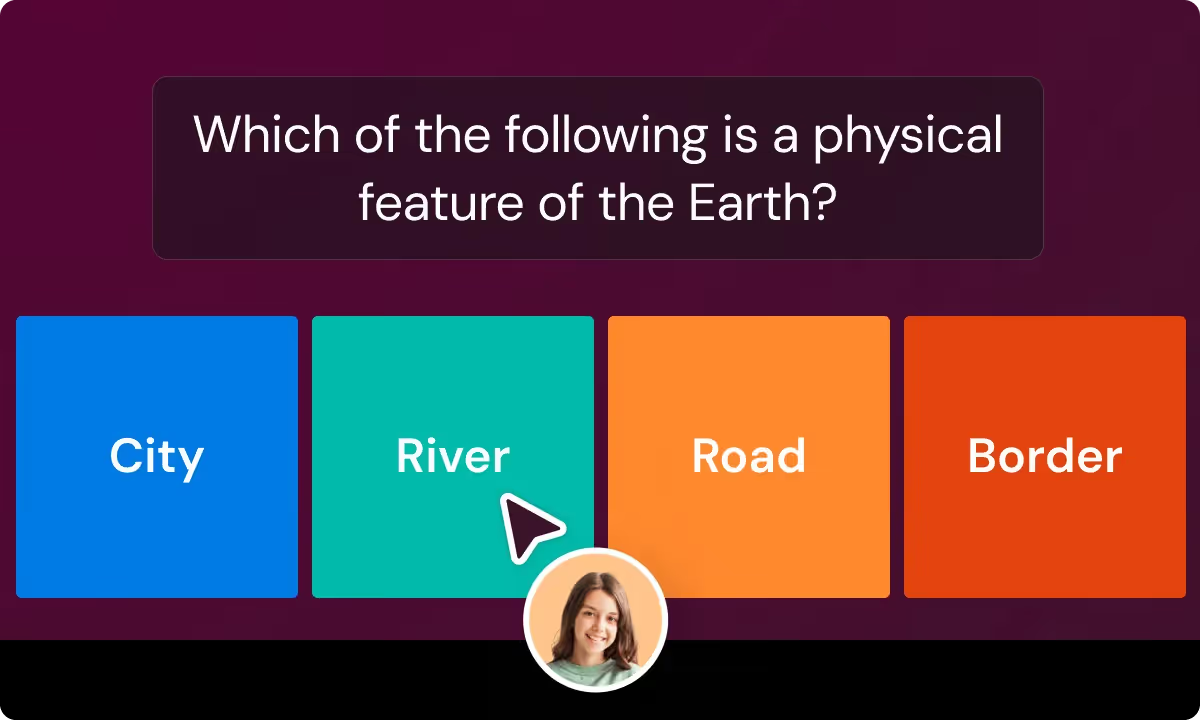
Multiple choice questions (MCQs) present learners with a prompt and a set of possible answers. Typically, one option is correct, while the remaining choices, often called distractors, are designed to reflect common misunderstandings or incorrect reasoning.
A standard multiple choice question includes:
- A clear question or statement (the stem)
- One correct answer
- Several plausible incorrect options
- Consistent formatting and structure
While MCQs are often associated with basic recall, they are capable of assessing much more when designed thoughtfully. The key lies in how the question is framed and how the answer choices are constructed.
Good vs. Poor Multiple Choice Questions
A poorly written multiple choice question:
- Is vague or confusing
- Uses obvious or unrealistic distractors
- Tests trivial facts
- Can be answered through guessing or test-taking tricks
A well-written multiple choice question:
- Is clear and focused
- Tests an important learning objective
- Uses plausible distractors
- Requires understanding, not memorization
The difference between the two has a major impact on how useful the assessment is for both students and educators.
Why Multiple Choice Questions Still Matter
Despite criticism, multiple choice questions remain popular for good reason. They allow educators to assess learning efficiently, consistently, and at scale. When aligned with clear learning goals, MCQs can provide reliable data about student understanding while saving valuable instructional time.
They’re especially effective when:
- Assessing large groups of learners
- Conducting formative or summative assessments
- Checking understanding quickly
- Comparing performance across students or classes
The challenge isn’t the format. It’s how the questions are written.
Pros and Cons of Multiple Choice Questions
Understanding the strengths and limitations of multiple choice questions helps educators use them more intentionally.
Pros of Multiple Choice Questions
- Efficient to administer and grade
- Provide consistent scoring
- Reduce grading bias
- Allow for broad content coverage
- Work well for formative and summative assessments
- Can reveal common misconceptions through distractors
According to a study, MCQs can assess more than surface-level knowledge and provide valuable insights into student learning.
Cons of Multiple Choice Questions
- Can encourage guessing
- May overemphasize recall if poorly written
- Do not always show reasoning or thought process
- Can be time-consuming to write well
- Limited insight without follow-up explanation
These limitations highlight the importance of thoughtful design and strategic use, rather than reliance on multiple choice questions alone.
How to Write Multiple Choice Questions That Work
Strong multiple choice questions don’t happen by accident. They require intentional planning and careful wording.
Start With a Clear Learning Objective
Before writing a question, clarify what you want students to demonstrate. Are you assessing:
- Knowledge of a concept?
- Understanding of a process?
- Ability to apply information?
- Recognition of common misconceptions?
A clear objective ensures the question measures what matters most.
Write a Clear, Focused Stem
The stem should clearly state the problem or question without unnecessary complexity. Avoid:
- Tricky wording
- Double negatives
- Irrelevant information
Students should understand what’s being asked before they look at the answer choices.
Make Distractors Plausible
Effective distractors are one of the most important elements of a good MCQ. Weak distractors make the correct answer obvious.
Strong distractors:
- Reflect common student errors
- Are similar in length and structure
- Are clearly incorrect but believable
- Avoid humor or extreme language
Well-designed distractors turn a multiple choice question into a diagnostic tool, revealing how students think.
Avoid Test-Taking Clues
Unintentional clues can make questions easier than intended. Common mistakes include:
- One answer being much longer or more detailed
- Using absolute terms like “always” or “never”
- Repeating keywords from the stem in the correct answer only
Consistency across options helps ensure students rely on understanding, not guessing strategies.
Examples of Effective Multiple Choice Questions
Science Example
Poor question:
- “What is photosynthesis?”
Better question:
- “Which statement best explains why photosynthesis is essential to life on Earth?”
This version requires understanding the purpose and impact of photosynthesis, not just memorizing a definition.
Additional strong science MCQs:
- “Which change would most likely happen to an ecosystem if photosynthesis suddenly stopped?”
- “Why are plants considered producers in a food web?”
- “Which scenario best shows how energy moves from the Sun through a food chain?”
- “Which observation best supports the claim that plants convert light energy into chemical energy?”
These questions push students to apply concepts, predict outcomes, and connect cause and effect rather than recite facts.
Educators can explore ready-made science quizzes and examples in the Wayground Library, which offers a wide range of question styles and difficulty levels.
Math Example
- “Which method would be most effective for solving this equation, and why?”
Even in a multiple choice format, questions can focus on strategy and reasoning rather than just final answers.
Additional strong math MCQs:
- “Which step shows the first mistake in this student’s solution?”
- “Which representation best explains why these two expressions are equivalent?”
- “If one variable increases, which outcome will change and why?”
- “Which strategy would be most efficient for solving this problem without a calculator?”
Well-designed math MCQs can reveal misconceptions, strategic thinking, and conceptual understanding, even when students select from fixed answer choices.
English Language Arts Example
- “Which sentence best explains how the author develops the theme of the story?”
This type of question assesses interpretation and analysis, not recall.
Additional strong ELA MCQs:
- “Which detail from the text most strongly supports the central theme?”
- “How does the character’s decision in paragraph four contribute to the overall message of the text?”
- “Which interpretation of the metaphor best fits the author’s tone?”
- “Why does the author include this scene, and how does it affect the reader’s understanding?”
These questions assess interpretation, inference, and textual analysis rather than surface-level recall.
How Multiple Choice Questions Are Used
Multiple choice questions are used across grade levels and subject areas for a wide range of instructional purposes. Their flexibility makes them a staple in many learning environments.
Assessing Knowledge and Understanding
MCQs are commonly used to check whether students understand key concepts, vocabulary, and processes. When questions are well-aligned with learning objectives, they can assess not just recall, but comprehension and application.
For example, instead of asking students to identify a definition, a question might ask them to apply a concept to a new scenario.
Supporting Formative Assessment
Educators frequently use multiple choice questions during lessons to gauge understanding in real time. Quick checks help identify misconceptions early and guide instruction before misunderstandings become ingrained.
Because MCQs can be answered quickly, they’re ideal for low-stakes assessments that inform teaching decisions.
Preparing Students for Standardized Tests
Many standardized exams rely heavily on multiple choice questions. Regular exposure to high-quality MCQs helps students become familiar with the format while also reinforcing content knowledge and test-taking strategies.
When students encounter well-written questions consistently, they learn how to read prompts carefully, analyze options, and avoid common traps.
Reviewing and Reinforcing Learning
Multiple choice questions are also useful for review. They help students revisit key ideas, identify areas of weakness, and strengthen retention through repeated exposure.
When used thoughtfully, review questions can reinforce understanding rather than simply repeat memorized facts.
Multiple Choice Questions Can Do More Than You Think
Multiple-choice questions are most effective when they’re designed with intention. When educators move beyond trivia and focus on clear learning objectives, strong question stems, and meaningful answer choices, multiple choice questions can do far more than test memorization. They can reveal understanding, surface misconceptions, and support long-term learning.
With Wayground, educators can create, organize, and reuse high-quality multiple choice questions as part of engaging learning experiences. Explore Wayground to start building assessments that reveal how students think and support deeper learning.
Find your way forward
Multiple Choice Questions: Frequently Asked Questions (FAQs)
Are multiple choice questions effective for higher-order thinking?
Yes, when written well. Questions that focus on application, analysis, and evaluation can assess higher-order thinking just as effectively as other formats.
How many answer choices should a multiple choice question have?
Most educators use three to four options. Research suggests that well-written distractors matter more than the total number of choices.
Can multiple choice questions reveal misconceptions?
Absolutely. Plausible distractors based on common errors can show exactly where students misunderstand a concept.
Should multiple choice questions include “all of the above”?
In most cases, no. These options can introduce test-taking strategies that undermine the purpose of the question.
How do I keep multiple choice questions from being too easy?
Focus on meaningful learning objectives, write clear stems, and design strong distractors. Avoid trivia and surface-level facts.