
What Are Matching Questions? Definition, Examples, and Classroom Strategies
.avif)
Key Takeaways:
- Matching questions are an efficient and accessible way to assess student understanding, offering quick feedback while reducing cognitive load for diverse learners.
- Thoughtful design—such as adding plausible distractors, visual or audio supports, and shuffling answer choices—maximizes the effectiveness and inclusivity of matching questions.
- Digital tools like Wayground streamline the creation of matching questions, saving teachers time and providing instant, actionable data to inform instruction.
When students pair "photosynthesis" with "plants make food using sunlight," that quick connection helps reinforce what they've learned. Matching questions offer an efficient way to check understanding without overwhelming working memory, giving you instant insight into who's ready to move forward and who needs more practice.
This article explains what matching questions are, how they work in the classroom, and practical strategies for creating effective assessments across subjects.
At a Glance: Matching Questions
What Are Matching Questions?
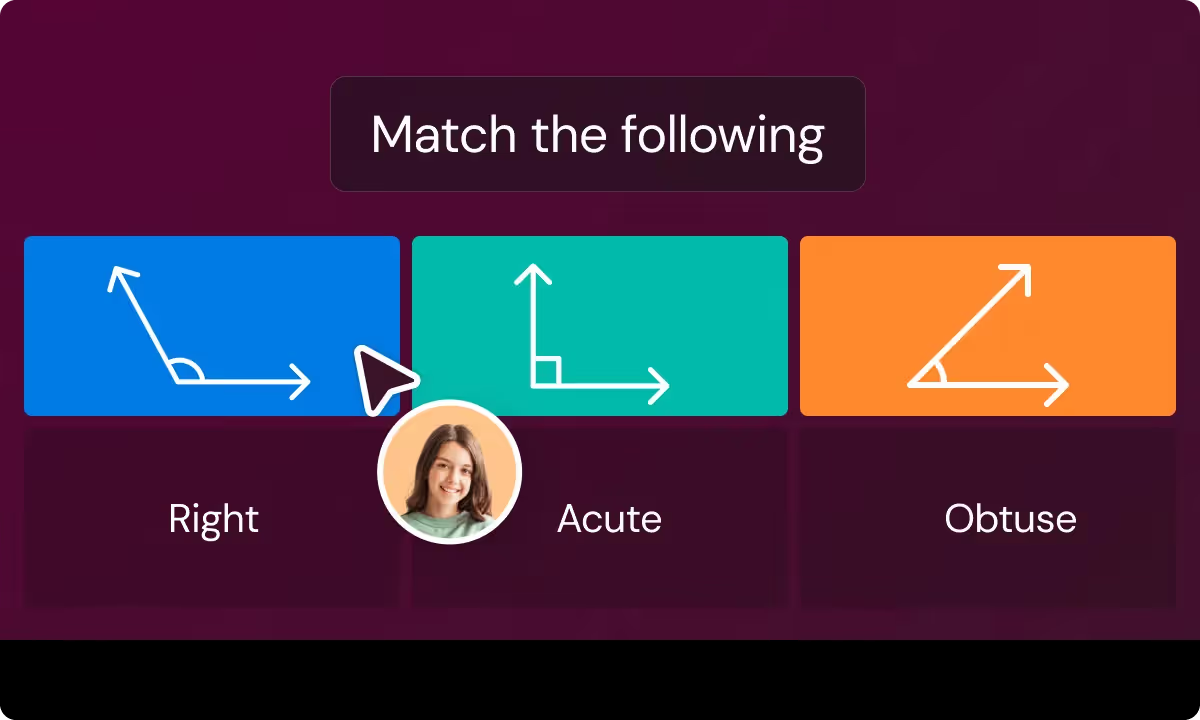
Need a quick way to check if learners can connect what they've learned? Matching questions offer a straightforward solution that helps you see if your class recognizes relationships between ideas without the complexity of essays or the guesswork of multiple choice.
Structure Based on Pairing Two Related Lists
What are matching questions exactly? These questions present learners with two columns: prompts on one side and answer options on the other, which they pair according to a specific rule. These questions work well for connecting vocabulary terms to definitions, historical events to dates, or scientific processes to their outcomes.
In virtual classrooms or quizzes, this question format can let learners drag and drop or click to create pairs, streamlining the response process.
Question Type Suited for Quick Formative Checks
These questions shine during moments when you need fast feedback on understanding. They work beautifully as warm-ups to activate prior knowledge, exit tickets to gauge lesson comprehension, or station rotations where learners practice associations before diving deeper. Many educators feel that they're "best suited for assessing recognition and recall," making them ideal for confirming your class has the basic understanding needed for more complex tasks.
Adaptable Format That Supports Accessibility
Building on their formative assessment value, these questions can easily become more accessible for diverse learners. Research also shows that providing more answer options than prompts reduces guessing and improves validity. Adding visual elements, audio options, or allowing each answer to be used multiple times helps multilingual learners and those with different processing needs demonstrate their knowledge.
Pros and Cons of Matching Questions
Like any assessment tool, matching questions come with trade-offs. Understanding both helps you make smart choices about when and how to use them in your classroom.
Pros
They increase efficiency and make assessment accessible for every student.
- Space and time efficiency: Assess 8-12 concept pairs on one screen, giving you instant data for regrouping without eating up class time
- Multilingual learner support: Pairing visuals or audio with concise stems supports content assessment over language barriers
- Quick feedback loops: Instant results help you spot patterns in student thinking and adjust instruction on the fly
- Reduced cognitive load: Students focus on recognition rather than recall, making these questions less overwhelming for struggling learners
Cons
They require thoughtful design to avoid predictable pitfalls.
- Guessing vulnerability: Students can succeed through test-wiseness rather than knowledge when options are too obvious.
- Construction demands: Well-written matching items require skill—avoid obvious clues like identical wording or grammatical hints.
- Limited depth: Matching questions work well for associations, but can't capture complex reasoning or application skills.
- Technology barriers: Not all students have reliable devices, and technical issues can disrupt the flow.
How to Address These Challenges
Research shows that adding two or more plausible wrong answers reduces the likelihood of students guessing their way through the test from 67% to 49%. The key is intentional design: use matching questions for what they do best (quick association checks) while building in supports that help every student demonstrate their actual understanding. Provide more answer options than prompts, shuffle choices, and include clear directions about whether answers can be reused.
How Matching Questions Are Used in the Classroom
Teachers use matching questions throughout the lesson cycle to check understanding, differentiate instruction, and make teaching more responsive:
- As do-nows and transitions: Launch matching activities to activate prior knowledge or reset attention between activities.
- For station rotations: Students practice associations at their own pace before moving to deeper work.
- As exit tickets: Gather immediate evidence of understanding to plan your next lesson.
- For differentiated practice: Try color-coding matching items by difficulty—green for foundational concepts, yellow for grade-level connections, red for extension thinking. This differentiation approach gives every student access to appropriate challenge while avoiding the pitfalls of permanent ability grouping.
The real power lies in how quickly matching questions reveal misconceptions and guide your next instructional move. When students confuse cause and effect or mix up similar terms, you'll spot patterns within minutes of collecting responses. Follow up immediately with a short explanation to address common errors before they solidify.
20 Matching Question Examples Across Subjects
Creating effective matching question examples doesn't have to eat up your planning time. These classroom-tested prompts give you instant formative assessments that work across subjects and grade levels.
Science Examples (Perfect for Grades K-8)
- Life Cycles: Have students associate animal names (butterfly, frog, chicken) with their development stages (egg → larva → pupa → adult)
- Weather Patterns: Students identify weather conditions (sunny, rainy, snowy) with appropriate clothing or safety measures
- States of Matter: Learners categorize everyday examples (ice cubes, steam, raindrops) by their physical states
- Body Systems: Students recognize major organs (heart, lungs, kidneys) and align them with their primary functions
- Ecosystems: Have learners sort animals (arctic fox, desert lizard, tropical fish) into their natural habitats
Math Examples (Adaptable for Grades 1-7)
- Fraction Equivalents: Students identify visual pie charts and associate them with numerical fractions (1/2, 2/4, 3/6)
- Geometric Properties: Learners examine shape characteristics and categorize them by name (triangle, hexagon, rhombus)
- Time Relationships: Have students align analog clock faces with their digital counterparts
- Problem-Solving Patterns: Students analyze word problems and associate them with the correct operation equations
- Measurement Sense: Learners evaluate real objects (paperclip, classroom door, playground) and sort them by appropriate units
ELA Examples (Great for Building Academic Language)
- Vocabulary Development: Students examine academic terms and definitions to strengthen content-area language
- Literary Analysis: Have learners identify story excerpts and categorize them by literary device (metaphor, personification, foreshadowing)
- Grammar Recognition: Students analyze sentence examples and sort words by their grammatical roles
- Author Studies: Learners associate famous writers with their signature works or writing styles
- Character Analysis: Have students examine character actions from texts and align them with personality traits
Social Studies Examples (Building Cultural Connections)
- Historical Impact: Students recognize key figures and associate them with their lasting contributions to society
- Geographic Literacy: Learners examine landform images and categorize them by their proper terminology (mesa, fjord, archipelago)
- Civic Understanding: Have students identify government roles and sort them into their respective branches of power
- Cultural Awareness: Students explore celebrations worldwide and associate them with their countries or cultural origins
- Economic Thinking: Learners analyze real-world scenarios and categorize them using economic principles (supply, demand, opportunity cost)
Want to prep a quiz instantly? Wayground lets you create digital quizzes that automatically shuffle answer choices and add accommodations like read-aloud or extended time. Adaptive platforms like this save you hours of prep while giving students the practice they need. Plus, you can pull from thousands of existing tests and customize them in minutes rather than starting from scratch.
Bring Matching Questions to Your Classroom
Matching questions work best when they're quick to create and easy to differentiate. The key is choosing tools that amplify your teaching rather than complicate it. The right quiz maker for matching questions should handle the heavy lifting—shuffling answers, adding accommodations, and delivering data you can actually use.
Wayground's Quiz Maker allows you to auto-shuffle answers, add accommodations, and get instant data. Need a head start? Pull ready-to-use items from the Library and customize in minutes.
Find your way forward
Matching Questions: Frequently Asked Questions (FAQs)
How do matching questions support diverse learners in the classroom?
Matching questions reduce cognitive load by presenting clear, visual relationships that students can process quickly. You can differentiate easily by adjusting time limits, adding visual cues, or providing audio support. The format works well for multilingual learners since it relies less on complex sentence construction than open-ended questions.
What are the best strategies for writing effective matching questions?
Keep lists short (3-6 items) with 2-3 extra answer choices to prevent guessing. Maintain consistency within each list—all dates, all vocabulary terms, or all concepts. Arrange responses logically (alphabetically or chronologically) and provide clear directions about whether answers can be reused. For higher-order thinking, design items that connect causes with effects or match examples to broader concepts.
How can teachers use matching questions for formative assessment?
Use matching questions as quick pulse checks during lessons or exit tickets to identify misconceptions before your next lesson. They're more practical than written responses for frequent checks. Create versions with different difficulty levels to identify which students need additional support or enrichment.
What are common mistakes to avoid when creating matching questions?
One common pitfall is mixing unrelated content within the same list, such as pairing dates with vocabulary terms, which can confuse rather than clarify relationships. Another is making answer choices too obvious or too limited, allowing students to guess through elimination instead of demonstrating understanding. Using enough plausible distractors and keeping each list conceptually consistent helps preserve the integrity of the question. Question types built into tools like Wayground can help educators double-check alignment, difficulty, and distractor quality while designing matching items.