
 Worksheets
Astronomy Milestones Review
Total questions: 59
Worksheet time: 36mins
Name
Class
Date
1.
what is The Earth mostly made up of?
a)
people
b)
water
c)
grass
d)
sheep
2.
what is all around the Earth?
a)
atmosphere
b)
hydrosphere
c)
geosphere
d)
hemisphere
3.
what is the geosphere?
a)
the solid part of the earth
b)
the water that covers the earth
4.
What does the movement of The Earth cause?
a)
seasons
b)
people
c)
seasons and day,night
d)
day and night
5.
put in order from smallest to biggest
a)
Moon,Earth,Sun,Solar System and Universe
b)
Sun,Earth.SolarSystem,Moon and universe
c)
Moon,Sun,Solar System,Universe and Earth
d)
space universe moon earth
6.
what are the two different movements of the earth?
a)
rotation and revolution
b)
rotation
c)
parellels and meridians
d)
revolution
7.
what is revolution?
a)
the movement of the earth around the sun
b)
the movement at the earths axis
8.
how long does it take the earth to move around the sun?
a)
365 1/4 days
b)
24 hours
c)
365 days
9.
how long does it take the earth to rotate?
a)
24 hours
b)
365 days
10.
what does the earths rotation cause?
a)
day and night
b)
seasons
11.
According to most scientists, the universe formed 13 to 14 _________ years ago.
a)
million
b)
billion
c)
trillion
12.
The father of modern science who made improvements to the telescope and discovered the four largest moons of Jupiter
a)
Albert Einstein
b)
Isaac Newton
c)
Galileo Galilei
13.
Something that orbits around another object
a)
rocket
b)
satellite
c)
space shuttle
14.

WHICH PLANET IS THE SMALLEST?
a)
MARS
b)
NEPTUNE
c)
MERCURY
d)
JUPITER
15.

HOW MANY STARS IN OUR GALAXY?
a)
1,000
b)
1,000,000,000
c)
10,000
d)
100,000
16.

HOW OLD IS THE MOON?
a)
2.2 MILLION YEARS OLD
b)
3.3 BILLION YEARS OLD
c)
4.5 BILLION YEARS OLD
d)
5.O BILLION YEARS OLD
17.
What planet has the largest pull of gravity?
a)
Neptune
b)
Uranus
c)
Jupiter
d)
The Sun
18.
What is the largest object in the Solar System?
a)
The Moon
b)
Jupiter
c)
Neptune
d)
The Sun
19.
How long does it take the Moon to orbit the Earth?
a)
15 days
b)
24 hours
c)
29 days
d)
365 days
20.
What lies between the orbits of Mars and Jupiter?
a)
Comets
b)
Asteroids
c)
Venus
d)
An alien spacecraft
21.
What Moon phase comes after a "full Moon"?
a)
waxing gibbous
b)
waning gibbous
c)
waxing crescent
d)
waning crescent
22.
What phase comes after a "new Moon"?
a)
waxing gibbous
b)
waning gibbous
c)
waxing crescent
d)
waning crescent
23.
What causes seasons on the Earth?
a)
How close the Earth is to the Sun
b)
The wobble of the Earth
c)
The tilt of the Earth's axis
d)
The amount of cloud cover
24.
put these in order from the smallest to the largest
a)
moon, planet, star, solar system, galaxy, universe
b)
planet, star, universe, galaxy, moon, solar system
c)
universe, galaxy, solar system, star, planet, moon
d)
star, galaxy, universe, solar system, moon, planet
25.
Between a meteroid and a comet, whose orbit (ellipse) moves the furthest away from the sun and sometimes past Neptune?
a)
meteroids
b)
comets
26.
What is a solar eclipse?
a)
When the Moon comes between the Earth and the Sun
b)
When the Sun comes between the Earth and the Moon
c)
When the Earth comes between the Sun and the Moon
d)
When light from the Sun reflects off the Moon
27.
What date is the spring equinox?
a)
21 April
b)
10 March
c)
15 May
d)
21 March
28.

What model of the solar system is accepted by the scientists of today?
a)
Heliocentric
b)
Geocentric
c)
Flying Unicorns
d)
Terracentric
29.

What does the Big Bang theory suggest?
a)
The universe was just there
b)
The Milky Way is the only solar system
c)
The universe is continually expanding
d)
The universe started as a point and is moving towards each other
30.

We see 1/2 of the moon illuminated. What is the phase and visibility?
a)
Full moon , 100%
b)
Full moon, 0%
c)
New moon, 100%
d)
New moon, 0%
31.
It's a full moon what tides are there
a)
Neap
b)
Spring
c)
cool water
d)
Get out jimmy
32.
Which objects can be seen because they reflect light?
a)
stars, planets, the Moon
b)
the Sun, Jupiter, the Moon
c)
asteroids, the Moon, planets
d)
Mercury, stars, Pluto
33.
Which is the correct order for planets in the Solar System
a)
Venus, Mercury, Mars, Earth, Jupiter, Uranus, Saturn, Neptune
b)
Mercury, Venus, Earth, Mars, Jupiter, Saturn, Neptune, Uranus
c)
Mercury, Venus, Mars, Earth, Jupiter, Saturn, Uranus, Neptune
d)
Mercury, Venus, Earth, Mars, Jupiter, Saturn, Uranus, Neptune
34.
What is a Solar Eclipse
a)
When the Moon comes between the Sun and the Earth
b)
When light reflects off the Moon
c)
When the Sun comes between the Earth and the Moon
d)
When the Earth comes between the Sun and the Moon
35.

What astronomer proposed the idea that our solar system was geocentric?
a)
Copernicus
b)
Ptolemy
c)
Galileo
d)
Hubble
36.

Does this picture represent a waxing or waning moon?
a)
waxing
b)
waning
37.
What does the moon look like when there is a difference in the lunar month and the time it takes the moon to orbit the Earth?
a)
Crescent
b)
Waxing Gibbous
c)
Waning Gibbous
d)
Full Moon
38.
The moon seems to change shape from day to day in a cycle that lasts about a month as it goes through _.
a)
revolutions
b)
phases
c)
rotations
d)
eclipses
39.

What season is letter A?
a)
Winter
b)
Summer
c)
Spring
d)
Fall
40.

Which moon phase is shown in this diagram?
a)
new moon
b)
first quarter
c)
full moon
d)
last quarter/3rd quarter
41.
Who is Earth's twin?
a)
Earth
b)
Mars
c)
Venus
d)
Mercury
42.
When do eclipse occur?
a)
From Earth
b)
The sun
c)
Space
d)
Shadows
43.
One-half of the Moon (facing Earth) appears to be illuminated.
a)
Full
b)
Waning
c)
Quarter
d)
Waxing
44.
The moon's unilluminated side is facing the Earth
a)
New
b)
Full
c)
Satellite
d)
Gibious
45.
To decrease gradually in size. The illuminated part of the moon is becoming smaller
a)
New
b)
eclispe
c)
waxing
d)
waning
46.
One reason why we do not see too many craters caused by meteorites hitting our Earth is because....
a)
Only tiny meteorites hit our Earth causing little, tiny craters that we can't always see.
b)
Meteorites do not hit our Earth.
c)
Most of them fall into our ocean since 80% of our Earth is made up of water.
47.
Piece of rock that burns up as it passes through the earth's atmosphere.
a)
asteroid
b)
meteoroid
c)
comet
d)
meteor
48.

Which phase of the moon is shown?
a)
Third Quarter
b)
First Quarter
c)
Full Moon
d)
New Moon
49.

Which phase of the moon is shown?
a)
Full Moon
b)
First Quarter
c)
New Moon
d)
Half Moon
50.

What Moon phase is this?
a)
Waxing Gibbous
b)
Waning Crescent
c)
Waning Gibbous
d)
Full Moon
51.

What Moon phase is this?
a)
Waxing Crescent
b)
Waning Gibbous
c)
Waxing Gibbous
d)
Waning Crescent
52.

The tails of a comet are called...
a)
Gas tail and dust tail
b)
Hydrogen tail and gas tail
c)
Dust tail hydrogen tail
d)
Coma and gas tail
53.

What causes meteors to burn up in our atmosphere?
a)
Heat from the Sun
b)
Heat from Earth's atmosphere
c)
They are already so hot that our atmosphere can't handle it
d)
Friction from the Earth's atmosphere
54.
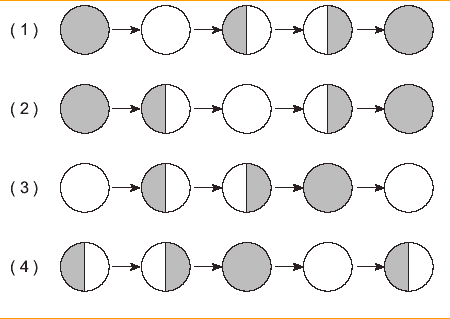
Beginning with the new-Moon phase, which sequence of Moon phases would be seen by an observer on Earth during 1 month?
a)
1
b)
2
c)
3
d)
4
55.
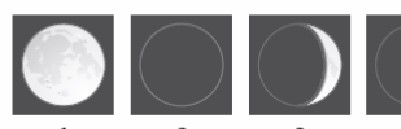
Which is the correct order of the moon phases?
a)
1,2,3,4
b)
2,3,4,1
c)
3,2,1,4
d)
4,3,2,1
56.
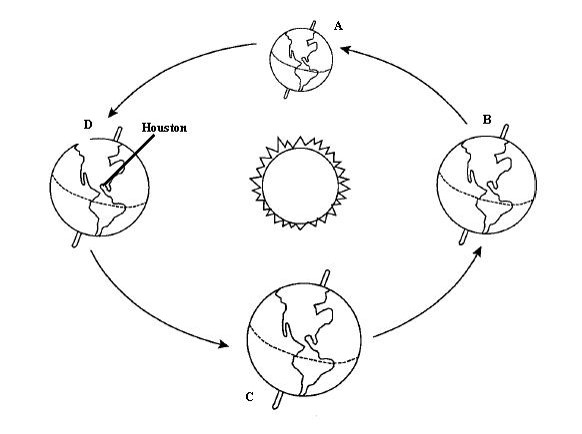
About how long will it take the Earth to move from Point B to Point A in the diagram?
a)
3 hours
b)
3 days
c)
3 months
d)
3 years
57.
Why do we see phases of the moon?
a)
the earth's shadow on the moon changes over the month
b)
the distance to the moon changes slightly as it revolves around the earth
c)
the part of the moon's sunlit side that we can see from earth changes
d)
sometimes no part of the moon reflects light from the sun
58.
Why are there no clouds on the moon? There is—
a)
no liquid water on the moon
b)
no solar energy on the moon
c)
no living things on the moon
d)
no gravity on the moon
59.

Where is the sun located in the galaxy of stars?
a)
Position A
b)
Position B
c)
Position C
d)
Position D
100 %

