
 Worksheets
Review for Benchmark
Total questions: 90
Worksheet time: 1hrs 1mins
Name
Class
Date
1.

What happens when the area in which you live tilts away from the sun?
a)
It is summer.
b)
It is spring.
c)
It is winter.
d)
It is fall.
2.
Which definition explains what a solstice is?
a)
When the days and nights are equal?
b)
When the Sun is at its lowest or highest.
c)
When the Sun moves.
d)
When we don't see any light for 6 months.
3.

What causes seasons? (Take your time!!)
a)
Tilt
b)
Tilt & Rotation
c)
Rotation
d)
Tilt & Revolution
4.
What causes day and night?
a)
Tilt
b)
Rotation
c)
Sun
d)
Revolution
5.

Name that phase AND the tide that occurs during this phase!!
a)
Full moon, Spring tide
b)
New moon, Spring tide
c)
Full moon, Neap tide
d)
New moon, Neap tide
6.

At which position will the Southern Hemisphere receive the most direct sunlight?
a)
1
b)
2
c)
3
d)
4
7.

Which of the following best compares the conditions at Location X and Location Y?
a)
Less daylight hours in X than Y
b)
Night at X, Day at Y
c)
X receives more direct sunlight than Y
d)
Summer at X, Winter at Y
8.
a natural, nonliving substance that makes up rock
a)
mineral
b)
rocks
c)
plasma
d)
lava
9.
Sedimentary rocks form where weathered and eroded materials are dropped
a)
true
b)
false
10.
Fossils are often found in ____________ because it is formed from the remains of once living things.
a)
metamorphic
b)
magma
c)
igneous
d)
sedimentary
11.
rock that has been changed by heat and pressure, or squeezing
a)
sedimentary
b)
metamorphic
c)
igneous
d)
fuels
12.
___________________ rock means FIRE and is formed from melted rock either from magma below Earth's crust or from lava above it
a)
sedmetary
b)
igneous
c)
metamorphic
d)
magma
13.
a rock is formed when magma cools and softens
a)
true
b)
false
14.
When minerals line up in bands within a metamorphic rock, this rock is...
a)
Nonfoliated
b)
Foliated
c)
Igneous
d)
Sedimentary
15.

In what phase is the moon when in position #3?
a)
First Quarter
b)
New Moon
c)
Waxing Gibbous
d)
Waning Crescent
16.
Why does none of the moon appear lit during a new moon?
a)
The sun's light is blocked by Earth's shadow
b)
Because the moon is between the Earth and the Sun
c)
Because the moon is located at a right angle to Earth, relative to the sun
d)
Part of the moon that is lit faces away from the sun and Earth
17.

What type of tide is occurring on Earth?
a)
Reverse tide
b)
Quarter tide
c)
Neap tide
d)
Spring tide
18.
Which statement about the relationship between Earth's tides and the moon is true?
a)
A tidal bulge occurs at Earth's north pole when the moon is farthest from the sun and at the south pole when the moon is closest to the sun.
b)
A tidal bulge occurs at Earth's south pole when the moon is farthest from the sun and at the north pole whe the moon is closest to the sun.
c)
Tidal bulges occur on the sides of Earth that are at right angles to the position of the moon.
d)
A tidal bulge occurs on the side of Earth closest to the moon, as well as on the side farthest from the moon.
19.

The diagram below shows Earth and the moon.In which position(s) will Earth's tidal bulge(s) occur?
a)
4 only
b)
1 and 4
c)
3 and 4
d)
2 and 4
20.
What are the the two causes of high tide?
a)
Magnetism and Gravity
b)
There is only one
c)
Magnetism and Centrifugal Force
d)
Gravity and Centrifugal Force
21.
Soil is a type of ____________.
a)
rocks
b)
sand
c)
sediment
d)
dirt
22.
rocks are broken down by________.
a)
wind
b)
weathering
c)
erosion
d)
man
23.

How was this arch formed?
a)
man made
b)
weathering
c)
erosion
d)
weathering & erosion
24.
Sand are tiny pieces of ___________.
a)
sand
b)
soil
c)
rock
d)
sediment
25.
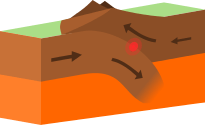
What type of plate boundary is this?
a)
Plate
b)
Divergent
c)
Convergent
d)
Transform
26.
The type of plate boundary where two plates come together is a .....
a)
Convergent Boundary
b)
Divergent Boundary
c)
Transform Boundary
d)
Plate Boundary
27.
The theory that says Earth's continents once made up an ancient supercontinent, and have been drifting apart ever since, is called the theory of...
a)
Pangea
b)
Plate Tectonics
c)
Natural Selection
d)
Gravity
28.
Oceanic Trenches are formed by _______ plate boundaries
a)
Convergent
b)
Transform
c)
Plate
d)
Divergent
29.
Which stress causes no land to be gained or lost?
a)
compression
b)
tension
tension
tension
c)
shearing
30.
Stretching rock so it becomes thinner in the middle is what kind of stress?
a)
tension
b)
compression
c)
shearing
31.
Squeezing rock until it breaks is what stress?
a)
tension
b)
compression
c)
shearing
32.
When the hanging wall slips downward below the footwall, what kind of fault is it?
a)
strike-slip
b)
normal
c)
reverse
33.
Compression is the type of stress that causes the crust to become thinner in the middle.
a)
True
b)
False
34.

True or False: The Mid-Atlantic ridge in the Atlantic ocean is the ONLY example of a divergent boundary (<---->)
a)
True
b)
False
35.

What two words are BEST used to describe how the seafloor spreads?
a)
Magma and convection
b)
Earthquakes and convection
c)
Magma and convention
d)
Volcanoes and earthquakes
36.

True or False: The plates will never stop moving
a)
True
b)
False
37.
Most of the sun’s energy is a result of
a)
nuclear fusion
b)
nuclear fission
c)
atomic reactions
d)
coronal mass ejection
38.
Strong magnetic fields on regions of the sun lead to sunspots because
a)
convection slows and energy decreases.
b)
convection increases and energy increases.
c)
radiation slows and energy decreases.
d)
radiation increases and energy increases.
39.
What is the hottest layer of the sun’s atmosphere called?
a)
convective zone
b)
corona
c)
radiative zone
d)
photosphere
40.
What elements make up most of the sun’s mass?
a)
carbon and oxygen
b)
carbon and hydrogen
c)
helium and nitrogen
d)
hydrogen and helium
41.
Geology and biology come together in the study of organisms and their environment.
a)
Geolgoy
b)
Ecology
c)
Environmental Science
d)
Geography
42.
The study of the physical and biological parts of Earth's oceans.
a)
Geology
b)
Geography
c)
Cartography
d)
Oceanography
43.
The study of the stars and other celestial bodies.
a)
Meteorology
b)
Astronomy
c)
Oceanography
d)
Astrology
44.
The study of the physical features of the earth (mountains, lakes, rivers, valleys, etc.).
a)
Geology
b)
Geography
c)
Cartography
d)
Ecology
45.
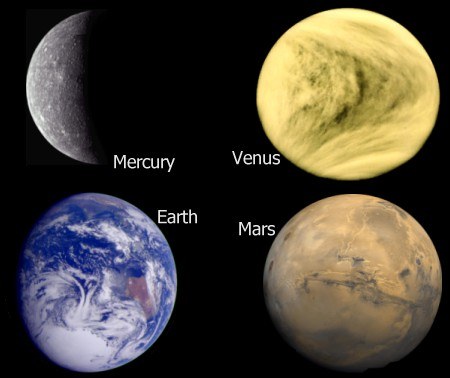
Earth and the other planets closest to the Sun are made mostly of _______
a)
gas
b)
metal
c)
water
d)
rock
46.

Earth's ________ on its axis causes day and night.
a)
rotation
b)
revolution
c)
phase
d)
comet
47.

The __________ has planets, moons, comets, and asteroids.
a)
solar system
b)
earth
c)
rotation
d)
United States
48.
Select the order from smallest to largest.
a)
Sun, Milky Way, solar system, universe
b)
Sun, Milky Way, universe, solar system
c)
Sun, solar system, Milky Way, universe
d)
Sun, solar system, universe, Milky Way
49.
Which outer planets have rings?
a)
Just Saturn
b)
Saturn and Jupiter
c)
Jupiter, Neptune, and Saturn
d)
all 4 of them
50.
The pattern of stars in a constellation stays the same, but a planet can be seen in different locations at different times because _______________.
a)
Stars don't move; planets revolve and rotate
b)
Stars and planets revolve and rotate.
c)
Stars not planets move
d)
Planets don't move; Stars revolve and rotate.
51.
Which one takes one year?
a)
rotation
b)
revolution
52.
Which planet is the hottest planet?
a)
Mercury
b)
Mars
c)
Venus
d)
Saturn
53.

a pattern of stars that form an imaginary picture or design in the sky
a)
Orbit
b)
Rotate
c)
constellation
d)
Milky Way
54.
A spiral galaxy of stars that contains our Sun
a)
Planisphere
b)
Intensity
c)
Star
d)
Milky Way
55.
A giant sphere of glowing gases is a ___________
a)
Galaxy
b)
Light-year
c)
Star
d)
Magnitude
56.
How long does it take Earth to complete one revolution around the Sun?
a)
24 hours
b)
one week
c)
one month
d)
one year
57.

Who is the person credited with developing the theory of continental drift?
a)
Harry Hess
b)
Galileo
c)
Alfred Wegener
d)
Newton
58.

Name this plate boundary.
a)
divergent
b)
convergent
c)
transform
d)
transformers
59.

Name this plate boundary.
a)
divergent
b)
convergent
c)
transform
d)
allegiant
60.

Mesosaurus fossils are found between where?
a)
India
b)
Africa and South America
c)
Antartica
d)
Australia
61.
Deep cracks in the Earth's crust.
a)
faults
b)
tear
c)
twist
d)
shear
62.
This layer of the core is made of liquid metals.
a)
outer core
b)
inner core
c)
middle core
d)
apple core
63.
Where does the heat come from that drives this convection current in the mantle?
a)
The sun
b)
The crust
c)
the mantle
d)
the core
64.

The physical layer of Earth made of solid rock and soil is called the ___________.
a)
mesosphere
b)
lithosphere
c)
asthenosphere
d)
mantle
65.

Which layer is made up of iron and nickel?
a)
Crust
b)
Mantle
c)
Inner Core
d)
Lithosphere
66.
The OLDEST seafloor is located?
a)
Closest to the mid-ocean ridge
b)
Farthest from the mid-ocean ridge
67.
The deepest part of the ocean; long, narrow ditches
a)
Tectonic plates
b)
Trenches
c)
Divergent boundary
d)
Continental shelves
68.
Where is the point at which the first movement occurs during an earthquake?
a)
Epicenter
b)
Focus
c)
Fault
d)
Plate
69.
What is a break in the lithosphere along which movement in an earthquake has first occurred?
a)
Earthquake
b)
Epicenter
c)
Fault
d)
Focus
70.
Where is the point on the Earth’s surface directly above the focus of an earthquake?
a)
Epicenter
b)
Fault
c)
Hypocenter
d)
Tremor
71.
Which body waves cause particles of rock material to move at right angles to the direction in which the waves are traveling?
a)
Body Waves
b)
P Waves
c)
S Waves
d)
Surface Waves
72.
P Waves can move through which of the following?
a)
Gas
b)
Liquid
c)
Solid
d)
All of these
73.
What is another term for P Wave?
a)
Compression Wave
b)
Principal Wave
c)
Shear Wave
d)
Secondary Wave
74.
Which type of wave is the first to arrive after an earthquake occurs?
a)
P Wave
b)
Rayleigh Wave
c)
S Wave
d)
Shear Wave
75.
What is an instrument that detects and records waves produced by earthquakes? (This piece of equipment can measure the magnitude of an earthquake.)
a)
Epicenter
b)
Fault
c)
Seismogram
d)
Seismograph
76.
What is the measure of the amount of energy released in an earthquake?
a)
Earthquake
b)
Epicenter
c)
Magnitude
d)
Seismogram
77.
Which scale rates earthquakes based on the amount of damage done?
a)
Mercalli Scale
b)
Richter Scale
c)
Seismogram Scale
d)
Bernoulli Scale
78.
A giant ocean wave that forms after a volcanic eruption, submarine earthquake or landslide is ________________
a)
earthquake
b)
hurricane
c)
tsunami
d)
tornado
79.
An __________ on the ocean floor causes a tsunami.
a)
tidal wave
b)
earthquake
c)
aftershock
d)
underquake
80.

What is one part of a volcano?
a)
Vent
b)
Wave
c)
Shake
d)
Gas
81.
What type of rock forms from stratification?
a)
Intrusive
b)
Igneous
c)
Sedimentary
d)
Metamorphic
82.
Which type of rock results from melting and cooling of magma?
a)
Igneous
b)
Metamorphic
c)
Sedimentary
d)
Extrusive
83.
Wind, water, and ice breaking down rock is called
a)
Erosion
b)
Deposition
c)
Compaction
d)
Weathering
84.
What is the process of moving sediments from location to another?
a)
Deposition
b)
Erosion
c)
Weathering
d)
Compaction
85.
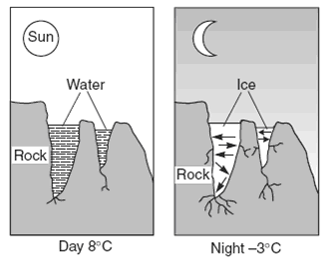
The diagrams shows a natural process that weathers rock.
Which statement best explains why this process results in weathering?
Which statement best explains why this process results in weathering?
a)
frozen water acts as a solute
b)
water expands when it freezes
c)
the mass of water increases when it freezes
d)
frozen water dissolves most types of rock
86.
The process that breaks down rocks and other materials on Earth's surface is called
a)
weathering
b)
erosion
c)
soil conservation
d)
decomposition
87.
A[n] ___________ tide occurs when the sun, Earth, and the moon are nearly in a line.
a)
spring
b)
high
c)
low
d)
neap
88.

Which moon phase is shown in this diagram?
a)
new moon
b)
first quarter
c)
full moon
d)
last quarter/3rd quarter
89.

Name the moon phase
a)
Waxing Gibbous
b)
Waxing Crescent
c)
Waning Crescent
d)
Waning Gibbous
90.

Name the moon phase
a)
Waning Crescent
b)
Waxing Crescent
c)
Waning Gibbous
d)
Waxing Gibbous
100 %

