
 Worksheets
Cell Structures and Functions
Total questions: 75
Worksheet time: 4hrs 45mins
Name
Class
Date
1.
Allows materials to come in and out of the cell
a)
Cell Wall
b)
Cell Membrane
c)
Vacuole
d)
Mitochondria
2.
Found in plant cells; traps energy from the sun to make food
a)
Cell Wall
b)
Cell Membrane
c)
Mitochondria
d)
Chloroplasts
3.
Uses energy from sugar to make energy for the cell
a)
Chloroplast
b)
Mitochondria
c)
Nucleus
d)
Cell Membrane
4.
gel-like substance where work happens within the cell
a)
Cytoplasm
b)
Mitochondria
c)
DNA
d)
Chloroplasts
5.

This cell most likely came from which of the following organisms?
a)
pneumonia bacteria
b)
human
c)
shark
d)
elodea plant
6.
Plant cells and animal cells possess many of the same organelles. Which of the following organelles, however, would be indicative of a plant cell rather than an animal cell?
a)
nucleus
b)
ribosome
c)
mitochondira
d)
chloroplast
7.

Using the information in the table, which of the cells most likely came from an animal?
a)
1 and 3 only
b)
4 only
c)
1 only
d)
2 and 4 only
8.
Which of the following is the only cell organelle that is capable of converting light energy into chemical energy?
a)
vacuole
b)
mitochondrion
c)
chloroplast
d)
endoplasmic reticulum
9.
Plant and animal cells are both eukaryotic, and thus they are similar in many ways. However, plant cells have some organelles that are not present in animal cells. Which of the following organelles is not found in animal cells?
a)
Golgi complex
b)
smooth endoplasmic reticulum
c)
mitochondria
d)
central vacuole
10.
Cells have particular structures that perform specific jobs. These structures are known as ___.
a)
organs
b)
tissues
c)
systems
d)
organelles
11.

This is a picture of a plant cell, what is the name of structure 4?
a)
cell wall
b)
nucleus
c)
vacuole
d)
chloroplast
12.

This is a picture of a plant cell, what is the name of structure 1?
a)
cell wall
b)
nucleus
c)
vacuole
d)
chloroplast
13.

In this plant cell, what is the function of structure 3?
a)
serves a variety of secretory, excretory, and storage roles
b)
provides structural support to the cell
c)
serves as the control center of the cell and contains the cell's genetic information
d)
captures energy from the sun and makes food through photosynthesis
14.
Which type of cell has no membrane-bound nucleus?
a)
eukaryotic plant cell
b)
eukaryotic animal cell
c)
prokaryotic cell
15.
What is the main function of ribosomes?
a)
synthesize proteins
b)
destroy worn out organelles
c)
produce DNA
16.
The smallest unit that can carry out all activities associated with life is ----
a)
the organelle
b)
the atom
c)
a tissue
d)
the cell
17.

Which statement is not part of the cell theory?
a)
All cells come from other cells.
b)
All living things have one or more cells.
c)
Cells are a living thing's basic unit of structure and function.
d)
All cells have a nucleus.
18.

The organelle that is the control center of the cell.
a)
nucleus
b)
cell membrane
c)
ER
d)
ribosomes
19.
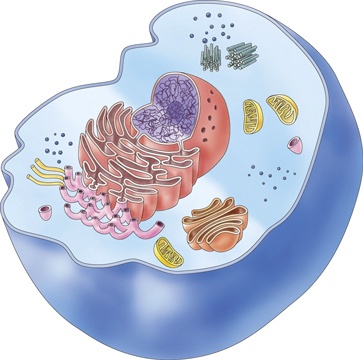
The organelle that allows things in and out of the cell. Also protects the cell.
a)
nucleus
b)
cell membrane
c)
ER
d)
ribosomes
20.

The organelle that makes lipids, breaks down drugs and packages proteins.
a)
nucleus
b)
cell membrane
c)
ER
d)
ribosomes
21.

The organelle that looks like small dots. It makes proteins.
a)
nucleus
b)
cell membrane
c)
ER
d)
ribosomes
22.

The jelly-like fluid that supports the organelles in place.
a)
nucleus
b)
cell membrane
c)
chloroplast
d)
cytoplasm
23.

Which organelle collects sunlight to make sugar during photosynthesis?
a)
Chloroplast
b)
Cell Wall
c)
Cell Membrane
d)
Vacuole
24.

Which rigid organelle provides strength and support to plant cells.
a)
Chloroplast
b)
Cell Wall
c)
Cell Membrane
d)
Vacuole
25.

Which organelle is found in both plant and animal cells and converts sugars into energy? (the powerhouse of the cell)
a)
Mitochondria
b)
Cell Wall
c)
Cell Membrane
d)
Vacuole
26.

What organelle is labeled A?
a)
cytoplasm
b)
cell membrane
c)
cell wall
d)
nucleus
27.

What organelle is labeled C?
a)
cytoplasm
b)
cell membrane
c)
cell wall
d)
nucleus
28.

What organelle is labeled J?
a)
cytoplasm
b)
cell membrane
c)
cell wall
d)
nucleus
29.

What organelle is labeled K?
a)
cytoplasm
b)
mitochondria
c)
cell wall
d)
nucleus
30.
What is the cell organelle that stores water, food and waste called?
a)
The cytoplasm
b)
The lysosomes
c)
The vacuole
d)
The mitochondria
31.
What is the main
difference between prokaryotic and eukaryotic cells?
a)
Prokaryotic cells have a nucleus and Eukaryotic cells do not
b)
Prokaryotic cells are unicellular and Eukaryotic cells are multicellular.
c)
Prokaryotic cells do not have a nucleus, Eukaryotic cells do have a nucleus.
d)
Prokaryotic cells are plant cells and Eukaryotic cells are animal cells.
32.
The main function of chloroplasts is:
a)
To control what enters and leaves the cell.
b)
To break down food to release energy for the cell.
c)
To control all activities of the cell.
d)
To produce food for the cell using the sun's energy.
33.
The cytoplasm
a)
Is the gel-like fluid that holds other organelles in place.
b)
Breaks down food to produce energy for the cell.
c)
Is known as the "brain" of the cell.
d)
Is where photosynthesis takes place.
34.
Which statement is NOT part of the Cell Theory?
a)
Only animals are made of cells.
b)
Cells are the basic unit of structure and function in all living things.
c)
All living things are made of cells.
d)
New cells come from existing cells.
35.
Identify which of these is NOT a major difference between plant and animal cells.
a)
Only plant cells have a cell wall.
b)
Only animal cells have mitochondria.
c)
Animal cells do NOT contain chloroplasts.
d)
Plant cells have a large central vacuole.
36.
The mitochondria
a)
Controls what enters and leaves the cell
b)
Performs photosynthesis to make food for the cell.
c)
Contains the chromosomes and is known as the "brain" of the cell.
d)
Breaks down food to produce energy for the cell.
37.
Ribosomes are the cell organelle that
a)
Break down food to produce energy for the cell.
b)
Produce proteins for the cell.
c)
Break down broken cell parts.
d)
Make food for the cell using the sun's energy.
38.
The cell wall
a)
Controls what enters and leaves the cell.
b)
Provides structure and support for the plant cell.
c)
Is a flexible out layer of the cell.
d)
Is the transportation system of the cell.
39.
What is the function of the cell membrane?
a)
To protect and support the cell
b)
To perform different functions in each cell
c)
To control what enters and leaves the cell
d)
To form a hard outer covering for the cell
40.
What is the function of the lysosomes?
a)
To make proteins for the cell
b)
To store water and other materials
c)
To convert food and oxygen into energy
d)
To use enzymes to digest old or worn out cell parts
41.
Which organelle in plant cells captures the energy in sunlight?
a)
Cell Wall
b)
Nucleus
c)
Chloroplasts
d)
Vacuole
42.
Organisms composed of many cells are called
a)
Prokaryotic
b)
Eukaryotic
c)
Unicellular
d)
Multicellular
43.
Which types of organisms are Prokaryotes?
a)
Animals
b)
Plants
c)
Fungi
d)
Bacteria
44.
Unicellular organisms are
a)
Prokaryotic
b)
Eukaryotic
c)
Made of many cells
d)
Made of one cell
45.
Where the genetic material is found in the cell
a)
nucleolus
b)
cytoplasm
c)
nucleus
d)
chloroplast
46.
This structure regulates the passage of water, food and waste into and out of the cell.
a)
nucleus
b)
vacuole
c)
cytoplasm
d)
cell membrane
47.

What is the name of the dark spot inside some cells' nuclei?
a)
Nucleolus
b)
Pore
c)
Phospholipid
d)
Core
48.

What cell part is NOT found in all cells?
a)
Cell Wall
b)
Cell Membrane
c)
Cytoplasm
d)
Genetic Material
49.
Rough ER has attached to it
a)
Nucleosomes
b)
Golgi apparatus
c)
Ribosomes
d)
Chromosomes
50.
Which organelle would not be found in animal cells?
a)
Smooth ER
b)
Chloroplast
c)
Mitochondria
d)
Ribosome
51.
Which organelle is the "packing center" for the cell?
a)
Endoplasmic reticulum
b)
Nucleus
c)
Lysosome
d)
Golgi apparatus
52.
What is the small dark structure in the nucleus that produces ribosomes?
a)
Rough ER
b)
Nucleolus
c)
Smooth ER
d)
Chromatin
53.
This is a series of sac-like tunnels that have ribosomes attached. The main function of this organelle is to make and process proteins.
a)
Nucleus
b)
Rough ER
c)
Smooth ER
d)
Golgi apparatus
54.
This is a sac-like structure that contains digestive enzymes. It may digest waste materials or even dead cells.
a)
ER
b)
Lysosome
c)
Vacuole
d)
Vesicle
55.
There are some similarities between prokaryotic and eukaryotic cells. Which of the following structures is found in both prokaryotic and eukaryotic cells?
a)
lysosome
b)
mitochondrion
c)
nucleus
d)
cell membrane
56.

The Mitochondria is which number in the picture?
a)
1
b)
5
c)
9
d)
12
57.

The Cell Membrane is which number in the picture?
a)
7
b)
8
c)
9
d)
10
58.

The Lysosomes are indicated by which number?
a)
5
b)
6
c)
10
d)
11
59.

The Nucleus is which number?
a)
1
b)
5
c)
6
d)
7
60.

The Endoplasmic Reticulum is which number?
a)
5
b)
9
c)
12
d)
1
61.

The Golgi Apparatus is which number?
a)
12
b)
4
c)
10
d)
6
62.

The "powerhouse" of the cell- it makes energy for the cell.
a)
Nucleus
b)
Vacuole
c)
Mitochondria
d)
Cell Wall
63.

Small, dense spheres that make protein.
a)
Ribosomes
b)
Nucleus
c)
Chloroplasts
d)
Mitochondria
64.

The "brain" of the cell- it controls all cell activities.
a)
Mitochondria
b)
Vacuole
c)
Nucleus
d)
Cell Membrane
65.

Spaces in the cell used for storing water, food, and wastes
a)
Nucleus
b)
Cell Membrane
c)
Cell Wall
d)
Vacuole
66.

The structures where photosynthesis occurs.
a)
Mitochondria
b)
Cell Wall
c)
Chloroplasts
d)
Vacuole
67.
Non-living objects have cells.
a)
True
b)
False
68.
Joy took the notes shown below while learning about cells.
• Forms boundary between a cell and the outside environment
• Controls the movement of materials into and out of the cell
• Forms boundary between a cell and the outside environment
• Controls the movement of materials into and out of the cell
a)
endoplasmic reticulum
b)
cell membrane
c)
cell wall
d)
nucleus
69.
Name the prokaryote?
a)
animal cell
b)
plant cell
c)
bacteria
d)
fungi cell
74.
Cell walls are made of __________
a)
lysosomes
b)
ribosomes
c)
ER
d)
cellulose
71.
What is the most abundant chemical in a cell?
a)
Lipid
b)
Carbohydrate
c)
Protein
d)
Water
72.
Thin strands of genetic material floating in the nucleus are called ____________
a)
ER
b)
golgi apparatus
c)
DNA/Chromosomes
d)
lysosomes
73.
Small structures in cells are called:
a)
molecules
b)
ribosomes
c)
organelles
d)
atoms
74.
Cell walls are made of __________
a)
lysosomes
b)
ribosomes
c)
ER
d)
cellulose
75.
This is part of the endoplasmic reticulum that is used to make proteins that will be used by other cells. It is lined with ribosomes.
a)
Vesicles
b)
Lysosomes
c)
Rough ER
d)
Smooth ER
100 %

