
 Worksheets
Genetics Review
Total questions: 70
Worksheet time: 2hrs 43mins
Name
Class
Date
1.
A homozygous dominant dog with brown fur is crossed with a heterozygous dog with brown fur. What are the percentages of the possible genotypes?
a)
100% BB
b)
75% BB and 25%Bb
c)
50 % BB and 50% Bb
d)
50% Bb and 50% bb
2.
The man who studied genetics and came up with genetics is
a)
Watson
b)
Crick
c)
Mendel
d)
Darwin
3.

Genotype refers to the ...
a)
physical expression of the genes
b)
the possible combination of alleles in a gene
c)
whether an allele is dominant or recessive
d)
how an organism will appear
4.

Squidward has light blue skin, and his genotype for this trait is Bb. Would Squidward be considered a purebred or hybrid for light blue skin?
a)
Purebred
b)
Hybrid
5.

An offspring will receive how many alleles from each parent to determine a specific trait?
a)
one
b)
two
c)
three
d)
five
6.
Which of the following is a phenotype?
a)
BB
b)
Bb
c)
bb
d)
Blue eyes
7.
What is a phenotype
a)
The genetic make up (code)
b)
The physical trait
8.
the passing of genetic traits from parent to offspring.
a)
heredity
b)
trait
c)
gene
d)
allele
9.
having two of the same genes for the trait (sometimes called purebred).
a)
homozygous
b)
hetrozygous
c)
protein
d)
chromosome
10.
having two different genes for a trait (sometimes called hybrid).
a)
protein
b)
homozygous
c)
heterozygous
d)
genotype
11.
Magda is a tall, 11 year old drummer. She has a scar on her right cheek. She is good at swimming. Which of her traits did Magda most likely inherit?
a)
height
b)
the scar
c)
ability to swim
d)
ability to play drums
12.
Two brown eyed parents (Bb) have a baby. What is the chance the baby is blue eyed?
a)
0 %
b)
25%
c)
50%
d)
75%
13.
G = green, g = yellow
The genotype for a yellow plant is...
The genotype for a yellow plant is...
a)
GG
b)
Gg
c)
gg
d)
all of the choices result in yellow
14.
An allele whose trait only shows up when no dominant allele is present.
a)
hidden allele
b)
dominant allele
c)
recessive allele
d)
present allele
15.
Two heterozygous (Tt) tall pea plants are crossed. Which describes their offspring?
a)
50% tall and 50% short
b)
75%tall and 25% short
c)
100%short
16.
Which answer best describes codominant alleles?
a)
Both are equally dominant
b)
Both are equally recessive
c)
Neither are dominant or recessive
17.
Which of the following genotypes is a purebred?
a)
Bb
b)
Gg
c)
bb
d)
Dd
18.
What is the definition of phenotype?
a)
The physical expression of a trait
b)
The genetic combination of alleles
c)
A gene on the DNA strand
19.
One form of a gene is called_______________
a)
a DNA
b)
a Phenotype
c)
a trait
d)
an allele
20.
the condensed form of DNA is called________________
a)
an allele
b)
a gene
c)
a chromosome
d)
a phenotype
21.
Where, in the eukaryotic cell, is DNA located?
a)
ribosomes
b)
nucleus
c)
E.R.
d)
cytoplasm
22.
Which of the following will only show if two alleles are present?
a)
a dominant trait
b)
a recessive trait
23.

What is the percentage of offspring that have green pods?
a)
100%
b)
75%
c)
50%
d)
25%
24.

What percentage of the offspring in the punnett square are shown as a hybrid?
a)
100%
b)
75%
c)
50%
d)
25%
25.
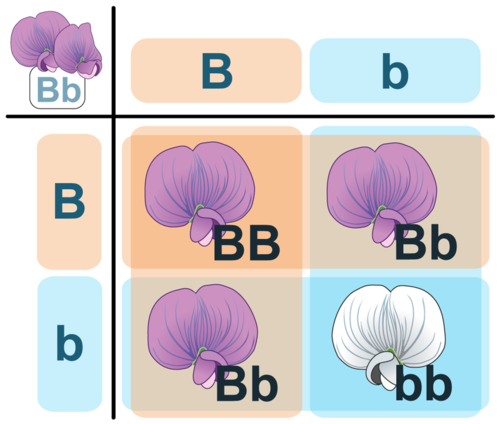
In this punnett square, which is the dominant trait?
The B stands for bud.
The B stands for bud.
a)
purple flower bud
b)
white flower bud
c)
dominant
d)
recessive
26.
A dog gives birth to 5 puppies. What percentage of the chromosomes does each puppy share with the mother?
a)
25%
b)
50%
c)
75%
d)
100%
27.

If T=Tall & t=short, what is the genotypic ratio?
a)
1:3
b)
3:1
c)
1:2:1
d)
2:2
28.

Two brown eyed parents (Bb) have a baby. What is the chance the baby is blue eyed?
a)
0 %
b)
25%
c)
50%
d)
75%
29.

If a Homozygous red snapdragon and a Heterozygous pink snapdragon were crossed - what percentage of the offspring would be homozygous white?
a)
0%
b)
25%
c)
50%
d)
75%
30.

Which process and type of resulting cells are represented?
a)
mitosis, gametes
b)
mitosis, body cells
c)
meiosis, gametes
d)
meiosis, body cells
31.

Which best describes the process shown?
a)
mutation in which the DNA content of the gene is ltered
b)
segregation of sister chromatids
c)
condensation and segregation of the alleles
d)
crossing-over which alleles are exchanged
32.

Term for homozygous organisms that display two dominant phenotypes at the same time
a)
codominance
b)
incomplete dominance
c)
multiple alleles
d)
linked genes
33.

Red/green color blindness is a recessive trait. A woman who is a carrier for this allele marries a normal-vision male. What is the probability that they will have a child who is color blind?
a)
1/4
b)
1/2
c)
3/4
d)
1
34.
The inherited combination of alleles is known as the offspring's
a)
heredity
b)
phenotype
c)
genotype
d)
redigree
35.
Sex cells are produced through the process of
a)
mitosis
b)
cytokinesis
c)
binary fission
d)
meiosis
36.
How many alleles (letters) do each person carry for a trait?
a)
1
b)
2
c)
3
d)
4
37.
Dominant alleles are represented by a:
a)
Male gene
b)
lowercase letter
c)
recessive trait
d)
capital letter
38.
Aa, DD, bB, yy are all examples of
a)
genotypes
b)
phenotypes
39.
AA and Aa always show up as
a)
dominant
b)
recessive
40.
Which of the characteristics is a lion least likely to pass on to its offspring?
a)
fur color
b)
length of tail
c)
scars on leg
d)
body size
41.
What gender has an X and a Y chromosome?
a)
male
b)
female
c)
transgender
d)
all of the above
42.

In certain rats, black fur is dominant over white fur. If two rats, both heterozygous for fur color are mated, their offspring would be expected to have
a)
four different genotypes and two different colors
b)
two different genotypes and three different colors
c)
three different genotypes and two different colors
d)
three different genotypes and three different colors
43.
A person with type O blood marries a person with type AB blood. Possible blood genotypes of their children are
a)
I(A)i and I(B)I(B)
b)
I(B)I(B) and I(A)I(A)
c)
I(A)i and I(B)i
d)
I(A)I(B) and ii
44.
A cross between two tall garden pea plants produced 314 tall plants and 98 short plants. What genotypes are the parents?
a)
TT and tt
b)
TT and Tt
c)
Tt and Tt
d)
TT and TT
45.
A woman with blood genotype I(A)i marries a man with blood genotype I(B)i. What is the probability that they would have a child with type O blood?
a)
1/1
b)
1/2
c)
1/3
d)
1/4
46.
What does a Punnett Square help you do?
a)
Determine the ratio of phenotypes
b)
Determine the ratio of genotypes
c)
Predict possible traits the offspring will have
d)
All of the above
47.
True/False: Different genotypes can code for the same phenotype.
a)
True
b)
False
48.
Scientific study of how traits are passed to offspring through genes
a)
Heredity
b)
Genetics
c)
Inheritance
d)
Allele
49.
Segment of DNA on a chromosome that contains instructions for protein synthesis and controls a particular inherited trait
a)
Gene
b)
Pedigree
c)
Punnett Square
d)
Dominant
50.
A person who has one recessive allele for a trait, but does not have the trait
a)
Homozygous
b)
Selective Breeding
c)
Mutation
d)
Carrier
51.
the passing of genetic traits from parent to offspring.
a)
heredity
b)
trait
c)
gene
d)
allele
52.
What characteristic would a child not inherit from parents?
a)
freckles
b)
eye color
c)
hair style
d)
dimples
53.
R=round seed
r=wrinkled seed.
Cross a homozygous round with a wrinkled. Which statement predicts the results?
r=wrinkled seed.
Cross a homozygous round with a wrinkled. Which statement predicts the results?
a)
offspring will be Rr
b)
offspring will be RR
c)
round seeds will be recessive to wrinkled
d)
Wrinkled will be observed in half of offspring
54.

He is known as the father of modern day genetics.
a)
Gregory Mendel
b)
Greg Mendel
c)
Gregor Mendel
d)
Grace Mendel
55.
A human usually has _____ total chromosomes.
a)
6
b)
22
c)
4
d)
46
56.

Colorblindness is a recessive, X chromosome sex-link disorder. Cross the parents to figure out which percentage of their offspring will be colorblind.
a)
25%
b)
0%
c)
75%
d)
50%
57.
The inheritance pattern that allows are only one trait to show is called _______________ _______________.
a)
complete dominance
b)
co-dominance
c)
incomplete dominance
d)
dominant trait
58.
Which law states that organisms inherit two copies of each gene and donate one copy to each of their offspring?
a)
law of genetic linkage
b)
law of segregation
c)
law of independent assortment
d)
law of inheritance
59.
According to Mendel's law of ___________, two alleles for each trait separate during meiosis, and during fertilization, the two alleles unite.
a)
independent assortment
b)
segregation
60.
Gregor Mendel's law of segregation states
a)
allele pairs separate from one another during gamete formation
b)
that (1) organisms inherit two copies of genes, one from each parent and (2) organisms donate only one copy of each gene in their gametes because the genes separate during gamete formation
c)
that babies are genetic copies of their parents
d)
no comment
61.
1. ‘The Father’ was very smart and he came up with three hypothesis that later became scientific laws. The first law shows that some alleles can hide other alleles. When making this law, he recognized that two alleles were present (genius that he was) and that one disappeared for a generation and then reappeared in the next. This law is
a)
Independent Assortment
b)
Dominance and Recessiveness
c)
Segregation
62.
1. The Father’ was very smart and he came up with three hypothesis that later became scientific laws. The idea of the second law was that we have two alleles that determine a trait and these get separated when making sex cells or gametes. Name the Law:__________________________. Also, what is the ‘key word’ that helps you remember what this law is about (it should always be in the definition)?
a)
Independent Assortment, individually
b)
Dominance and Recessiveness, always shows
c)
Segregation, separated
63.
1. ‘The Father’ was very smart and he came up with three hypothesis that later became scientific laws.
The third law was created when he examined the statistics of two traits at a time. He noticed that they could be arranged in any combination, suggesting that each allele can be passed on independent of alleles for other traits. The name of this law is
The third law was created when he examined the statistics of two traits at a time. He noticed that they could be arranged in any combination, suggesting that each allele can be passed on independent of alleles for other traits. The name of this law is
a)
Independent Assortment
b)
Dominance
c)
Segregation
64.
What is the type of inheritance when the offspring show a 'medium' or blended trait of the two alleles?
a)
codominance
b)
mendelian
c)
incomplete
d)
x-linked
65.
In what type of inheritance are both alleles clearly expressed?
a)
codominance
b)
mendelian
c)
incomplete
d)
x-linked
66.
A trait that is found on the X chromosome is called a/an
a)
sex-linked trait
b)
sex-influenced trait
c)
female trait
67.
If fathers can’t pass a trait on to their sons the trait is on the _____ chromosome(s).
a)
autosomal
b)
X
68.
If Mr. and Mrs. Smith can only have children with AB blood type, what must the parents’ genotypes be?
a)
IAi x IBi
b)
IAIA x IBi
c)
IAIA x IBIB
d)
IAIB x ii
69.
Cross a mom heterozygous A blood type with dad, O blood type. What is the phenotypic ratio?
a)
3 A: 1 O
b)
1 A: 1 O
c)
1 A: 3 O
70.

Round is dominant over wrinkled and purple flowers are dominant over white flowers in pea plants. If we crossed two plants that are both heterozygous for both traits (a) What are the possible gamete combinations that each parent could make? (b) What are possible phenotypes of the offspring from this cross? HINT: You don’t have to make Punnett squares to figure this out if you don’t want to.
a)
RP, Rp, rP, rp and 9 round purple, 3 round white, 3 wrinkled purple, and 1 wrinkled white
b)
RP, rp and 1Round Purple: 2 wrinkled purple, 1 wrinkled whiter
c)
RP, Rp, rP, rp and 1 round purple, 1round white, 1 wrinkled purple, 1wrinkled white.
100 %

