
NEW
Font size
S
M
L
XL
 Worksheets
Classification Test Review
Total questions: 68
Worksheet time: 1hrs 28mins
Name
Class
Date
1.
Which organisms are most closely related?
a)
Equus caballas (Horse) & Equus burchellii (Zebra)
b)
Cyanea artica (Jellyfish) &
Ctenodiscus crispatus (Mud Starfish)
Ctenodiscus crispatus (Mud Starfish)
c)
Naja naja (cobra) & Glycine max (soya bean)
d)
Ophiocomina nigra (black brittle star) & Brassica nigra (black mustard)
2.
The science of describing, classifying, and naming living things is called:
a)
Geology
b)
Biology
c)
Taxonomy
d)
Chemistry
3.
The scientific name for an organism is made from the:
a)
class and family name
b)
genus and species name
c)
domain and kingdom name
d)
kingdom and phylum name
4.
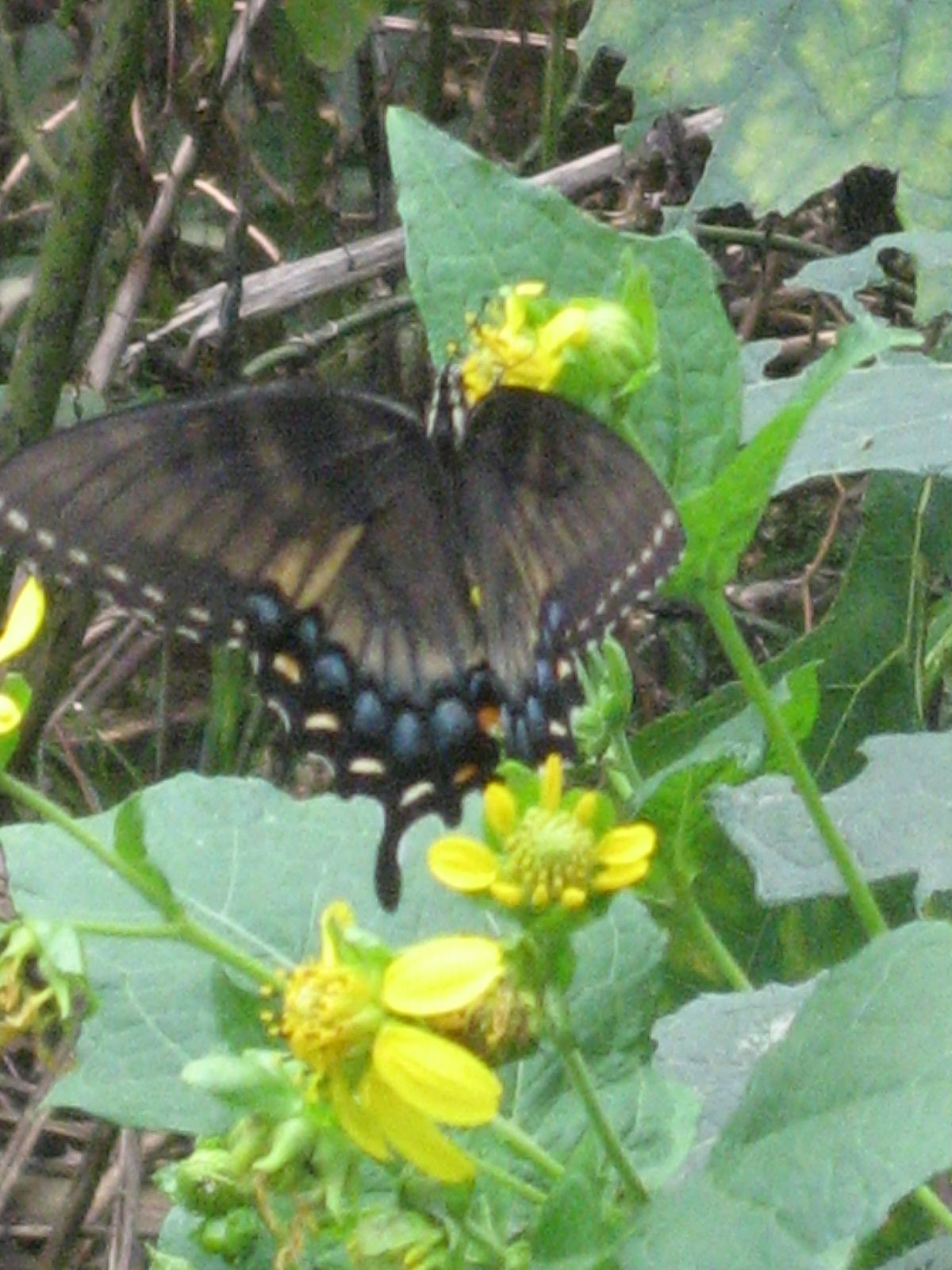
The 8 levels of classification, broadest to most specific.
a)
Domain, Genus, Family, Order, Class, Phylum, Kingdom, Species
b)
Domain, Species, Kingdom, Genus, Phylum, Family, Class, Order
c)
Domain, Kingdom, Phylum, Class, Order, Family, Genus, Species
d)
Order, Kingdom, Species, Domain, Phylum, Family, Class, Genus
5.
An organism made up of more than one cell would be called:
a)
multicellular
b)
unicellular
c)
heterotroph
d)
autotroph
6.
An example of an unicellular organism would be:
a)
monkey
b)
bacteria
c)
spider
d)
human
7.
Prokaryotes do not have a nucleus or membrane bound organelles.
a)
True
b)
False
8.
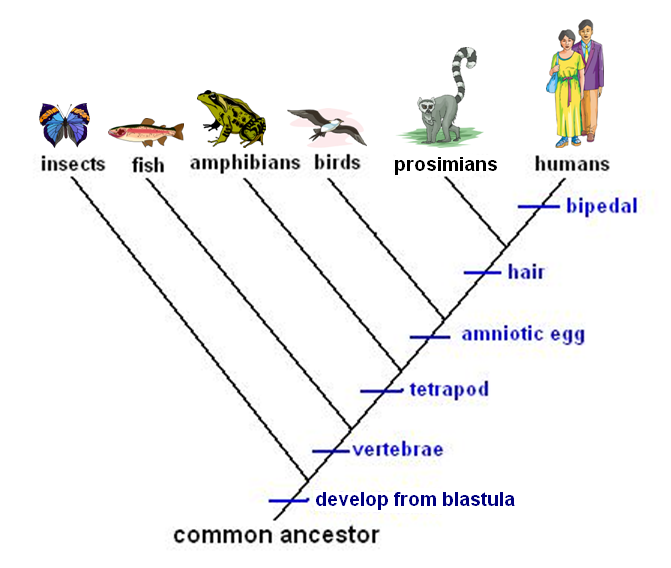
Which organisms pictured on the cladogram have hair?
a)
prosimians only
b)
prosimians and humans
c)
humans only
d)
prosimians and birds
9.
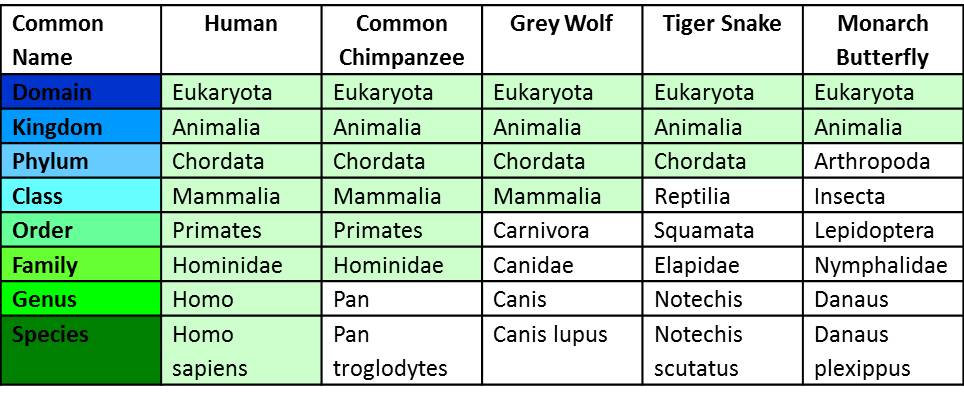
Which organism in the table is least closely related to the chimpanzee?
a)
human
b)
grey wolf
c)
tiger snake
d)
monarch butterfly
10.

Which organism in the table shown is most closely related to the common dolphin?
a)
human
b)
killer whale
c)
giant kelp
d)
bat star
11.

An illustration and a dichotomous key are given. What is the correct classification for this organism?
a)
Class Insecta
b)
Order Amblygygi
c)
Order Araneae
d)
Order Scorpiones
12.

Which 2 organisms would be able to reproduce and produce fertile offspring?
a)
2 organisms in the same class
b)
2 organisms in the same family
c)
2 organisms in the same genus
d)
2 organisms in the same species
13.
Members of this kingdom are multicellular and heterotrophic.
a)
Plantae
b)
Protista
c)
Animalia
d)
Achaebacteria
14.
What kingdom do unicellular, prokaryotic organisms that live in extreme environments?
a)
Animal
b)
Archaebacteria
c)
Eubacteria
d)
Plant
15.
I have a nuclear membrane, can do photosynthesis and am multicellular. What kingdom do I belong to?
a)
Animalia
b)
Archaebacteria
c)
Plantae
d)
Protista
16.

I am prokaryotic and am found everywhere. What kingdom do I belong to?
a)
Eubacteria
b)
Archaebacteria
c)
Fungi
d)
Protista
17.
I'm motile and have no cell walls. What kingdom do I belong to?
a)
Animalia
b)
Archaebacteria
c)
Eubacteria
d)
Plantae
18.
This organism is multicellular, heterotroph, that has a cell wall made of chitin. What kingdom does it belong in?
a)
fungi
b)
plantae
c)
animalia
d)
eubacteria
19.
An organism is microscopic, does not have a nucleus, and is known to cause strep throat in humans. What kingdom does it belong in?
a)
archaebacteria
b)
fungi
c)
eubacteria
d)
protista
20.
This organism is found in pond water. It has a nucleus, is microscopic, unicellular and can perform photosynthesis. What kingdom does it belong in?
a)
protista
b)
eubacteria
c)
archaebacteria
d)
plantae
21.
This organism is multicellular, autotroph, that has a cell wall made of cellulose.
a)
animalia
b)
plantae
c)
fungi
d)
eubacteria
22.
An organism that consists of a single cell is called?
a)
multicellular
b)
unicellular
c)
autotroph
d)
heterotroph
23.
How many levels of classification do scientists use today?
a)
eight
b)
six
c)
four
d)
two
24.
What do scientists look at to classify living things?
a)
their diseases
b)
their likes and dislikes
c)
their characteristics
d)
their ages
25.
All members of kingdom________________ must eat food in order to survive.
a)
plantae
b)
fungi
c)
protista
d)
animalia
26.
A domain made up of prokaryotes that live in soil, water, an in the human body ____________.
a)
Bacteria
b)
Fungi
c)
Protista
27.
They are eukaryotic living things that have cell walls and make their own food.
a)
plants
b)
food
c)
animals
28.
Cladograms are constructed by grouping organisms together based on their____________ characteristics.
a)
shared
b)
different
c)
similar
d)
opposite
29.
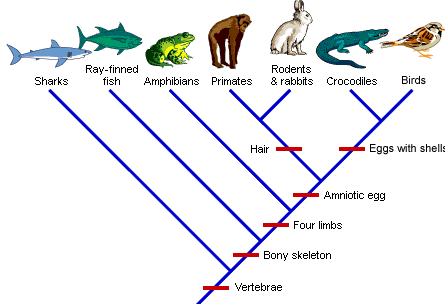
According to this cladogram, sharks are MOST closely related to which organism?
a)
Amphibians
b)
Ray finned fish
c)
Crocodiles
d)
Birds
30.
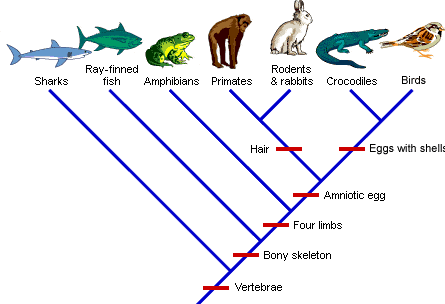
According to this cladogram, birds are LEAST related to:
a)
Amphibians
b)
Sharks
c)
Ray Finned Fish
d)
Crocodiles
31.
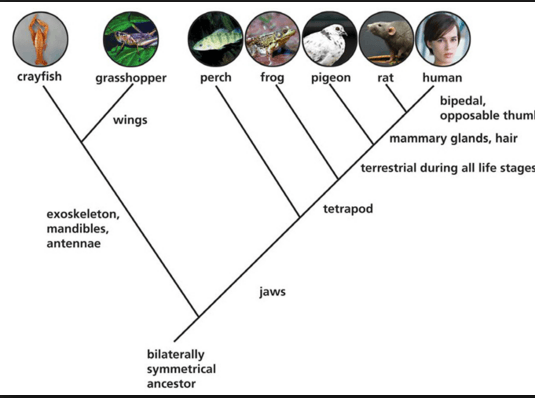
Which trait do only humans have, according to the cladogram?
a)
jaws
b)
mammary glands & hair
c)
terrestrial during all life stages
d)
bipedal & opposable thumbs
32.
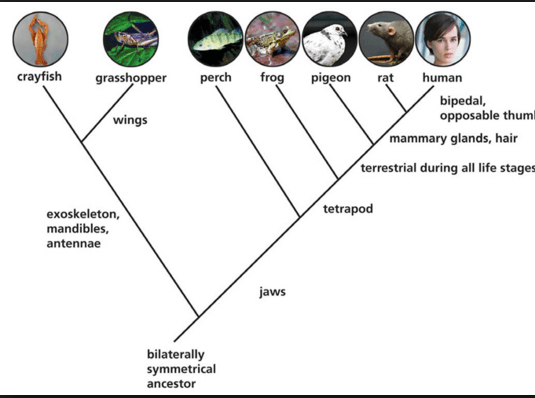
According to the cladogram, which organism is most distantly related to the human?
a)
crayfish
b)
grasshopper
c)
perch
d)
frog
33.
You look at two species and see very similar DNA. What does this likely tell you?
a)
These are the same animal.
b)
These animals have a common ancestor.
c)
These animals are not likely related.
d)
These animals are likely becoming one species.
34.
What should you do when typing a scientific name?
a)
Capitalize the first word
b)
Capitalize the first word and underline the whole thing
c)
Capitalize the first word and italicize the whole thing
d)
Nothing
35.

What trait separates sharks from ray-finned fish?
a)
Vertebrae
b)
Bony skeleton
c)
Four limbs
d)
None
36.

What traits do crocodiles and amphibians have in common?
a)
Vertebrae and hair
b)
Four limbs and amniotic eggs
c)
Bony skeleton and vertebrae
d)
Amniotic eggs and hair
37.

Which of dot represents the most recent ancestor of a mushroom?
a)
A
b)
B
c)
C
d)
D
38.

Which frog is most closely related to the Southern Leopard Frog?
a)
Bullfrog
b)
Carpenter frog
c)
There is no closely related frog
d)
Green frog
39.

What species of frog has no ridges and a mottled back?
a)
Southern leopard frog
b)
Green frog
c)
Bullfrog
d)
Carpenter frog
40.
The Baltomore Oriole has the scientific name: Icterus galbula. What taxonomic levels do the scientific name include?
a)
Genus and species
b)
Phylum and genus
c)
Kingdom and phylum
d)
Class and species
41.
Term given to describe the 2 name naming system is:
a)
dichotmous key
b)
binomial nomenclature
c)
2 scientific names
d)
binomial key
42.
Who first proposed binomial nomenclature as a way of classifying organisms?
a)
Carl Linnaeus
b)
Carl's Jr.
c)
Charles Darwin
d)
Henry Groseclose
43.

An illustration and a dichotomous key are given. What is the correct classification for this organism?
a)
Class Insecta
b)
Order Amblygygi
c)
Order Araneae
d)
Order Scorpiones
44.

A dichotomous key for trees is provided. Hikers found a tree that has large brown cones and single sharp needles. What species of tree have the hikers found?
a)
Juniper
b)
Pine
c)
Spruce
d)
Fir
45.
Which of the following is an example of binomial nomenclature?
a)
Moon Jelly
b)
Jelly fish
c)
Chrysaora fuscescens
d)
Cnidarian
46.

If two organisms are in the same phylum, they must also be in the same
a)
class
b)
species
c)
family
d)
kingdom
47.
A wolf's scientific name is Canis rufus. Which genus does it belong to?
a)
Canis
b)
rufus
c)
wolf
d)
animal
48.

The taxon (group) with the largest amount of organisms grouped together is
a)
species
b)
phylum
c)
genus
d)
domain
49.
Which of the following is NOT true when comparing scientific names and common names?
a)
Scientific names vary from place to place.
b)
Common names vary from place to place.
c)
Scientific names are in Latin.
d)
There can be multiple common names for one organism.
50.
Which is the correct way of writing the scientific name for human?
a)
homosapien
b)
homo sapien
c)
Homo sapien
d)
Homo Sapien
51.
Which Domain contains members who are prokaryotic?
a)
Archae and Bacteria
b)
Archae and Protista
c)
Bacteria and Animalia
d)
Bacteria and Fungi
52.
Members of this kingdom are multicellular and autotrophic
a)
Plantae
b)
Animalia
c)
Protista
d)
Fungi
53.
Members of this kingdom are multicellular and heterotrophic
a)
Plantae
b)
Protista
c)
Animalia
d)
Achae
54.
Members of this kingdom live in unusual conditions such as deep ocean trenches or volcanoes
a)
Bacteria
b)
Protista
c)
Fungi
d)
Archae
55.
How many kingdoms are there?
a)
1
b)
6
c)
3
d)
13
56.
Which is NOT a domain?
a)
Eukarya
b)
Archaea
c)
Bacteria
d)
Plantae
57.
A multicelled organism that has cell walls and makes its own food
a)
Animal
b)
Plant
c)
Fungi
d)
Protist
58.
Which is NOT a kingdom?
a)
Mammal
b)
Plant
c)
Bacteria
d)
Fungi
59.
An organism that can make its own food
a)
Heterotroph
b)
Autotroph
c)
Herbivore
d)
Vegetarian
60.
An organism that does NOT have a nucleus is a ....
a)
Prokaryote
b)
Eukaryote
c)
Primitive
d)
Amoeba
61.
What are humans?
a)
Prokaryote
b)
Eukaryote
62.
Molds, yeast, and mushroom belong to kingdom:
a)
Bacteria
b)
Archae
c)
Protista
d)
Fungi
63.
Which of the following is NOT one of the Domains that scientists use to classify?
a)
Bacteria
b)
Eukarya
c)
Fungi
d)
Archaea
64.
What are the 3 Domains?
a)
Archaea, Bacteria, Eukarya
b)
Archaea, Eukarya
c)
Archaea, Bacteria, Eukarya, Eubacteria
d)
Archaea, Eubacteria, Eukarya
65.
This domain contains organisms that have a true nucleus in each of their cells. This domain breaks down into four kingdoms.
a)
Animalia
b)
Archaea
c)
Bacteria
d)
Eukarya
66.
I am made of many cells. My cells have an organized nucleus. I mostly have two parents, but sometimes one. I make my own food.
a)
Fungi
b)
Bacteria
c)
Plantae
d)
Animalia
67.

Which of the following slides contains eukaryotic cells?
a)
Slide A because the cells contain nuclei
b)
Slide A because the cells lack nuclei
c)
Slide B because the cells have nuclei
d)
Slide B because the cells do not have nuclei
68.
The domain Archaea:
a)
are multicellular
b)
Undergo photosynthesis
c)
have membrain bound organelles
d)
are able to tolerate extreme conditions
Reset

