
 Worksheets
Bioquizizz 9
Total questions: 60
Worksheet time: 58mins
Name
Class
Date
1.
Which term refers to a picture of an individual’s chromosomes, used to detect genetic conditions?
a)
synapsis
b)
tetrad
c)
centriole
d)
karyotype
2.
What chromosomal abnormality causes Down's Syndrome?
a)
Trisomy 47
b)
Trisomy 46
c)
Trisomy 21
d)
Trisomy 23
3.
A person with Turner syndrome has only one X chromosome. This means one of their gametes was missing a chromosome.
Which of the following is why gametes sometimes lack a complete chromosome?
Which of the following is why gametes sometimes lack a complete chromosome?
a)
Incomplete dominance
b)
Nondisjunction
c)
Inversion mutation
d)
Substitution mutation
4.
If a cell has an abnormal number of chromosomes, usually from meiosis, what is this considered? Choose the best answer.
a)
Chromosome mutation
b)
Nondisjunction
c)
Sex-linked mutation
d)
Inversion
5.

In the figure, how many children of individuals 4 and 5 have attached earlobes?
a)
1
b)
3
c)
0
d)
4
6.
Which blood type can receive a blood transfusion from anyone?
a)
A
b)
B
c)
AB
d)
O
7.

Sex-linked recessive traits occur
a)
more often in males
b)
because of genes on chromosome 21.
c)
more often in females
d)
because of genes on autosomes
8.

A chromosome that is not a sex chromosome is known as a(an)
a)
autosome.
b)
karyotype.
c)
pedigree.
d)
chromatid.
9.

An individual with blood type O can receive blood from an individual with type
a)
A
b)
B
c)
AB
d)
O
10.

The ABO blood group is made up of
a)
three alleles.
b)
two alleles.
c)
identical alleles.
d)
dominant alleles.
11.

Because of nondisjuntion, ____ are not distributed evenly in the zygote.
a)
chromosomes
b)
genes
c)
alleles
d)
gametes
12.

In a pedigree chart, how are females illustrated
a)
circles
b)
squares
c)
triangles
d)
lines
13.

In a pedigree chart, how are characteristics or traits illustrated
a)
circles
b)
squares
c)
shading
d)
lines
14.

In a pedigree chart, how are males illustrated
a)
circles
b)
squares
c)
triangles
d)
lines
15.

In a pedigree chart, how are relations illustrated
a)
circles
b)
squares
c)
shading
d)
lines
16.
In cows coat color exhibits incomplete dominance. RR gives a red coat. WW gives a white coat, RW give a roan coat. What is the probability of getting white offspring when you cross a red and a white cow?
a)
0%
b)
25%
c)
50%
d)
100%
17.
A man with type O blood is accused of being the father of a type B baby. The mother is type A. Could this man be the father?
a)
Yes
b)
No
18.
Which term(s) best describes the inheritance of human blood types?
a)
incomplete dominance and multiple alleles
b)
codominance and epistasis
c)
codominance and multiple alleles
d)
incomplete dominance and codominance
19.

What is the gender of the individual whose karyotype is seen in the image?
a)
Male
b)
Female
20.

This is a picture of chromosomes arranged in homologous pairs---what is it called?
a)
Genome
b)
Punnett Square
c)
Karyotype
d)
Autosomal cells
21.
Which pair of chromosomes is known as the "sex chromosomes" and determines the sex of the child?
a)
1st
b)
16th
c)
22nd
d)
23rd
22.
Chromosomal pairs 1 through 22 produce what kind of cells?
a)
Sex cells
b)
Body cells
23.
This disorder results in a male with an extra X chromosome.
a)
Down syndrome
b)
Turner's syndrome
c)
Klinefelter's syndrome
d)
ALS
24.

Which condition is caused by nondisjunction and results in an extra chromosome on pair 21?
a)
Down Syndrome
b)
Kleinfelter's Syndrome
c)
Turner's Syndrome
d)
Colorblindness
25.
Colorblindness is what kind of pattern of inheritance?
a)
Dominant
b)
Recessive
c)
Sex-linked recessive
26.
Which of the following can a karyotype not tell you?
a)
Whether someone has Down syndrome
b)
Whether someone has a monosomy
c)
What gender someone is
d)
Whether someone has Tay-Sachs
27.
Why is eye color in humans so complicated?
a)
It's polygenic (affected by multiple genes)
b)
It's polygenic (not affected by any genes)
c)
It's codominant (created by a combination of alleles)
d)
It's codominant (controlled by dilution)
28.

How many girls in this family express this recessive disorder?
a)
4
b)
5
c)
6
d)
7
29.
For an XX female to express a recessive sex-linked trait, she must have
a)
a Y chromosome.
b)
an inactivated allele.
c)
two recessive alleles.
d)
two dominant alleles.
30.
A person who is heterozygous for a disorder caused by recessive alleles is a carrier of the disorder. A carrier is a person who
a)
does not have the disorder but can pass it on to offspring.
b)
can develop the disorder later in life but cannot pass it on.
c)
has a dominant normal allele that has been inactivated.
d)
passes the disorder to offspring on the Y chromosome only.
31.

What is the mode of inheritance shown here?
a)
Autosomal Dominant
b)
Autosomal Recessive
c)
Sex Linked
32.

What can you determine about this person based on their karyotype?
a)
They have Turner's Syndrome (Monosomy X)
b)
They have Downs Syndrome
c)
They are normal
d)
They are male
33.

In the second generation-how many people are carriers of the trait?
a)
2
b)
3
c)
5
d)
6
34.

How many individuals are there in the 3rd generation?
a)
2
b)
3
c)
4
d)
6
35.

Examine the pedigree. The allele for the presence of a widow’s peak is dominant. Therefore, we can tell from the chart that in the couple labeled 2:
a)
the male is heterozygous and the female is homozygous.
b)
the male is homozygous and the female is heterozygous.
c)
the male is homozygous and the female is homozygous.
d)
the male is heterozygous and the female is heterozygous.
36.

Why do all the daughters in Generation II carry the colorblind gene?
a)
Because mom passed on the gene.
b)
Because dad passed on the X chromosome.
c)
Because their brother has it.
d)
Because their brother gave it to them.
37.

Why does individual IV-7 have colorblindness?
a)
Because his mom is a carrier.
b)
Because his dad has it.
c)
Because his siblings have it.
d)
Because his uncle has it.
38.

Give the genotype for person III-3
a)
GG
b)
Gg
c)
gg
39.

What is the mode of inheritance shown here?
a)
Recessive
b)
Sex Linked
c)
Dominant
40.

If this pedigree shows a recessive disorder, what MUST the genotype of individual II-3 be?
a)
HH
b)
Hh
c)
hh
d)
None of the above
41.

What is the relationship between person I 1 and III 2?
a)
Father and Son
b)
Father and Daughter
c)
Grandfather and Granddaughter
d)
Uncle and Niece
42.

Which members of the family above are afflicted with Huntington's Disease?
a)
I-1, II-2, II-3, II-7, and III-3
b)
I-1, I-2, II-3, II-7, and III-5
c)
I-1, I-3, II-8, and III-2
d)
I-2, II-1, II-4, II-5, II-6, II-8, III-1, III-2, III-4, and III-5
43.

What kind of trait is colorblindness if females can be carriers without having the disease?
a)
Regular trait
b)
Sex-linked trait
44.
Which of the following units are repeatedly joined together to form a strand of DNA?
a)
amino acids
b)
nucleotides
c)
fatty acids
d)
polysaccharides
45.

In a molecule of double-stranded DNA, the amount of Adenine present is always equal to the amount of
a)
cytosine
b)
guanine
c)
thymine
d)
uracil
46.
Why is DNA important?
a)
it is very small and very complicated
b)
it's in everything
c)
it serves as the blueprint for traits of all living things
d)
because we eat it every day for energy
47.
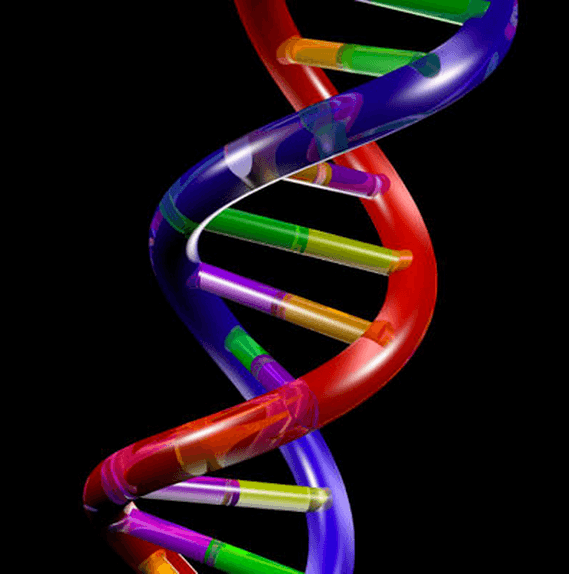
What determines the code, or information, of a DNA molecule?
a)
the shape (structure) of the nitrogen bases
b)
the order (sequence) of the nitrogen bases
c)
the color of the nitrogen bases
d)
the frequency (number) of nitrogen bases
48.
Which 2 molecules form the sides (backbone) of the DNA ladder?
a)
deoxyribose sugar and adenine
b)
deoxyribose sugar and a hydrogen bond
c)
deoxyribose sugar and the nucleus
d)
deoxyribose sugar and phosphate
49.
Which organelle is DNA usually found in?
a)
cell membrane
b)
vacuole
c)
chloroplast
d)
nucleus
50.
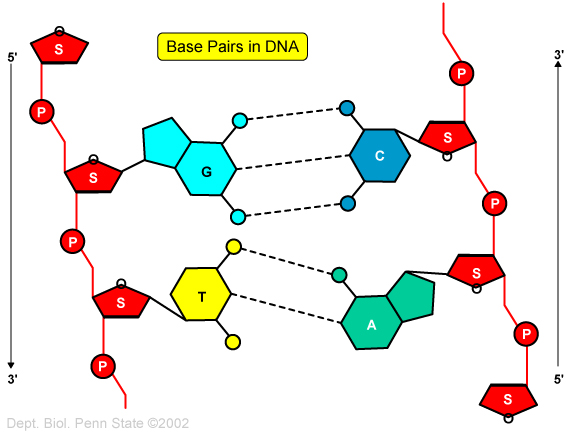
Nitrogenous bases are joined by which type of bond?
a)
polar bonds
b)
ionic bonds
c)
covalent bonds
d)
hydrogen bonds
51.

Replicate the following strand of DNA:
AATCATGGA
AATCATGGA
a)
AATCATGGA
b)
TTAGTACCT
c)
UUAGUACCU
d)
GGATAUCUA
52.
A process in which DNA has the unique ability to make an exact copy of itself.
a)
Replication
b)
Translation
c)
Transcription
53.
The enzyme that attaches the complimentary base pairs to the original strand of DNA is called
a)
helicase
b)
polymerase
c)
replicase
d)
synthase
54.
What are the 4 nitrogen bases?
a)
adenine, thymine, cytoplasm, and guanine
b)
adenine, thymine cytosine, and guanine
c)
adenine, thymine, cytosine, and gylcerol
d)
adenine, thymine, cytosine, and glucose
55.
What sugar is found in DNA
a)
Sucrose
b)
deoxyribose
c)
Phosphate
56.
What determines the traits of an organism?
a)
The length of DNA molecules
b)
The way nucleotides are paired in the two strands of DNA
c)
The order of nucleotides in DNA molecules
d)
The proportions of A, T, C, and G in DNA molecules
57.
DNA is a polymer made of monomers called
a)
Nucleotides
b)
Proteins
c)
Amino Acids
d)
Lipids
58.
DNA and RNA are macromolecules in the category of
a)
Proteins
b)
Lipids
c)
Nucleic Acids
d)
Carbohydrates
59.
Guanine bonds with ______________.
a)
Adenine
b)
Guanine
c)
Cytosine
d)
Thymine
60.
Adenine bonds with ______________.
a)
Guanine
b)
Thymine
c)
Cytosine
d)
Adenine
100 %

