Wayground logo

Free Printable Worksheets

Font size

S
M
L
XL
Worksheets

Chem Covalent Bonds/Molecules and naming test review

Total questions: 85

Worksheet time: 3hrs 10mins

Name
Class
Date
1.
Name the following compound:
SeF7
a)
selenium hexafluoride
b)
monoselenium heptafluoride
c)
selenium fluoride
d)
selenium heptafluoride
2.
Name the following compound:
P2O5
a)
phosphorus oxide
b)
diphosphorus pentoxide
c)
phosphorus pentoxide
d)
diphosphorus hexoxide
3.
Is the following ionic or covalent:
CS2
a)
Ionic 
b)
Covalent
4.
What is the correct formula for the compound, lithium oxide?
a)
LiO
b)
Li2O
c)
LiO2
d)
Li2O2
5.
What is the formula for the compound, phosphorus trifluoride?
a)
PF3
b)
PhF3
c)
PO4F3
d)
PF
6.
What is the formula for the the compound, hexaboron monosilicide?
a)
B5S
b)
BS6
c)
B6S
d)
BoS
7.
Which of these compounds is ionic? 
a)
Carbon dioxide
b)
Dinitrogen Trioxide
c)
Silicon tetrachloride
d)
Lithium bromide
8.
Nitrite
a)
NO2-
b)
NO3-
c)
MnO4-
d)
NH4+
9.
Hydroiodic acid
a)
H2I2
b)
H1I1
c)
HI
10.
bromic acid
a)
HBr
b)
H2Br
c)
HBrO3
d)
HBrO4
11.
chlorous acid
a)
HClO3
b)
HClO2
c)
HClO
d)
HCl
12.
HIO
a)
hydroiodic acid
b)
iodic acid
c)
iodous acid
d)
hypoiodous acid
13.
Name HF
a)
hydrofluoric acid
b)
Hypofluoric acid
c)
hydrogen fluorine acid
d)
fluoric acid
14.
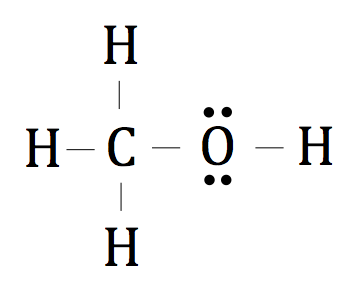
What is incorrect about the Lewis structure?
a)
too many valence e-
b)
too few valence e-
c)
paired e- with not all sides filled
d)
nothing
15.
How many chemical bonds will be formed by the atom in the picture?
a)
4
b)
2
c)
3
d)
no way to know
16.
How many electrons are shared in a triple bond?
a)
6
b)
3
c)
6 pairs
d)
5
17.
In this molecule, each CARBON makes how many bonds?
a)
1
b)
2
c)
3
d)
4
18.
In this molecule, each HYDROGEN makes how many bonds?
a)
1
b)
2
c)
3
d)
4
19.
In this molecule, each NITROGEN makes how many bonds?
a)
1
b)
2
c)
3
d)
4
20.
What are the formulas for the 7 diatomic molecules?
a)
H2, N2, O2, F2, Cl2, Br2, I2
b)
He2, N2, O2, F2, Cl2, Br2, I2
c)
H2, N2, O2, F2, Ne2, Ar2, Kr2
d)
H2, Ne2, O2, F2, C2, Br2, I2
21.
What is another name for a covalent compound?
a)
Molecule
b)
Salt
c)
Metallic bond
d)
Nonmetal
22.
The shorter the bond length, the _________ the bond dissociation energy and the ______ the bond.
a)
greater; stronger
b)
greater; weaker
c)
less; stronger
d)
less; weaker
23.
Which formula shows the total number of atoms of each element in the molecule?
a)
Molecular
b)
Empirical
c)
Structural
24.
What is the difference between a Lewis structure and a structural formula?
a)
Lewis shows unpaired electrons, structural does not
b)
Lewis doesn't show unpaired electrons, structural does
25.
C2H4 is what type of formula?
a)
Molecular
b)
Empirical
c)
Structural
d)
Lewis Dot
26.
Covalent compounds
a)
Share electrons
b)
transfer electrons
c)
contain a sea of electrons
d)
conduct electricity
27.
CO, carbon monoxide, obeys the octet rule using a coordinate covalent bond. What is a coordinate covalent bond?
a)
both bonding electrons come from one atom
b)
a very strong bond.
c)
one electron serves as its own pair
d)
CO is an exception to the octet rule
28.
For the structural formula shown, what is the chemical formula?
a)
NO
b)
N2O2
c)
NO2
d)
N2O
29.
Why do atoms share electrons?
a)
To attain the electron configuration of a noble gas.
b)
To become ions and take a charge
c)
to increase the mass
d)
it's a nice thing to do.
30.
What is it called when atoms share one pair of electrons?
a)
A double bond
b)
A triple bond
c)
A quadruple bond
d)
A single bond
31.
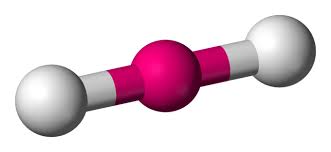
Which of the following molecular shapes would have a bond angle of 180 Degrees?
a)
Bent
b)
Trigonal Planar
c)
Tetrahedral
d)
Linear
32.
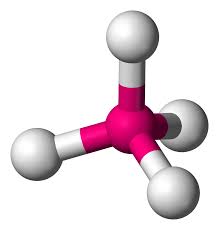
What is the measure of a tetrahedral bond angle?
a)
90 Degrees
b)
109.5 Degrees
c)
120 Degrees
d)
180 Degrees
33.
Which molecule would have this shape?
a)
BF3
b)
CH4
c)
PCl5
d)
CO2
34.
The bond angle for a trigonal planar molecule is 
a)
90 Degrees
b)
109.5 Degrees
c)
120 Degrees
d)
180 Degrees
35.
Who could this molecule be?
a)
CH4
b)
CO2
c)
PCl5
d)
BF3
36.
One can predict the shape of a molecule by drawing its Lewis structure and
a)
balancing the oxidation numbers.
b)
accounting for nonbonded pairs of valence electrons.
c)
determining the empirical formula.
d)
identifying the presence of polyatomic ions.
37.
What is the VSEPR theory used to predict?
a)
Bond Strength
b)
Polarity
c)
Molecular Shape
d)
Electronegativity
38.
BCl3 would have what structure?
a)
linear
b)
tetrahedral
c)
trigonal planar
d)
trigonal pyramidal
39.

The model is based on the principle that electron pairs around the central atom ------ each other.

a)

bond

b)

attract

c)

repel

40.

What is the correct Lewis Dot Structure for ammonia NH3

a)
b)
c)
d)
41.

Which is the correct molecular structure for carbon dioxide?

a)
b)
c)
d)
42.
Which of the following is the correct Lewis dot structure for the molecule fluorine (F2)?
a)
A
b)
B
c)
C
d)
D
43.

Is this the correct structure for CH2O?

a)

Yes

b)

No

44.
Three pairs of electrons are shared in a
a)
Single bond
b)
Double bond
c)
Triple bond
45.
What is the correct formula for this molecule?
a)
Si4F
b)
SiF4
c)
SiF
d)
Si4F4
46.

Which of the following compounds has only single bonds?

a)

I only

b)

II only

c)

III only

d)

I and III

e)

III and IV

47.
According to the octet rule most elements need _______ valence electrons.
a)
2
b)
8
c)
6
d)
18
48.
Each line in a Lewis Structure represents __________ electron(s).
a)
3
b)
2
c)
1
d)
4
49.

NH3 has how many lone pairs?

a)

0

b)

1

c)

2

d)

3

50.

In HCN (Carbon is usually the central atom) what kind of bond is between the C and N

a)

Single

b)

Double

c)

Triple

51.
How many electrons should Phosphorus have around its Lewis dot model?
a)
2
b)
4
c)
5
d)
7
52.
diphosphorus pentoxide
a)
P2O5
b)
PO5
c)
P5O2
d)
P2O6
53.
The chemical formula of tetraphosphorus heptaoxide is
a)
F₄O₁₀
b)
P₄O7
c)
PO
d)
P₁₀O₄
54.

What is the hybridization of a linear molecule?

a)

sp

b)

sp2

c)

sp3

d)

sp3d

55.

What is the hybridization of this molecule shown above

a)

sp

b)

sp2

c)

sp3

d)

sp4

56.

What is the hybridization of the central atom of a bent molecule? (AB2E2)

a)

sp

b)

sp2

c)

sp3

d)

sp3d

57.
Choose the correct shape for this molecule:
a)
Trigonal planar
b)
Trigonal pyramidal
c)
Tetrahedral
d)
Linear
58.
Choose the correct shape for this molecule:
a)
Trigonal planar
b)
Trigonal pyramidal
c)
Bent
d)
Linear
59.
The molecule shown in the diagram can best be classified as a
a)
polar covalent molecule
b)
nonpolar covalent molecule
c)
ionic compound
d)
nonpolar ionic compound
60.

The polarity of a bond between two elements can be best determined by

a)

The difference in electronegativity between the elements

b)

The difference in first ionization energy between the elements

c)

The number of electrons shared in the bond

d)

The difference in atomic radius between the elements

61.
Which bond is most polar?
a)
H-F
b)
H-Cl
c)
H-Br
d)
H-I
62.
What are the hybridization and the approximate bond angles in CS2?
a)
sp2, 1070
b)
sp3, 1200
c)
sp2, 1200
d)
sp, 1800
63.

Which of the following molecules has Π bonds?

a)

CO2

b)

BF3

c)

NH3

d)

H2O

64.

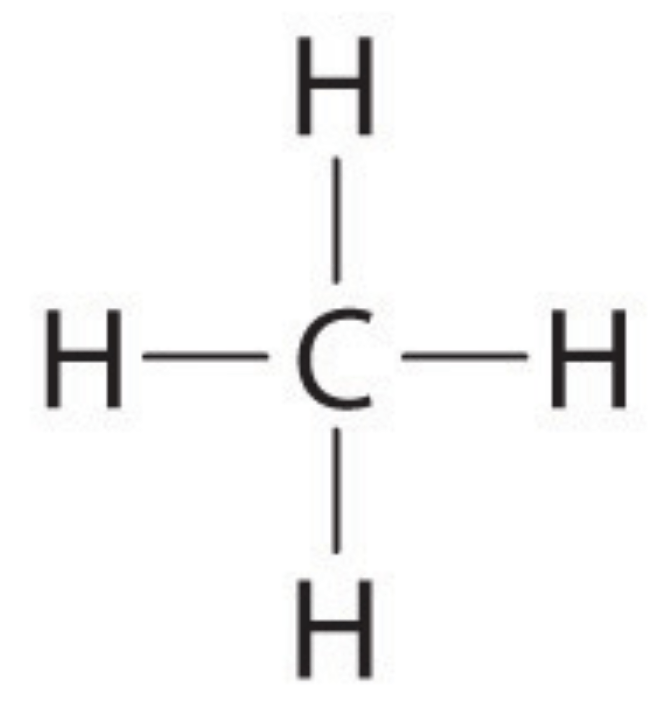
This carbon atom went through ....

a)

sp hybridization

b)

sp2 hybridization

c)

sp3 hybridization

d)

dsp3 hybridization

65.

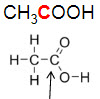
What is the hybridization of the Carbon atom indicated by the arrow?

a)

sp hybridization

b)

sp2 hybridization

c)

sp3 hybridization

d)

dsp3 hybridization

66.
phosphorous acid
a)
H3PO4
b)
H2PO4
c)
H3P
d)
H3PO3
67.
hydrochloric acid
a)
HCl
b)
HClO
c)
H3ClO3
d)
HClO3
68.
Mg(OH)2
a)
magnesium hydroxide acid
b)
hydromagnesium acid
c)
magnesium oxygen hydride
d)
magnesium hydroxide
69.
Barium hydroxide
a)
BaOH
b)
Ba2OH
c)
Ba(OH)2
70.
Nitrous Acid
a)
HNO2
b)
H2NO2
c)
HNO3
71.

Classify the following molecule.

a)

polar

b)

nonpolar

72.

Classify the following molecule as polar or nonpolar: HCl

a)

Polar

b)

Nonpolar

73.

Classify the following molecule as polar or nonpolar: F2

a)

Polar

b)

Nonpolar

74.

Is the following molecule polar or nonpolar?

a)

polar

b)

nonpolar

75.

Electronegativity is a measurement of the ability of a nucleus to:

a)

attract bonding electrons

b)

attract other nuclei

c)

attract electrons in the non-valence energy levels

76.

Which of the following formulas represents a polar molecule?

a)

H2

b)

NI3

c)

CO2

d)

CCl4

77.
Which formula represents a nonpolar molecule?
a)
HBr
b)
H2S
c)
CBr4
d)
PCl3
78.

Classify the following as polar or nonpolar: SiO2

a)

polar

b)

nonpolar

79.

Classify the following as polar or nonpolar: SF2

a)

polar

b)

nonpolar

80.

How many sigma and how many pi bonds in this structure?

a)

2 sigma, 0 pi

b)

2 pi, 0 sigma

c)

1 sigma, 1 pi

d)

3 sigma, 0 pi

81.

How many sigma and how many pi bonds in this structure?

a)

2 sigma, 7 pi

b)

2 sigma, 9 pi

c)

9 sigma, 2 pi

d)

7 sigma, 2 pi

82.
Pi bonds are formed by 
a)
side to side overlap of s orbitals
b)
end to end overlap of s orbitals
c)
side to side overlap of p orbitals
d)
end to end overlap of p orbitals
83.
How many pi bonds are there in a single bond? 
a)
0
b)
1
c)
2
d)
3
84.
How many sigma bonds are there in a triple bond? 
a)
0
b)
1
c)
2
d)
3
85.

a single covalent bond that is formed when an electron pair is shared by the direct overlap of bonding orbitals

a)

covalent bond

b)

pi bond

c)

coordinate covalent bond

d)

sigma bond