
 Worksheets
Living Organisms & Ecology
Total questions: 74
Worksheet time: 48mins
Name
Class
Date
1.
What is the original source of almost all energy in most ecosystems?
a)
carbohydrates
b)
sunlight
c)
water
d)
carbon
2.
What is the term for each step in the transfer of energy and matter within a biological community?
a)
energy path
b)
food web
c)
trophic level
d)
food pyramid
3.
Autotrophs make up the _______ level in all ecosystems.
a)
First
b)
Second
c)
Third
d)
Fourth
4.

which symbiosis is this
a)
parasitism
b)
mutualism
c)
commensalism
d)
nonalism
5.

symbiotic relationship in which both organisms benefit
a)
competition
b)
Mutualism
c)
nitrogen fixation
d)
energy pyramid
6.

A living relationship between two species in which one organism is harmed is called...
a)
mutualism
b)
commensalism
c)
parasitism
d)
niche
7.

What does a food web represent?
a)
All connections of energy flow throughout all organisms in a habitat.
b)
The specific ways that mutualism is carried out.
c)
A single pathway or energy flow between organisms.
d)
How carnivores get their food.
8.

The image provided is an example of a(n):
a)
Carnivore
b)
Herbivore
c)
Producer
d)
Autotroph
9.
The amount of energy that usually transfers from one trophic level to the next...
a)
10%
b)
20%
c)
80%
d)
50%
10.
The nonliving aspects of an ecosystem.
a)
Abiotic factors
b)
Biotic factors
11.
The living portions of the ecosystem.
a)
Biotic factors
b)
Abiotic factors
12.
Water temperature would be an example of ...
a)
A biotic factor
b)
An abiotic factor
13.
A place where an organism lives.
a)
Terrain
b)
Habitat
c)
Community
d)
Population
14.
Organisms that can capture energy from inorganic, nonliving sources.
a)
Producers
b)
Consumers
c)
Detritivores
d)
Carnivores
15.
An organism at the second trophic level would be considered a...
a)
Top carnivore
b)
Producer
c)
Herbivore
d)
Carnivore
16.

What are the plants in this picture?
a)
Heterotrophs
b)
Autotrophs
c)
Carnivores
d)
Herbivores
17.
Organisms that feed on both living producers and other consumers.
a)
Carnivores
b)
Omnivores
c)
Herbivores
d)
Detritivores
18.
True or False: It is possible for a carnivore to be a producer.
a)
False
b)
True
19.
a kind of behavior common to some newly hatched birds or newly born animals that causes them to adopt the first person, animal, or object they see as their parent
a)
imprinting
b)
colony
c)
scout bees
d)
stallion
20.
how animals act when they interact with each other
a)
social behavior
b)
ingestive behavior
c)
ruminants
d)
grubs
21.
Behavior where an animal associates a certain response with a certain stimulus.
a)
Instinct
b)
Social
c)
Conditioning
d)
Ingestive
22.
The conditioning stimuli Pavlov introduced to dogs to gain the response of salivation.
a)
Clapped hands
b)
Ringing a bell
c)
Food
d)
Blew a whistle
23.

What type of tropism response to gravity?
a)
Hydrotropism
b)
Phototropism
c)
Thigmotropism
d)
Gravitropism
24.

What is this an image of
a)
thigmatropism
b)
gravitropism
c)
phototropism
d)
photoperiodism
25.
When a hawk swoops and catches a mouse to eat, it is exihibiting:
a)
innate behavior
b)
operative conditioning
c)
classical conditioning
d)
imprinting
26.
When my dogs hear the sound of me scooping dog food, they start barking and jumping around excitedly. This is an example of:
a)
instinct
b)
operant conditioning
c)
classical conditioning
d)
territorality
27.
Traveling to a different region during different times of the year
a)
Migration
b)
Communication
c)
Hibernation
d)
Competition
28.
Some male birds perform elaborate dances in order to attract females. This is an example of _______.
a)
camouflage
b)
insight
c)
courtship
d)
mimicry
29.
A cat is stalking a mouse. What is the stimulus for this behavior?
a)
food (prey)
b)
avoiding predation
c)
seasonal change
d)
reproduction
30.
A rabbit is running away from a fox. What is the stimulus for this behavior?
a)
avoiding a predator
b)
food
c)
migration
d)
estivation
31.
Getting use to something after being exposed to it for a long period of time is an example of which type of learned behavior?
a)
insight learning
b)
playing
c)
habituation
d)
observational learning
32.
Which type of behavior is most likely to occur due to a seasonal change stimulus?
a)
migration
b)
estivation
c)
reproduction
d)
social grooming
33.
Migration is an innate behavior.
a)
true
b)
false
34.
The behavior of some animals to attract other animals
a)
Courtship
b)
Dating
c)
Showing off
d)
Hibernation
35.
Animals compete for...
a)
Food
b)
Mates
c)
Territory
d)
All of these
36.
Temperatures in the desert are at an all time high. What are ectotherms likely doing to avoid overheating?
a)
hibernating
b)
estivating
c)
panting
d)
hiding
37.
In the park, you noticed a girl throwing a stick for her dog to fetch. The dog ran and got the stick every time. This is an example of
a)
instinctive behavior
b)
learned behavior
38.
Which of the following is an example of an animal showing an instinctive behavior?
a)
a dog sitting on command when the owner says, "Sit!"
b)
a woman sneezing when she gets pepper in her nose
c)
a bird building a perfect nest the first time it tries
d)
a bear sitting in a cave to keep from getting wet in a rain storm
39.
A reaction to a stimulus:
a)
behavior
b)
stimulus
c)
response
d)
classification
40.
___ behavior can be taught from a parent or gained through experience.
a)
innate
b)
instinctive
c)
learned
d)
innate and instinctive
41.
A chemical secreted by an animal that influences the behavior of the others of the same species
a)
aggression
b)
olfactory
c)
pheromones
d)
none of these
42.
A unicellular organism is made up of
a)
one cell
b)
more than one cell
c)
less than one cell
43.
Whip-like tail helps an organism with locomotion
a)
Cilia
b)
Pseudopods
c)
Flagellum
44.
Tiny hair-like structures that beat to help an organism with locomotion
a)
Cilia
b)
Pseudopods
c)
Flagellum
45.

This is an image of a(n) _________
a)
Amoeba
b)
Euglena
c)
Paramecium
d)
Bacteria
46.

This is an image of a(n) _________
a)
Amoeba
b)
Euglena
c)
Paramecium
d)
Bacteria
47.
What is the flagella used for?
a)
eating
b)
reproduction
c)
movement
d)
communicating
48.
A euglena uses its ________ to detect light.
a)
eyespot
b)
pinkeye
c)
eye sore
d)
laser vision
49.
Amoebas move by extending their _______.
a)
cillium
b)
pseudopods
c)
legs
d)
arms
50.
Bacteria are unicellular
a)
True
b)
False
51.

The number of individuals a habitat can sustain with the resources it has available
a)
Carrying capacity
b)
Limiting factors
c)
Resources
d)
Population
52.

A supply of materials in a habitat
a)
Resources
b)
Biomes
c)
Organisms
d)
Groceries
53.
Which of the following is an EXAMPLE of a limiting factor?
a)
Water
b)
the color of the sky
c)
Migration
d)
Thick fur
54.
Which of the following is an example of competition?
a)
Two vultures fight over a dead rabbit
b)
A bear eats a fish
c)
Birds migrate south
d)
Pet dog keeps a man company
55.
Which is an example of mutualism?
a)
Lion hunts and eats a zebra
b)
A bird eats harmful parasites off of an ox's skin
c)
Two wolves fight over territory
d)
A herd of horses eat grass
56.

What is the carrying capacity of the following graph?
a)
1000
b)
8000
c)
800
d)
600
57.
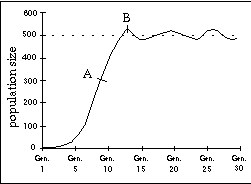
What is the carrying capacity of the graph?
a)
around 500
b)
more than 500
c)
less than 500
d)
around 600
58.

If a disease destroying barley plants in a field swept through an ecosystem, what would happen to the barley eating bird population in the the field ?
a)
The bird population would stay the same
b)
The bird population would infinitely increase
c)
The bird population would decrease
59.

Any thing or organism that regulates the size of a population is known as __________.
a)
a limiting measure
b)
a limiting factor
c)
carrying capacity
d)
biodiversity
60.

What type of growth is represented in this graph?
a)
exponential
b)
logistics
c)
a good kind
d)
representative
61.

What type of growth is represented by this graph?
a)
exponential
b)
logistics
c)
a good kind
d)
representative
62.
Anything that would keep a population from growing larger.
a)
Symbiosis
b)
Limiting Factors
c)
Carrying capacity
63.
Combustion is another word for _______________.
a)
a train
b)
a bus
c)
a dog
d)
burning
64.
What does not produce carbon dioxide?
a)
Photosynthesis
b)
Burning Fossil Fuels
c)
Animal respiration
d)
Plants decaying
65.

In the carbon cycle, producers take in the gas __
a)
carbon dioxide
b)
oxygen
c)
nitrogen
d)
carbon monoxide
66.
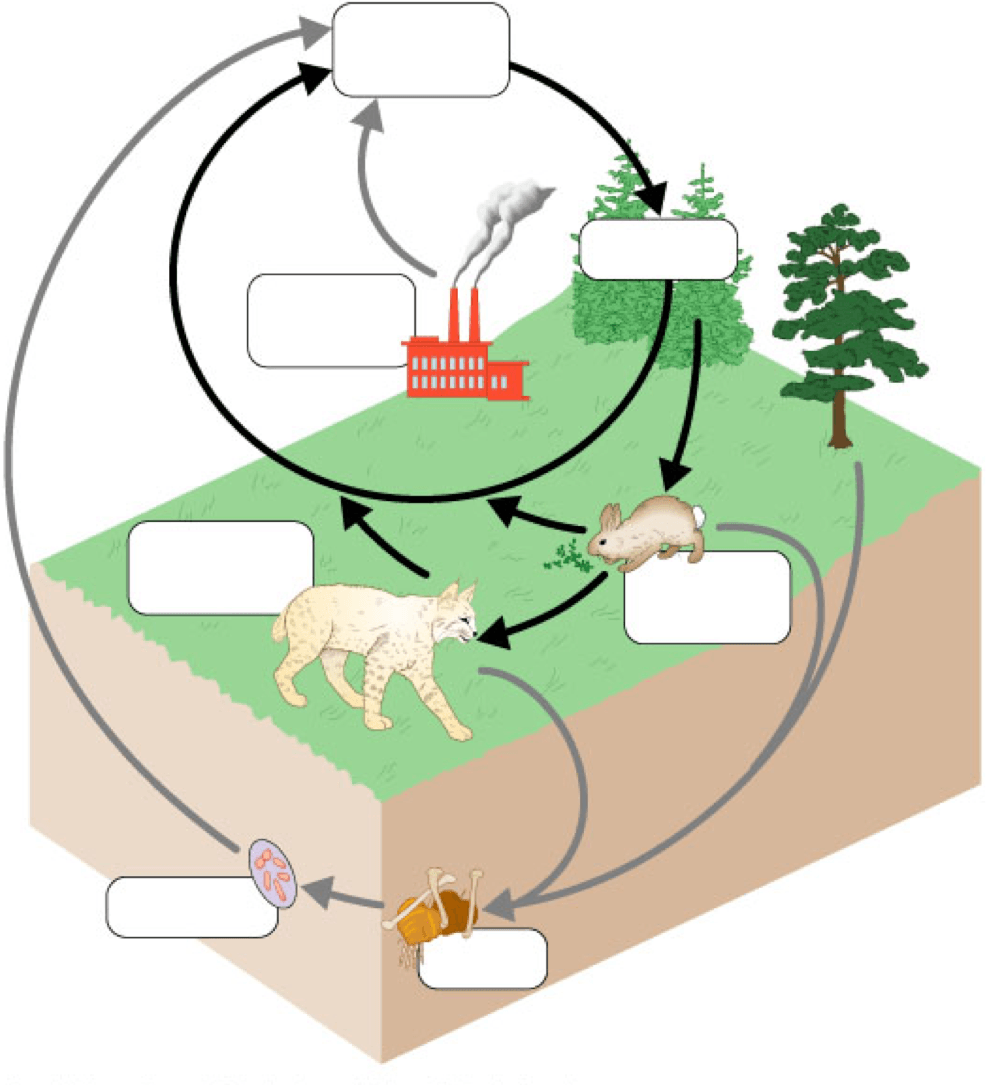
In what process is Carbon transformed into chemical energy?
a)
Photosynthesis
b)
Respiration
c)
Primary Production
d)
Secondary Production
67.
How does carbon affect global warming?
a)
Speeds up the effects of global warming
b)
Slows down the effects of global warming
c)
Does nothing to the speed of global warming
d)
Global warming is FAKE
68.

Why does too much carbon dioxide in the atmosphere cause climate change?
a)
It cools down our planet
b)
It blocks out UV rays
c)
It traps heat and warms up our planet
d)
It lets sunlight escape
69.
Carbon dioxide is created by
a)
Burning fossil fuels
b)
Cellular respiration
c)
Decomposing organic matter
d)
All answers are correct
70.
What is the process of combining nitrogen gas with hydrogen to make nitrogen into usable compounds?
a)
nitrogen composition
b)
ammonia
c)
nitrogen fixation
d)
denitrification
71.

How do plants get the nitrogen they need?
a)
from the air
b)
from the soil or water in which they live
c)
from the Sun
d)
from broken-down rocks
72.
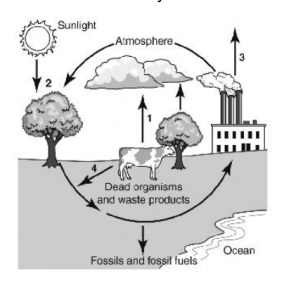
What is happening at 1?
a)
respiration: releasing CO2
b)
decomposing CO2 in the soil
c)
photosynthesis: absorbing CO2
d)
turning CO2 from the atmosphere into organic molecules
73.
Photosynthesis
a)
absorbs CO2
b)
releases CO2
74.
Respiration
a)
absorbs CO2
b)
releases CO2
100 %

