
 Worksheets
Science 2nd Semester Final Review
Total questions: 80
Worksheet time: 1hrs 5mins
Name
Class
Date
1.
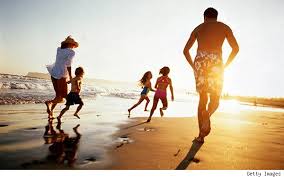
The sun shines down on this family as the play on the beach.
a)
conduction
b)
convection
c)
radiation
2.

Blow drying your wet hair.
a)
conduction
b)
convection
c)
radiation
3.
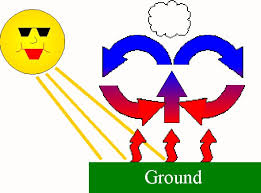
Warm air rises and the cool air sinks.
a)
conduction
b)
convection
c)
radiation
4.

In this experiment, the WARM red dye and the COLD blue dye was placed in the water at the same time. The warm red dye rose to the top while the cold blue dye sank to the bottom.
a)
conduction
b)
convection
c)
radiation
5.

The chocolate bunny and the iron.
a)
conduction
b)
convection
c)
radiation
6.
What type of winds blow constantly, predictably, and over long distances?
a)
land breezes
b)
mountain breezes
c)
global winds
d)
land breezes
7.

Which diagram shows the formation of a land breeze?
a)
diagram Y
b)
diagram X
c)
neither
d)
both
8.
A severe storm that involves high winds and forms over water is:
a)
tornado
b)
thunderstorm
c)
hurricane
d)
blizzard
9.
A severe storm which involves a funnel cloud forming over land is:
a)
hurricane
b)
tornado
c)
thunderstorm
d)
blizzard
10.
What do hurricanes feed on?
a)
warm tropical water
b)
hot water
c)
cold artic water
d)
rain
11.

What phase of the moon is pictured here?
a)
New moon
b)
First quarter moon
c)
Full moon
d)
Last quarter moon
12.
Also known as a “shooting star”
a)
Meteoroid
b)
Meteor
c)
Comet
d)
Asteroid
13.
This is when an object spins on its axis.
a)
Rotation
b)
Orbit
c)
Tilt
d)
Revolution
14.

Spins on its axis clockwise.
a)
prograde
b)
retrograde
c)
gatorade
15.
Venus's motion is _________
a)
prograde
b)
retrograde
c)
gatorade
16.

Which type of eclipse is shown in this picture?
a)
Solar Eclipse
b)
Orbit
c)
Lunar Eclipse
d)
Total Eclipse
17.

Which type of eclipse is shown in the diagram?
a)
Solar Eclipse
b)
Lunar Eclipse
c)
Total Eclipse
d)
Partial Eclipse
18.
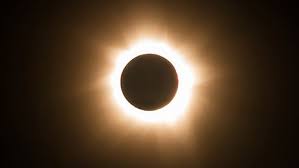
During a solar eclipse...
a)
The sun is blocked
b)
The Earth is blocked
c)
The moon is blocked
d)
You are blocked
19.
The order of a lunar eclipse is..
a)
Sun-Earth-Moon
b)
Earth-Sun-Moon
c)
Moon-Sun- Earth
d)
Earth-Moon-Sun
20.
Which of the following is a fossil fuel?
a)
Wind
b)
Coal
c)
Solar
d)
Biomass
21.
Hydroelectric power produces electricity using.....
a)
Wind
b)
Sunlight
c)
Moving water
d)
Dung
22.
Energy from the sun is known as.........
a)
hydroelectric energy
b)
geothermal energy
c)
solar energy
d)
wind energy
23.
The cleanest burning fossil fuel is ______.
a)
coal
b)
oil
c)
wind
d)
natural gas
24.
Fossil fuels are classified as nonrenewable because they.......
a)
require expensive equipment
b)
take millions of years to replace
c)
can be found all over
d)
provide all the energy we use
25.
What is biomass?
a)
energy from the sun
b)
energy from water
c)
energy from wind
d)
energy from plant and animal waste
26.
What characteristic do all renewable resources share?
a)
Produced by waste products
b)
Form underground from dead organisms.
c)
Replaced in a short period of time
d)
Allow energy to pass through them easily
27.
Why is the Sun considered the ultimate energy source?
a)
The Sun is the center of our solar system.
b)
The Sun provides energy for the water cycle and plants.
c)
The Sun is limited in the amount of energy released daily.
d)
The Sun rises and sets each day as seen from Earth.
28.
Nuclear power produces a large amount of energy along with a large amount of _____ that cannot easily be disposed.
a)
waste
b)
trash
c)
greenhouse
d)
radioactive
29.
2. What is it called when humans generate electricity by using the heat of the Earth?
a)
Geothermal Energy
b)
Hydroelectric Energy
c)
Radiation Energy
30.
Phases of the moon in which the moon appears to be getting larger are referred to as _.
a)
waxing
b)
waning
c)
new
d)
eclipse
31.
What are the reasons for the seasons?
a)
Earth's tilt and rotation.
b)
Earth's rotation and revolution.
c)
Earth's tilt and revolution.
d)
Earth's tilt and resolution
32.

What season is it in the Southern Hemisphere when it is fall in the Northern Hemisphere?
a)
winter
b)
spring
c)
summer
d)
fall
33.
What part of the moon do we see from Earth?
a)
all of it
b)
the same side
c)
none of it
d)
only one quarter
34.
What model is where the earth is in the middle of our universe?
a)
Heliocentric Model
b)
Geocentric Model
c)
Moon phases
d)
Tidal Phases
35.
What Model is where the sun is the center of the universe?
a)
Geocentric
b)
Heliocentric
c)
Earth's rotations
d)
Earth's planets
36.

This image shows the:
a)
Geocentric Solar System
b)
Heliocentric Solar System
37.
Who's book was published about the heliocentric solar system just after he died?
a)
Ptolemy
b)
Copernicus
38.
This person discovered moons on Jupiter, which helped to support the heliocentric theory
a)
Aristotle
b)
Copernicus
c)
Ptolemy
d)
Galileo
39.
This person was the first to use a telescope to make observations in the sky -
a)
Aristotle
b)
Ptolemy
c)
Copernicus
d)
Galileo
40.
This person developed the heliocentric theory and was considered the founder of modern astronomy.
a)
Aristotle
b)
Copernicus
c)
Ptolemy
d)
Galileo
41.

Wha type of tide would this arrangement of earth-moon-sun create?
a)
full moon tide
b)
new moon tide
c)
neap tide
d)
spring tide
42.

What type of tides would this arrangement of earth-moon-sun create?
a)
neap tide
b)
spring tide
c)
new moon tide
d)
full moon tide
43.

Which body has the greater effect on Earth's tides?
a)
Sun
b)
Saturn
c)
Moon
d)
Venus
44.
Tides are caused by
a)
strong winds that blow over ocean waters.
b)
the interaction of Earth, the moon and the sun.
c)
the shifting of the plates on the ocean floor.
d)
variations in the salinity of ocean water
45.
What causes tides?
a)
gravity
b)
wind
c)
spring
d)
neap
46.
A lunar eclipse can occur only during the _________________.
a)
Full moon
b)
New moon
c)
Waxing moon
47.
A solar eclipse can occur only during the _________________.
a)
Full moon
b)
New moon
c)
Quarter moon
48.
A wet and cold air mass would be a...
a)
Maritime polar
b)
Continental polar
c)
Maritime tropical
d)
Continental tropical
49.
A dry and cold air mass would be...
a)
Maritime polar
b)
Continental polar
c)
Maritime tropical
d)
Continental tropical
50.
A dry and hot air mass would be...
a)
Maritime arctic
b)
Maritime tropical
c)
Continental tropical
d)
Continental polar
51.
Where would you find a tropical maritime air mass?
a)
over the ocean, near the equator
b)
over the ocean, near the poles
c)
over a continent, near the equator
d)
over a continent, near the poles
52.
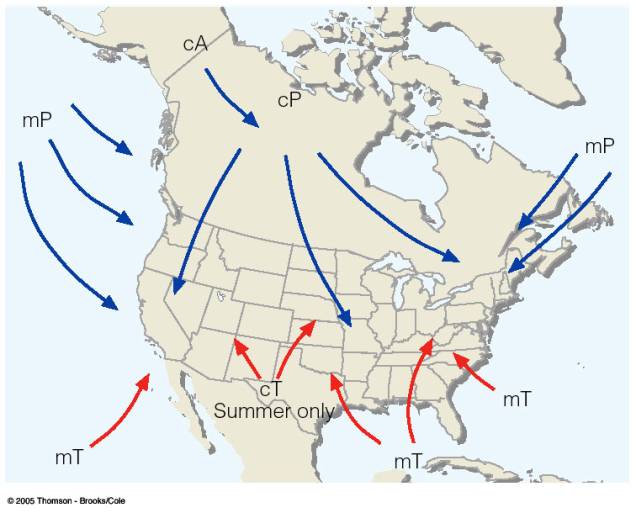
Which abbreviation of an air mass can be identified as dry and hot?
a)
cP
b)
mP
c)
cT
d)
mT
53.
Which abbreviation of an air mass can be identified as cold and moist?
a)
cP
b)
mP
c)
cT
d)
mT
54.
Air travels
a)
from high pressure to low pressure
b)
from low pressure to high pressue
55.

What kind of breeze is this & what time of day/night would it form?
a)
Land breeze - daytime
b)
Land breeze - nighttime
c)
Sea breeze - daytime
d)
Sea breeze - nighttime
56.
How do we name air masses?
a)
Water and temperature
b)
Air pressure
c)
Humidity and temperature
d)
Cold and warm
57.
What types of air masses form over land?
a)
Maritime
b)
Continental
c)
Polar
d)
Tropical
58.
Which global winds have the greatest impact on the weather in the US?
a)
trade winds
b)
prevailing westerlies
c)
doldrums
d)
polar easterlies
59.
Land temperatures heat up faster than water temperatures causing temperature extremes in inland locations.
a)
True
b)
False
60.
As you go to the top of a mountain (altitude increases), what happens to temperature?
a)
Nothing
b)
It increases
c)
It decreases
d)
It goes up and down
61.
As altitude _____________ temperature ___________.
a)
decreases, decreases
b)
increases, increases
c)
increases, decreases
d)
decreases, increases
62.
The _______ of a mountain range is the side that receives a lot of precipitation.
a)
dry side
b)
leeward/dry side
c)
windward/wet side
d)
cloudy side
63.
What is the day to day changes in the air?
a)
Weather
b)
Climate
c)
Storms
d)
Earth's Rotation
64.
The land on the ______ side of the mountain range is in the rain shadow.
a)
Cold
b)
windward
c)
Cloud covered
d)
leeward
65.
A rapidly moving cold air mass runs into a warm air mass. The cold air slides under the warm air. This is called a(n) .....
a)
cold front
b)
warm front
c)
stationary front
d)
occluded front
66.
When a warm air mass gently slides on top of a cold air mass, and you have drizzly rain and then warmer weather, what type of front is it?
a)
warm front
b)
cold front
c)
occluded front
d)
stationary front
67.
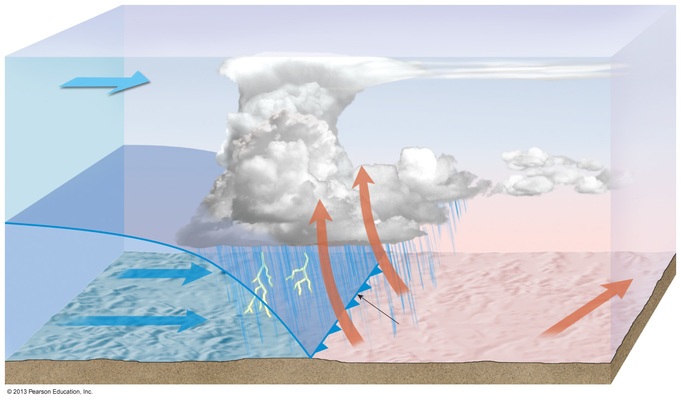
What type of storm front is this?
a)
warm front
b)
cold front
c)
stationary front
d)
occluded front
68.
What is the name of the steady winds that flow from west to east between latitudes 30*N and 60*N and 30*S and 60*S?
a)
trade winds
b)
land breeze
c)
westerlies
d)
jet stream
69.

The curving of air to the right in the Northern hemisphere is caused by ___________ and is called the _________ effect.
a)
Earth's rotation...Coriolis
b)
Earth's revolution...Coriolis
c)
Earth's rotation...Doppler
d)
Earth's revolution...Doppler
70.

The baby chickens are kept warm from the heat lamps demonstrates what type of heat transfer?
a)
conduction
b)
convection
c)
radiation
71.
Global winds over the United States blow in which direction?
a)
east to west
b)
north to south
c)
south to west
d)
west to east
72.
This area of Earth has little or NO wind and is between 5 degrees N and 5 degrees S.
a)
Horse Latitudes
b)
Trade Winds
c)
Prevailing Westerlies
d)
The Doldrums
73.
This type of wind helped blow trader's ships from Europe to the Americas. It blows winds from EAST to WEST.
a)
Polar Easterlies
b)
Trade Winds
c)
Prevailing Westerlies
d)
Horse Latitudes
74.
This type of wind comes from the POLES. It blows from east to west and brings freezing weather.
a)
Prevailing Westerlies
b)
Polar Easterlies
c)
Polar Westerlies
d)
Horse Latitudes
75.
This area of Earth has little or no wind and is located at 30 degrees N and 30 degrees S. Sailors threw their horses overboard in this area.
a)
Polar Express
b)
Horse Latitudes
c)
My Little Pony
d)
Trade Winds
76.

This is a lava lamp. When the light bulb heats the wax, the wax rises. When the wax cools, it falls. This cycle of rising/falling is an example of:
a)
Conduction.
b)
Convection.
c)
Radiation.
77.
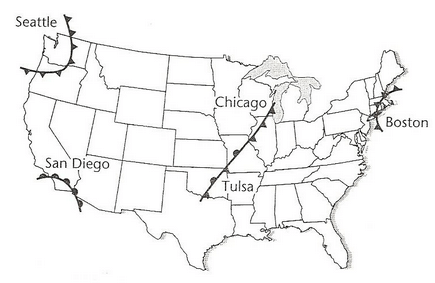
Which type of front is located near Boston?
a)
warm front
b)
cold front
c)
stationary front
d)
occluded front
78.

Which front is located near San Diego?
a)
cold front
b)
warm front
c)
occluded front
d)
stationary front
79.
Which type of front is associated with the front not moving in either direction?
a)
Cold
b)
Warm
c)
Stationary
d)
Occluded
80.
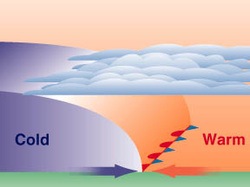
Which type of front is pictured?
a)
Cold front
b)
Warm front
c)
Occluded front
d)
Stationary front
100 %

