
NEW
Font size
S
M
L
XL
 Worksheets
Cellular Processes
Total questions: 71
Worksheet time: 1hrs 8mins
Name
Class
Date
1.
What is diffusion?
a)
when molecules move from a low concentration to a high concentration
b)
when molecules move from a high concentration to a low concentration.
c)
no movement
d)
molecules move everywhere
2.

Where is there a high concentration of water?
a)
in the flower
b)
cannot be determined by picture.
c)
in the vase
d)
in the leaves
3.

Where is there a high concentration of bbq smoke?
a)
In the bbq pit
b)
In the house
c)
Two streets over
d)
In the atmosphere
4.
When a person smells something, what is actually traveling up their nose?
a)
solids
b)
molecules
c)
matter
d)
plasma
5.

What is the definition of Selective Permeability?
a)
The movement of materials across the cell membrane that requires NO ENERGY from the cell.
b)
The movement of materials through (or across) the cell membrane
c)
The ability of the cell membrane to allow some things to pass through while preventing other things from passing through.
d)
The movement of molecules from an area of high concentration (where the molecules are more crowded together) to a area of low concentration (where molecules are more spread apart)
6.

Osmosis
a)
diffusion of water molecules through a semi-permeable mebrane from an area of low concentration to an area of high concentration
b)
the diffusion of particles from an area of high concentration to an area of low concentration
c)
diffusion of water molecules through a semi-permeable membrane from an area of high concentration to an area of low concentration
d)
the diffusion of particles from an area of low concentration to an area of high concentration
7.
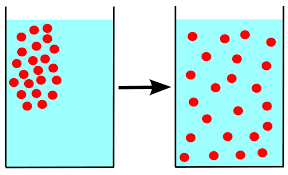
The picture below is an example of _________________.
a)
osmosis
b)
isotonic
c)
diffusion
d)
active transport
8.
Osmosis is the movement of _____ across a membrane.
a)
food
b)
energy
c)
oxygen
d)
water
9.

_______ regulates what enters and leaves a cell.
a)
Cell Membrane
b)
Nucleus
c)
Mitochondria
d)
Cytoplasm
10.

Equilibrium?
a)
a large amount of substance on side of the cell and a small amount on the other side
b)
a small amount of substance on side of the cell and a large amount on the otherside
c)
equal amount of substance on either side of the membrane
d)
no particles on either side of the a cell membrane
11.
What is the definition of Osmosis?
a)
the movement of WATER molecules across the cell membrane.
b)
the state where molecules are equally concentrated (balanced) on both sides of the cell membrane.
c)
the process that brings LARGE particles INTO the cell through the cell membrane
d)
he movement of molecules across the cell membrane that REQUIRES ENERGY output from the cell
12.
What is the definition of Equilibrium?
a)
the process that brings LARGE particles INTO the cell through the cell membrane
b)
The movement of molecules from an area of high concentration (where the molecules are more crowded together) to a area of low concentration (where molecules are more spread apart)
c)
the state where molecules are equally concentrated (balanced) on both sides of the cell membrane.
d)
the movement of WATER molecules across the cell membrane.
13.
In the given scenario what will happen to the organism: salt is poured onto eggplant.
a)
Water will move out of the eggplant cells and the cells will shrink.
b)
Water will move out of the eggplant cells and the cells will swell.
c)
Water will move into the eggplant cells and the cells will swell.
14.
In the given scenario what will happen? An egg is placed in pure water for 48 hours.
a)
The egg will gain water and swell.
b)
Water will move in and out of the cell equally, and the cell with neither shrink nor swell.
c)
The egg will lose water and shrink.
15.
An animal cell placed in a hypertonic (salty) solution will
a)
Shrink
b)
Swell
c)
Stay the same
16.
Just like Coke is a type of soda, __________ is a type of ___________.
a)
diffusion, osmosis
b)
concentration, equilibrium
c)
equilibrium, concentration
d)
osmosis, diffusion
17.
The movement of water through a semi-permeable membrane is called?
a)
cell membrane
b)
respiration
c)
osmosis
d)
diffusion
18.
When both inside and outside of a cell have the same amount of water it is said that the cell has reached a state of ___________.
a)
osmosis
b)
equilibrium
c)
diffusion
d)
hypertonic
19.
What does selectively-permeable mean?
a)
Only certain substances are able to pass through
b)
Nothing is able to pass through
c)
Everything is able to pass through
20.
If a cell is placed in a hypotonic solution, the cell will _______.
a)
stay the same
b)
swell (get bigger)
c)
shrink (get smaller)
21.
What does “high concentration area” mean?
a)
Spread out
b)
Tightly packed together
c)
Uncrowded
d)
Spacious
22.
Why is diffusion and osmosis important to cells?
a)
It allows them to take in materials without using energy.
b)
It allows them to reproduce.
c)
It allows them to absorb sunlight.
d)
It allows cells to use all energy.
23.

Which diagram best shows the end result of diffusion?
a)
F
b)
G
c)
H
d)
J
24.
A person would never have pure water put into their veins in a hospital because their cells would...
a)
Shrink/Dehydrate
b)
Expand
25.
A person should never drink salty water because their cells would
a)
shrink
b)
expand
26.
Passive transport requires no
a)
concentration gradients
b)
osmosis
c)
motion
d)
energy
27.

A student put a few drops of lemon juice into an uninflated balloon.The student tied a knot in the balloon, placed it in a shoe box, and covered it with a lid. The following day, the student opened the box and was able to smell lemon in the box. Through what process were molecules able to pass through the balloon?
a)
respiration
b)
fermentation
c)
osmosis
d)
diffusion
28.
What a cell needs to transport particles by active transport?
a)
Sun
b)
Wind
c)
Energy
d)
Channels
29.

Where is there a low concentration of perfume?
a)
in the bottle
b)
on the hand
c)
in the room
d)
in the top
30.

Where is there a low concentration of dye?
a)
at the bottom of cup
b)
in the color
c)
at the top of cup
d)
no concenteraion gradient
31.
Diffusion can be used in...
a)
Plants and Animals
b)
Only Plants
c)
Only Animals
d)
Only Humans
32.

The picture is an example of _________________.
a)
isotonic
b)
diffusion
c)
osmosis
d)
active transport
33.
What does selectively-permeable mean?
a)
The cell controls what passes in and out of the cell
b)
Nothing gets through
c)
The cell lets only large substances through
34.
If a shipwrecked individual drinks sea water, they will probably die.
How would you describe the solution compared to the cells?
How would you describe the solution compared to the cells?
a)
isotonic
b)
hypertonic
c)
hypotonic
35.

This egg has shrunk, what type of solution was it placed in?
a)
hypotonic solution
b)
hypertonic solution
c)
isotonic solution
d)
active transport
36.

The cell below is in a _________ solution.
a)
Hypotonic
b)
Hypertonic
c)
Isotonic
37.

The cell below is in a _____________ solution.
a)
Hypertonic
b)
Hypotonic
c)
Isotonic
38.
What does “high concentration area” mean?
a)
Spread out
b)
Tightly packed together
c)
Uncrowded
d)
Spacious
39.

What type of solution is this cell in?
a)
Isotonic
b)
Hypertonic
c)
Hypotonic
d)
diffused
40.
If a shipwrecked individual drinks sea water, they will probably die. What will happen to the cells in their body?
They will -
They will -
a)
swell up
b)
become more hypertonic
c)
shrivel up
d)
diffuse salt across the membrane
41.
Vegetables are often sprayed with water in grocery stores.
What will happen to the cells? They will -
What will happen to the cells? They will -
a)
become more hypertonic
b)
swell up
c)
shrivel up
d)
become hypotonic
42.
Vegetables are often sprayed with water in grocery stores.
Water enters the vegetables because the inside of their cells are:
Water enters the vegetables because the inside of their cells are:
a)
hypertonic
b)
isotonic
c)
hypotonic
d)
swole
43.

The inside of this cell is _______________ compared to the outside.
a)
Isotonic
b)
Hypertonic
c)
Hypotonic
d)
Diffusion
44.
A cell placed in a hypertonic solution will
a)
Stay the same
b)
Shrink- get smaller
c)
Swell- get bigger
45.
If a cell is placed in a hypotonic solution, the cell will _______.
a)
stay the same
b)
swell (get bigger)
c)
shrink (get smaller)
46.
A person should never drink salty water because their cells would
a)
shrink
b)
expand
c)
stay the same
d)
become overly bloated
47.

What type of solution is this cell in?
a)
Isotonic
b)
Hypertonic
c)
Hypotonic
d)
diffused
48.
The main source of energy for all life comes from ____.
a)
the Earth
b)
the moon
c)
the sun
d)
the food we eat/make
49.
The reactants of photosynthesis are
a)
sugar and water.
b)
sugar and oxygen.
c)
carbon dioxide and water.
d)
carbon dioxide and oxygen.
50.
The reactants of photosynthesis are
a)
sugar and water.
b)
sugar and oxygen.
c)
carbon dioxide and water.
d)
carbon dioxide and oxygen.
51.
What are the products of photosynthesis?
a)
Carbon dioxide and water
b)
Carbon dioxide and oxygen
c)
Glucose and oxygen
d)
Glucose and water
52.
What is the purpose of photosynthesis?
a)
make glucose
b)
make ATP
c)
make light
d)
release carbon dioxide
53.
What is the gas we breathe out that plants use for photosynthesis?
a)
sulfur
b)
carbon dioxide
c)
oxygen
d)
hydrogen
54.

In which organelle (part of the cell) does photosynthesis take place?
a)
mitochondria
b)
chloroplast
c)
nucleus
d)
cell membrane
55.
Carbon dioxide and oxygen both enter and leave the leaf at the
a)
pore
b)
spongy measophyll
c)
guard cells
d)
stomata
56.
What are the reactants in the equation for cellular respiration?
a)
oxygen and lactic acid
b)
carbon dioxide and water
c)
glucose and oxygen
d)
water and glucose
57.
Where does cellular respiration occur?
a)
Mitochondria
b)
Chloroplast
c)
Nucleus
d)
Vacuole
58.

What is the source of energy for photosynthesis?
a)
carbohydrates-chemical
b)
sunlight-radiant
c)
heat-thermal
d)
television-electrical
59.
What gas is released by plants during photosynthesis?
a)
sulfur
b)
carbon dioxide
c)
oxygen
d)
hydrogen
60.
What is the purpose of photosynthesis?
a)
make glucose
b)
make ATP
c)
make light
d)
release carbon dioxide
61.
All living things do which of the following?
a)
Chemosynthesis
b)
Cellular Respiration
c)
photosynthesis
d)
all of the answers
62.
Aerobic respiration is different from anaerobic respiration in that aerobic respiration needs...
a)
chlorophyll
b)
carbon dioxide
c)
glucose
d)
oxygen
63.

Which of the following structure is where cellular respiration occurs in the cell?
a)
nucleus
b)
cytoplasm
c)
mitochondria
d)
vacuoles
64.
Cellular Respiration's goal is to
a)
make water
b)
make ATP
c)
make glucose
d)
make oxygen
65.
Which of the following are made of cells?
a)
oak trees
b)
tigers
c)
humans
d)
all of the above
66.
Only animals carry out cellular respiration.
a)
True
b)
False
67.
Animals contain chlorophyll.
a)
True
b)
False
68.
The products of cellular respiration are
a)
oxygen, light, and glucose
b)
oxygen, ATP, and carbon dioxide
c)
carbon dioxide, ATP, water
d)
oxygen and glucose
69.
Which of the following is a waste gas produced by cellular respiration?
a)
nitrogen
b)
oxygen
c)
glucose
d)
carbon dioxide
70.
During periods of strenuous activity, muscle cells run low on
a)
oxygen
b)
carbon dioxide
c)
glucose
d)
lactic acid
71.
What type of organism uses photosynthesis?
a)
plants
b)
animals
Reset

