wayground logo

Free Printable Worksheets

Font size

S
M
L
XL
Worksheets

Anat Exam 2nd Sem Final

Total questions: 105

Worksheet time: 1hrs 2mins

Name
Class
Date
1.
Term
According to the text, which of these is the best definition for anatomy?
a)
The structural makeup of an organism
b)
The differences and similarities in the parts of a body
c)
The study of an organism's microscopic features
d)
The study of the parts of an organism that can be studied with one's naked eyes
2.
Term
According to the text, which of these is the best definition for physiology?
a)
The structural makeup of an organism
b)
The study of the anatomical changes that take place during an organism's growth
c)
The study of how an organism's parts carry out their jobs
d)
The study of the presence and actions of disease
3.
a)
occipitalis
b)
temporalis
c)
frontalis
d)
orbicularis oris
4.
a)
orbicularis oris
b)
orbicularis oculi
c)
orbicularis oral
d)
orbital oculi
5.
a)
trapezius
b)
masseter
c)
buccinator
d)
temporalis
6.
a)
internal obliques
b)
external obliques
c)
rectus abdominus
d)
tranverse obliques
7.
a)
rectus abdominus
b)
internal obliques
c)
external obliques
d)
pectoralis major
8.
a)
Lattisumus Dorsi
b)
Biceps
c)
Trapezius
d)
Occipitalis
9.
a)
Trapezius
b)
Latissimus dorsi
c)
Rhomboideus major
d)
Rhomboideus minor
10.
a)
Triceps
b)
Biceps
c)
Brachialis
d)
Traps
11.
a)
Gluteus minor
b)
Gluteus maximus
c)
Gluteus medius
d)
Tensor fascia latae
12.
a)
Sartorius
b)
Biceps femoris
c)
semitendinousus
d)
Gracilis
13.
a)
Rectus Femoris
b)
Gluteus Maximus
c)
Sartorius
d)
Erector spinea
14.
a)
Gluteus Maximus
b)
Gracilis
c)
Vastus Lateralis
d)
Rectus Femoris
15.
a)
Sartorius
b)
Gluteus Medius
c)
Gracilis
d)
Quadriceps
16.
a)
Popliteal
b)
Soleus
c)
Patella
d)
Gastrocnemius
17.
a)
Biceps
b)
Coracobrachialis
c)
Triceps
d)
Brachialis
18.
a)
Mastoid
b)
Sternocleidomastoid
c)
Trapezius
d)
Sternohyoid
19.
a)
Sternohyoid
b)
Sternothyroid
c)
Thyrohyoid
d)
Omohyoid
20.
a)
Omohyoid
b)
Mylohyoid
c)
Thyrohyoid
d)
Sternohyoid
21.
What is the approximate size of the heart?
a)
fist
b)
foot
c)
palm
d)
head
22.
In which cavity is the heart located?
a)
thoracic
b)
cranial
c)
abdominal
d)
pelvic
23.
What is the name for the upper chambers of the heart?
a)
atria
b)
ventricles
c)
aorta
d)
veins
24.
What is the name of the lower chambers of the heart?
a)
atria
b)
ventricles
c)
aorta
d)
veins
25.
What is the strongest (thickest) part of the heart?
a)
right atrium
b)
right ventricle
c)
left ventricle
d)
left atrium
26.
Where does blood go after the right atrium?
a)
left atrium
b)
left ventricle
c)
right ventricle
d)
aorta
27.
Where does the blood go after it goes into the pulmonary arteries?
a)
lungs
b)
heart
c)
head
d)
hands
28.
Which blood vessels carry blood to the heart?
a)
capilliaries
b)
veins
c)
arteries
d)
arterioles
29.
Which blood vessels carry blood away from the heart?
a)
capillaries
b)
veins
c)
arteries
d)
venules
30.
Which are the heart strings that are attached to the AV valves?
a)
chordae tendineae
b)
papillary muscles
c)
ventricles
d)
semilunar valves
31.
Which blood vessels are the thinnest?
a)
arteries
b)
veins
c)
capillaries
d)
arterioles
32.
What is the largest artery in the body?
a)
pulmonary veins
b)
right atrium
c)
vena cava
d)
aorta
33.
What is the largest vein in the body?
a)
aorta
b)
vena cava
c)
pulmonary trunk
d)
left atrium
34.
Which prevent the backward flow of blood?
a)
valves
b)
atria
c)
ventricles
d)
veins
35.
What is another name for high blood pressure?
a)
hypertension
b)
hypotension
c)
isotension
d)
systole
36.
The part of the nervous system that consists of nerves that branch out from the CNS and connect to other body parts
a)
Sympathetic
b)
Parasympathetic
c)
Autonomic
d)
Peripheral
37.
What is the main control center of the body that contains the brain and spinal cord?
a)
Peripheral nervous system
b)
Central nervous system
c)
Autonomic nervous system
d)
Somatic nervous system
38.
Your spinal cord is made of:
a)
bone
b)
muscle
c)
nerve cells
d)
tendons
39.
Your brain and spinal cord make up your central nervous system. What can you infer about the location of the rest of your nervous system?
a)
it's around your heart and lungs
b)
it stretches throughout your entire body
c)
it's based around your eyes, nose, and mouth
d)
it stretches through your digestive system
40.
Nerve cells that send information from one to another are called:
a)
spinal cells
b)
neurons
c)
T-cells
d)
blood cells
41.
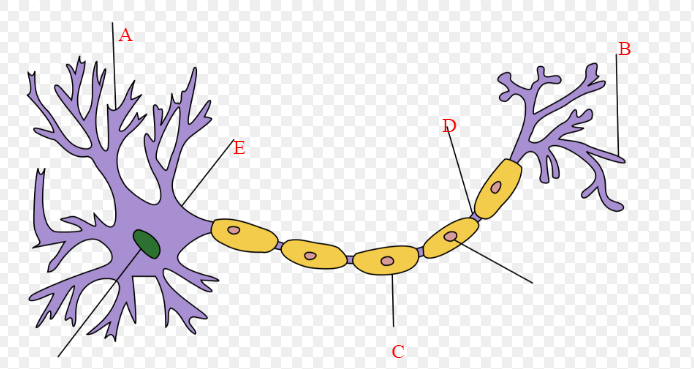
a)
"A" points to a Dendrite
b)
"A" points to an Axon
c)
"A" points to an Axon Terminal
d)
"A" points to a Cell Body
42.
a)
"B" points to a Dendrite
b)
"B" points to an Axon
c)
"B" points to an Axon Terminal
d)
"B" points to a Cell Body
43.
a)

"C" points to a Synapse

b)

"C" points to a Soma

c)

"C" points to an Axon Terminal

d)

"C" points to a Myelin Sheath

44.
This is the electrical charge that travels down an axon when a neuron is firing
a)
Resting Potential
b)
Action Potential
c)
Threshold
d)
Refractory Period
45.
The part of the neuron that insulates the axon and increases the speed of the neural message within the neuron.
a)
Synapse
b)
Dendrite
c)
Myelin Sheath
d)
Axon Terminal Button
46.
The tiny gap between neurons where nerve impulses are sent from one neuron to another.  It is where communication occurs between an axon and dendrite
a)
synapse
b)
axon terminal
c)
impulse
d)
myelin
47.
What is the largest part of the brain?
a)
Thalamus
b)
Cerebellum
c)
Spinal Cord
d)
Cerebrum
48.
What part of the brain is this?
a)
Amygdala
b)
Cerebellum
c)
Pons
d)
Brain stem
49.
Known as the "Little Brain" and is in charge of balance and coordinating movements
a)
Thalamus
b)
Reticular Formation
c)
Hypothalamus
d)
Cerebellum
50.
This part of the brain regulates visceral functions.
a)
cerebrum
b)
cerebellum
c)
brain stem
d)
spinal cord
51.
The fibrous covering of the eye consists of the white outer layer, known as the _____, and a transparent portion known as the _____.
a)
pupil; cornea
b)
iris; pupil
c)
conjunctiva; sclera
d)
sclera; cornea
52.
The structure that changes shape to focus light on the retina 
a)
cornea
b)
pupil
c)
lens
d)
iris
53.
The innermost sensory layer of the eye that contains photoreceptors 
a)
Choroid
b)
Retina
c)
Sclera
d)
Cornea
54.
The gel-like substance housed in the posterior segment of the eye 
a)
aqueous humor
b)
lens
c)
vitreous humor
d)
cornea
55.
The pupil is an opening within the:
a)
Iris
b)
Retina
c)
Lens
d)
Sclera
56.
Which type of retinal cell helps humans to interpret color?
a)
rods
b)
cones
c)
fovea
d)
ganglion
57.
Nerve that carries vision impulses to the brain:
a)
Sciatic nerve
b)
Cronial nerve
c)
Optic nerve
d)
Spinal nerve
58.
The type of receptor that a taste  receptor is, is a...
a)
chemoreceptor
b)
photoreceptor
c)
mechanoreceptor
d)
thermoreceptor
59.
The small projections on the surface of the tongue are called
a)
otoliths
b)
papillae
c)
taste buds
d)
gustatory hairs
60.
Structures that located throughout the upper surface of the tongue and contain chemoreceptors for sensing taste are more commonly known as...
a)
otoliths
b)
papillae
c)
taste buds
d)
gustatory hairs
61.
In order for taste receptors to trigger a taste sensation, the chemicals in the food must...
a)
form a loop.
b)
be dissolved in a solution.
c)
create a mechanical audition.
d)
make an electrothermal connection.
62.
Which of the following is a known role for saliva in sensing taste?
a)
Saliva acts to chemically break down sugars so that sugar molecules can be adsorbed.
b)
It establishes a background taste against which other tastes can be judged.
c)
It balances the pH of the mouth.
d)
Saliva ensures a wet environment into which chemicals from foods can dissolve.
63.
The five taste sensations are
a)
sweet, salty, spicy, bitter, gritty
b)
sweet, sour, chewy, gritty, umami
c)
sweet, sour, bitter, pasty, savory
d)
sweet, sour, bitter, salty, umami
64.
Sense of smell receptors are known anatomically as...
a)
gustation receptors
b)
olfactory receptors
c)
equilibrium receptors
d)
occipital receptors
65.
The type of receptor that a sense of smell receptor is, is a...
a)
chemoreceptor
b)
photoreceptor
c)
mechanoreceptor
d)
thermoreceptor
66.
Which of these is NOT a main purpose served by olfaction?
a)
It breaks up chemicals so they can be dissolved in solution.
b)
It detects potentially harmful or useful chemicals present in the air.
c)
Olfaction supplements gustation by adding to the flavor of foods.
67.
In order for smell receptors to trigger a smell sensation, the chemicals that form the smell must be...
a)
inhaled.
b)
impaled.
c)
ingested.
d)
digested.
68.
What is the name given to the enlargement of the olfactory nerve that senses smell?
a)
vomernasal gland
b)
sinus
c)
olfactory bulb
d)
papillae
69.
Through which cranial bone do the sensory nerves of the olfactory system pass?
a)
ethmoid
b)
parietal
c)
occipital
d)
zygomatic
70.
Which section of the brain controls your breathing?
a)
Pineal Body
b)
Hypothalamus
c)
Medulla oblongata
d)
Midbrain
71.
Which of the following is our Windpipe?
a)
Trachea
b)
Larynx
c)
Pharynx
d)
Epiglottis
72.
Which of the following is our Voice Box?
a)
Trachea
b)
Larynx
c)
Pharynx
d)
Epiglottis
73.
Which respiratory part(s) have cartilage?
a)
Trachea
b)
Trachea & Bronchi
c)
Trachea, Bronchi & Bronchioles
d)
Trachea, Bronchi, Bronchioles & Alveoli
74.
What is the function of the nasal cavity?
a)
warm and humidify air
b)
smell odors
c)
clean the air
d)
all of these
75.
What is the main purpose of our lungs?
a)
Taking in O2
b)
Getting rid of CO2
c)
Taking in nutrients
d)
Gas Exchange
76.
Which of the following muscles is least used for breathing?
a)
Latissimus Dorsi
b)
Rectus Abdominis
c)
Diaphragm
d)
Intercostals
77.
Which way does air move during Inspiration?
a)
From High->Low Pressure
b)
From Low->High Pressure
c)
Out of the lungs
d)
In & out of the lungs
78.
Which way does air move during Expiration?
a)
From High->Low Pressure
b)
From Low->High Pressure
c)
Into the lungs
d)
In & out of the lungs
79.
What is the Adam's apple?
a)
pharynx
b)
trachea
c)
larynx
d)
mouth
80.
In which of the following does gas exchange occur?
a)
Trachea
b)
Bronchi
c)
Bronchioles
d)
Alveoli
81.
What is the name for the protective sac that covers the lungs?
a)
Pericardium
b)
Periosteum
c)
Periscope
d)
Pleura
82.
dome shaped muscle found beneath the lungs
a)
intercostal muscle
b)
diaphragm
c)
respiratory membrane
d)
septum
83.
after your trachea divides, it becomes your left and right _______
a)
Bronchi
b)
Pharynx
c)
Larynx
d)
Alveoli
84.
Cilia are...
a)
vapors, gases, and fumes that can cause lung disease.
b)
caused by pollen, dust and pet hair.
c)
tiny hairs in nasal passages.
d)
communicable. 
85.
This progressive genetic disease that causes persistent lung infections and limits the ability to breath over time
a)
Emphysema
b)
Cystic fibrosis
c)
TB
d)
Pulmonary edema
86.
Swelling of the bronchi. It causes coughing, fever, and chest tightness.
a)
Allergies
b)
Bronchitis
c)
Asthma
d)
Pneumonia
87.
Disease in which the alveoli are damaged or destroyed. Strongly linked to smoking.
a)
Allergies
b)
Emphysema
c)
Asthma
d)
Pneumonia
88.
Food normally enters the digestive system (i.e. is ingested) here.
a)
mouth
b)
teeth
c)
pharynx
d)
salivary glands
89.
Mastication is accomplished with the aid of...
a)
teeth
b)
a stomach
c)
glands
d)
hydrochloric acid
90.
Salivary amylase initiates the digestion of which compound?
a)
lipids
b)
proteins
c)
starches
d)
nucleic acids
91.
What is another name for the alimentary canal?
a)
mouth
b)
digestive tract
c)
intestine
d)
gastrulation
92.
____________ is when smooth muscles contract to gently move food through the alimentary canal.  It begins with swallowing.
a)
pregastric factors
b)
peristalsis
c)
mastication
d)
ingestion
93.
A muscular tube that connects the mouth to the stomach.
a)
esophagus
b)
stomach
c)
large intestine
d)
small intestine
94.
Using HCl and churning, this organ chemically and mechanically digests food.
a)
esophagus
b)
stomach
c)
large intestine
d)
small intestine
95.
Digestive organ where most chemical digestion and absorption of food takes place through villi.
a)
esophagus
b)
stomach
c)
large intestine
d)
small intestine
96.
This organ absorbs water from undigested food
a)
esophagus
b)
stomach
c)
large intestine
d)
small intestine
97.
This regulates most chemical levels in the blood and excretes bile which helps to clear waste products from it.
a)
pancreas
b)
liver
c)
gallbladder
d)
spleen
98.
The small sac-like organ on the underside of the liver that stores bile.
a)
pancreas
b)
liver
c)
gallbladder
d)
spleen
99.
Waste matter discharged from the bowels after food has been digested.
a)
flatulence
b)
feces
c)
gastrin
d)
meconium
100.
The earliest stool of a human infant. It is composed of materials ingested during the time the infant spends in the uterus.
a)
flatulence
b)
feces
c)
gastrin
d)
meconium
101.

What was the stated justification for visiting the cadaver lab?

a)

To get out of school and get a free lunch.

b)

To apply what had been learned in class and investigate possible career paths.

c)

To get a resume item and possibly win money.

102.

What was the stated justification for visiting Clark Prosthetics?

a)

To get out of school and get a free breakfast.

b)

To apply what had been learned in class and investigate possible career paths.

c)

To get a resume item and possibly win money.

103.

What was the stated justification for creating models?

a)

So that we could learn anatomy without having to read a book.

b)

To apply what had been learned in class and gain new understanding.

c)

Take up class time so that there was less time for boring paperwork.

104.

What was the ceiling tile project's purpose?

a)

To better understand and to demonstrate understanding of the circulatory system

b)

To better understand and to demonstrate understanding of the nervous system

c)

To better understand and to demonstrate understanding of the respiratory system

d)

To better understand and to demonstrate understanding of the musculatory system

105.

What was the purpose of dissecting the cat?

a)

To investigate the career path of veterinary medicine

b)

To better understand and to demonstrate understanding of the respiratory system

c)

To see if students would be ready for a trip to Clark Prosthetics

d)

To better understand and to demonstrate understanding of the musculatory system