
 Worksheets
Chem Final Review
Total questions: 78
Worksheet time: 1hrs 4mins
Name
Class
Date
1.
Amount of matter
a)
Weight
b)
Mass
c)
Volume
d)
Density
2.
Color, smell, taste, texture, density
a)
Chemical properties
b)
Intensive properties
c)
Physical properties
d)
Extensive properties
3.
Center of an atom
a)
nucleus
b)
cloud
c)
shells
d)
energy levels
4.
Positively charged particle
a)
Electron
b)
Neutron
c)
Proton
d)
Isotope
5.
Which particle(s) move around the nucleus of an atom?
a)
protons
b)
neutrons
c)
electrons
d)
protons, neutrons
6.
Negatively charged particle in an atom
a)
electron
b)
neutron
c)
isotope
d)
proton
7.
Has no charge
a)
proton
b)
neutron
c)
isotope
d)
electron
8.
The number of protons an atom has
a)
isotope number
b)
mass number
c)
atomic mass
d)
atomic number
9.
These two are usually equal
a)
neutrons and protons
b)
protons and electrons
c)
neutrons and electrons
10.

What is a?
a)
proton
b)
electron
c)
neutron
d)
isotope
11.
The sum of protons and neutrons in the nucleus of an atom
a)
atomic mass
b)
atomic number
c)
mass number
12.
Where most of the mass is found in an atom
a)
Electron cloud
b)
Energy levels
c)
Nucleus
d)
Electron shells
13.
Same number of protons, but differ in the number of neutrons
a)
atomic mass
b)
atomic number
c)
neutral atom
d)
isotope
14.
Jack has a rock. The rock has a mass of 14g and a volume of 2cm3. What is the density of the rock?
a)
7 mL
b)
7 g/cm3
c)
28 g/cm3
d)
1/7 g/cm3
15.

What is the volume of Object X?
a)
10.0 cm3
b)
15.0 cm3
c)
20.0 cm3
d)
25.0 cm3
16.
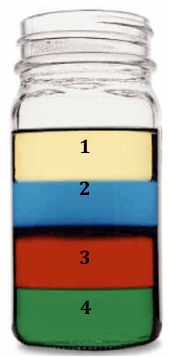
Put the liquids in order from most dense to least dense?
a)
4, 3, 2, 1
b)
1, 2, 3, 4
c)
3, 4, 2, 1,
d)
4, 3, 1, 2
17.
What is the formula for density?
a)
density = mass x volume
b)
density = mass / volume
c)
density = mass + volume
d)
density = mass - volume
18.
Frank has an eraser. It has a mass of 4g, and a volume of 2cm3. What is its density?
a)
8 g/cm3
b)
2 g/cm3
c)
1/2 g/cm3
d)
24 g/cm3
19.
What kind of properties can only be observed when a substance changes into a different substance?
a)
physical properties
b)
chemical properties
c)
liquid properties
d)
real properties
20.
Which of the following is a sign that a chemical reaction has occurred?
a)
change in shape
b)
melting
c)
formation of a gas
d)
dissolving
21.
Is hammering wood together to build a house a chemical or physical change?
a)
chemical
b)
physical
22.

Is burning wood a chemical or physical change?
a)
chemical
b)
physical
23.
A change in the size, shape, or state of matter.
a)
chemical change
b)
physical change
c)
chemical reaction
d)
electron change
24.
Kim puts an ice cube in a beaker and it melts. This is a good example of:
a)
a physical change.
b)
a chemical change.
c)
an experiment.
d)
an analysis.
25.

Photosynthesis is an example of a
a)
physical change
b)
chemical change
26.
Which is a Chemical property?
a)
Thermal Conductivity
b)
Density
c)
Malleability
d)
Flammability
27.
Which is a physical change?
a)
burning match
b)
vinegar in baking soda
c)
melting butter
d)
cooking an egg
28.
What is the formula for sodium nitrate?
a)
Na3NO
b)
NaNO
c)
Na3NO3
d)
NaNO3
29.
What is the formula for aluminum ?
a)
AlNO3
b)
Al(NO3)3
c)
Al(NO2)3
d)
Al(NO2)2
30.
What are the products in the following chemical equation?
2H2 + O2 --> 2H2O
2H2 + O2 --> 2H2O
a)
H2
b)
O2
c)
2H2 + O2
d)
2H2O
31.
NO2 --> N2 + O2
a)
Synthesis (combination)
b)
Decomposition
c)
Single replacement
d)
Combustion
32.
On the right side of a chemical reaction are the ....
a)
Reactants
b)
Products
33.
Which chemical reaction breaks down into 2 substances?
a)
Double Replacement
b)
Single Replacement
c)
Synthesis
d)
Decomposition
34.
AB + CD = AD + CB
a)
Double Replacement
b)
Single Replacement
c)
Combustion
d)
Decomposition
35.

A coefficient tells you...
a)
the # of atoms in the entire equation
b)
the # of elements in the equation
c)
the # atoms of the element it sits behind
d)
the # of molecules of that substance
36.
Be + N
a)
ionic
b)
covalent
c)
metallic
37.
H + O
a)
ionic
b)
covalent
c)
metallic
38.
In this type of bond, electrons are given and taken.
a)
ionic
b)
covalent
c)
metallic
39.
In this type of bond, electrons are shared.
a)
ionic
b)
covalent
c)
metallic
40.
Charles' Law States...
a)
As Pressure goes up volume goes down
b)
As Pressure goes up temperature goes up
c)
As Volume goes up temperature goes up
d)
As Pressure goes down volume goes down
41.
Whose law states that as pressure goes up, volume goes down?
a)
Charles
b)
Boyle
c)
Aglow
d)
Mazias
42.
A hot air balloon heats up. What happens to the pressure?
a)
increases
b)
decreases
c)
stays the same
43.
Directly proportional means that as one value increases ....................
a)
the other stays the same
b)
the other increases as well
c)
the other decereases
d)
the other goes to zero
44.
A gas has a pressure of 2.3 atm. If its temperature was decreased to -54 C and its new pressure was 1.8 atm, what was its original temperature?
a)
280 K
b)
69 K
c)
340 K
d)
-55 K
45.

Describe the speed of the rocket in the speed vs. time graph.
a)
Constant speed
b)
Decreasing speed
c)
Increasing speed
d)
Not moving
46.
A dog runs on the sidewalk 9 mi/hr.
a)
Speed
b)
Acceleration
c)
Velocity
47.
A bicyclist takes a curved, scenic ride through the park going 4.5 m/s.
a)
Speed
b)
Acceleration
c)
Velocity
48.

Describe the speed of the object from
5-6 seconds using the speed vs. time graph
5-6 seconds using the speed vs. time graph
a)
Speeding up
b)
Slowing down
c)
Not moving
d)
Constant speed
49.
If a cheetah runs 180 miles in 3 hours, what is its average speed?
a)
60 hours
b)
60 miles
c)
60 miles/hour
d)
60 miles/second/second
50.
What is a way to measure velocity
a)
miles per second
b)
meters per second
c)
meters per second squared
d)
seconds
51.
How far will a person go if they jog for 2 hours at a speed of 12 km/hr?
a)
6 km
b)
0.5 km
c)
10 km
d)
24 km
52.
A runners races in the 100 meter dash. It takes her 10 seconds to finish. What is her average speed?
a)
10 m/s
b)
1000 m/s
c)
100 seconds
d)
10 seconds
53.

What is the total displacement of the object represented in this motion graph?
a)
5 meters
b)
4 meters
c)
2 meters
d)
0 meters
54.
What is the total distance of the object represented in this motion graph?
a)
5 meters
b)
4 meters
c)
2 meters
d)
0 meters
55.

What is the total distance of the object represented in this motion graph?
a)
0 meters
b)
10 meters
c)
11 meters
d)
20 meters
56.

What is the total distance of the object represented in this motion graph?
a)
0 meters
b)
300 meters
c)
450 meters
d)
600 meters
57.

What is the total distance of the object represented in this motion graph?
a)
0 meters
b)
2 meters
c)
6 meters
d)
39 meters
58.
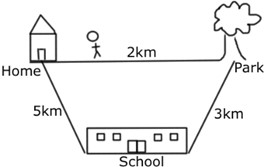
Jerry walked from home to school, then from the school to the park. What is his total displacement?
a)
2 km
b)
5 km
c)
8 km
d)
10 km
59.

Which of the following describes distance and displacement correctly?
a)
The blue arrow shows distance and the orange arrows show displacement
b)
The blue arrow shows displacement and the orange arrows show distance
c)
Both arrows show distance only
d)
Both arrows show distance and displacement
60.
What is a PUSH or PULL of an object?
a)
Motion
b)
Force
c)
Friction
d)
Gravity
61.
What is MOVEMENT?
a)
Inertia
b)
Force
c)
Work
d)
Motion
62.
What happens when one force PULLS an object toward another?
a)
Friction
b)
Motion
c)
Gravity
d)
Magnetism
63.
What is a force that works AGAINST MOTION?
a)
Force
b)
Motion
c)
Gravity
d)
Friction
64.
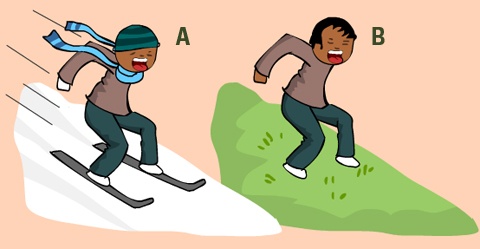
Why is it harder for the boy in Image B to get down the hill?
a)
Motion
b)
Friction
c)
Work
d)
Displacement
65.
How is gravity affected by mass?
a)
the larger the mass of the object, the greater the gravity
b)
small objects have no gravity
c)
gravity is not affected by mass of objects, whether large or small
66.
Why does a rolling ball stop?
a)
Gravity
b)
Friction
c)
Waterfalls
d)
Sand
67.
A push or pull that causes a change in motion
a)
Friction
b)
Gravity
c)
Force
d)
Mass
68.
What pulls a ball back to earth?
a)
Gas
b)
Gravity
c)
Friction
d)
Molecules
69.
What is the standard unit force is measured in?
a)
Newtons
b)
pounds
c)
grams
d)
meters
70.
Friction is a force that acts in an ___________ direction of movement.
a)
similar
b)
opposite
c)
parallel
d)
west
71.
The amount of friction depends on the weight of the objects pressing together.
a)
True
b)
False
72.

What type of friction is not moving?
a)
static
b)
sliding
c)
fluid
d)
rolling
73.
How does friction affect speed?
a)
more friction decreases speed
b)
more friction increases speed
c)
less friction decreases speed
d)
less friction doesn't affect speed
74.

How many protons are in Beryllium?
a)
4
b)
9
c)
5
d)
2
75.
_______ are the ROWS on the periodic table.
a)
Families
b)
Groups
c)
Periods
d)
Elements
76.
________ are the COLUMNS on the periodic table and are organized by similar properties.
a)
Classifications
b)
Groups
c)
Periods
d)
Elements
77.
The SI unit for mass is
a)
gram
b)
kilogram
c)
meter
d)
centigram
78.
The SI unit for force
a)
kilopascals
b)
newtons
c)
centimeters
d)
meters per gram
100 %

