
 Worksheets
Earth History Module Review
Total questions: 89
Worksheet time: 1hrs 10mins
Name
Class
Date
1.
True or False: Human life has existed on Earth for much of Earth's history.
a)
True
b)
False
2.
True or False: Geological time extends from the beginning of human life to the present.
a)
True
b)
False
3.
True or False: Geological time extends from the beginning of Earth's existence to the present.
a)
True
b)
False
4.
True or False: A geological timeline starts with the present and works backwards.
a)
True
b)
False
5.
Which type of rock would most likely form in a swamp?
a)
Shale
b)
Sandstone
c)
Limestone
6.
Which type of rock would most likely form in a mudflat?
a)
Shale
b)
Sandstone
c)
Limestone
7.
Which type of rock would most likely form in a sand dune?
a)
Shale
b)
Sandstone
c)
Limestone
8.
Which type of rock would most likely form on the ocean floor?
a)
Shale
b)
Sandstone
c)
Limestone
9.
The theory that states that layers form flat, horizontal lines is:
a)
Uniformitarianism
b)
Principle of original horizontality
c)
Principle of superposition
d)
Principle of stratification
10.
True or false: Older rock layers are found at the top of a rock column, because they are higher up.
a)
True
b)
False
11.
The theory that states that rock layers at the bottom of a rock column are the oldest is:
a)
Uniformitarianism
b)
Principle of superposition
c)
Principle of original horizontality
d)
Principle of stratification
12.
The type of rock that bubbles when you put acid on it is:
a)
Limestone
b)
Sandstone
c)
Shale
13.
The substance in rock that reacts with acid to produce fizzing is called:
a)
potassium
b)
calcite
c)
oxygen
d)
water
14.
True or false. The Colorado Plateau came before the grand canyon.
a)
TRUE
b)
FALSE
15.

The OLDEST rock in this rock column is:
a)
Hermit Formation
b)
Kaibab Formation
c)
Muav Limestone
d)
Bright Angle Shale
16.

The YOUNGEST rock in this rock column is:
a)
Toroweap Formation
b)
Kaibab Formation
c)
Bright Angel Shale
d)
Redwall Limestone
17.
The theory that states that geological processes from the past happen in the same way today is:
a)
Uniformitarianism
b)
Principle of superposition
c)
Principle of original horizontality
d)
Principle of stratification
18.
_______________ is a sedimentary rock composed of clay or silt.
a)
Sandstone
b)
Limestone
c)
Shale
19.
________________________ is a sedimentary rock composed of sand particles stuck together
a)
Sandstone
b)
Limestone
c)
Shale
20.
______________ is a sedimentary rock composed mainly of calcite.
a)
Limestone
b)
Sandstone
c)
Shale
21.
_________ is the deposition of cement in the spaces between particles of sediment:
a)
sedimentary rock
b)
cementation
c)
lithification
d)
compaction
22.
__________ decreasing the volume of accumulated sediments by using pressure to decrease the size and number of the spaces between the particles:
a)
compaction
b)
cementation
c)
stratification
d)
sedimentary rock
23.
_______ is calcium carbonate from the shells of dead animals that has settled to the bottom as sediment:
a)
shale
b)
ooze
c)
groundwater
d)
cement
24.
_____________ is a large low area where sediments have been deposited:
a)
basin
b)
container
c)
calcite
d)
layer
25.
Which process, compaction or cementation, is most likely to produce SHALE?
a)
compaction
b)
cementation
26.
Which process, compaction or cementation, is likely to produce SANDSTONE?
a)
compaction
b)
cementation
27.
____________ is water that has soaked into the ground and fills up spaces between rocks or deposited materials:
a)
juice
b)
groundwater
c)
cement
d)
ooze
28.
______ is the settling of sediments in a basin or delta:
a)
compaction
b)
erosion
c)
deposition
d)
abrasion
29.
The carrying away of weathered earth materials by water, wind, or ice is called:
a)
transportation
b)
erosion
c)
abrasion
d)
frost wedging
30.
______ is the breaking of rocks by rubbing and bumping into each other.
a)
transportation
b)
abrasion
c)
watering
d)
elevation
31.
A very angular rock, with many sharp edges is:
a)
very abraded
b)
not very abraded
32.
A well-rounded rock is:
a)
very abraded
b)
not very abraded
33.
Sediments that travel along a river or stream often end up in a large, lower area called a:
a)
shore
b)
basin
c)
canyon
d)
beach
34.
The Wentworth scale classifies rock particles by:
a)
texture
b)
size
c)
color
d)
minerals
35.
True or False. Larger particles are carried farther and more easily than smaller particles.
a)
TRUE
b)
FALSE
36.
Which one of these rock particles is the SMALLEST?
a)
boulder
b)
pebble
c)
cobble
d)
sand
37.
Which of these is NOT an example of CHEMICAL WEATHERING?
a)
lichens producing carbonic acid that breaks down rocks
b)
acid rain wearing away at rocks
c)
frost wedging enlarging the cracks between rocks
d)
plant roots producing carbon dioxide, which combines with moisture to produce a weak acid
38.
Which one of these is NOT an example of PHYSICAL WEATHERING?
a)
lichens wearing away rock with the weak acid they produce
b)
rocks bumping into each other and breaking
c)
wind carrying sediments from one place to another
d)
waves crashing against and particles at the beach
39.
Which one of these rock particles is the LARGEST?
a)
gravel
b)
boulder
c)
clay
d)
silt
40.
Which rock particle would travel the FARTHEST along a stream?
a)
boulder
b)
sand
c)
clay
d)
gravel
41.
Which rock particle would travel the LEAST along a stream?
a)
pebble
b)
cobble
c)
sand
d)
silt
42.
True or false. The Colorado Plateau came before the grand canyon.
a)
TRUE
b)
FALSE
43.
Which is NOT an example of a landform?
a)
The Grand Canyon
b)
Aleutian Islands
c)
The Eiffel Tower
d)
A Volcano
44.
matching up rock layers from different locations is called:
a)
layering
b)
correlation
c)
calcite
d)
elevation
45.
A scientist who studies Earth is called a:
a)
earthologist
b)
botanist
c)
geologist
d)
chemist
46.
The carrying away of weathered earth materials by water, wind, or ice is called:
a)
transportation
b)
erosion
c)
abrasion
d)
frost wedging
47.
The process by which rocks are weathered due to reactions with substances in water and air is:
a)
chemical weathering
b)
physical weathering
48.
The process of water freezing in the cracks of rocks and breaking them apart is:
a)
rock fall
b)
root wedging
c)
frost wedging
d)
abrasion
49.
A mass of rocks falling to the ground, similar to an avalanche, is called:
a)
rock fall
b)
frost wedging
c)
abrasion
d)
root wedging
50.
The process of plant roots growing, exerting pressure on the rocks and driving them apart, is called:
a)
root wedging
b)
frost wedging
c)
rock fall
d)
weathering
51.
_____ is a mix of humus, sand, silt, clay, gravel, and/or pebbles:
a)
boulder
b)
soil
c)
erosion
d)
abrasion
52.
___ is bits of dead plant and animal parts in soil:
a)
clay
b)
soil
c)
humus
d)
water
53.
______ is the breaking of rocks by rubbing and bumping into each other.
a)
transportation
b)
abrasion
c)
watering
d)
elevation
54.
The theory that states that geological processes from the past happen in the same way today is:
a)
Uniformitarianism
b)
Principle of superposition
c)
Principle of original horizontality
d)
Principle of stratification
55.
_________ is the deposition of cement in the spaces between particles of sediment:
a)
sedimentary rock
b)
cementation
c)
lithification
d)
compaction
56.
_______ is calcium carbonate from the shells of dead animals that has settled to the bottom as sediment:
a)
shale
b)
ooze
c)
groundwater
d)
cement
57.
_____________ is a large low area where sediments have been deposited:
a)
basin
b)
container
c)
calcite
d)
layer
58.
Which process, compaction or cementation, is most likely to produce SHALE?
a)
compaction
b)
cementation
59.
Which process, compaction or cementation, is likely to produce SANDSTONE?
a)
compaction
b)
cementation
60.
______ is the breaking of rocks by rubbing and bumping into each other.
a)
transportation
b)
abrasion
c)
watering
d)
elevation
61.
The carrying away of weathered earth materials by water, wind, or ice is called:
a)
transportation
b)
erosion
c)
abrasion
d)
frost wedging
62.
A very angular rock, with many sharp edges is:
a)
very abraded
b)
not very abraded
63.
A well-rounded rock is:
a)
very abraded
b)
not very abraded
64.

How do plants weather rocks?
a)
during photosynthesis
b)
when roots grow into cracks of rocks and expand the rock
c)
when the plant moves water from the roots to the leaves
d)
Plants don't weather rocks
65.
Weathering, erosion, and deposition occur over many________.
a)
days
b)
years
c)
hours
d)
months
66.
The process when soil or rock are left or placed in a new location.
a)
Erosion
b)
Weathering
c)
Mass movement
d)
Deposition
67.
Which is NOT an example of a landform?
a)
The Grand Canyon
b)
Aleutian Islands
c)
The Eiffel Tower
d)
A Volcano
68.
True or false. The Colorado Plateau came before the grand canyon.
a)
TRUE
b)
FALSE
69.
A scientist who studies Earth is called a:
a)
earthologist
b)
botanist
c)
geologist
d)
chemist
70.
The process by which rocks are weathered due to reactions with substances in water and air is:
a)
chemical weathering
b)
physical weathering
71.
_____ is a mix of humus, sand, silt, clay, gravel, and/or pebbles:
a)
boulder
b)
soil
c)
erosion
d)
abrasion
72.

In which location would you most likely find an igneous rock?
a)
A
b)
B
c)
C
d)
D
73.

What process is used to form metamorphic rocks?
a)
Lava cools and hardens to form a rock.
b)
Bits of sand gravel form layers that turn into rock from pressure.
c)
I don't know :(
d)
Extreme heat and pressure from inside the Earth turns rocks into new rocks.
74.

What type of rock forms from molten magma under the surface?
a)
Sedimentary
b)
Extrusive Igneous
c)
Intrusive Igneous
d)
Metamorphic
75.

What type of rock contains fossils?
a)
Intrusive Igneous
b)
Extrusive Igneous
c)
Metamorphic
d)
Sedimentary
76.

This rock was molten magma that slowly cooled under the ground. What type of rock is this?
a)
Sedimentary
b)
Igneous
c)
Metamorphic
77.
The three groups of rocks are classified by
a)
How they form
b)
Color
c)
Grain size
d)
Chemical Composition
78.
Fossils are only found in
a)
Sedimentary rocks
b)
Metamorphic rocks
c)
Igneous Rocks
d)
All rock types
79.
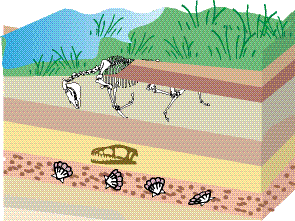
According to the law of superposition, the oldest fossils are found
a)
At the top of the rock layers
b)
Near the bottom of the rock layers
c)
In the middle of the rock layers
d)
Somewhat near the surface
80.
The best index fossils have which two traits?
a)
widespread geographically, long lifespan
b)
widespread geographically, short lifespan
c)
specific place, long lifespan
d)
specific place, short lifespan
81.
Index fossils help determine relative age through correlating rock layers.
a)
True
b)
False
82.

To be considered an index fossil, it had to have lived for a relatively short period of time.
a)
True
b)
False
83.

Which of the following events happens FIRST?
a)
Slowly, minerals in the water replace the bone.
b)
Sediment covers the bone.
c)
An animal dies.
d)
The bone is no longer a bone, but a rock copy.
84.

Rock layers can be most closely correlated if they both contain the same...
a)
Shapes
b)
Elements
c)
Fossils
d)
Types of Rocks
85.
To determine the AGE of the Earth, scientists most likely study which of the following?
a)
Water Samples
b)
Air Samples
c)
Rock Layers
d)
Soil samples
86.
Cambrian, Ordovician, Silurian, Devonian, Mississippian, Pennsylvanian, Permian, Triassic, Jurassic, Cretaceous, Tertiary, Quaternary all belong to:
a)
Periods
b)
Eons
c)
Epochs
d)
Eras
87.
A record of the geologic events and life forms in Earth's history.
a)
index fossil
b)
half-life
c)
radioactive dating
d)
geologic time scale
88.
The theory that states that geological processes from the past happen in the same way today is:
a)
Uniformitarianism
b)
Principle of superposition
c)
Principle of original horizontality
d)
Principle of stratification
89.
The theory that states that rock layers at the bottom of a rock column are the oldest is:
a)
Uniformitarianism
b)
Principle of superposition
c)
Principle of original horizontality
d)
Principle of stratification
100 %

