
 Worksheets
Life Science Review
Total questions: 86
Worksheet time: 1hrs 10mins
Name
Class
Date
1.
All living things have the ability to reproduce.
a)
True
b)
False
2.
All living things are composed of _______.
a)
minerals
b)
cells
c)
muscle tissue
3.
Cells form tissues. Tissues form organs. Organs form organ systems, and organ systems form organisms. These are called levels of __________________.
a)
the body
b)
energy
c)
organization
4.
Gathering information by using your 5 senses is called__________________
a)
observing
b)
inferring
c)
complementing
d)
collecting
5.
What type of observation is this?
" The sandpaper feels rough."
" The sandpaper feels rough."
a)
qualitative
qualitative
qualitative
b)
quantitative
c)
inference
6.
" The ice took 17 minutes to melt," is a quantitative observation. How do you know?
a)
It contains a description.
b)
It does not contain a number.
c)
It contains a number.
d)
I watched it.
7.
When you make an inference, what are you trying to do?
a)
Predict what will happen next.
b)
Explain your observation.
c)
Make a different kind of observation.
8.
"The plant is dry because it has not gotten enough water." Which part of this statement is an INFERENCE?
a)
The plant is dry
b)
because it has not gotten enough water
9.
What something DOES is it's ____________.
a)
job
b)
function
c)
structure
d)
dream
10.
The size and shape of something is part of its _________________.
a)
structure
b)
function
c)
body
11.
Because structure & function work together, in order for something to function, it MUST have the correct ____________.
a)
directions
b)
shape
c)
structure
d)
function
12.
If the structure of something is incorrect, it can usually still function, anyway.
a)
True
b)
False
13.
Maintaining a stable internal environment is called ________________
a)
hypothalamus
b)
homeostasis
c)
calmness
14.
The outside boundary of an animal cell, that controls which substances can enter or leave the cell.
a)
Cell wall
b)
cell membrane
c)
Neither of these
15.
The control center of a cell. It directs the cell's activities and contains the information that determines the cell's form and function.
a)
mitochondria
b)
nucleus
c)
brain
d)
cytoplasm
16.
Rod-shaped cell structures that convert the energy in food molecules to energy the cell can use to carry out its functions.
a)
chloroplasts
b)
nucleus
c)
compounds
d)
mitochondria
17.
A structure in plant cells that captures energy from sunlight and uses it to produce food.
a)
mitochondria
b)
chloroplast
c)
chloroform
d)
leaf
18.
Most chemical reactions in the cell could not take place without this compound.
a)
salt
b)
water
c)
element
19.
Organic compounds are found in non-living things.
a)
True
b)
False
20.
If a compound is organic, it contains which element?
a)
nitrogen
b)
oxygen
c)
carbon
d)
carbon dioxide
21.
These organic compounds give energy to the cell and are important components of many cell structures. They are sugars.
a)
Carbohydrates
b)
Protein
c)
Lipids
d)
Nucleic acids
22.
In DNA, Adenine pairs with ______________.
a)
Guanine
b)
Thymine
c)
Cytosine
d)
Adenine
23.
Which 2 molecules forms the sides (backbone) of the DNA ladder?
a)
deoxyribose and adenine
b)
deoxyribose and a hydrogen bond
c)
sugar and the nucleus
d)
deoxyribose (sugar) and phosphate
24.
What does DNA stand for?
a)
Deoxyribonucleic acid
b)
Denitrogenous acid
c)
Deribonucleic acid
d)
Diribonucleic acid
25.
Which sequence of DNA bases would pair with this partial strand
ATG TGA CAG
ATG TGA CAG
a)
ATG TGA CAG
b)
TAC ACT GTC
c)
GTA AGT GAC
d)
CAT TCA CTG
26.
In a DNA base pair, guanine pairs with ______________.
a)
Adenine
b)
Guanine
c)
Cytosine
d)
Thymine
27.

Which of the following best describes a DNA molecule?
a)
double helix
b)
contains ribose
c)
made of amino acids
d)
contains Uracil
28.
Requires only one parent
a)
sexual reproduction
b)
asexual reproduction
29.
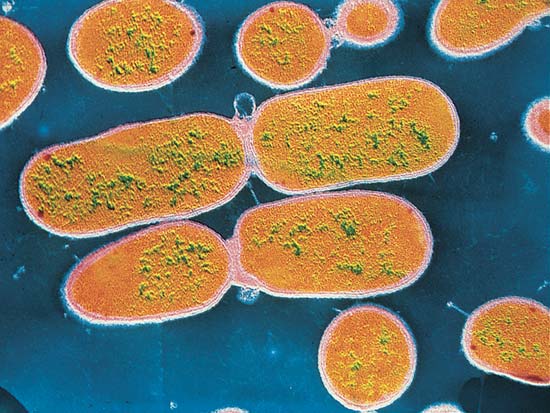
The offspring from asexually reproduced organisms are?
a)
Different than their parents
b)
Identical to parents
c)
Like a combination from both parents
d)
A different species
30.
What part of our cells holds our DNA?
a)
cytoplasm
b)
cell membrane
c)
nucleus
d)
ribosomes
31.
Bacteria reproduce asexually by a process called
a)
replication
b)
meiosis
c)
splitting in two
d)
binary fission
32.
How many parents are required for asexual reproduction?
a)
one
b)
two
c)
six
d)
four
33.
What do we call the process of copying DNA?
a)
transciption
b)
translation
c)
replication
d)
redundancy
34.

Meiosis makes sperm and egg cells. In humans, sperm and egg cells each have _____ chromosomes. Therefore a fertilized human egg cell (sperm and egg cell combined) would create a cell with _____ chromosomes.
a)
23, 46
b)
46, 23
c)
2, 4
d)
50, 100
35.
What type of cells only contain 23 Chromosomes?
a)
Bone cells
b)
Skin cells
c)
Sex cells
d)
Liver cells
36.
Which process creates genetically DIFFERENT offspring?
a)
sexual reproduction
b)
asexual reproduction
37.
A male shark has 40 chromosomes in each of its sex cells. How many would be present in its BODY cells?
a)
20
b)
40
c)
80
d)
160
38.
In the male reproduction system, the testes produces sperm.
a)
True
b)
False
39.
Dominant alleles are represented by a:
a)
Male gene
b)
lowercase letter
c)
recessive trait
d)
capital letter
40.
How many alleles (letters) does a child get from each parent for each trait?
a)
1
b)
2
c)
3
d)
4
41.
How many alleles (letters) do each person carry for a trait?
a)
1
b)
2
c)
3
d)
4
42.
What gender has an X and a Y chromosome?
a)
male
b)
female
c)
transgender
d)
all of the above
43.
B = brown eyes
b = blue eyes
What is true about these two brothers that have brown eyes?
One has genotype BB the other Bb.
b = blue eyes
What is true about these two brothers that have brown eyes?
One has genotype BB the other Bb.
a)
they have same phenotype and genotype
b)
they have different genotypes and phenotypes
c)
they have same phenotype but different genotypes
d)
they have same genotype but different phenotypes
44.
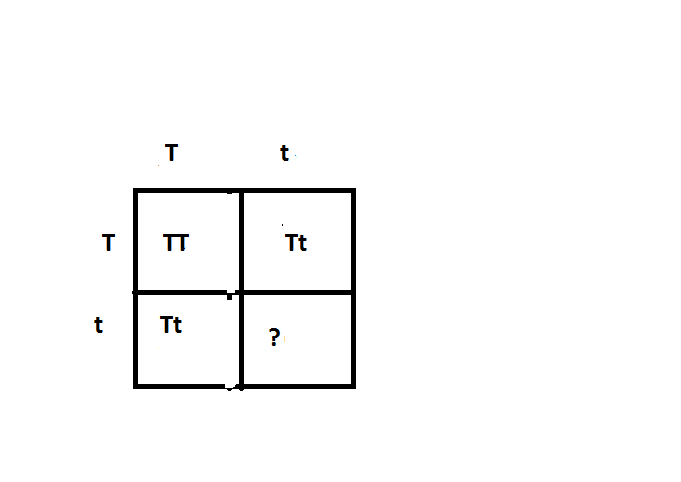
T = tall and t = short
In the punnett square below, what belongs in the missing square?
In the punnett square below, what belongs in the missing square?
a)
tt
b)
Tt
c)
Bb
d)
TT
45.
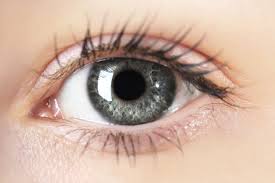
What you see, or the physical appearance.
a)
Genotype
b)
Phenotype
c)
Homozygous
d)
Heterozygous
46.
In a heterozygous genotype, the ___________ allele takes over in the phenotype.
a)
recessive
b)
dominant
c)
lower case letter
d)
both
47.
Which of the following genotypes is heterozygous?
a)
Bb
b)
BB
c)
bb
d)
B
48.
Which of the following genotypes is homozygous dominant?
a)
A
b)
Aa
c)
AA
d)
aa
49.
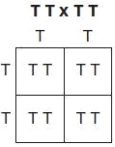
What ratio of the offspring from the cross shown will be homozygous recessive for the trait of tallness?
a)
0 in 4
b)
1 in 4
c)
2 in 4
d)
4 in 4
50.
AA and Aa always show up as
a)
dominant
b)
recessive
51.
Aa, DD, bB, yy are all examples of
a)
genotypes
b)
phenotypes
52.
where is the pacific garbage patch located
a)
A:In between north America and Japan
b)
B:In between north America and south America
53.

Why was a plastic toy spill so helpful to scientists studying ocean currents?
a)
The toys showed them where the sea floor was.
b)
The ducks showed that wind currents are real.
c)
The Ducks helped them discover trade winds.
d)
The ducks gave scientists lots of data to study ocean currents.
54.
Osteo means?
a)
Bone
b)
Bone tissue
c)
skin
d)
tissue
55.
Attaches bone to bone.
a)
tendon
b)
ligament
56.
How many bones are in the human body?
a)
200
b)
206
c)
205
d)
204
57.
What are functions of the skelton?
a)
A) protection
b)
b) Body shape
c)
C) movement
d)
D) A,b and c
58.
What foods contain Calcium that helps our bones?
a)
Milk
b)
Oranges
c)
Soda
d)
Celery
59.
What mineral are bones made of?
a)
Vitamin C
b)
Calcium
c)
Zinc
d)
Vitamin B
60.
Bones are living things
a)
True
b)
False
61.
Where is the largest bone in the body?
a)
finger
b)
leg
c)
arm
d)
Spine
62.

What do the bones create?
a)
white blood cells
b)
platlets
c)
red blood cells
d)
flying turkeys
63.
Which type of joint give you the largest range of motion?
a)
pivot
b)
ball-and-socket
c)
hinge
d)
gliding
64.

What is the place where two bones meet?
a)
hinge
b)
bone
c)
spot
d)
joint
65.
The main purpose of the ____________ system is to break food particles into pieces that can be used.
a)
circulatory
b)
respiratory
c)
digestive
d)
skeletal
66.
What is responsible for delivering oxygen and removing carbon dioxide from the body?
a)
cell nucleus
b)
excretory system
c)
nervous tissue
d)
respiratory system
67.
The __________ is the main organ of the nervous system.
a)
heart
b)
lungs
c)
brain
d)
skin
68.
The circulatory system uses _________ to deliver oxygen to the rest of the body.
a)
blood cells
b)
lungs and nose
c)
blood vessels
d)
brain and spinal cord
69.
In multicellular organisms, tissues are comprised of _______.
a)
organs
b)
systems
c)
cells
d)
blood
70.
When tissues come together, they form ___________.
a)
cells
b)
atoms
c)
organs
d)
systems
71.

My spinal cord helps _________ travel between my brain and the nerves in my body.
a)
Memories
b)
Blood
c)
Waste
d)
Messages
72.

My heart is a _________, that pumps blood through the body.
a)
Cell
b)
Tissue
c)
Muscle
d)
Bone
73.

My body needs ______ from the air to live.
a)
Oxygen
b)
Cardon Dioxide
c)
Carbon Monoxide
d)
Hydrogen Peroxide
74.

I breathe out a gas called ___________ that my body does not need.
a)
Oxygen
b)
Carbon Monoxide
c)
Carbon Dioxide
d)
Hydrogen Peroxide
75.
What are the products of photosynthesis?
a)
water and carbon dioxide
b)
oxygen and glucose
c)
oxygen and carbon dioxide
d)
oxygen and water
76.
Which statement about photosynthesis is correct?
a)
Plants get the energy they need for photosynthesis from water.
b)
Plants get the energy they need for photosynthesis from soil.
c)
Plants get the energy they need for photosynthesis from sunlight.
d)
Plants do not require energy to perform photosynthesis.
77.
The main source of energy for all life comes from ____.
a)
the Earth
b)
the moon
c)
the sun
d)
the food we eat/make
78.
The raw materials or of photosynthesis are
a)
sugar and water.
b)
sugar and oxygen.
c)
carbon dioxide and water.
d)
carbon dioxide and oxygen.
79.
Why do we eat food?
a)
to provide energy/fuel
b)
to eliminate waste products
c)
to prevent diseases
d)
to kill pathogens
80.
Where does cellular respiration take place in the cell?
a)
Cell Membrane
b)
Nucleus
c)
Mitochondria
d)
Vacuole
81.
What is the purpose of cellular respiration?
a)
to break down food
b)
to create energy in the body
c)
to release energy from food
d)
there is none; it's a waste of time
82.
What are the products of respiration?
a)
Glucose and oxygen
b)
Carbon dioxide and water
c)
Lactic acid
d)
Carbon monoxide
83.
Which organ excretes carbon dioxide?
a)
Lungs
b)
Liver
c)
Heart
d)
Kidney
84.
What happens to your breathing rate when you exercise?
a)
It increases
b)
It decreases
c)
It stays the same
85.
The products of photosynthesis are the raw materials for cellular respiration, & the products of respiration are the raw materials for photosynthesis.
a)
True
b)
False
86.
If any one system of the body were removed, you would still remain alive.
a)
True
b)
False
100 %

