
 Worksheets
Intro to World History
Total questions: 161
Worksheet time: 2hrs 28mins
Name
Class
Date
1.
How many continents are there in the world?
a)
4
b)
5
c)
6
d)
7
2.
How many oceans are there in the world?
a)
7
b)
6
c)
5
d)
4
3.
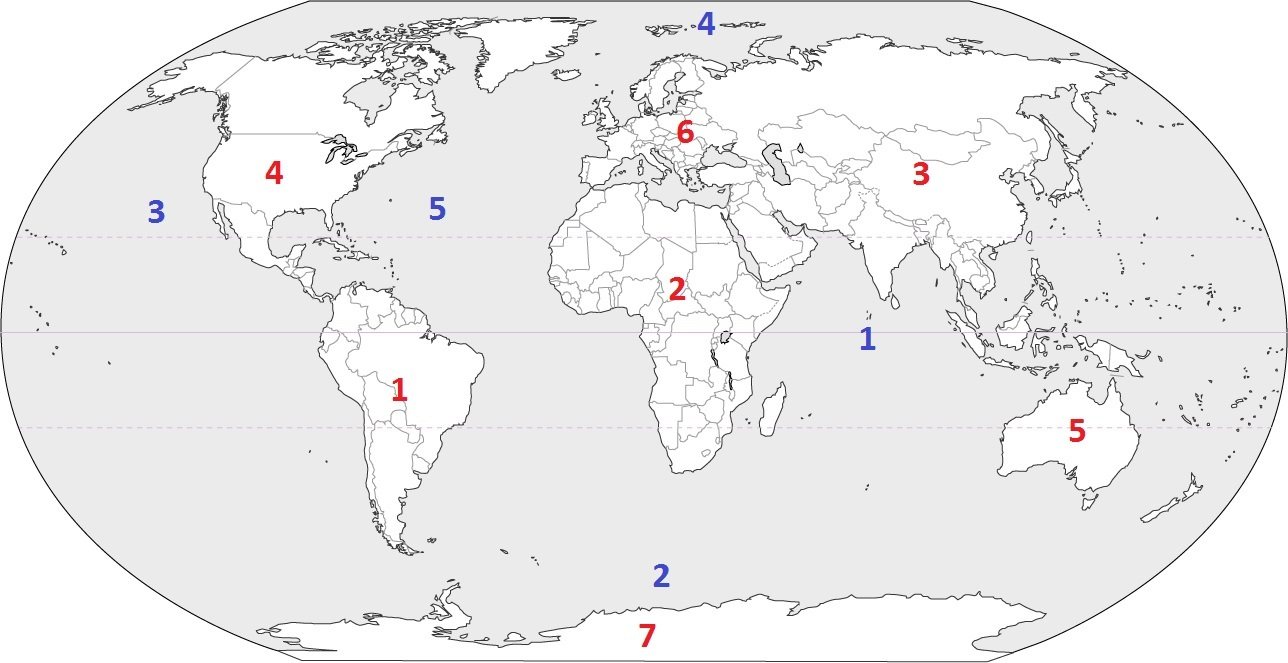
Which continent is located at #3?
a)
Australia
b)
Asia
c)
Europe
d)
South America
4.

This is the smallest continent, farthest away from the others where you may find koalas and kangaroos.
a)
Europe
b)
Africa
c)
South America
d)
Australia
5.

This continent contains major historic cities like Paris, London and Rome.
a)
Africa
b)
Europe
c)
Asia
d)
North America
6.
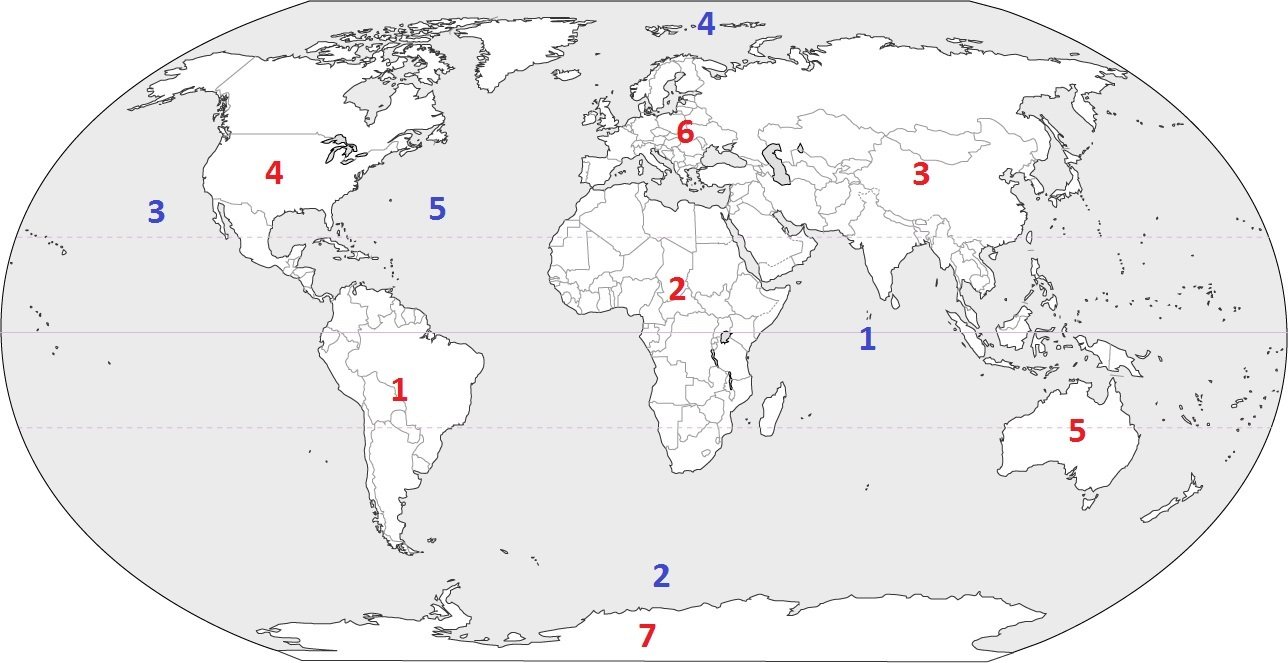
Identify the ocean at location #5
a)
Atlantic Ocean
b)
Southern Ocean
c)
Pacific Ocean
d)
Arctic Ocean
7.
A source that is original, from the time period & a first hand account
a)
Primary
b)
Secondary
8.
At school we use textbooks to learn about the history? When we use textbooks, what are we using?
a)
Primary Source
b)
Secondary Source
9.
A movie showing the life of George Washington.
a)
Primary Source
b)
Secondary Source
10.
A journal written by Sequoyah describing how he created the Cherokee alphabet.
a)
Primary Source
b)
Secondary Source
11.
What was the first monothestic religion?
a)
Judaism
b)
Confucianism
c)
Christiantiy
d)
Islam
12.

What river is shown in this image
a)
Nile
b)
Huang He
c)
Euphrates
d)
Indus
13.
What is the definition of prehistory?
a)
history before fire
b)
history study only by anthropologists
c)
history without innovations
d)
history before writing
14.
Which geographic feature helped determine the cradles of civilization?
a)
Oceans
b)
Rivers and Valleys
c)
Fertile soils
d)
Rainy seasons in the Angle Region
15.
Papyrus was used as a surface for the Egyptian writing system called?
a)
Cuneiform
b)
Hieroglyphics
c)
Inscribing
d)
Pictographs
16.
The Phoenicians contributed greatly to written communication by introducing the first use of:
a)
Money
b)
Papyrus
c)
Pictographs
d)
Alphabet
17.
The most sacred writings of the Jewish religion are the first five books of the Hebrew Bible, known as the:
a)
Torah
b)
Old Testament
c)
Ten commandments
d)
Ark of the covenant
18.
Where do scientists believe that humans originated?
a)
Africa
b)
Asia
c)
Europe
d)
Australia
19.
Choose the correct list:
a)
Egypt- Tigris-Euphrates; Mesopotamia- Nile; Indus Valley- Yellow; China- Indus
b)
Egypt- Indus; Mesopotamia- Yellow; Indus Valley- Indus; China- Tigris-Euphrates
c)
Egypt- Nile; Mesopotamia- Tigris-Euphrates; Indus Valley- Indus; China- Yellow
d)
Egypt- Yellow; Mesopotamia- Nile; Indus Valley- Indus; China- Tigris-Euphrates
20.
The process of mummification was connected to the Egyptian belief in?
a)
Spirts
b)
Magic
c)
Afterlife
d)
Multiple gods
21.
Papyrus was used as a surface for the Egyptian writing system called?
a)
Cuneiform
b)
Hieroglyphics
c)
Inscribing
d)
Pictographs
22.

The Paleolithic Age is
a)
New Stone Age
b)
not proven to have existed
c)
usually known as the Primitive Age
d)
the period in which humans used simple stone tools
23.

Which of the following was part of the agricultural revolution?
a)
widespread use of bronze
b)
domestication of animals
c)
the beginning of agricultural rituals
d)
significant artistic activity
24.

The Mesopotamian religion, which identified nearly 3,000 gods and goddesses, can be described as
a)
cuneiform
b)
polytheistic
c)
patriarchal
d)
theocratic
25.
The Ten Commandments is attached to which ancient civilization?
a)
Hebrew
b)
Egyptian
c)
China
d)
Sumerian
26.
Ziggurats and cuneiform are linked to which ancient civilization?
a)
Sumerians
b)
Indians
c)
Egyptians
d)
Hebrews
27.
Which is true of the following statement? "Egypt is the gift of the Nile." by Herodutus, Greek Historian.
a)
The Nile supports civilization in Egypt.
b)
Egypt as a land is the gift of Thoth
c)
Egypt has rewarded the world with the Nile
28.
People who move from place to place in search of food is known as?
a)
Homo-sapien
b)
Artifact
c)
Nomad
d)
Clan
29.
What are two of the first written law codes?
a)
The Ten Commandments & The Twelve Tables
b)
Hammurabi's Code & The Twelve Tables
c)
The Ten Commandments & Justinian's Code
d)
Hammurabi's Code & The Ten Commandments
30.
Which empire was tolerant of conquered people and built the Royal Road?
a)
The Mongol Empire
b)
The Roman Empire
c)
The Persian Empire
d)
The Assyrian Empire
31.

Where did humans first appear in accordance with current scientific theory?
a)
I
b)
II
c)
III
d)
IV
32.

Which letter shows the location of Mesopotamia?
a)
A
b)
B
c)
C
d)
D
33.
Hammurabi is known for -
a)
conquering the Indian subcontinent
b)
leading Athens during the Golden Age
c)
establishing a harsh law code
d)
developing cuneiform writing
34.

According to the law of superposition, the oldest fossils are found
a)
At the top of the rock layers
b)
Near the bottom of the rock layers
c)
In the middle of the rock layers
d)
Somewhat near the surface
35.
What is a Fossil?
a)
A Bone
b)
Nasty
c)
the preserved remains or traces of animals, plants, and other organisms from the remote past
d)
The Bone of a dead thing
36.

Homo Sapiens emerged in ________ between ________ and _______ years ago.
a)
India; 300,000; 400,000
b)
Africa; 100,000; 400,000
c)
Africa; 20,000; 40,000
d)
India; 10,000; 40,000
37.
Instead of staying in one place, the first humans were ________.
a)
Nomadic
b)
Simple
c)
Movers
d)
Paleolithic
38.

Humans in the Neolithic Era -
a)
Used advanced tools
b)
Made pottery
c)
Developed weaving skills
d)
All options are correct
39.
Agriculture was developed in the Paleolithic Era.
a)
True
b)
False
40.
Who was the king of the Gods?
a)
Hera
b)
Apollo
c)
Zeus
d)
Athena
41.
Archaeology is the study of past societies through an analysis of what people have left behind.
a)
True
b)
False
42.
The consistent growing of crops on a continuing basis
a)
Agrarian Revolution
b)
Systematic Agriculture
c)
Domestication of Animals
d)
Archaeology
43.
Where were the Mesopotamian River Valley Civilizations located?
a)
Southwest Asia
b)
South Asia
c)
East Asia
d)
Africa
44.
Which is an example of social patterns in the ancient civilizations?
a)
Hereditary Rulers
b)
Rigid Class Systems
c)
Democracy
d)
Both A and B
45.

Where was Cuneiform created?
a)
Phoenicians
b)
Egypt
c)
Sumer
46.

At the time, the Persian Empire was -
a)
very small
b)
the largest empire in the world
c)
declining
d)
nonexistent
47.
In the Persian Empire, what was the dominant religion?
a)
Christianity
b)
Buddhism
c)
Zoroastrianism
d)
Judaism
48.
The development of _________ was an important contribution to Indian culture.
a)
Zoroastrianism
b)
Hindusim
c)
Buddhism
d)
Toaism
49.
Who fought in the Peloponnesian War?
a)
Sparta and Marathon
b)
Persia and Sparta
c)
Athens and Persia
d)
Athens and Sparta
50.
Where is considered the birthplace of democracy?
a)
Troy
b)
Marathon
c)
Sparta
d)
Athens
51.
"Clergy" is also known as...
a)
Church officials
b)
common people
c)
Soldiers
d)
slaves
52.
What does the word Paleolithic mean?
a)
The Fire Age
b)
New Stone Age
c)
Old Stone Age
d)
The Homo Sapiens Sapiens Age
53.
Monotheism was practiced by who?
a)
Nubians
b)
Phoenicians
c)
Hebrews
d)
Sumer
54.
The Paleolithic Era was a time when the majority of humans used
a)
agriculture to produce food
b)
religious temples for sacrifices
c)
stone tools and hunting methods
d)
Farmland to build houses
55.
Archaeologists have been able to use fossil and geographic data to trace the first human activity back to which continent?
a)
Asia
b)
Africa
c)
North America
d)
Australia
56.
What is the name of the Babylonia King who created a law code that showed social inequalities?
a)
Justinian
b)
Ceasar
c)
Alexander
d)
Hammurabi
57.
Which statement would be supported by a Spartan citizen?
a)
"Let's vote on our options."
b)
"We must unite all of Greece under equal rule"
c)
"Battle is our strongest option."
d)
"Slavery is inhumane."
58.

Which religion does this symbol represent?
a)
Christianity
b)
Islam
c)
Hinduism
d)
Confucius
59.
Which world religion believes in striving to reach enlightenment?
a)
Hinduism
b)
Judaism
c)
Buddhism
d)
Christianity
60.
Alexander the Great was a king from?
a)
Greece
b)
Persia
c)
Macedonia
d)
Rome
61.
Which Greek city-state was the first to create a democratic government?
a)
Athens
b)
Sparta
c)
Thebes
d)
Corinth
62.
Who wrote the Iliad and the Odyssey?
a)
Virgil
b)
Homer
c)
Socrates
d)
Plato
63.
Who was the Athenian leader during the Golden Age who extended democracy and rebuilt the city after the Persian Wars?
a)
Alexander the Great
b)
Zues
c)
Xerxes
d)
Pericles
64.
Which of the following was NOT a battle of the Persian Wars?
a)
Marathon
b)
Salamis
c)
Bull Run
d)
Thermopyle
65.
What type of government is ruled by a small group?
a)
Democracy
b)
Oligarchy
c)
Tyranny
d)
Monarchy
66.
What city-state had a direct democracy?
a)
Athens
b)
Sparta
c)
Troy
d)
Carthage
67.
What government is ruled by a small group of nobles?
a)
Aristocracy
b)
Tyranny
c)
Monarchy
d)
Democracy
68.
What government is ruled by one person who seized power?
a)
Aristocracy
b)
Tyranny
c)
Democracy
d)
Monarchy
69.
What geographic feature isolated and hindered the development of Greece city-states?
a)
deserts
b)
mountains
c)
rivers
d)
islands
70.

This map shows the spread of
a)
Islam
b)
Christianity
c)
Buddhism
d)
Hinduism
71.
What are the two distinct groups the Homo Sapiens split into?
a)
Neanderthals and Homo Sapiens Sapiens
b)
Cro-magnon and Neandertals
c)
Paleolitic and Cro-magnon
d)
Paleolithic and Homo Sapien Sapiens
72.
History..
a)
is based on evidence
b)
can be biased in primary documents
c)
is sometimes forgotten
d)
All are correct
73.
A _______________________ is a person who studies and writes about the human past.
a)
Historian
b)
Biologist
c)
Psychologist
d)
Paleontologist
74.
The time before people first began to write about 5,500 years ago is called
a)
Prehistory
b)
Middle Ages
c)
Classical Age
d)
Modern Age
75.
A scientist who digs up clues about the past.
a)
Historian
b)
Archaeologist
c)
Anthropologist
d)
Gardener
76.
A weapon, tool, or other item made by humans dug up by an archaeologist.
a)
Artifact
b)
Fossil
c)
Ruin
77.
Traces of plants or animals that have been preserved in rock
a)
Fossil
b)
Artifact
c)
Ruin
78.
A scientist who studies how humans and their societies develop.
a)
Anthropologist
b)
Archaeologist
c)
Historian
d)
Psychologist
79.
Humans have changed over millions of years by adapting new traits to better survive. This is called__________.
a)
Evolution
b)
Revolution
c)
Extinction
80.
Humans first evolved on what continent?
a)
Asia
b)
Africa
c)
Europe
d)
North America
81.
The tools and methods that help humans perform tasks are called _______________.
a)
Technology
b)
Trade
c)
Evolution
82.
The period of early human history that began when humans first began making tools out of stone
a)
Stone Age
b)
Modern Age
c)
Classical Age
d)
Medieval Era
83.
Early period of the Stone Age that began about 2.5 million BCE & lasted until about 8000 BCE.
a)
Paleolithic Age
b)
Neolithic Age
c)
Bronze Age
d)
Iron Age
84.
The later period of the Stone Age that started around 8000 BCE and lasted to about 4000 BCE.
a)
Neolithic Age
b)
Paleolithic Age
c)
Bronze Age
d)
Iron Age
85.
During the Paleolithic Age, people got food by ________.
a)
Hunting and Gathering
b)
Farming
86.
Paleolithic Age is a term meaning ____________________.
a)
Old Stone Age
b)
New Stone Age
c)
Ice Age
d)
New Technology
87.
Groups of people who move from place to place are called __________________.
a)
Nomads
b)
Anthropologists
c)
Astronomers
d)
Historians
88.
Groups of people who move from place to place are called __________________.
a)
Nomads
b)
Anthropologists
c)
Astronomers
d)
Historians
89.
The start of the Neolithic Age is often called the _________________________ because farming changed people's lives
a)
Neolithic Revolution
b)
New Age
c)
Modern Era
90.
____________________ means to tame plants or animals for human use.
a)
Domesticate
b)
Artisan
c)
Irrigation
d)
Specialization
91.
The word _________ describes changes that affect many areas of life.
a)
revolution
b)
rebellion
c)
renaissance
92.
The Neolithic Revolution was important because...
a)
Domestication of plants and animals allowed people to settle in permanent homes
b)
Villages and later cities were able to form
c)
Job specialization occurred
d)
All of these answers are correct
93.
___________ is a practice in which different people can focus on different jobs (besides making food)
a)
Specialization
b)
Irrigation
c)
Agriculture
d)
Democratization
94.
A skilled worker who crafts goods like pottery, cloth, weapons, or jewelry.
a)
Artisan
b)
Merchant
c)
Farmer
d)
Priest
95.
Complex societies are known as ___________________.
a)
Civilizations
b)
Scribes
c)
Empires
d)
Republics
96.
The first complex societies were developed in a region of the Middle East known as ______.
a)
Mesopotamia
b)
Machu Picchu
c)
Nile River Valley
d)
Yangtze River Valley
97.
Which of the following is NOT one of the 7 shared features of all civilizations?
a)
Government
b)
Religion
c)
Writing
d)
People's appearance
98.
Mesopotamia is often called the ______________ because its lands were good for farming.
a)
Fertile Crescent
b)
Fruitful Corridor
c)
Prolific Paragon
99.
A man-made way of watering crops
a)
irrigation
b)
specialization
c)
democratization
d)
artisan
100.
Mesopotamian farmers created a system of ________________ to control the flow of the Tigris and Euphrates Rivers.
a)
irrigation
b)
cuneiform
c)
flooding
d)
city-states
101.
A city & surrounding lands that are under their own government rather than part of larger unit.
a)
city-state
b)
kingdom
c)
empire
d)
realm
102.
The ancient Sumerians invented a form of writing that we call __________.
a)
cuneiform
b)
sanskrit
c)
hieroglyphics
d)
farsi
103.
The Sumerian religion was _____ because they believed in many different gods.
a)
Polytheistic
b)
Monotheistic
c)
Animistic
104.
Sumerians built large temples called _______ in their city centers in honor of their main god.
a)
Ziggurats
b)
Mosques
c)
Wats
d)
Cathedrals
105.
Which of the following is NOT a Sumerian invention?
a)
The first system of writing
b)
The 60 second minute, and the 60 minute hour
c)
The wheel
d)
The first flying machine
106.
A large group of lands under one ruler
a)
Empire
b)
City-State
c)
Civilization
d)
Farming Village
107.
In 1800s BCE a new group came to power in Mesopotamia. Their king ________________ created the Babylonian Empire
a)
Hammurabi
b)
Tutankhamen
c)
Nebuchadnezzar
d)
Sargon
108.
Hammurabi was best known for his...
a)
Religion
b)
Code of Laws
c)
Super-human strength
d)
Love of art
109.
The Assyrian army was the first to use __________, which made it a fearsome and mighty force
a)
iron
b)
copper
c)
tin
d)
steel
110.
Trade between cities in Mesopotamia became a good way to make money. A group of traveling merchants is called a _______________.
a)
caravan
b)
squad
c)
entourage
d)
expedition
111.
Chaldeans mostly studied space. A person who studies planets & stars in space is called an ________________.
a)
Astronomer
b)
Chemist
c)
Paleontologist
d)
Historian
112.
The knowledge, behaviors and ways of thinking that a group has in common.
a)
Culture
b)
Economy
c)
Government
d)
System
113.
A group that shares a place to live, a culture and an identity
a)
Society
b)
Civilization
c)
System
d)
Ethnic Group
114.
A smaller group of people that have a lot in common, such as language, identity and culture – they can be different than other people around them.
a)
Society
b)
Civilization
c)
System
d)
Ethnic Group
115.
The spread of culture from one place to another.
a)
Cultural Diffusion
b)
System
c)
Government
d)
Barter
116.
A way of doing things
a)
System
b)
Barter
c)
Economy
d)
Society
117.
The authority that sets rules for a society, helps its members relate to one another (and to others), and keeps a civilization running smoothly, securely, and peacefully.
a)
Government
b)
Economy
c)
Religion
d)
Border
118.
What things a country has, what people do for work, how people trade with each other and how people spend money.
a)
Government
b)
Economy
c)
Religion
d)
Society
119.
A form of trade where people exchange goods and services without
the use of money.
the use of money.
a)
Barter
b)
Import
c)
Export
d)
Political System
120.
A product or good that is sold out of one country to another.
a)
Export
b)
Import
121.
A good or product brought into a country from another.
a)
Export
b)
Import
122.
An area of land, like a country or province.
a)
Region
b)
Border
c)
Economy
d)
Society
123.
A belief in a supernatural power or
powers that are regarded as creators and maintainers of the universe - it is
usually also a system of moral values.
powers that are regarded as creators and maintainers of the universe - it is
usually also a system of moral values.
a)
Economy
b)
Religion
c)
Government
d)
Ethnic Group
124.
Belief in one god
a)
Monotheistic
b)
Polytheistic
c)
Animistic
125.
A belief in the divine forces of nature
a)
Monotheistic
b)
Polytheistic
c)
Animistic
126.
Belief in many gods
a)
Polytheistic
b)
Monotheistic
c)
Animistic
127.
A writing system made up of pictures and sound symbols
a)
hieroglyphics
b)
embalming
c)
delta
d)
papyrus
128.
What culture developed the caste system
a)
China
b)
Europe
c)
India
d)
Egypt
129.
What early civilizations helped develop a writing system that would later influence ours?
a)
Egyptians
b)
Phoenicians
c)
Hitties
d)
Chaldeans
130.

Where was the ancient land known as Mesopotamia?
a)
in northern Africa near the Nile River
b)
in eastern Europe along the Danuble River
c)
in central Asia between the Syr Darya and Amu Darya
d)
in southwest Asia between the Tigris and Euphrates Rivers
131.

How did Sumerian farmers control the water supply?
a)
They built levees to prevent flooding.
b)
The dug canals to shape the paths the water took.
c)
They built reservoirs to store water for later use.
d)
All of the above.
132.
A reed plant that grows long the Nile River. Ancient Egyptians made baskets, sandals, river rafts, and paper from it.
a)
cataract
b)
delta
c)
papyrus
d)
embalming
133.
A line of rulers from one family
a)
theocracy
b)
pharaoh
c)
dynasty
d)
shadoof
134.
A line of rulers who belong to the same family is called a
a)
Phara
b)
province
c)
Emperor
d)
Dynasty
135.
Earliest center of civilization in the Aegean region
a)
Starta
b)
Athens
c)
Minoan
d)
Mycenae
136.
Civil War between Athens and their Allies vs. Sparta and their Allies
a)
Peloponnesian War
b)
Persian War
c)
Alexander the Greats War
d)
Minoan Conflict
137.
Conquered most of the known world in eight years.
a)
Alexander the Great
b)
Darius III
c)
Plato
d)
Socrates
138.

What is this Greek structure called?
a)
Pantheon
b)
Acropolis
c)
Parthenon
d)
Polis
139.
Homer's Illiad and the Odyssey were
a)
epic poems
b)
songs
c)
statues
d)
gods
140.
The process of changing plants and animals to make them more useful for humans is called _____.
a)
Agriculture
b)
Farming
c)
Domestication
d)
Irrigation
141.
What region had the earliest evidence of a civilization?
a)
Rome
b)
Greece
c)
Mesopotamia
d)
Central America
142.
What river was the Egyptian civilization based around
a)
Nile
b)
Tigris
c)
Huang He
d)
Indus
143.
Mesopotamia, Egypt, China and India all developed near what important geographic feature?
a)
Mountains
b)
Valleys
c)
Rivers
d)
Oceans
144.
What democratic ideas did the United States adopt form ancient Greece
a)
Direct Democracy
b)
Representative Democracy
c)
The three branches of government
d)
Balance of Power
145.
What invention led to people going from living in isolated nomadic communities to cities and towns?
a)
The invention of the wheel
b)
Agriculture
c)
Tools
d)
Weaponry
146.
Which philosopher used questions to teach his students and was condemned to death for corrupting the youth of Athens
a)
Socrates
b)
Aristotle
c)
Ovid
d)
Pluto
147.
In ancient Greece, people saw gods in what way?
a)
Romantic
b)
Human-like
c)
Evil
d)
Corrupt
148.
Iliad and Odyssey are 2 famous what?
a)
Greco-Roman stories
b)
Epic Poems
c)
Italic poems
d)
Songs
149.
Greece's economy was based on?
a)
Agriculture
b)
Livestock
c)
Wars
d)
Trade
150.
India & China both had eldest males in charge of society, what is that called?
a)
Theocracy
b)
Patriarchy
c)
Monarchy
d)
Geriotracy
151.
What crops led to farming in the Middle East?
a)
Corn and rice
b)
Wheat and barley
c)
potatoes and beans
d)
Sugar Cane and Bananas
152.
Archaeologists study these to help explain history in the ancient civilizations?
a)
Fossils
b)
Secondary Sources
c)
Maps
d)
Textbooks
153.

Nomadic groups whose food supply depends on hunting animals and collecting plant foods?
a)
Hunter-Gatherers
b)
Culture
c)
Hominids
d)
Artifacts
154.

The taming of animals?
a)
Domestication
b)
Scribes
c)
Paleolithic Age
d)
Cuneiform
155.

The development of skills in a specific kind of work?
a)
Specialization
b)
Domestication
c)
Nomads
d)
Barter
156.

Professional record keepers?
a)
Scribes
b)
Technology
c)
Hominids
d)
Artifacts
157.

Highly mobile people who moved from place to place foraging for new sources of food?
a)
Nomads
b)
Artifacts
c)
Artisans
d)
Barter
158.
Cultural diffusion is
a)
the blocking of culture from one place to another
b)
how culture is made
c)
the spread of culture
d)
a shared way of life
159.
To adapt means to
a)
get rid of
b)
get used to
c)
change or adjust
d)
move from one place to another
160.
Early civilizations originated in which region?
a)
East Africa
b)
West Africa
c)
Middle East
d)
Europe
161.
What was the name of the revolution that saw the introduction of farming?
a)
Paleolithic Revolution
b)
Steel Revolution
c)
Green Revolution
d)
Neolithic Revolution
100 %

