
 Worksheets
Microscope Quiz EMHS
Total questions: 58
Worksheet time: 42mins
Name
Class
Date
1.

Part 9
a)
Body tube
b)
Eyepiece
c)
Objective
d)
Light Source
2.

Part 10
a)
Stage
b)
Arm
c)
Base
d)
Diaphragm
3.

Part 11
a)
Stage Clips
b)
Stage
c)
Diaphragm
d)
Illuminator
4.
This holds the eye piece and connects it to the objective
a)
Arm
b)
Base
c)
Body Tube
d)
Objective
5.
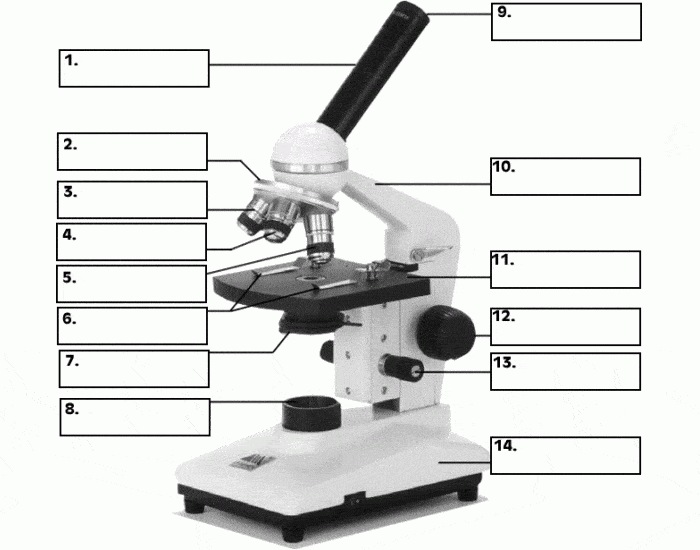
Part 12
a)
Fine Adjustment Knob
b)
Coarse Adjustment Knob
c)
Diaphragm
d)
Objective
6.

Part 13
a)
Fine Adjustment Knob
b)
Course Adjustment Knob
c)
Stage
d)
Diaphragm
7.

Part 14
a)
Stage
b)
Diaphragm
c)
Base
d)
Illuminator
8.
This bring the specimen into sharp focus
a)
Coarse Adjustment Knob
b)
Fine Adjustment Knob
c)
Eyepiece
d)
Diaphragm
9.
Connects to the base and helps carry the microscope easily
a)
Arm
b)
Base
c)
Body Tube
d)
Revolving Nosepiece
10.
This moves the specimen up or down to adjust the slide containing specimen
a)
Fine Adjustment Knob
b)
Coarse Adjustment Knob
c)
Stage
d)
Diaphragm
11.
Used to control the amount of light reaching the specimen
a)
Illuminator
b)
Stage
c)
Eyepiece
d)
Diaphragm
12.
Source of light usually situated at the bottom/ base of the microscope
a)
Eyepiece
b)
Diaphragm
c)
Objective
d)
Illuminator
13.
Part that holds two or more objectives
a)
Stage
b)
Stage Clip
c)
Revolving Nosepiece
d)
Body Tube
14.
Helps in magnifying the sample object
a)
Body Tube
b)
Eyepiece
c)
Illuminator
d)
Objectives
15.
This is responsible for magnifying the image of specimen
a)
Eyepiece
b)
Illuminator
c)
Objectives
d)
Diaphragm
16.
The flat surface where the slide with the specimen is placed
a)
Base
b)
Arm
c)
Stage
d)
Diaphragm
17.

Part 1
a)
Eyepiece
b)
Body Tube
c)
Arm
d)
Objective
18.

Part 2
a)
Objectives
b)
Body Tube
c)
Revolving Nosepiece
d)
Stage
19.

Part 3
a)
Low Objective
b)
Medium Objective
c)
High Objective
d)
Revolving Nosepiece
20.

Part 6
a)
Stage
b)
Stage Clips
c)
Diaphragm
d)
Arm
21.

Part 7
a)
Stage
b)
Stage Clips
c)
Light Source
d)
Diaphragm
22.

Name this part of the microscope
a)
arm
b)
scanning objective
c)
diaphragm
d)
eyepiece/ ocular
23.
Part 10
a)
Stage
b)
Arm
c)
Base
d)
Diaphragm
24.
Part 11
a)
Stage Clips
b)
Stage
c)
Diaphragm
d)
Illuminator
25.
Part 12
a)
Fine Adjustment Knob
b)
Coarse Adjustment Knob
c)
Diaphragm
d)
Objective
26.
Part 13
a)
Fine Adjustment Knob
b)
Course Adjustment Knob
c)
Stage
d)
Diaphragm
27.
Part 14
a)
Stage
b)
Diaphragm
c)
Base
d)
Illuminator
28.
Part 1
a)
Eyepiece
b)
Body Tube
c)
Arm
d)
Objective
29.
Part 2
a)
Objectives
b)
Body Tube
c)
Revolving Nosepiece
d)
Stage
30.

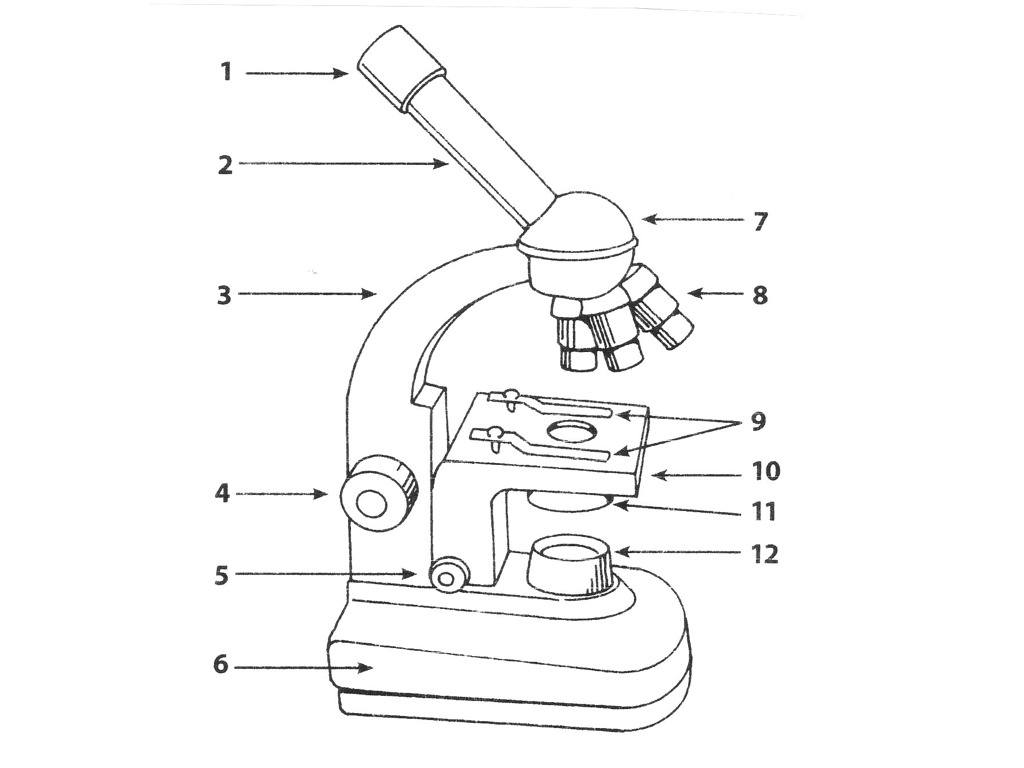
Number 3
a)
Ocular Lens
b)
Objective Lens
c)
Diaphragm
d)
Base
31.

Number 7
a)
Ocular Lens
b)
Objective Lens
c)
Base
d)
Arm
32.

Number 8
a)
Base
b)
Stage
c)
Tube
d)
Arm
33.
To calculate the magnifying power of a microscope multiply the eyepiece by the objective you are using. Suppose an eyepiece of 10x and Objective of 20X. Total Power????
a)
200X
b)
30X
c)
2X
d)
40X
34.
To calculate the magnifying power of a microscope multiply the eyepiece by the objective you are using. Suppose an eyepiece of 10x and Objective of 50X. Total Power????
a)
60X
b)
500X
c)
1,000X
d)
5,000X
35.
Hold the slide in place on the stage
a)
Stage
b)
Stage Clips
c)
Aperature
d)
Light Source
36.
Holds objective lenses; Rotates to change objectives
a)
Arm
b)
Base
c)
Revolving Nosepiece
d)
Diaphragm
37.
Moves the stage slightly to sharpen the image
a)
Body Tube
b)
Course Focus Knob
c)
Aperature
d)
Fine Focus Knob
38.
Place where slide is placed on while being viewed
a)
Base
b)
Stage Clips
c)
Diaphragm
d)
Stage
39.
Lens used to view specimen; also called eyepiece
a)
Scanning Lens
b)
Objective Lens
c)
Ocular Lens
d)
Illuminator
40.
What will be the total magnification if the ocular lens is 10X and the objective lens is 10X?
a)
10X
b)
100X
c)
1000X
d)
1X
41.
What will be the total magnification if the ocular lens is 10X and the objective lens is 40X?
a)
40X
b)
10X
c)
100X
d)
400X
42.
Moves stage up and down for focusing; large amounts
a)
Fine Focus Knob
b)
Large Focus Knob
c)
Course Focus Knob
d)
Small Focus Knob
43.
The higher the magnification, the ________ you see of the specimen.
a)
more
b)
less
c)
higher
d)
lower
44.
If I move the slide away from me the image moves
a)
toward me me
b)
to the left
c)
to the right
d)
away from me
45.

Number 6
a)
Insulator
b)
Objective Lens
c)
Ocular Lens
d)
Light
46.

Number 5
a)
Knob
b)
Ocular Lens
c)
Diaphragm
d)
Objective Lens
47.
Which knob should you turn first in order to see the what is on the slide more clearly?
a)
The little knob (fine adjustment knob) down lower
b)
The larger knob (course adjustment knob) up higher
c)
The revolving lenses
d)
The diaphragm
48.
What type of microscope do we use in our classroom?
a)
Single Lens
b)
Compound
c)
Electron
49.
Why do you need to use a light?
a)
Make specimen visible
b)
Add more light to the room
c)
Just happens when it turns on
50.

What does the word "microscopic" mean?
a)
Something that can't be seen with an eye alone
b)
A type of microscope
c)
Matter
d)
Mass that takes up space
51.
The higher the magnification, the ________ you see of the specimen.
a)
more
b)
less
c)
higher
52.
Why do you need to use a light?
a)
Make specimen visible
b)
Add more light to the room
c)
Just happens when it turns on
53.

What is the total magnification of a microscope with two lenses when one lens has a magnification of 10x, and the other lens has a magnification of 30x?
a)
15x
b)
30x
c)
40x
d)
300x
54.

If you move the slide left while viewing, in which direction will it appear to move?
a)
right
b)
left
c)
up
d)
down
55.
A microscope is an instrument that.
a)
makes faraway objects look closer.
b)
makes small objects appear larger.
c)
decreases the size of small objects.
d)
increases the size of small objects.
56.
The ________ of the microscope would show you the MOST zoomed in image, or the SMALLEST field of view.
a)
low power objective
b)
medium power objective
c)
high power objective
d)
stage
57.
The__________ sharpens the image under high magnification.
a)
the diaphragm
b)
fine adjustment knob
c)
coarse adjustment knob
d)
the ocular
58.
You should always carry the microscope by the
a)
arm and base
b)
arm and body tube
c)
arm only
d)
the objectives
100 %

