
 Worksheets
Matter and Changes in Matter
Total questions: 100
Worksheet time: 3hrs 54mins
Name
Class
Date
1.
A mixture is two or more _____ or ______ that are not chemically combined:
a)
fries or ketchup
b)
elements or compounds
c)
mass or weight
d)
solutions or mixtures
2.
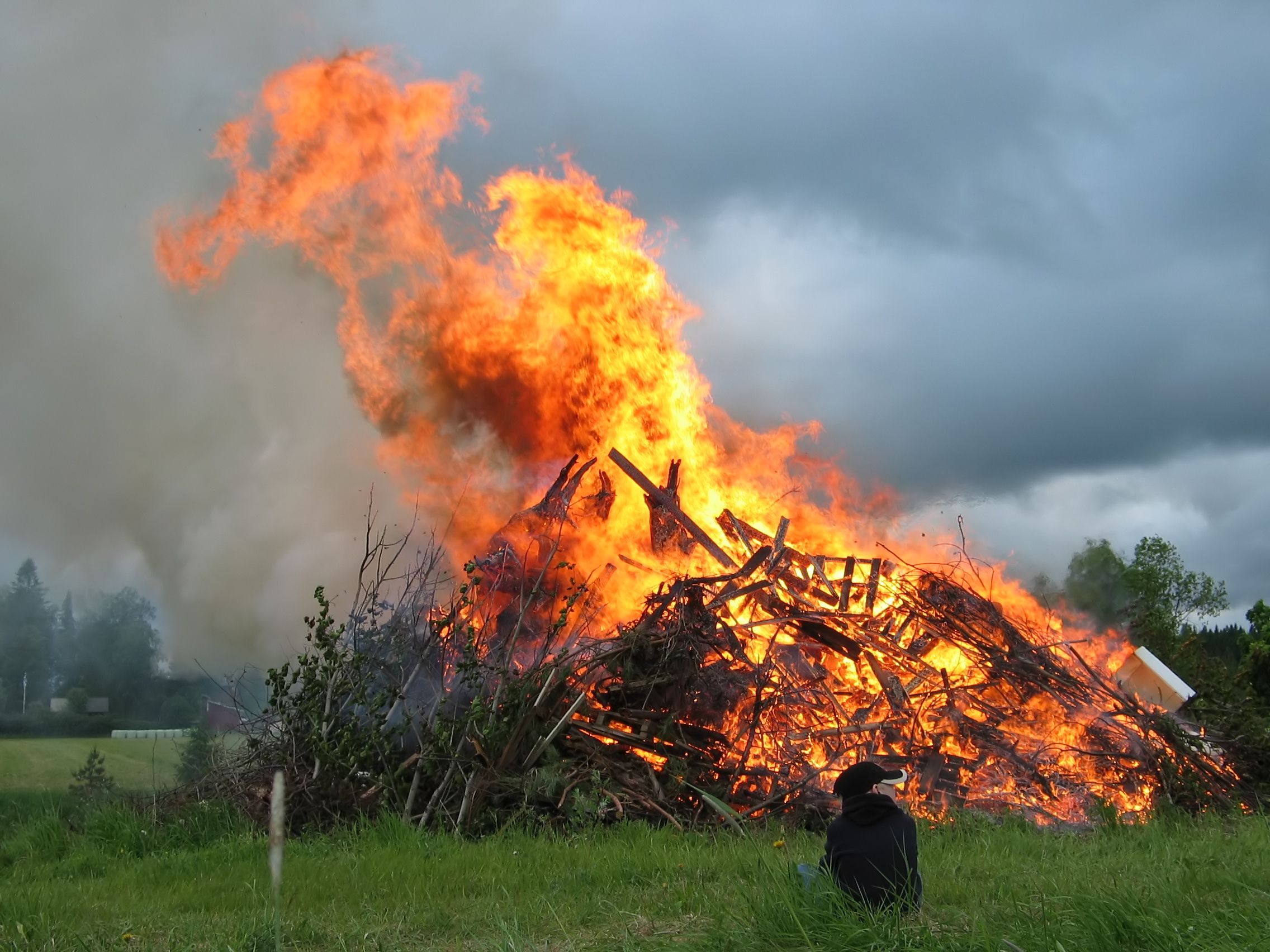
Is wood burning a physical or chemical change?
a)
Physical
b)
Chemical
3.

Is mold growing on cheese a physical or chemical change?
a)
Physical
b)
Chemical
4.

Is making orange juice a physical or chemical change?
a)
Physical
b)
Chemical
5.

Is sharpening a pencil a physical or chemical change?
a)
Physical
b)
Chemical
6.

Is copper tarnishing a physical or chemical change?
a)
Physical
b)
Chemical
7.
Which of the following is a chemical property of water?
a)
Reacts with pure Sodium
b)
Boils at 100 degrees Celsius
c)
Dissolves Sugar
d)
Has a density of 1 g/mL
8.
In a chemical reaction, how do the reactants compare to the products?
a)
They are the same
b)
They are different
9.
Adding baking soda and vinegar together and it fizzes and creates carbon dioxide.
a)
Chemical
b)
Physical
10.

What is evaporation?
a)
physical change
b)
water
c)
chemical change
d)
chemical property
11.
Carbon (C) is a(n):
a)
Element
b)
Mixture
c)
Compound
d)
None of these
12.
Water (H2O) is a(n):
a)
Element
b)
Mixture
c)
Compound
d)
None of these
13.
Dry Ice (CO2) is a(n):
a)
Element
b)
Mixture
c)
Compound
d)
None of these
14.

Gasoline is a(n):
a)
Element
b)
Mixture
c)
Compound
d)
None of these
15.
A pail of garbage is a(n):
a)
Element
b)
Mixture
c)
Compound
d)
None of these
16.

Milk is a(n):
a)
Element
b)
Mixture
c)
Compound
d)
None of these
17.

Popcorn is a(n):
a)
Element
b)
Mixture
c)
Compound
d)
None of these
18.
Ink is a(n):
a)
Element
b)
Mixture
c)
Compound
d)
None of these
19.
An element is a pure substance containing only one kind of: _____
a)
mixture
b)
atom
c)
compound
d)
chemical reaction
20.
An element _______ be separated into simpler materials (except during nuclear reactions).
a)
cannot
b)
can
21.
The atoms in a compound (like bronze) are ______ combined.
a)
chemically
b)
physically
c)
not
d)
hardly
22.
A material's ability to burn in the presence of oxygen:
a)
Flammability
b)
Malleability
c)
Conductivity
d)
Metal
23.
A material's ability to be hammered flat without shattering:
a)
Flammability
b)
Malleability
c)
Conductivity
d)
Metal
24.
A material's ability to allow heat or electricity to flow through:
a)
Flammability
b)
Malleability
c)
Conductivity
d)
Metal
25.
Which is an example of a chemical reaction?
a)
paper cut into small pieces
b)
chocolate melting in a pan
c)
flour and sugar mixed in a bowl
d)
cookies baking in an oven
26.
The melting of wax is an example of a
a)
chemical change
b)
physical change
27.
Digesting your food is an example of
a)
chemical change
b)
physical change
28.
Iron (Fe) is a(n):
a)
Element
b)
Mixture
c)
Compound
d)
Nickname for Ron
29.

Italian Salad Dressing
a)
heterogeneous mixture
b)
homogeneous mixture
30.

A blue berry muffin is a:
a)
heterogeneous mixture
b)
homogeneous mixture
c)
compound
31.

Chicken noodle soup
a)
heterogeneous mixture
b)
homogeneous mixture
32.
Mixtures that are uniform in composition:
a)
mixture
b)
homogeneous mixture
c)
heterogeneous mixture
33.
Copper is a mixture. T or F?
a)
True
b)
False
34.

Gatorade is a __________ mixture
a)
Homogeneous
b)
Heterogeneous
35.

Fog is a:
a)
solution
b)
suspension
c)
colloid
36.
What is a solute?
a)
The substance that does the dissolving in a solution.
b)
The substance that is dissolved into the solution.
c)
The mixing of different substances.
d)
The process in which neutral molecules lose or gain electrons
37.

What is viscosity?
a)
A liquid's resistance to flow.
b)
a liquids flow.
c)
a liquid
d)
gas to solid.
38.

What characteristic property of matter describes the relationship between mass and volume?
a)
ductility
b)
density
c)
reactivity
d)
weight
39.

What is a graduated cylinder used to measure?
a)
volume
b)
mass
c)
weight
d)
length
40.

The ability of 2 or more substances to join together to form brand new substances is a chemical property called ___________.
a)
Electrolysis
b)
Reactivity
c)
Flammability
d)
Density
41.
Convert 1.7 g to kg
a)
0.0017g
b)
17g
c)
170g
d)
0.17g
42.
Convert 0.25 m to mm
a)
25mm
b)
2.5mm
c)
250mm
d)
0.025mm
43.
convert 30 cm to m
a)
300m
b)
3m
c)
0.03m
d)
0.3 m
44.
convert 9 km to mm
a)
900,000mm
b)
9,000,000mm
c)
9,000mm
d)
90,000mm
45.
convert 650 m to km
a)
6.5km
b)
0.65km
c)
65km
d)
0.065km
46.
convert 12 mL to L
a)
0.12L
b)
0.012L
c)
1.2L
d)
0.0012L
47.
Convert 0.036 mL to L
a)
3600 L
b)
3.6L
c)
360L
d)
0.000036L
48.

Find the volume of the figure.
a)
63 cm³
b)
91 cm³
c)
819 cm³
d)
409.5 cm³
49.
What is mass?
a)
the distance between two points
b)
the amount of matter (stuff) in an object
c)
the volume of an object
d)
the distance between three points
50.

Which is constant on both the Earth and the moon?
a)
Mass
b)
Gravity
c)
Weight
d)
Spaghetti texture
51.
What step does every scientific experiment begin with?
a)
hypothesis
b)
question/problem
c)
procedures
d)
conclusion
52.
The summary at the end of an experiment that explains the results.
a)
conclusion
b)
procedures
c)
materials
d)
hypothesis
53.
True or False: Your hypothesis can never be wrong.
a)
True
b)
False
54.
Which is NOT a step in the scientific method?
a)
Make observation
b)
Form a theory
c)
Collect data
d)
Form a hypothesis
55.

If I needed to survive on a desert island with no fresh water or coconuts, what would I do to the salt water to separate the salt and fresh water?
a)
It's hopeless! I wouldn't even try!
b)
Have the freshwater evaporate and condense, leaving the salt behind
c)
Physically separate the salt from the fresh water with my hands
d)
Salt and water form a compound, so it is impossible.
56.
15.6 L = ___________ mL
a)
15,600
b)
156,000
c)
1,560,000
d)
15,600,000
57.
1000 m = ___________ km
a)
100
b)
10
c)
1
d)
0.1
58.
240 cm = ___________ m
a)
2400
b)
24
c)
2.4
d)
0.24
59.
0.57 mL = ___________ L
a)
5.7
b)
0.057
c)
0.0057
d)
0.00057
60.
0.932 g = ___________ mg
a)
9.32
b)
93.2
c)
932
d)
9,320
61.

What is the mass on this triple beam?
a)
40g
b)
1g
c)
401g
d)
41g
62.

What is the volume of the water in this graduated cylinder?
a)
8.8 mL
b)
8.6 mL
c)
9.2 mL
d)
9 mL
63.
Sarah is participating in a walkathon to raise money for local literacy programs. The amount of money Sarah will raise depends on the distance she walks.
m = the amount of money Sarah will raise
d = the distance Sarah walks
Which of the variables is dependent?
m = the amount of money Sarah will raise
d = the distance Sarah walks
Which of the variables is dependent?
a)
m
b)
d
64.
On a graph, which axis shows the dependent variable?
a)
x-axis
b)
y-axis
c)
neither
d)
it changes
65.
When experimenting with the growth of a plant, a scientist uses three (of the same type of) plants, two different fertilizers, equal light, and equal water. What type of variable is the fertilizer?
a)
Dependent
b)
Independent
c)
Control
d)
Compound
66.
What is the dependent variable in this question?
What affect will the shape of the airplane's nose have on the distance it flies?
What affect will the shape of the airplane's nose have on the distance it flies?
a)
hang time
b)
distance
67.
A controlled experiment is one where
a)
you change only one variable.
b)
you change many variables.
68.
The dependent variable is the one
a)
you measure.
b)
you change.
69.
2804 mg = ___________ g
a)
0.2804
b)
2.804
c)
28.04
d)
280.4
70.
15.6 L = ___________ mL
a)
15,600
b)
156,000
c)
1,560,000
d)
15,600,000
71.
56 L = ___________ mL
a)
560
b)
5,600
c)
56,000
d)
560,000
72.

What is the volume?
a)
50.0 mL
b)
53.0 mL
c)
54.0 mL
73.

What is the length of the eraser?
a)
3 cm
b)
2 cm
c)
5 cm
d)
7 cm
74.

What is the volume of liquid in this graduated cylinder?
a)
40.0 mL
b)
40.3 mL
c)
43.0 mL
d)
44.0 mL
75.

At which point should your eyes be when you read a graduated cylinder? (Hint: see the letter next to the eye)
a)
A
b)
B
c)
C
76.

Calculate the volume of the rock
a)
10.0 cm3
b)
16.0 cm3
c)
30.0 cm3
d)
40.0 cm3
77.
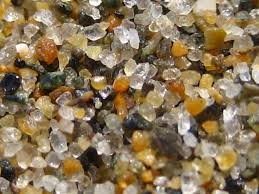
The picture shown here is what type of mixture?
a)
homogeneous
b)
heterogeneous
c)
pure substance
d)
element
78.
A mixture that is uniform and well mixed is _____.
a)
homogeneous
b)
heterogeneous
c)
pure substance
d)
compound
79.

This diagram represents a _____.
Note: The different colors represent different types of atoms.
Note: The different colors represent different types of atoms.
a)
pure substance that is a compound
b)
mixture of elements
c)
pure substance that is an element
d)
mixture of compounds
80.
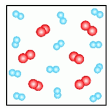
This diagram represents a _____.
Note: The different colors represent different types of atoms.
Note: The different colors represent different types of atoms.
a)
pure substance that is a compound
b)
mixture of elements
c)
pure substance that is an element
d)
mixture of compounds
81.
The building blocks of matter are:
a)
Mixtures
b)
Atoms
c)
Elements
d)
Substances
82.
Water is an element:
a)
true
b)
false
83.
This is made up of one or more of kind of the SAME kind of atom:
a)
Element
b)
Mixture
c)
Compound
d)
Matter
84.
A homogeneous mixture has the same composition of particles throughout.
a)
True
b)
False
85.
What is an example of a mixture?
a)
iron
b)
ice
c)
soil
d)
gold
86.
Wood rotting is a:
a)
Chemical Change
b)
Physical Change
c)
Mixture
87.

Vinegar is a:
a)
Heterogeneous Mixture
b)
Homogeneous Mixture
88.

Air is a:
a)
Heterogeneous Mixture
b)
Homogeneous Mixture
89.

Sugar water is a:
a)
Heterogeneous Mixture
b)
Homogeneous Mixture
90.

Fireworks exploding is a:
a)
physical change
b)
chemical change
91.

Mowing the lawn is a:
a)
physical change
b)
chemical change
92.

Frying an egg is a:
a)
physical change
b)
chemical change
93.

A bicycle rusting is a:
a)
physical change
b)
chemical change
94.

A metal corroding is a:
a)
physical change
b)
chemical change
95.

Separating sand and gravel is a:
a)
physical change
b)
chemical change
96.

Ice cream melting is a:
a)
physical change
b)
chemical change
97.
A clear liquid is poured into an Erlenmeyer flask that contains a second clear liquid. As the two chemicals meet a solid is formed, that is yellow in color? What are the signs that help you to identify the type of change?
a)
Precipitate and change in color, Physical Change.
b)
Color change, Physical Change
c)
There are two liquids, Chemical change.
d)
and made a new substance (precipitant and change in color, Chemical Change.
98.
"Dissolving"
Is this a chemical or physical change?
Is this a chemical or physical change?
a)
Physical change
b)
Chemical change
99.
Which word below is NOT a physical change?
a)
Swallow
b)
Chew
c)
Digestion
d)
Tear
100.
Is milk souring a chemical or physical change?
a)
chemical
b)
physical
100 %

