
 Worksheets
Chemical Reactions and Enzymes
Total questions: 54
Worksheet time: 53mins
Name
Class
Date
1.
Which of the following is an example of a chemical reaction?
a)
A marshmallow turning black when heated over a fire
b)
A powder dissolving in water to make lemonade
c)
An ice cube melting into a puddle of water
d)
Salt crystals being crushed into a powder
2.
What happens when chemical bonds break and new bonds form?
a)
a physical change
b)
a chemical reaction
c)
matter is destroyed
d)
surface area increases
3.
The substances listed on the left side of a chemical equation are the
a)
Products
b)
Coefficients
c)
Precipitates
d)
Reactants
4.
A chemical reaction that absorbs energy in the form of heat is described as
a)
endothermic
b)
exothermic
c)
combustion
d)
unbalanced
5.

Identify the reactant(s) and product(s) of the reaction.
a)
All three are reactants and none are products.
b)
Hydrogen and water are the reactants, and oxygen is the product.
c)
Water and oxygen are the reactants, and hydrogen is the product.
d)
Hydrogen and oxygen are the reactants, and water is the product.
6.
In the reaction methane + oxygen turns into carbon dioxide + water, the methane and oxygen are called _______________.
a)
reactants
b)
products
c)
neutrals
d)
energizers
7.
The reactants are on the left side of the chemical equation.
a)
True
b)
False
8.
2H2 + O2 ----> 2H2O What is the product?
a)
------>
b)
2H2O
c)
2H2+ O2
9.
What is the right part of a chemical equation called?
H2 + O → H2O
H2 + O → H2O
a)
Reactants
b)
Products
c)
Yields
d)
Chemical Equation
10.

What kind of reaction is this?
a)
Endothermic
b)
Exothermic
c)
Cannot be determined
11.

Which letter corresponds to the activation energy of the forward reaction?
a)
A
b)
B
c)
C
d)
D
12.
A(n) _______ is a substance that increases reaction rate by lowering the activation energy of a reaction.
a)
activator
b)
inhibitor
c)
catalyst
d)
polymerase
13.
This speeds up chemical reactions in living cells.
a)
activist
b)
enzyme
c)
diamine
d)
solute
14.
This slows down or even stops a chemical reaction.
a)
de-activator
b)
catalyst
c)
enzyme
d)
inhibitor
15.

This chart shows what type of reaction?
a)
exothermic
b)
combustion
c)
endothermic
d)
mesothermic
16.

This chart shows what type of reaction?
a)
endothermic
b)
mesothermic
c)
exothermic
d)
hotothermic
17.

Which shows the activation energy required for this reaction?
a)
A
b)
B
c)
C
d)
D
18.
Enzymes are considered to be
a)
Lipids
b)
Carbohydrate
c)
Protein
d)
Nucleic Acid
19.
What is the purpose of an enzyme?
a)
give permission for the reaction
b)
raise activation energy
c)
speed up reactions
d)
control how many reactions occur
20.
Enzymes are capable of increasing the rate of a chemical reaction within a living cell. Enzymes accomplish this through which of the following means?
a)
reducing the number of products
b)
reducing the activation energy
c)
increasing the temperature of the cell
d)
increasing the concentration of reactants
21.

What is structure A?
a)
Substrate
b)
Active site
c)
Enzyme
d)
Products
22.

What is structure D?
a)
Substrate
b)
Active site
c)
Enzyme
d)
Products
23.

What is structure C?
a)
Substrate
b)
Active site
c)
Enzyme
d)
Products
24.

What is structure E, F, G?
a)
Substrate
b)
Active site
c)
Enzyme
d)
Products
25.
How do enzymes speed up chemical reaction?
a)
Increasing activation energy
b)
Decreasing activation energy
c)
Increasing deactivation energy
d)
Decreasing deactivation energy
26.
What is a substance called if it speeds up a chemical reaction?
a)
reusable
b)
catalyst
c)
specific
d)
fragile
27.
Each enzyme only has 1 substrate that will fit its active site. What is this called?
a)
reusable
b)
catalyst
c)
specific
d)
fragile
28.
Once a new product leaves an enzyme, the enzyme is unchanged and ready for the next substrate. What is this called?
a)
reusable
b)
catalyst
c)
specific
d)
fragile
29.

Which of the following conclusions can be drawn from this graph?
a)
The optimum pH of the enzyme is 6.6.
b)
The optimum pH of the enzyme is 5.8
c)
The enzyme’s activity increases as pH increases 5.0 to 9.0
d)
The enzyme’s activity is greater around pH of 8.0 .
30.
Which chemical is classified as an enzyme?
a)
Galactose
b)
Lipid
c)
Protease
d)
Manganese dioxide
31.
Any substance that is acted upon by an enzyme is called a(n)?
a)
Coenzyme
b)
Substrate
c)
Vitamin
d)
Polypeptide
32.
The "lock and key hypothesis" attempts to explain the mechanism of?
a)
Vacuole formation
b)
Pinocytosis
c)
Sharing of electrons
d)
Enzyme specificity
33.
Where do substrates bind on an enzyme?
a)
voltage-gated channels
b)
surface receptor
c)
calcium channels
d)
active site
34.
Enzymes need certain environmental conditions in order to function properly. What happens when enzymes are heated to a high temperature?
a)
they die
b)
they denature
c)
they change their amino acid sequence
d)
they work better
35.
The part of the enzyme that the substrate bonds to is called the _____.
a)
active site
b)
activation energy
c)
bond site
d)
peptide bond
36.
Which of these do NOT affect enzyme activity?
a)
Temperature
b)
pH
c)
Competitive Inhibitors
d)
Carbohydrates
37.
Which of these is NOT true.
a)
Enzymes can denature (change shape) when the temperature gets too high.
b)
Enzymes can only be used once in a chemical reaction.
c)
Enzymes can denature when the pH changes.
d)
Enzymes speed up chemical reactions.
38.
Which of these is most likely an enzyme? (Based on the suffix)
a)
Sucrose
b)
Galactose
c)
Fructose
d)
Amylase
39.
What is another name for enzymes?
a)
chemical catalyst
b)
microorganism
c)
biological catalyst
d)
catalyst
40.

Based on the graph, what temperature does this enzyme work best?
a)
15 C
b)
40 C
c)
30 C
41.

Letter E...
a)
active site
b)
enzyme
c)
substrate
d)
products
42.
Enzymes are composed of which of the following monomers?
a)
amino acids
b)
carbohydrates
c)
nucleotides
d)
monosaccharides
43.

The graph shows how enzymes affect reactions in cells. Which statement best summarizes the information shown in the graph?
a)
Enzymes increase the energy of the reactants.
b)
Enzymes decrease the energy level of the products.
c)
Enzyme decrease the activation energy of the reaction.
d)
Enzymes reverse the direction of the reaction.
44.

Where do substrates bind on an enzyme?
a)
voltage-gated channels
b)
surface receptor
c)
calcium channels
d)
active site
45.
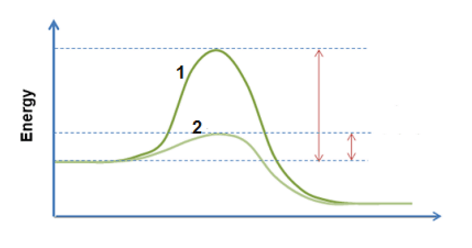
Which line represents an enzyme-catalyzed reaction?
a)
Line 1
b)
Line 2
46.
The "lock and key hypothesis" attempts to explain the mechanism of?
a)
Vacuole formation
b)
Pinocytosis
c)
Sharing of electrons
d)
Enzyme specificity
47.

The diagram shows the series of a reactions that convert lactose into a usable form .
If enzyme 4 is denatured (stops working), the levels of which substance will increase?
If enzyme 4 is denatured (stops working), the levels of which substance will increase?
a)
Lactose
b)
Galactose
c)
Glucose-1-Phosphate
48.

The portion labeled "C" represents the
a)
reaction with enzyme
b)
reaction without enzyme
c)
reactants
d)
products
49.
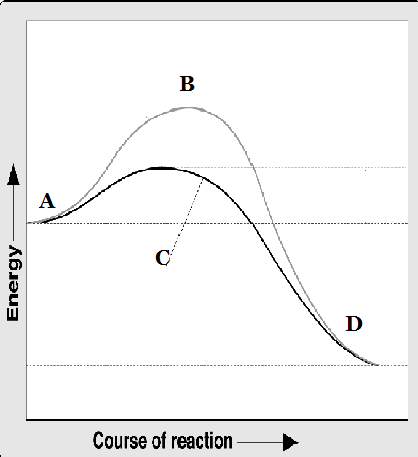
The portion labeled "B" represents the
a)
reaction with enzyme
b)
reaction without enzyme
c)
reactants
d)
products
50.
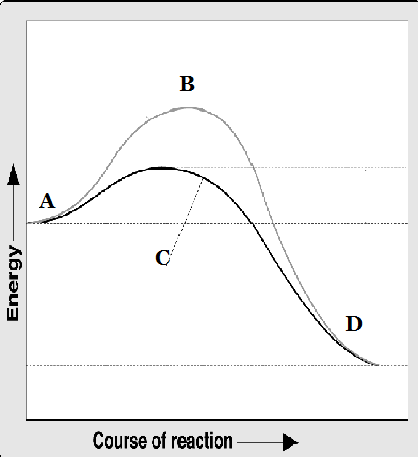
The portion labeled "D" represents the
a)
reaction with enzyme
b)
reaction without enzyme
c)
reactants
d)
products
51.
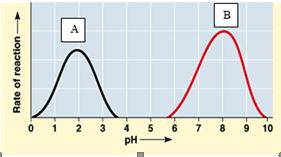
What is the optimal pH of enzyme A?
a)
8
b)
2
c)
5.7-10
d)
10
52.
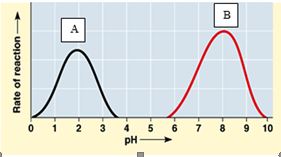
What is the pH range of enzyme A?
a)
2
b)
0-3.7
c)
3.7
d)
0
53.
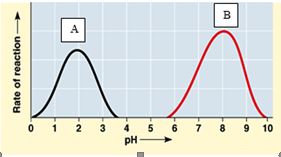
Which enzyme is most efficient in a basic solution?
a)
A
b)
B
54.

What is indicated by letter A?
a)
enzyme
b)
product
c)
substrate
d)
active site
100 %

