
 Worksheets
HST 111 - Midterm
Total questions: 130
Worksheet time: 3hrs 33mins
Name
Class
Date
1.
A giant landmass that existed 200 million years ago
a)
Wegener
b)
Pangaea
c)
Archyopteryx
d)
Ammonite
2.
The Theory of Continental Drift states that Pangaea broke apart and the continents "drifted" away from each other
a)
True
b)
False
3.
Which piece of evidence did Wegener use to prove continental drift?
a)
The shape of the continents
b)
Similar fossils found on separate continents
c)
Tree fossils found in odd places
d)
All of the above
4.

What is this a picture of?
a)
plate tectonics
b)
continental drift
c)
pangea
d)
glacier scaring
5.
What does the theory of continental drift state?
a)
The continents were once joined in a super-continent and have moved over time
b)
Continents are stationary and do not move
c)
The Earth is broken into lithospheric plates that move due to convection currents
d)
none of the above
6.
Why did no one believe Wegener's thoery?
a)
He could not explain HOW the continents moved
b)
He didn't have evidence
c)
His data was wrong
d)
He didn't use the right technology to gather data
7.

_______ is the type of plate boundary where subduction zones are found.
a)
Convergent
b)
Divergent
c)
Transform
d)
mountain ranges
8.
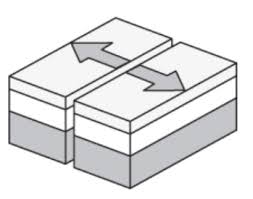
Name the boundary
a)
convergent boundary
b)
divergent boundary
c)
transform boundary
d)
sergent boundary
9.

Who is the person credited with developing the theory of continental drift?
a)
Harry Hess
b)
Galileo
c)
Alfred Wegener
d)
Newton
10.

The area where one plate goes under another is called
a)
Subduction zone
b)
Boundary
c)
Transform
d)
mid- ocean ridge
11.

When the seafloor is spreading what feature is located at the middle
a)
Subduction Zone
b)
Mid- Ocean Ridge
c)
Pangea
d)
Geology
12.

_____ is a type of plate boundary where two plate slide past each other
a)
divergent
b)
transform
c)
convergent
d)
crust
13.

This is a type of plate boundary where mountains are built
a)
Transform
b)
Divergent
c)
Convergent
d)
Pangea
14.
_________ are people who do not live in one place.
a)
Clovis point
b)
Ice Age
c)
Nomads
d)
Archaeologists
15.

Sec 2 pp.16-19
The __________ started a kingdon in southern Peru
The __________ started a kingdon in southern Peru
a)
Mayans
b)
Olmecs
c)
Incas
16.

Sec 2 pp.16-19
A major city of the __________ was Tenochtitlan
A major city of the __________ was Tenochtitlan
a)
Olmecs
b)
Toltecs
c)
Aztecs
17.
How do most scientists believe the first humans arrived in America?
a)
Large canoes from Asia
b)
A land-bridge between Siberia and Alaska
c)
Swimming from Africa
d)
There have always been humans in America
18.
Why did the first people cross into North America?
a)
They were hunters following their food source
b)
They were in search of new crops to plant
c)
They were running away from attacking animals
d)
They were running away from attacking tribes
19.
What did farming enable Native Americans to do?
a)
Hunt larger animals
b)
Travel from Asia to the Americas
c)
Wander in search of food
d)
Settle into communities and trade with others
20.
someone who studies remains and artifacts to learn about the past is called a(n)
a)
cartographer
b)
archeologist
c)
climatologist
d)
teacher
21.
the theory that humans walked or used boats to travel down the Pacific Coast is called the
a)
Land Bridge Theory
b)
Beringia
c)
Coastal Migration Theory
22.
From what continent did the first humans travel to North America?
a)
Africa
b)
Asia
c)
Europe
d)
Australia
23.
The time before Europeans and Columbus is called
a)
Prehistoric
b)
Pre-Columbian
c)
A.D.
d)
B.C.
24.
the Anasazi built homes of
a)
wood
b)
ice/snow
c)
stone and mud
d)
grass
25.
What caused Native American tribes to live differently from one another?
a)
climate/region
b)
names
c)
religion
d)
their language
26.
the Inuit using polar bear skin for clothing and the Iroquois using wood for their homes are examples of
a)
adaptations
b)
climate
c)
natural resources
d)
Beringia
27.
What crop was important to most Native american groups?
a)
potatoes
b)
deer
c)
corm/maize
d)
grass
28.
Artifacts are -
a)
Manufactured items
b)
Man-made items
c)
Items that paleontologists work with
d)
Another name for carbon-dating
29.
Archaeologists learn about prehistoric people by studying all of the following except
a)
Fossils
b)
Pottery
c)
tools and weapons
d)
written record
30.
What does prehistory mean?
a)
Before man
b)
Before writing
c)
Before farming
d)
Before language
31.
The first people to arrive in North America got here by:
a)
Walking across a land bridge from Central America
b)
Ship when trying to find a short cut to India
c)
Walking across a frozen land bridge called Beringia
d)
Sailing on the Mayflower
32.
The movement that criticized church practices and ultimately led to a split in religion throughout Europe was called the:
a)
Renaissance
b)
Treaty of Tordesillas
c)
Columbian Exchange
d)
Reformation
33.
What conquistador was able to defeat the Aztec empire?
a)
Pizarro
b)
Calvert
c)
Cortes
d)
Smith
34.
Who were many of the first workers that helped grow tobacco around Jamestown?
a)
African Slaves
b)
Indentured Servants
c)
Quakers
d)
Puritans
35.
What group of people believed in things such as allowing anybody to preach, pacifism, and paying Native American people for land?
a)
Dutch
b)
Quakers
c)
Protestants
d)
Mercantilists
36.
The voyage that brought African Americans to the West Indies and to North America via ship was called the:
a)
Middle Passage
b)
Slave Trade
c)
Long Journey
d)
Atlantic Mission
37.
What country benefitted from the Navigation Acts?
a)
Portugal
b)
Netherlands
c)
Spain
d)
England
38.
The movement that emphasized the use of reason and scientific method as a way to gain knowledge was called:
a)
domino theory
b)
Renaissance
c)
Enlightenment
d)
Reformation
39.
The primary religion of West Africans was what?
a)
Christianity
b)
Judaism
c)
Hinduism
d)
Islam
40.
The majority of Africans who would be sent to America as slaves came from what part of Africa?
a)
North
b)
East
c)
West
d)
South
41.
Dissatisfaction with corruption in the Catholic Church led to what event?
a)
Reformation
b)
Renaissance
c)
Great Awakening
d)
Great Revival
42.
What does it mean for something to be "secular"?
a)
Not Religious
b)
Divisive
c)
Overpowering
d)
Grand
43.
A large Native American city located near present-day St. Louis is called what?
a)
Hopewell
b)
Anasazi
c)
Pueblo
d)
Cahokia
44.
True or False: Most Native Americans practiced the same religion.
a)
TRUE
b)
FALSE
45.
The belief that all things have spirits and those spirits interact with the physical world.
a)
Christianity
b)
Buddhism
c)
Animism
d)
Islam
46.
Native American societies where men hunted while women gather fruit and care for families.
a)
Nomad
b)
Farming
c)
Feudal
d)
Hunter-Gatherer
47.
Which native group inhabited the South West of North America before the Pueblos?
a)
The Inupiaq
b)
The Anasazi
c)
The Navajo
48.
Pueblo buildings are made from what material?
a)
Adobe bricks
b)
Balsa wood & hot glue
c)
Cloth & poles
49.
The Pueblo people were eventually conquered by the:
a)
English
b)
Navajo
c)
Spanish
50.
Who was the first European to see the Pacific Ocean?
a)
Vasco Nunez de Balboa
b)
Hernando De Soto
c)
Christopher Columbus
d)
Vasco de Gamma
51.
An Italian explorer who sailed for Spain and landed in the Caribbean islands when looking for a route to Asia.
a)
Vasco Nunez de Balboa
b)
Hernando Desoto
c)
Christopher Columbus
d)
Vasco De Gamma
52.
Who was a famous Viking explorer we covered?
a)
Vasco De Nunez Balboa
b)
Hernando Desoto
c)
Leif Erickson
d)
Vasco De Gamma
53.
A Portuguese explorer who found an Atlantic-Pacific passage.
a)
Vasco De Nunez Balboa
b)
Hernando Desoto
c)
Christopher Columbus
d)
Ferdinand Magellan
54.
Who was a conquistador who sailed to Mexico with many soldiers?
a)
Hernando Cortes
b)
Hernando Desoto
c)
Amerigo Vespucci
d)
Ferdinand Magellan
55.
Fransisco Pizzaro is known for what?
a)
Defeating the Incas in modern day Peru
b)
Defeating the Aztecs in modern day Peru
c)
Defeating the Aztecs in modern day Portugal
d)
Portuguese waffle making
56.
What does the three (3) G's stand for?
a)
God, Glory, Gold
b)
Gold, God, Gavel
c)
Glory, Geld, Gold
d)
Gild, Gold, Glory
57.
Cortes conquerors what area and people?
a)
Mexico: Maya
b)
Mexico: Aztec
c)
Peru:Inca
d)
Yucatan:Maya
58.
Pizarro conquers which area and people?
a)
Mexico:Aztec
b)
Yucatan:Maya
c)
Mexico:Maya
d)
Peru:Inca
59.
What was the Spanish' motivation for exploration?
a)
Mineral Wealth
b)
Northwestern Passage
c)
Spread Christianity
d)
All of these
60.
France's motivation for exploration was:
a)
Spread Christianity
b)
Find a route to India
c)
National Pride
National Pride
National Pride
d)
All of these
61.
What was the English's motivation for exploration:
a)
Land
b)
Rum
c)
Sugar
d)
None of these
62.
Which of the following explorers sailed for Portugal?
a)
de Gama
b)
Columbus
c)
Drake
d)
Zheng He
63.
Which explorer is NOT correctly matched with his country?
a)
France:Cartier
b)
Spain:Columbus
c)
England:Drake
d)
Portugal:Pizzaro
64.
Magellan is best known for :
a)
Circumnavigation of the World
b)
Discovering Cuba
c)
Conversion to Christianity
d)
Establishing trading outpost in India
65.
A sponsor of exploration, known as 'the Navigator', he encouraged exploration of new trade routes:
a)
Bartolomeu Dias
b)
Prince Henry
c)
Ferdinand Magellan
d)
John Cabot
66.
Who was the first explorer to sail from Europe to India by going around the Southern tip of Africa?
a)
Francisco Pizarro
b)
Vasco de Gama
c)
Vespucci
d)
Cabral
67.
In what year was Jamestown settled?
a)
1492
b)
1607
c)
1585
d)
1625
68.
Who said, "If you don't work, then you don't eat!"?
a)
Chief Powhatan
b)
Pocahontas
c)
Lord Baltimore
d)
Captain John Smith
69.
The most profitable agricultural product in the Virginia colony was
a)
lumber
b)
peanuts
c)
corn
d)
tobacco
70.
What became Jamestown's "gold"?
a)
wild game animals for hunters
b)
tobacco
c)
saltwater
d)
tomatoes
71.
Why did the settlers select the name "Jamestown"?
a)
To honor their King James
b)
To honor a baby born on the ship
c)
To honor Saint James
d)
To honor the ship's captain
72.
Why did many of the men at Jamestown not want to work?
a)
They didn't know how.
b)
They forced the women to work.
c)
They wanted to hire American Indians to do the work.
d)
They were rich and used to having servants do all of their work in England.
73.
How did John Rolfe help Jamestown generate income for the Virginia Company?
a)
He introduced high-quality tobacco crops in the colonies
b)
He traded heavily with the natives
c)
He sold slaves for high profits
d)
Marrying Pocahontas
74.

What happened the winter after John Smith left Jamestown?
a)
Most colonists froze to death
b)
There was a Christmas feast with natives
c)
The Starving Time
d)
Chief Powhatan was mysteriously killed
75.

What tribe is Pocahontas from?
a)
Chippawa
b)
Chesapeake
c)
Powhatan
d)
Delaware
76.
England wanted to establish a ________ in order to gain wealth and power.
a)
colony
b)
country
c)
town
d)
tribe
77.
What did the settlers eat during the starving time of 1609?
a)
dogs and cats
b)
horses and snakes
c)
human corpses
d)
all of the above
78.
What were some of the reasons England wanted to start colonies in North America?
a)
to gain wealth
b)
to stop slavery
c)
to gain indentured servants
d)
to gain independence
79.
How did John Smith contribute to the survival of the Jamestown Settlement?
a)
He worked alongside settlers.
b)
He raised enough money to send to the Virginia Company.
c)
He made sure all colonists worked for their food, shelter and safety.
d)
He made sure the colony's governors followed the law.
80.
Why were Africans brought to Jamestown in 1619?
a)
To work on Sugar Plantations
b)
To seek Religious freedom
c)
To work on tobacco plantations
d)
To fight against American Indians
81.
Jamestown was located on a peninsula in ...
a)
Virginia
b)
North Carolina
c)
Florida
d)
New York
82.
What was the name of the system of incentive that offered 50 acres of land to anyone who brought an indentured servant to the new world?
a)
Bacon's Rebellion
b)
Headright System
c)
Middle Passage
d)
House of Burgesses
83.
The House of Burgesses in Virginia Colony represents which of the following?
a)
colonial rebellion against Great Britain
b)
royal rule over the North American colonies
c)
royal indifference towards the colonies
d)
colonial self-government in North America
84.
This was an agreement made by the Pilgrims on the way to the New World that established SELF-GOVERNMENT...
a)
The Constitution
b)
The Declaration of Independence
c)
Mayflower Compact
d)
Articles of Confederation
85.
Who were the two groups of Christians that left England?
a)
Catholics and Puritans
b)
Romans and Puritans
c)
Pilgrims and Slaves
d)
Puritans and Pilgrims
86.
Quakers spoke which language?
a)
German
b)
French
c)
Belgian
d)
Italian
87.

Both Pilgrims and Puritans left England because they wanted...
a)
Religious Freedom
b)
Gold
c)
Money
d)
Indentured Servants
88.
What was the name of the colony that the Quakers lived on?
a)
Virginia
b)
Georgia
c)
Pennsylvania
d)
New York
89.
The Quakers did not believe in this, but everyone thought it wasn't a problem.
a)
Slavery
b)
Banks
c)
Religion
d)
Sports
90.
What DID the Quakers practice?
a)
Catholicism
b)
Boxing
c)
Slavery
d)
Tolerance
91.
Who were known as PACIFISTS?
a)
Pilgrims
b)
Quakers
c)
Puritans
d)
The Dutch
92.
Which were the two majors cities of the Massachusetts Bay Colony?
a)
Salem & Boston
b)
Jamestown and Williamsburg
c)
Philadelphia & New Amsterdam
d)
Plymouth & Rhode Island
93.
The Quakers, Puritans, and Pilgrims all had this in common.
a)
Believed in Slavery
b)
Spoke German
c)
Had strict rules in society
d)
Were Christians
94.
This historic person was banished from their colony and sent to New York for their Feminist beliefs and speaking out against the Puritan society.
a)
George Fox
b)
Anne Hutchinson
c)
William Penn
d)
Roger Williams
95.
This person was also banished from Puritan society for their beliefs, and later founded Rhode Island.
a)
Roger Williams
b)
William Penn
c)
John Locke
d)
William of Orange
96.

Document giving permission to start a colony (once land has been claimed, then people asked for these).
a)
Decree
b)
Charter
c)
Contract
d)
Declaration
97.

What was Roanoke also know as?
a)
Jamestown
b)
"Little 1"
c)
Lost Colony
d)
The City that never sleeps
98.

Why was Roanoke called the "Lost Colony?"
a)
b/c colonists couldn't find their way to the new world
b)
b/c colonists couldn't find their way to the island of Croatoan
c)
b/c colonists almost starved and got lost on their way back to England.
d)
b/c colonists were never heard from again
99.

Large amount of diseases and high death rate, land swampy – lots of diseased mosquitoes, no one wanted to work – too busy wanting to make money, didn’t focus on what needs to be done for survival
Which settlement did this describe?
Which settlement did this describe?
a)
Jamestown
b)
Massachusetts Bay
c)
Plymouth
d)
Roanoke
100.

Introduced tobacco to be grown in Virginia and exported to England (finally making some money – which is the purpose of a colony to most people)
Who helped Jamestown thrive economically?
Who helped Jamestown thrive economically?
a)
Capt. John Smith
b)
John Rolfe
c)
Pocahontas
d)
John Winthrop
101.

Why did the Puritans go to the new world?
a)
To practice their religion freely.
b)
To escape religious persecution from the King of the Netherlands.
c)
To convert Native American to their religion.
d)
To get some of the vast amounts of land in the new world.
102.

What was the significance of Mayflower Compact?
a)
It was the first representative government in the colony.
b)
It promoted self-government in the colony.
c)
It promoted freedom of religion in the colonies.
d)
It gave the Pilgrims the authority to settle on the Kings land.
103.

Why did the Puritans rely so heavily on the bible?
a)
The Puritan religion dictated that it was the law that you must live your life by the bible.
b)
The stories of the bible taught them life lessons, and with these lessons, life would be easier.
c)
They felt that people would be educated through the Bible and educated people can create their own government.
d)
Their bible had been passed down for generation to generation.
104.

Why did the Pilgrims go to the Netherlands?
a)
They wanted to establish the first English colony in the new world.
b)
They wanted to befriend and trade with the Indians
c)
They were trying to convert others to their religion
d)
They were being persecuted by King James I, for not following the Church of England
105.
King Charles I gave ____ permission to start a new Maryland colony, but he died before he could get the colony started.
a)
Leonard Calvert
b)
Leon Uris
c)
George Calvert
d)
Frederick Douglass
106.
Cecil Calvert named Maryland after the king's wife ___.
a)
Mary, mother of Jesus
b)
Marie Calvert
c)
His niece, Mary
d)
Henrietta Maria
107.
Maryland was founded by _________________.
a)
Lord Baltimore
b)
Lord Chesapeake
c)
Lord Annapolis
d)
Ms. Vallee
108.
In its earliest days, Maryland was refuge colony for what group of people?
a)
Catholics
b)
Jews
c)
Protestants
d)
Slaves
109.
What state borders Maryland to the North?
a)
New Jersey
b)
Pennsylvania
c)
West Virginia
d)
Virginia
110.
This northern Maryland border is commonly thought of as the division between the North and South.
a)
Majinot Line
b)
Order-Niesse Line
c)
Mason-Dixon Line
d)
Durand Line
111.
Who led the Parliament during the English Civil War?
a)
Oliver Cromwell
b)
King Charles
c)
Royalists
d)
John Locke
112.

What term means absolute or complete rule by a king or queen in European history?
a)
Mandate of Heaven
b)
Divine Right
c)
Theocracy
d)
Social Darwinism
113.
Supporters of Parliament during the English Civil War were called the
a)
Royalists
b)
Cavaliers
c)
Parliamentarians
d)
Tories
114.
The ruler who was beheaded at the end of the English Civil War was
a)
Charles I
b)
Elizabeth I
c)
Oliver Cromwell
d)
William of Orange
115.
Which of the following were NOT at the head (ruler) of England?
a)
Oliver Cromwell
b)
John Locke
c)
Richard Cromwell
d)
Charles II
116.
__________________________________, the leader of Parliament during the English Civil War, would abolish the monarchy and declare himself Lord Protector of England.
a)
Robert Walpole
b)
William Wallace
c)
Oliver Cromwell
d)
Sir Thomas More
117.
After years of Puritan rule, the English people would welcome Charles II, the Merry Monarch, back to England during a period known as the
a)
Insurrection
b)
Restoration
c)
Reformation
d)
Renaissance
118.
The supporters of the King during the English Civil War were
a)
roundheads
b)
cavaliers
c)
royalists
d)
both b and c
119.
Which quotation did an absolute monarch most likely make?
a)
“The government that governs best governs least.”
b)
“I am the state.”
c)
“The government must be based on a sound constitution.”
d)
“It is the parliament that must make the laws.”
120.
In England, the group that makes the laws and is made up of elected officials.
a)
Roundheads
b)
Commonwealth
c)
Cavaliers
d)
Parliament
121.
Ruled by divine right. Ignores the Petition of Rights and eventually leads to the English Civil War. Executed in 1647.
a)
James I
b)
Charles I
c)
Oliver Cromwell
d)
Thomas Jefferson
122.
This economic system focused on the good of the mother country. Colonies were meant to support and strengthen the mother country
a)
Capitalism
b)
Monarchism
c)
Socialism
d)
Mercantilism
123.
Which choice would be appropriate for the statements below?
*Salutary Neglect
*Taxation without Representation
*Mercantilism
*Salutary Neglect
*Taxation without Representation
*Mercantilism
a)
reasons colonists sought an alliance with France
b)
taxes imposed on the colonists
c)
causes for the American Revolution
d)
political influences for the American Revolution
124.
What is Salutary Neglect?
a)
When the British Empire sometimes enforces the Navigation acts and other laws
b)
When the English decided that they would not enforce the Navigation acts unless they found cases of smuggling
c)
The Colonists not following the laws
d)
When the English Empire decided not to enforce the Navigation Acts despite being aware of the smuggling
125.
Instituted due to King James II's frustration with Puritan dominance in New England. Took away local self-government.
a)
Navigation Act
b)
Salutary Neglect
c)
Dominion of New England
d)
Mayflower Compact
126.
Required colonial products to be shipped through England or on English ships.
a)
Salutary Neglect
b)
Peter Zenger's Trial
c)
Navigation Acts
d)
Mayflower Compact
127.
Tyranny refers to
a)
a government that shares power with lower levels of gov't
b)
a strong central government
c)
a government controlled by the citizens
d)
a government that abuses its power
128.
A series of laws that restricted the use of foreign ships to trade between Britain and its colonies
a)
Boycott
b)
Triangular Trade
c)
Parliament
d)
Navigation Acts
129.
Trade laws regulating economic activities in the English colonies.
a)
Navigation Acts
b)
Declaratory Acts
130.
A British policy in the early 1700s that allowed the colonies virtually self-rule as long as Great Britain profited economically
a)
Enlightenment
b)
Salutary Neglect
c)
Proclamation of 1763
d)
Navigation Acts
100 %

