
Font size
S
M
L
XL
 Worksheets
Chapter 22 and 23 Plants
Total questions: 160
Worksheet time: 1hrs 23mins
Name
Class
Date
1.
Which plant tissue results in growth at the tips of roots and stems?
a)
apical meristem
b)
intercalary meristem
c)
cork cambium
d)
vascular cambium
2.
The plant tissue that transports water and dissolved nutrients is called
a)
Vascular Tissue
b)
Spongy Tissue
c)
Nervous Tissue
d)
Muscle Tissue
3.

This is a _____ plant.
a)
gymnosperm
b)
vascular
c)
nonvascular
d)
not enough information to tell
4.

This is a ____ plant.
a)
gymnosperm
b)
angiosperm
c)
vascular
d)
nonvascular
5.
Seedless plants reproduce with ___.
a)
spores
b)
seeds
c)
binary fission
d)
flowers
6.
What attracts insects for pollination?
a)
anther
b)
ovary
c)
stigma
d)
petals
7.
Which of the following are characteristics of nonvascular plants?
a)
tall with xylem tubes
b)
many leaves
c)
no roots, stems, or leaves
d)
conifers
8.
The development of flowers did not affect the reproductive efficiency of land plants.
a)
True
b)
False
9.
Phloem transports water and mineral nutrients.
a)
True
b)
False
10.
The waxy protective covering of a land plant is called a
a)
cuticle.
b)
capsule.
c)
rhizome.
d)
stoma.
11.
The xylem in a plant
a)
transports food from the leaves.
b)
transports water and minerals.
c)
exchanges carbon dioxide with the atmosphere.
d)
All of the above
12.
In plants, haploid gametes are produced as a result of
a)
fertilization.
b)
meiosis
c)
encapsulation
d)
mitosis
13.

The internal transport of water and minerals in plants requires the two systems to work together. Which diagram correctly describes how the two systems accomplish this?
a)
F
b)
G
c)
H
d)
J
14.

Which structure regulates gas exchange during the processes of photosynthesis and respiration?
a)
R
b)
Q
c)
S
d)
T
15.
Where in a plant does photosynthesis take place?
a)
Roots
b)
Stems
c)
Leaves
d)
Flowers
16.
Cells around the stomata that react to stimulus are?
a)
Parenchyma cells
b)
Sclerenchyma cells
c)
Cheek cells
d)
Guard cells
17.
Which tissue transports dissolved sugars around the plant?
a)
Xylem
b)
Mesophyll
c)
Phloem
d)
Epidermis
18.
Which tissue transports water and minerals around the plant?
a)
Xylem
b)
Phloem
c)
Epidermis
d)
Mesophyll
19.

Which of the following best describes the interaction that occurs between a plant’s reproductive parts during self-fertilization?
a)
Pollen is released from the anther and is transferred to the stigma. A pollen tube forms and grows through the style. The pollen tube reaches the filament, where the sperm fertilizes the egg.
b)
Pollen moves from the ovule up through the style and is released from the stigma. The pollen is transferred to the anther, where the sperm fertilizes the egg.
c)
Pollen is released from the anther and is transferred to the stigma. A pollen tube forms and grows through the style. The pollen tube reaches an ovule within the ovary, where the sperm fertilizes the egg.
d)
Pollen is released from the stigma and is transferred to the anther. A pollen tube grows down from the anther through the filament and fuses with the ovule, where the sperm fertilizes the egg.
20.
Which of the following characteristics could help short plants survive in areas with limited sunlight?
a)
Broad leaf surfaces
b)
Brightly colored flowers
c)
Thick stems
d)
Shallow roots
21.
Some mesquite trees have deeper roots than any other plant in the desert. How are deep roots an adaptation for survival in the desert?
a)
Deep roots can protect the tree from predators.
b)
Roots encounter cooler conditions far below the desert surface.
c)
Roots can extend great distances to reach water.
d)
Deep roots interact with beneficial bacteria below the surface.
22.
Cacti grow slowly compared to most other plants. The fact that cacti keep their stomata closed for much of the day can help explain this growth characteristic. Which of these best explains the advantage of keeping stomata closed during the day?
a)
It limits water loss through transpiration.
b)
It conserves oxygen produced in photosynthesis.
c)
It recycles carbon dioxide within plant systems.
d)
It protects plant tissues from predators.
23.
Plant leaves have a waxy covering called a cuticle. When some plants are stressed by lack of water, their cuticle increases in thickness. What does this action demonstrate?
a)
Alternation of generations in plants
b)
Structural response to the environment
c)
Differentiation of vascular tissue in plants
d)
Genetic mutation induced by the Environment
24.
What is the structure on top of a leaf that protects a leaf from drying out?
a)
Stomata
b)
Cuticle
c)
Stem
d)
Casparian Strip
25.
Xylem allows plants to?
a)
Dance
b)
Grow
c)
Transport water and minerals up
d)
Transport water and minerals down
26.
Phloem allows plants to?
a)
Transport water and minerals up
b)
Dance
c)
Grow
d)
Transport water and food nutrients down
27.
What is the main difference between a nonvascular and a vascular plant?
a)
Vascular transports
Non Vascular lacks transport system
Non Vascular lacks transport system
b)
Vascular plants are smaller than non Vascular Plants
c)
Vascular lacks transport system
Non Vascular transports
Non Vascular transports
d)
Vascular has veins
Non Vascular has arteries
Non Vascular has arteries
28.
Name 2 seed producing plants.
a)
Angiosperms Nonvascular
b)
Gymnosperms Self pollinating
c)
External pollinating Gymnosperms
d)
Angiosperms Gymnosperms
29.
Name the 3 female reproductive structures in a flowering plant?
a)
Stigma, style, and ovary
b)
Anther, filament, and ovary
c)
Anther, style, and ovary
d)
Stigma, filament, and style
30.
What are the male and female gametes?
a)
Pollen Ovary
b)
Sperm Egg
c)
Stamen Pistil
d)
Pollen and Ovule
31.
What is the function of a root?
a)
Photosynthesis
b)
Reproduction
c)
Anchor and absorption of water
d)
Holds leaves and branches
32.
What is a function of a stomata?
a)
Let oxygen and carbon dioxide enter and exit
b)
Conduct photosynthesis
c)
Help the leaves grow
d)
Produce sugar
33.
Cells around the stomata that react to stimulus are?
a)
Parenchyma cells
b)
Sclerenchyma cells
c)
Cheek cells
d)
Guard cells
34.

The diagram below represents root epidermal cells. The major function of the structures labeled X is to
a)
Increase the surface area for absorption of water
b)
Absorb complex food particles for transport to the leaves
c)
Transport carbon dioxide from the roots to the leaves
d)
Move food particles into the phloem
35.
The underside of a leaf contains tiny pores called stomata. These pores lie next to specialized guard cells. The structure of the specialized guard cells and the stomata do not help the plant to….
a)
release water during transpiration
b)
capture pollen for sexual reproduction
c)
absorb carbon dioxide for photosynthesis
d)
enable the flow of nutrients from roots to the rest of the plant
36.
A buttercup produced a small, dry fruit. The buttercup did not get enough water and died. Its fruit fell on the ground and began to rot. A clump of Bermuda grass used its root system to absorb nutrients from the buttercup fruit. Which of the Bermuda grass’s systems then sent the nutrients from the buttercup fruit to its leaves?
a)
The integumentary system
b)
The excretory system
c)
The vascular system
d)
The reproductive system
37.
What type of plants do not have true roots, stems, or leaves and transport water cell to cell?
a)
vascular
b)
nonvascular
38.
If a plant has flowers with large, colorful petals, how would it disperse pollen to reproduce?
a)
The petals would push the pollen out of the flower.
b)
Animals would disperse the pollen because the petals are large.
c)
The wind would probably blow the pollen because the petals are large.
d)
Animals would disperse the pollen because the colorful petals attract insects and other animals.
39.
Which is the region of actively dividing cells at the tip of the stem?
a)
apical meristem
b)
vascular tissue
c)
dermal tissue
d)
lateral meristem
40.
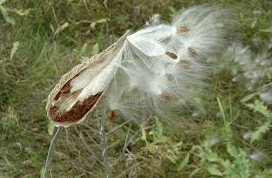
All of the following are examples of seed disbursement except:
a)
wind
b)
volcanic eruptions
c)
physical movement (rolling)
d)
animals feces
41.

A flowering plant with leaves that have parallel veins.
a)
gymnosperms
b)
angiosperms
c)
dicot
d)
monocot
42.
Small grains that contain a plant's male reproductive cells.
a)
stamen
b)
pollen
c)
anther
d)
stigma
43.
The stalks in a flower that produce the male reproductive cells
a)
pistil
b)
stamen
c)
filament
d)
stigma
44.

Small leaf-like structures forming an outer circle at the base of a flower.
a)
petals
b)
sepal
c)
anthers
d)
dicots
45.
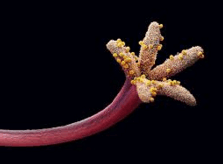
The part of the flower on which the pollen grains land.
a)
pistil
b)
stamen
c)
style
d)
stigma
46.

Their leaves are not veined, and the flower parts are usually in fours or fives.
a)
monocot
b)
dicot
c)
angiosperm
d)
gymnosperm
47.
Which of the following is NOT a way in which vascular tissue helps seed plants live on land?
a)
Gives plants structure
b)
Carries nutrients and food
c)
Carries water
d)
Creates energy for the plant
48.

Identify the type of angiosperm as a dicot or monocot.
a)
monocot
b)
dicot
49.

Identify the type of angiosperm as a dicot or monocot.
a)
monocot
b)
dicot
50.

Identify the type of angiosperm as a dicot or monocot.
a)
monocot
b)
dicot
51.

Identify the type of angiosperm as a dicot or monocot.
a)
monocot
b)
dicot
52.

Identify the type of angiosperm as a dicot or monocot.
a)
monocot
b)
dicot
53.

Identify the type of angiosperm as a dicot or monocot.
a)
monocot
b)
dicot
54.

Identify the type of angiosperm as a dicot or monocot.
a)
monocot
b)
dicot
55.
Which is one of the differences between nonflower-ing seed plants and flowering seed plants?
a)
presence of stomata in the roots
b)
amount of sugar stored in the roots
c)
presence of tracheids and vessels
d)
structure of parenchyma cells
56.
Which fill(s) the space between spongy mesophyll cells?
a)
chlorophyll
b)
gases
c)
cells
d)
vascular tissue
57.
Which plant structure is not part of a root?
a)
endodermis
b)
root cap
c)
pericycle
d)
stomata
58.
Which control(s) the movement of water vapor through the stomata?
a)
bark
b)
pericycle
c)
guard cells
d)
vascular tissues
59.
Which describes a positive phototropism?
a)
The plant grows away from the light.
b)
The plant grows toward the light.
c)
The plant grows toward gravity.
d)
The plant grows away from gravity
60.
Which is involved in the transport of gibberellins throughout the plant?
a)
cork cambium
b)
guard cells
c)
vascular tissue
d)
apical meristem
61.
What is produced by the pericycle?
a)
leaves
b)
dermal cells
c)
lateral roots
d)
strong stems
62.
Which is not an example of a tropic response?
a)
vine climbing a trellis
b)
Venus flytrap closing its leaves
c)
roots growing down into the soil
d)
stems leaning toward a sunny window
63.
Which component identifies a cell as a plant cell?
a)
nucleus
b)
Golgi apparatus
c)
large central vacuole
d)
plasma membrane
64.
Which plant cells are flexible and provide support for surrounding cells?
a)
collenchyma cells
b)
meristematic cells
c)
parenchyma cells
d)
sclerenchyma cells
65.
Which plant cells divide and repair damaged tissue?
a)
apical cells
b)
meristematic cells
c)
parenchyma cells
d)
sclerenchyma cells
66.
What type of plant tissue contains rapidly dividing cells that result in primary and secondary growth?
a)
dermal tissue
b)
ground tissue
c)
meristematic tissue
d)
vascular tissue
67.
What is the term for a tissue that transports substances?
a)
apical
b)
endoderm
c)
tropic
d)
vascular
68.
What tissue replaces cells of the root cap that are rubbed off as the root grows?
a)
apical meristem
b)
cork cambium
c)
dermal tissue
d)
ground tissue
69.
What type of root system is not used for storage?
a)
adventitious root
b)
fibrous root
c)
modified root
d)
taproot
70.
What type of stem grows along the soil’s surface and can produce a new plant?
a)
bulb
b)
rhizome
c)
runner
d)
tuber
71.
What is the effect of applying gibberellins to a plant?
a)
an increase in height
b)
a greater response to sunlight
c)
an increase in lateral branching
d)
a decrease in the number of leaves
72.
How does a plant’s apical meristem inhibit the growth of side branches?
a)
The apical meristem produces auxin.
b)
The side branches receive less gibberellin.
c)
The apical meristem absorbs all of the cytokinin.
d)
The side branches have a nastic response to sunlight.
73.
What type of response causes plant movement that can be reversed and repeated?
a)
nastic response
b)
hormonal response
c)
thigmoresponse
d)
tropic response
74.
Which is an example of negative gravitropism?
a)
the dropping of fruit
b)
the upward growth of a stem
c)
the growth of roots into the soil
d)
the horizontal growth of rhizomes
75.
Which leaf structure
has tightly-packed,
column-shaped cells
used in photosynthesis?
has tightly-packed,
column-shaped cells
used in photosynthesis?
a)
spongy mesophyll
b)
epidermis
c)
palisade mesophyll
d)
cuticle
76.
Identify the main food-carrying tissue of plants.
a)
xylem
b)
phloem
c)
tracheids
d)
vessel elements
77.
Which type of cells provides fiber that humans use to make ropes and clothing?
a)
cambium cells
b)
mesophyll cells
c)
sclerenchyma cells
d)
trichome cells
78.
What is the function of parenchyma cells in a fruit?
a)
gas exchange
b)
photosynthesis
c)
protection
d)
storage
79.
Which is a result of the growth of lateral meristem tissue?
a)
increasing the diameter
of a branch
of a branch
b)
lengthening of the stem
c)
production of leaves
d)
starch and water storage
80.
Which plant tissue translocates nutrients from sources to sinks?
a)
cambium
b)
mesophyll
c)
phloem
d)
xylem
81.
Which tissue regulates
the movement of substances into the vascular tissues?
the movement of substances into the vascular tissues?
a)
epidermis
b)
cortex
c)
endodermis
d)
pericycle
82.
What hormone will accumulate in an enclosed sack that contains unripe bananas?
a)
cytokinin
b)
auxin
c)
gibberellin
d)
ethylene
83.

This is an example
of what type of leaf?
of what type of leaf?
a)
alternate
b)
palmate
c)
pinnate
d)
whorled
84.

Where in the leaf does most of the photosynthesis take place?
a)
cuticle
b)
spongy mesophyll
c)
palisade mesophyll
d)
vascular bundle
85.
What term is used to describe the process in which new plants grow from parts of an existing plant?
a)
budding
b)
regeneration
c)
vegetative reproduction
d)
sexual reproduction
86.
What is the threadlike structure of a spore which develops into a gametophyte?
a)
chemotaxis
b)
prothallus
c)
protonema
d)
microspore
87.
What structure of the plant embryo first appears outside the seed?
a)
cotyledon
b)
first leaf
c)
hypocotyls
d)
radicle
88.
Which scientist uses plant cells to grow new plant tissues on nutrient agar?
a)
botanical technologist
b)
horticulture specialist
c)
plant physiologist
d)
tissue-culture technician
89.
What is the term for the movement of cells in response to a chemical?
a)
chemotaxis
b)
chemitropism
c)
chemiosmosis
d)
hydrochemisis
90.
What is the tiny heart-shaped gametophyte produced from a fern spore called?
a)
frond
b)
sorus
c)
prothallus
d)
protonema
91.
What is the term for a plant that produces two types of spores that develop into male or female gametophytes?
a)
bisporous
b)
diasporous
c)
gametosporous
d)
heterosporous
92.
In conifers, how are pollen grains produced by a male cone transported to a female cone?
a)
animals
b)
fire
c)
water
d)
wind
93.
What type of flowers are either male reproductive organs or female reproductive organs, not both?
a)
complete flowers
b)
perfect flowers
c)
incomplete flowers
d)
imperfect flowers
94.
What is a characteristic of plants that are pollinated by animals?
a)
brightly colored petals
b)
large pistils
c)
long stamens
d)
many sepals
95.
Which type of plant flowers when the number of hours of darkness is less than its critical period?
a)
short day plant
b)
neutral day plant
c)
long day plant
d)
intermediate day plant
96.
Which type of plants generally has flower organs in multiples of three?
a)
dicots
b)
monocots
c)
tricots
d)
eudicots
97.
What is the dominant generation in flowering plants?
a)
anthophyte
b)
gametophyte
c)
saprophyte
d)
sporophyte
98.
From what plant organ does a fruit develop?
a)
anther
b)
stigma
c)
style
d)
ovary
99.
How does the dispersal of seeds increase the survival rate of offspring?
a)
It increases genetic diversity.
b)
It limits the spread of disease.
c)
It reduces competition.
d)
It results in new adaptations.
100.
What begins the process of seed germination?
a)
absorption of water
b)
appearance of the radicle
c)
breakdown of the endosperm
d)
growth of cotyledons
101.
What is an adaptation that increases the survival rate of seeds exposed to harsh conditions?
a)
dormancy
b)
photoperiodism
c)
alternation of generations
d)
internal germination
102.

Which flower organ is indicated by F?
a)
pistil
b)
spore
c)
sepal
d)
stamen
103.
Photoperiodism is associated with what plant necessity?
a)
hours of daylight
b)
hours of darkness
c)
ability to perform photosynthesis
d)
ability to reproduce
104.
What is the food source for the embryo in a eudicot seed?
a)
seed coat
b)
endosperm
c)
cotyledon
d)
radicle
105.
What occurs when a new plant grows at the end of a parent plant’s runner or stolon?
a)
artificial duplication
b)
botanic replication
c)
organic cloning
d)
vegetative reproduction
106.
What are the first
cells of the gametophyte stage?
cells of the gametophyte stage?
a)
gametes
b)
spores
c)
zygotes
d)
gametophyte cells
107.
How are flowering plants heterosporous?
a)
Antheridia produce sperm; archegonia produce eggs.
b)
Pistils produce megaspores; stamens produce microspores.
c)
Females produce pollen grains; males develop ovules.
d)
Gametophytes produce female spores;sporophytes produce male spores
108.
What is this multinucleated cell called?
a)
female gametophyte
b)
male megaspore
c)
pollen grain
d)
ovule
109.
A pollen grain from one species of plant lands on the stigma of a plant that is a different species. How is fertilization prevented?
a)
The pollen grain cannot undergo mitosis
b)
The sperm nucleus cannot fuse with the egg.
c)
The pollen grain cannot produce a pollen tube.
d)
The pollen tube cannot produce sperm nuclei.
110.

Which fertilization results in the endosperm?
a)
A
b)
B
c)
C
d)
D
111.

Which seed is a monocot?
a)
top
b)
bottom
112.
Which is not an advantage of vegetative reproduction?
a)
uniform plant features
b)
genetically identical plants
c)
greater genetic variation
d)
faster reproduction
113.
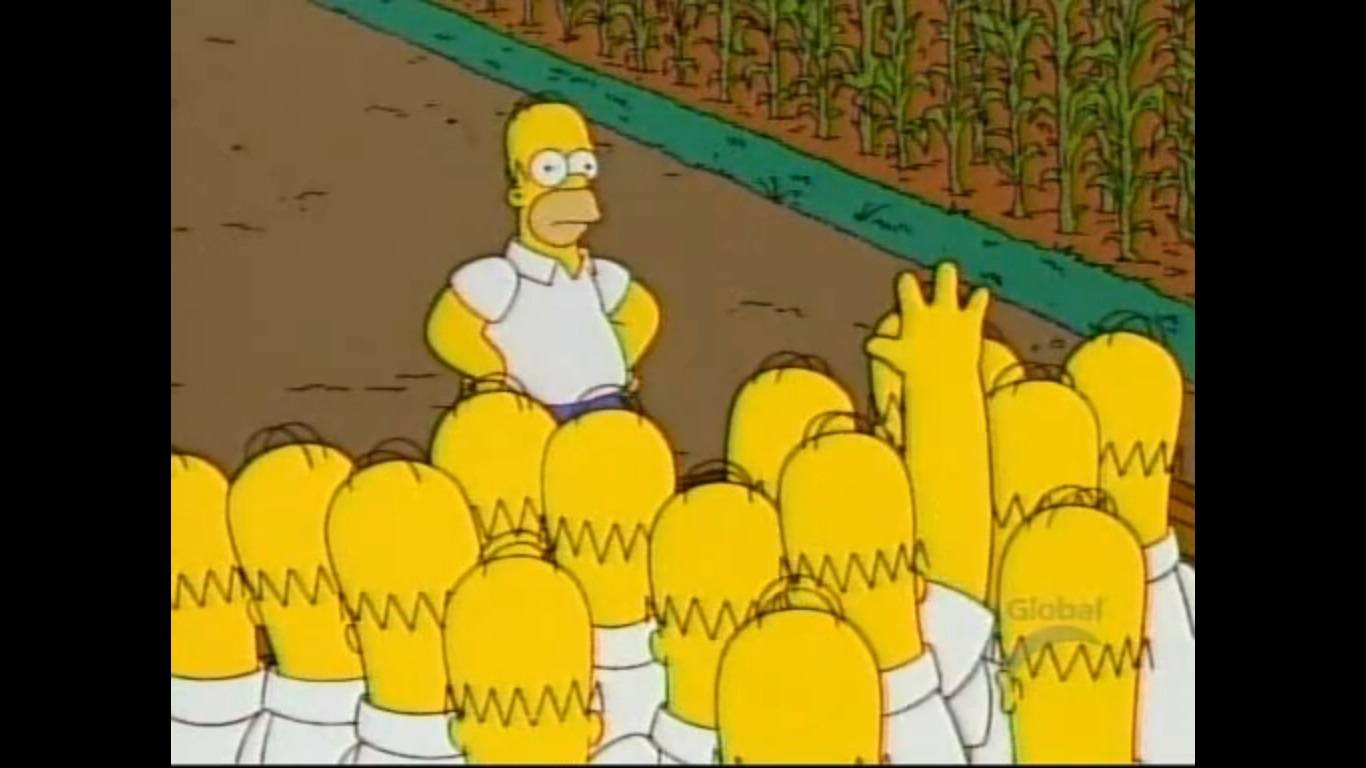
All of the offspring of an organism have the same genetic material, which is identical to the parent organism. From this, we can conclude that this organism -
a)
makes its own food
b)
is unicellular
c)
live in a marine habitat
d)
reproduces asexually
114.

What is #8 pointing to?
a)
petal
b)
stamen
c)
pistil
d)
ovary
115.
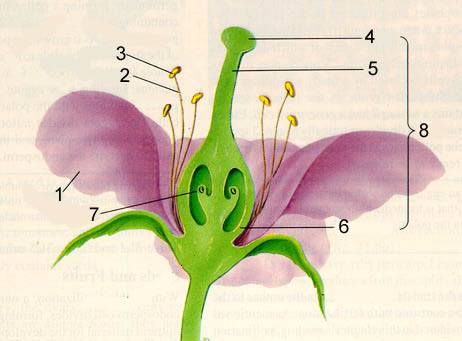
What is #2 pointing to?
a)
anther
b)
filament
c)
ovary
d)
style
116.
Where is pollen made?
a)
ovary
b)
petal
c)
pistil
d)
anther
117.
What is the sticky part of the flower that catches pollen?
a)
style
b)
stigma
c)
ovary
d)
petal
118.
The filament___________
a)
holds up the anther
b)
protects the petal
c)
is the male part of the flower
d)
catches pollen
119.
What dark/light conditions produce flowers ina short-day plant?
a)
hours of darkness are greater than the hoursof light
b)
hours of darkness are less than hours of light
c)
hours of darkness are equal to hours of light
d)
hours of darkness and light are not factors
120.
Which best describes pollen production in wind-pollinated flowers?
a)
small amounts of pollen
b)
larger pollen grains
c)
large amounts of pollen
d)
large quantities of nectar
121.
Which is not part of a seed?
a)
cotyledon
b)
endosperm
c)
embryo
d)
pollen
122.
Which describes the embryo of an anthophyte?
a)
haploid
b)
diploid
c)
monoploid
d)
triploid
123.
Which terms could describe a monocot flower?
a)
four sepals, four petals
b)
five sepals, ten petals
c)
twelve sepals, twelve petals
d)
four sepals, eight petals
124.
From what structure does a pollen grain develop?
a)
egg
b)
embryo
c)
microspore
d)
endosperm
125.
A tuber is an adaptation of which structure?
a)
cell
b)
leaf
c)
root
d)
stem
126.
which of this tissues are not known as ground tissue?
a)
perenchyma tissue
b)
collenchyma tissue
c)
epidermal tissue
d)
sclerenchyma tissue
127.
which tissue provide support and mechanical strength to the plant?
a)
parenchyma tissue
b)
sclerenchyma tissue
c)
xylem tissue
d)
collenchyma tisssue
128.

which of this function not belongs to parenchyma tissue?
a)
carries out photosynthesis
b)
stores food materials such as starch
c)
absorption of water and mineral
d)
provides support to the plants
129.
which of this tissues support the young plants and woody plants?
a)
collenchyma tissue
b)
parenchyma tissue
c)
sclerenchyma tissue
d)
xylem tissue
130.

What type of cells give the edge of this celery flexible support?
a)
Parenchyma
b)
Sclerenchyma
c)
Collenchyma
131.

What type of cells are shown here?
a)
Parenchyma
b)
Sclerenchyma
c)
Collenchyma
132.
Region of stem near seed
a)
Hypotocotyl
b)
Dormancy
c)
Germenation
d)
Polar Nuclei
133.
Cell found in most plants. Functions in photosynthesis, gas exchange, protection, storage, tissue repair and replacement.
a)
Collenchyma
b)
Parenchyma
c)
Guard Cell
d)
Meristem
134.
Elongated plant cell provides flexibility, support for tissue, functions in tissue repair and replacement.
a)
Collenchyma
b)
Parenchyma
c)
Guard Cell
d)
Meristem
135.
Lacks cytoplasm and other living components when mature, thick rigid walls for support and function in transportation.
a)
Collenchyma
b)
Parenchyma
c)
Sclerenchyma Cell
d)
Meristem
136.
Meristematic tissue that produces cell with tough cell walls that form protective outside layer on stems and roots.
a)
Vascular Cambium
b)
Cord Cambium
c)
xylem
d)
Meristem
137.
Leaf tissue layer that contains chloroplasts and where photosynthesis takes place.
a)
Photoperiodism
b)
Spongy Mesophyll
c)
Palisade Mesophyll
d)
Stamen
138.
Loosely packed, irregularly shaped cells with spaces located below palisade mesophyll.
a)
Photoperiodism
b)
Spongy Mesophyll
c)
Palisade Mesophyll
d)
Stamen
139.
Plant that lacks vascular tissue, moves substances by osmosis and diffusion, grows only in damp environments.
a)
Non vascular Plant
b)
Vascular Tissue
c)
Vascular Plant
d)
Perennial
140.
Seed structure that stores food or helps absorb food for the sporophyte of vascular seed plants.
a)
Seed
b)
Stomata
c)
Cone
d)
Cotyledon
141.
Long, cylindrical plant cell in which water passes from cell to cell through pitted ends.
a)
Tracheid
b)
Root Cap
c)
Petiole
d)
Phloem
142.
Plant tissue consisting of parenchyma, collenchyma, and sclerenchyma.
a)
Sieve tube member
b)
Companion Cell
c)
Ground Tissue
d)
Root Cap
143.
Plant tissue that produces lateral roots.
a)
Cortex
b)
Endodermis
c)
Pericycle
d)
Petiole
144.
This is a ____ plant.
a)
gymnosperm
b)
angiosperm
c)
vascular
d)
nonvascular
145.
The diploid form in a plant’s life cycle is called the
a)
Sporophyte
b)
Gametophyte
c)
Alternation of Generations
d)
Parental Generation
146.
13) An unknown plant species has stomata, xylem and phloem. It reproduces sexually and has male pollen and female seed cones. Which of the following is the most logical conclusion about the classification of this plant?
a)
It is a gymnosperm and belongs to the division Coniferophyta.
b)
It is a nonvascular plant, and belongs the the division Psilophyta.
c)
It is a seedless vascular plant, and belongs to the division Psilophyta.
d)
It is an angiosperm, and belongs to the division Anthophyta.
147.
If a plant’s leaves developed so that its vascular tissue only contained xylem, how would this affect the rest of the plants physiological processes?
a)
Since most of the parts of the plant contain chloroplasts, the plants cells would funcCon as usual, without a need for glucose from the leaves.
b)
The carbon dioxide required for photosynthesis would not be absorbed and transported to the leaf cells, and photosynthesis would stop.
c)
The glucose produced during photosynthesis in the leaf cells would not be able to reach the rest of the plant, and the cellular respiraCon in the plant’s other cells would not function.
d)
The plant’s ground Cssues would sCll be able to transport the water and nutrients from the roots to the rest of the plant, and so other processes like photosynthesis would conCnue as usual.
148.
Terrestrial plants have a waxy covering produced by the dermal tissue called the cuticle. If this waxy covering was overproduced so that the stomata became clogged, what would happen to the plant?
a)
Glucose produced during photosynthesis would be prevented from reaching the rest of the plant, and energy production by cellular respiration would stop.
b)
Sunlight would not be able to reach the plant’s ground Cssue cells through the thick dermal Cssue, and the plants ability to perform photosynthesis would be damaged.
c)
The plant would not be able to absorb water and oxygen from the air, and the plant would dry out, limiting most cell functions.
d)
The plant would not be able to exchange oxygen for carbon dioxide, and the plant’s ability to perform photosynthesis would be limited.
149.
An unknown plant species has gametophytes that grow within the sporophyte, and the male and female gametophytes grow on the same plant, within the same flower. Which of the following is the most logical conclusion about the life cycle of this plant?
a)
The plant is a fern, and the gametophyte is its dominant phase.
b)
The plant is a gymnosperm, and the sporophyte is its dominant phase.
c)
The plant is a moss, and the gametophyte is its dominant phase.
d)
The plant is an angiosperm, and the sporophyte is its dominant phase.
150.
This is the type of meristem found at the tips of roots and stems that causes primary growth?
a)
Lateral meristem
b)
Epidermis
c)
Intercalary meristem
d)
Apical meristem
151.
This is the type of meristem that increases plant width or girth, known as secondary growth.
a)
Apical meristem
b)
Lateral meristem
c)
epidermis
d)
Intercalary meristem
152.
Which tissue type does a majority of the photosynthesis?
a)
Dermis
b)
Ground
c)
Mersitematic
d)
Vascular
153.
Monocots have what type of vascular bundles
a)
Scattered
b)
Ring
c)
Both
d)
Depends
154.
Dicots have what type of vascular bundles
a)
Scattered
b)
Ring
c)
Oblong
d)
None
155.
Which type of plant cell has a thick primary cell wall and no secondary cell wall? Hint: It is used to support the growing parts of the plant.
a)
parenchyma
b)
collenchyma
c)
schlerenchyma
d)
guard cells
156.
The area of a plant where active growth occurs.
a)
Pollination
b)
Germination
c)
Meristem
d)
Dormancy
157.

What type of root system is this?
a)
Fibrous
b)
Taproot
158.

What type of root system is this?
a)
Fibrous
b)
Taproot
159.

What is the waxy coating on the outer part of the leaf?
a)
Petiole
b)
Node
c)
Cuticle
d)
Compound
160.
What is a seed plant whose seeds are encased in fruit?
a)
Sporophyte
b)
Gymnosperm
c)
Gametophyte
d)
Angiosperm
Reset

