
 Worksheets
Unit 3 - GTS and Fossils
Total questions: 76
Worksheet time: 49mins
Name
Class
Date
1.

The scientist who studies living things from the past.
a)
Scientist
b)
Paleontologist
c)
Geologist
d)
Teacher
2.

Fossilized tree resin.
a)
Rock
b)
Mineral
c)
Marble
d)
Amber
3.

A hollow space in rock in the shape of an organism.
a)
Mold fossil
b)
Cast fossil
c)
Body fossil
d)
Trace fossil
4.

These fossils shows evidence of activity. Scientists use these fossils to study animal behaviors.
a)
Mold fossil
b)
Trace Fossil
c)
Cast fossil
d)
Body Fossil
5.

This fossil is made when mud or dirt fill in a mold fossil and create a 3-D version of an organism.
a)
Mold fossil
b)
Cast Fossil
c)
Body Fossil
d)
Trace Fossil
6.

The preserved remains or trace of a living thing from long ago.
a)
Imprint
b)
Decay
c)
Amber
d)
Fossil
7.
Which of the following describes a group of living things that is no longer living.
a)
fossil
b)
extinct
c)
mold
d)
cast
8.
Why are there more animal fossils than plant fossils?
a)
Animals eat plants.
b)
Plants are smaller than animals.
c)
Plants have softer body parts than animals.
d)
There were more ancient animals than ancient plants.
9.
In which type of rock are most fossils found?
a)
igneous
b)
sedimentary
c)
volcanic
d)
metamorphic
10.
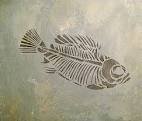
If scientists found this fossil, what could they infer?
a)
what fish are like today
b)
that this fish lacked oxygen
c)
what kind of animal ate this fish
d)
that water once covered the area
11.

What is the correct order of the rock layers from oldest to youngest?
a)
B, C, D, E, A
b)
A, B, C, D, E
c)
E, D, C, B, A
d)
B, C, D, A, E
12.
Fossils are usually found in
a)
igneous rock
b)
extrusions
c)
intrusions
d)
sedimentary rock
13.
Where can the oldest layer be found?
a)
The top layer
b)
The middle layer
c)
They are all the same age
d)
The bottom layer
14.
How are fossils created?
a)
Traces of organisms get turned into stone.
b)
Dead organisms are quickly buried for millions of years.
c)
Animals get trapped.
d)
All of the above
15.
Several wooly mammoth fossils have been found. Mammoths, which lived hundreds of thousands of years ago, were covered with thick fur. Based on the evidence, mammoth fossils tell us that the area in which they are found -
a)
has too many humans
b)
no longer has large animals
c)
was, at one time, very cold
d)
receives more rain that it used to
16.
An area is currently a forest. What evidence would best indicate that this area was covered by water millions of years ago?
a)
An increase in rainfall in the forest over time
b)
The presence of plants in the forest that need water to live
c)
Fossils of fish discovered in rock below the forest
d)
Insects in the forest that lay their eggs in the water
17.

Which fossil layer is the youngest?
a)
A. Layer A
b)
B. Layer B
c)
C. Layer C
d)
D. Layer D
18.
The Law of Superposition helps scientists to determine what?
a)
The absolute age of rock layers
b)
The age of fossils
c)
The relative age of rock layers
d)
the super powers of rocks
19.
Which type of dating method can be used on rock layers by applying the Law of Superposition?
a)
relative dating
b)
absolute dating
c)
radioactive dating
d)
radiometric dating
20.

Look at the diagram, what layer did animal E first show up in?
a)
Layers #4
b)
Layers #5
c)
Layers #6
d)
Layers #7
21.
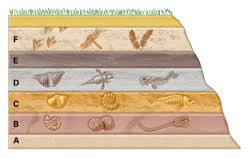
Which rock layer contains the newest fossils?
a)
F
b)
E
c)
B
d)
C
22.
Precambrian, Paleozoic, Mesozoic, and Cenozoic all belong to:
a)
Epochs
b)
Eras
c)
Periods
d)
Eons
23.
Archean and Proterozoic belong to:
a)
Precambrian
b)
Cambrian
c)
Period
d)
Era
24.
Modern mammals was during this era:
a)
Cenozoic
b)
Mesozoic
c)
Paleozoic
25.
Age of fish was during this era:
a)
Cenozoic
b)
Mesozoic
c)
Paleozoic
26.
Age of reptiles was during this era:
a)
Cenozoic
b)
Mesozoic
c)
Paleozoic
27.
The earliest part of Earth's history is called the:
a)
Cenozoic
b)
Cambrian
c)
Holocene
d)
Precambrian
28.
Which division of the geologic time scale is the longest?
a)
Eon
b)
Period
c)
Era
d)
Epoch
29.
Which of these groups of animals appeared on Earth most recently?
a)
Reptiles
b)
Amphibians
c)
Mammals
d)
Fish
30.
________ are fossils of organisms that were only found during very specific times in history.
a)
Index fossils
b)
Trace fossils
31.

_________ is a cavity or impression left behind in rock when an organism's buried remains are dissolved. The shape of the organism's exterior can be seen in the walls and floor of the cavity.
a)
Mold
b)
Cast
c)
Trace
d)
Index
32.

________ is a mold that has been filled in with sediments which hardened and took the shape of the cavity.
a)
Cast
b)
Mold
c)
Trace
d)
Carbon film
33.

Is a process in which minerals fill in the empty spaces of an organism's remains.
a)
Cast
b)
Premineralization
c)
Replacement
d)
Mold
34.
The remains are replaced by other minerals before they can decay—this process is called
a)
Premineralization
b)
Replacement
c)
Cast
d)
Index
35.

When permineralization and replacement both occur in a fossil, the fossil is said to be
a)
Petrified
b)
Cast
c)
Mold
d)
Preserved
36.
The largest subdivision of time on the geologic time scale is an
a)
Eon
b)
Era
c)
Epoch
d)
Period
37.
After Precambrian time, Earth's history is divided into three eras, beginning with the
a)
Paleozic Era
b)
Mesozoic Era
c)
Cenozoic Era
38.
Which is the correct order for the 3 eras on geologic time scale. This order is from oldest to current.
a)
Paleozoic, Mesozoic, Cenozoic
b)
Mesozoic, Paleozoic, Cenozoic
c)
Cenozoic, Mesozoic, Paleozoic
39.
Each of the three eras can be divided into ____
a)
Periods
b)
Eons
40.
Each period can then be divided into
a)
Epoch
b)
Eon
41.
The current epoch, which is a part of the Quaternary period, is the
a)
Holocene
b)
Cenozoic
c)
Paleozoic
42.

Which fossil is an impression left by the original organism?
a)
cast
b)
mold
c)
trace
d)
preserved remains
43.
Relative dating of rock layers tells us that the deeper we dig, _______.
a)
the younger the rocks get
b)
the smellier the rocks get
c)
the harder the rocks get
d)
the older the rocks get
44.
The Geologic Time Scale is a record of what?
a)
old geologists
b)
sweet geology music
c)
the known history of rocks and fossils
d)
a list of every living thing ever
45.
How old do Paleontologists believe the Earth is?
a)
2015 years old
b)
3.6 billion years old
c)
4.6 billion years old
d)
4.6 million years old
46.

A bug stuck in amber is an example of what type of fossil?
a)
cast
b)
mold
c)
trace
d)
preserved remains
47.
What type of rock do fossils form in?
a)
Igneous
b)
Sedimentary
c)
Metamorphic
d)
Classic
48.
Why is the fossil record incomplete?
a)
fossils get eroded away over time
b)
most organisms never became fossils
c)
scavengers and decomposers eat them too quickly
d)
all of the above
49.

According to the law of superposition, which layer is the youngest?
a)
A
b)
B
c)
C
50.
Footprints, nests, burrows and fossilized poop are examples of what kind of fossils?
a)
Trace Fossils
b)
preserved remains
c)
Erosion
d)
sedimentary rock
51.
Identify the Era:
called the "Age of Mammals"
called the "Age of Mammals"
a)
Precambrian
b)
Paleozoic
c)
Mesozoic
d)
Cenozoic
52.
Identify the Era:
that was the longest of all eras
that was the longest of all eras
a)
Precambrian
b)
Paleozoic
c)
Mesozoic
d)
Cenozoic
53.
Identify the Era:
where dinosaurs thrived
where dinosaurs thrived
a)
Precambrian
b)
Paleozoic
c)
Mesozoic
d)
Cenozoic
54.
Identify the Era:
First forms of life appeared in this era.
First forms of life appeared in this era.
a)
Precambrian
b)
Paleozoic
c)
Mesozoic
d)
Cenozoic
55.
What is a fossil?
a)
any dead organism
b)
the preserved remains or traces of an organism
c)
a perfect copy of a rock
d)
an unusual type of rock
56.
How do most fossils form?
a)
Living things die and their remains are covered by sediment
b)
The hard parts of an organism dry out in the air
c)
The soft parts of an organism change to stone
d)
Freezing preserves the remains of an organism
57.
What is absolute dating
a)
The age when the rock was formed
b)
dinner and movie with a rock
c)
A range of rock compared to other rocks
d)
Relative dating
58.
What type of scientists study fossils?
a)
Astronomists
b)
Archaelogists
c)
idoentnoeigists
d)
Paleontologists
59.
The Earth is constantly changing.
a)
True
b)
False
60.
Which is the most recent time frame?
a)
Mesozoic
b)
Precambrian
c)
Holocene
d)
Cretaceous
61.
Put this in order of smallest to largest time frame.
a)
Eon, Era, Periods, Epoch
b)
Periods, Epoch, Eon, Era,
c)
Epochs, Periods, Eras, Eons
d)
Eras, Periods, Epochs, Eons
62.

What principle proves Layer 1 is younger than 2.
a)
superposition
b)
crosscutting
c)
inclusions
d)
horizonality
63.
The age of a rock compared to the ages of other rocks is the rock's
a)
absolute age
b)
geologic age
c)
sedimentary age
d)
relative age
64.
A gap in the geologic record is known as a(n)_______________.
a)
unconformity
b)
intrusion
65.
The number of years that have passed since the rock formed is the rock's
a)
relative age
b)
law of superposition
c)
absolute age
d)
index fossil
66.
A break in Earth's crust is called
a)
an intrusion
b)
a fault
c)
a layer
d)
an index fossil
67.
Geologists use the law of _________ to determine the relative ages of sedimentary rock layers.
a)
geology
b)
superposition
68.

According to the law of __________, in horizontal sedimentary rock layers the oldest layer is at the bottom and the youngest layer is at the top.
a)
superposition
b)
index fossil
69.
The ________ states that layers of sediment were originally deposited horizontally under the action of gravity.
a)
law of superposition
b)
law of horizontality
c)
uniformitarianism
d)
unconformities
70.

Which of the following correctly lists the layers in order from oldest to youngest?
a)
A, B, C, D, E
b)
E, B, C, D, A
c)
E, D, C, B, A
d)
C, B, A, D, E
71.

Letter "F" is a....
a)
inclusion
b)
intrusion
c)
fault
d)
unconformity
72.

The rock formation labeled "P" is a(n)...
a)
fault
b)
intrusion
c)
inclusion
d)
unconformity
73.

In this rock layer diagram there are two unconformities, a fault at E and an intrusion at D. Which unconformity occurred first? How do you know?
a)
Intrusion D occurred first because the instrusion has been moved by the fault.
b)
The fault occurred first because it has moved the intrusion D.
c)
Intrusion D occurred first because it can be seen in all of the rock layers.
d)
Fault E occurred first because it is a normal fault.
74.
The best index fossils have which two traits?
a)
widespread geographically, long lifespan
b)
widespread geographically, short lifespan
c)
specific place, long lifespan
d)
specific place, short lifespan
75.
How does absolute age differ from relative age?
a)
only absolute dating indicates which rock is older than another
b)
only absolute dating finds the age in years
c)
only relative dating finds the age in years
76.
What is half-life?
a)
it refers to the lifespan of a fossil
b)
the time required for half of a sample of radioactive isotope to form a daughter isotope
c)
the time required for daughter isotopes to become radioactive
100 %

