
 Worksheets
History of Planetary Motion and Types of Galaxies
Total questions: 82
Worksheet time: 57mins
Name
Class
Date
1.
A light year is...
a)
The speed light travels
b)
How long it takes light to get to you from the sun
c)
The distance light can travel in a year
d)
How many years it takes light to be emitted
2.
Scientist use Light years to measure objects in space rather than units such as Miles or Kilometers because of how massive the Galaxy and Universe is.
a)
True
b)
False
3.
To express the distance between the Milky Way galaxy and the Andromeda galaxy, the most appropriate unit of measure is the -
a)
meter
b)
kilometer
c)
light year
d)
astronomical unit
4.
An object at rest, stays at rest. Object in motion, stays in motion unless acted upon by an unbalanced force.
a)
Newton's 1st Law
b)
Newton's 3rd Law
c)
Kepler's 2nd Law
d)
Kepler's 1st Law
5.
If you exert the same force on two objects of different mass, you will get different accelerations (changes in motion).
a)
Newton's 1st Law
b)
Newton's 2nd Law
c)
Kepler's 3rd Law
d)
Kepler's 2nd Law
6.
Every action has an equal and opposite reaction.
a)
Newton's 2nd Law
b)
Kepler's 1st Law
c)
Newton's 3rd Law
d)
Kepler's 3rd Law
7.
Acceleration is produced when a force acts on a mass. The greater the mass (of the object being accelerated) the greater the amount of force needed (to accelerate the object).
a)
Kepler's 1st Law
b)
Kepler's 2nd Law
c)
Newton's 3rd Law
d)
Kepler's 3rd Law
8.
The speed of a planet orbiting the sun constantly changes due to a change in distance.
a)
Kepler's 1st Law
b)
Newton's 1st Law
c)
Kepler's 2nd Law
d)
Newton's 1st Law
9.
Planets farther away from the sun have a longer path and travel slower because gravity is weaker.
a)
Kepler's 2nd Law
b)
Newton's 3rd Law
c)
Kepler's 3rd Law
d)
Newton's 3rd Law
10.
The force of attraction between objects that have mass.
a)
Force
b)
Gravity
c)
Weight
d)
Density
11.
Any physical object has a change in it's state of motion.
a)
Gravity
b)
Weight
c)
Inertia
d)
Acceleration
12.
Made up of atoms and makes up everything.
a)
Electrons
b)
Matter
c)
Particles
d)
Compounds
13.
How close particles are together.
a)
Density
b)
Weight
c)
Mass
d)
Matter
14.
Increase in the rate or speed of something.
a)
Speed
b)
Acceleration
c)
Weight
d)
Momentum
15.
The amount of matter in an object
a)
Speed
b)
Density
c)
Weight
d)
Mass
16.
A _______ is any interaction that, when unopposed, will change the motion of an object (example: pushing a car).
a)
Balanced Force
b)
Unbalanced Force
c)
Force
d)
Inertia
17.
The heaviness of an object due to a force (gravity) and their relative mass.
a)
Weight
b)
Mass
c)
Speed
d)
Unbalanced force
18.
The resistance that one surface or object encounters when moving over another.
a)
Mass
b)
Unbalanced Force
c)
Friction
d)
Balanced Force
19.
The curved path of a celestial object
a)
Mass
b)
Ellipse
c)
Velocity
d)
Orbit
20.
Two forces acting in opposite directions but equal in size.
a)
Unbalanced Force
b)
Strong Nuclear Force
c)
Balanced Force
d)
Gravity
21.
Two forces acting in opposite directions but one is stronger than the other.
a)
Gravity
b)
Unbalanced Force
c)
Velocity
d)
Balanced Force
22.
Planets orbit the Sun in a shape called a(n)
a)
circle
b)
ellipse
c)
focus
d)
perihelion
23.
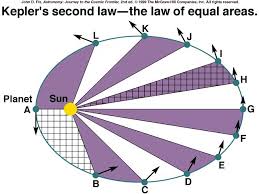
Where is the planet moving faster
a)
Position A to B
b)
Position B to C
c)
Position H to I
d)
Position I to J
24.

What is true about the area between points A, B and the Sun, and the area between points H, I and the Sun?
a)
The area between A, B and the Sun is the largest.
b)
The area between H, I and the Sun is the largest
c)
Both areas are equal in size
d)
There is not enough information to determine the areas
25.
Kepler's 2nd Law deals with
a)
the shape of the planets' orbits
b)
the speed/area the planet travels
c)
the length of time it takes the planet to orbit the sun
26.
A planet moves __________ when it is farthest from the sun.
a)
faster
b)
slower
27.
The farther away a planet is from the sun, the _______ it takes it to orbit the sun once.
a)
longer
b)
shorter
28.
The path a planet travels around the sun is called its
a)
orbit
b)
ellipse
c)
barycenter
d)
precession
29.
Two factors effecting the magnitude of the force of gravity between 2 objects are...
a)
mass and distance
b)
mass and matter
c)
distance and weight
d)
weight and mass
30.

Who created the Universal Law of Gravitation?
a)
Copernicus
b)
Newton
c)
Kepler
d)
Galileo
31.
Double the product of the masses of two objects
a)
4 times stronger gravity force
b)
4 times weaker gravity force
c)
2 times weaker gravity force
d)
2 times stronger gravity force
32.

Complete the following statement: The farther away two planets are the _______ the gravitational force between them.
a)
greater
b)
same
c)
zero
d)
less
33.

The Milky Way is the galaxy that contains our Solar System. The name is from its appearance as a dim "milky" glowing band arching across the night sky, in which the naked eye cannot distinguish individual stars.
a)
TRUE
b)
FALSE
34.

A model of the solar system in which Earth and the other planets revolve around the SUN
a)
Heliocentric
b)
Geocentric
35.

A model of the universe in which Earth is at the center of the revolving planets and stars. This includes the sun revolving around the Earth. This model was proven wrong.
a)
Geocentric
b)
Heliocentric
36.

Which 2 scientists suggested the Helio-centric theory.
a)
Kepler and Newton
b)
Galileo and coperinicus
37.
The initial explosion that resulted in the formation and expansion of the universe and has been expanding ever since. Also, this explosion released all of the matter and energy that exists in the universe today.
a)
The Accelerating Universe
b)
Plasma Cosmology
c)
The Standard Model
d)
The Big Bang
38.
The study of the moon, stars, and other objects in space is called
a)
chemistry
b)
biology
c)
geology
d)
astronomy
39.

a)
Heliocentric
b)
Geocentric
40.
What would happen if the Earth's inertia "quit working"?
a)
We would float off into space
b)
Sun's gravity would push us into space
c)
We would smash into Mars
d)
Sun's gravity would pull us in to it
41.
Which two forces keep the planets in orbit around the sun?
a)
inertia & momentum
b)
gravity & inertia
c)
inertia & velocity
d)
gravity & velocity
42.
What is the shape of a planet's orbit?
a)
circular
b)
elliptical
c)
spherical
d)
round
43.
Planets move in elliptical orbits is Kepler's _____ Law.
a)
1st
b)
2nd
c)
3rd
d)
4th
44.
Planets that are farther from the sun have larger orbits is Kepler's ___ Law.
a)
1st
b)
2nd
c)
3rd
d)
4th
45.
Line drawn from the sun to planet sweeps out equal areas in equal time is Kepler's _____ Law.
a)
1st
b)
2nd
c)
3rd
d)
4th
46.
If a planet is closer to the sun, its orbit will be _____ than one farther away.
a)
longer
b)
slower
c)
bigger
d)
shorter
47.
Kepler's 2nd Law states that a planet's velocity is ____ when farther from the sun.
a)
fastest
b)
slowest
c)
unchanged
d)
the same
48.
If lil Wayne, who is an alien, weighs 578 Newtons on Earth and 96 Newtons on the moon, this means that his...
a)
mass is greater on earth.
b)
mass is greater on the moon.
c)
inertia is greater on earth and less on the moon.
d)
mass is the same on the moon and the earth.
49.
Which law explains why when you put a book on a table the table pushes on the book
a)
3rd law
b)
4th law
c)
1st law
d)
2nd law
50.
An object will not have any inertia if it is _______________
a)
Accelerating
b)
Moving in a circle
c)
In space
d)
… Nonsense! All objects have inertia
51.

Which best explains why we are able to accelerate forward when starting to run?
a)
As one leg moves backward, it provides an equal and opposite force for the other foot to move forward.
b)
No acceleration takes place. Runners are always at a fixed velocity.
c)
The striking foot pushes backward against the ground. The friction with the ground provides an equal and opposite force forward.
d)
The runner's upper body quickly leans forward, causing the entire body to begin accelerating forward
52.
The scientist who is most famous for developing the Laws of Motion is _____.
a)
Albert Einstein
b)
Stephen Hawking
c)
Sir Isaac Newton
d)
Galileo Galilei
53.
An object and rest will stay at rest and an object in motion will stay in straight line motion unless acted on by a force, is which one of Newton's Laws of Motion?
a)
4th Law of Motion
b)
1st Law of Motion
c)
3rd Law of Motion
d)
2nd Law of Motion
54.
When an object resits change, like a body in a turning car, it is called ________________.
a)
inertia
b)
force
c)
friction
d)
drag force
55.
Which law explains when a magician pulls a tablecloth out from under dishes and glasses on a table without disturbing them.
a)
Law 1
b)
Law 3
56.
According to Newton’s first law of motion, a moving object that is not acted on by an unbalanced force will
a)
remain in motion.
b)
eventually come to a stop.
c)
change its momentum.
d)
accelerate.
57.
Forces always act in equal and opposite pairs.
a)
Newton's 1st Law
b)
Newton's 3rd Law
c)
Newton's second law
58.

A person in car slides to the right when going through a very sharp left turn on the highway.
a)
1st Law
b)
2nd Law
c)
3rd Law
d)
4th Law
59.
Acceleration is caused by a force acting on a mass.
a)
Newton’s first law of motion
b)
Newton’s second law of motion
c)
Newton’s third law of motion
d)
Newton's fourth law of motion
60.
For every action, thereʼs an equal and opposite reaction.
a)
Newton's First Law
b)
Newton's Second Law
c)
Newton's Third Law
d)
force
61.
Newton's second law states that F=ma (force is mass times acceleration) which example would have the GREATEST?
a)
a 10 kg ball thrown with a 50 N force
b)
a 1 kg ball thrown with a 0.5N force
c)
a 50 kg student launched by a 100 N catapult
d)
a) a 500 kg car accelerated by 1000 N from the engine
62.

A person steps out of the boat and onto the dock. As the person moves forward onto the dock, the boat moves backward. Which statement best describes the backward motion of the boat as the person steps forward?
a)
For every action there is an equal and opposite reaction.
b)
Every mass exerts a force on every other mass.
c)
An object at rest tends to stay at rest.
d)
Friction opposes the motion of an object.
63.
A sled sliding on a flat, icy surface with a constant velocity is best described by
a)
Newton’s first law of motion for objects at rest.
b)
Newton’s first law of motion for objects in motion.
c)
Newton’s second law of motion.
d)
Newton’s third law of motion.
64.
When air rushes out of a balloon and it moves upward. This is an example of which Law of Motion.
a)
Newton's First Law
b)
Newton's Second Law
c)
Newton's Third Law
d)
Newton's Fourth Law
65.
All forced added together is known as
a)
net force
b)
unbalanced force
c)
balanced force
66.
What are the the 3 types of galaxies?
a)
Spiral Galaxies, Regular Galaxies, and Lliptical Galaxies
b)
Spiral Galaxies, Irregular Galaxies, and Elliptical Galaxies
c)
Milky Way, Elliptical Galaxies, and Spiral Galaxies
d)
Milky Way, Elliptical Galaxies, and Irregular Galaxies
67.
What are galaxies held together by?
a)
Gravitational Attraction
b)
Stars
c)
Other galaxies
d)
Dust and Gas
68.
What type of galaxy contains some of the oldest stars?
a)
Constellations
b)
Spiral Galaxies
c)
Elliptical Galaxies
d)
Irregular Galaxies
69.

What type of galaxy is this?
a)
Spiral
b)
Elliptical
c)
Irregular
d)
Irrational
70.

What type of galaxy is this?
a)
Spiral
b)
Elliptical
c)
Irregular
d)
Irrational
71.
The type of galaxy that has few young stars, little gas or dust, and NO arms is a/n
a)
elliptical galaxy
b)
spiral galaxy
c)
irregular galaxy
d)
barred spiral galaxy
72.
What type of galaxy has no defined pattern or shape?
a)
Spiral
b)
Elliptical
c)
Irregular
d)
Constellation
73.
All existing matter and space considered as a whole is called what?
a)
Galaxy
b)
Planet
c)
Universe
d)
Milky Way
74.

What type of galaxy is this?
a)
Spiral
b)
Elliptical
c)
Irregular
d)
Irrational
75.

What type of galaxy is this?
a)
Spiral
b)
Elliptical
c)
Irregular
d)
Irrational
76.

What type of galaxy is this?
a)
Spiral
b)
Elliptical
c)
Irregular
d)
Irrational
77.
Galaxies are composed of (best answer)
a)
stars
b)
stars and gas
c)
stars, dust, and gas
d)
stars, dust, and gas held together by gravity
78.
Which unit of measure do we use to measure distances between stars and galaxies?
a)
light year
b)
astronomical unit
c)
hectometer
d)
kilometer
79.
The force of attraction of 2 objects based on the mass and distance between them is
a)
Velocity
b)
Magnetasphere
c)
Centrifugal Force
d)
Gravity
80.
What is our galaxy?
a)
The Milky Way
b)
The Galaxy S7 Note
c)
The Andromeda Galaxy
d)
Constellations
81.
What is the shape of an spiral galaxy?
a)
oval
b)
square
c)
no shape
d)
pinwheel
82.

What type of galaxy is this?
a)
Spiral
b)
Elliptical
c)
Irregular
d)
Irrational
100 %

