
Font size
S
M
L
XL
 Worksheets
Final Review
Total questions: 107
Worksheet time: 3hrs 3mins
Name
Class
Date
1.
Write 7.113 x 10⁷ in standard notation.
a)
71,130,00
b)
7,113,000
c)
0.0000007113
d)
7,113
2.
Write 7.8 x 10⁻³ in standard notation
a)
0.0078
b)
7,800
c)
78
d)
0.078
3.
Write 6,700 in scientific notation.
a)
6.7 x 10³
b)
6.7 x10⁻³
c)
67 x 102
d)
67 x 10-2
4.
Write 0.037 in scientific notation.
a)
3.7 x 10⁻²
b)
3.7 x 10²
c)
37 x 10-3
d)
37 x 103
5.
Which is an example of a physical property?
a)
ability to react with acid
b)
color
c)
flammability
d)
ability to react with oxygen
6.

Ice melting is an example of a
a)
physical change
b)
chemical change
c)
physical property
d)
chemical property
7.
Which of the following is a chemical property?
a)
how something tastes
b)
ability to explode
c)
ability to float in water
d)
size of an object
8.
Example of a physical property
a)
flammability
b)
luster
c)
ability to rust
d)
ability to explode
9.

What is the correct value?
a)
5 ml
b)
15 ml
c)
20 ml
d)
25 ml
10.

What is measured with a graduated cylinder?
a)
Passage of time
b)
Distance from one thing to another
c)
Weight of an object
d)
Volume of liquid
11.

What is the object pictured used to measure?
a)
Weight
b)
distance
c)
Volume
d)
Mass
12.

What is the volume of the fish inside the graduated cylinder?
a)
38 mL
b)
6 mL
c)
32 mL
d)
Not enough information to solve
13.

What is the volume of liquid in this graduated cylinder?
a)
40.0 mL
b)
40.3 mL
c)
43.0 mL
d)
44.0 mL
14.
Intensive property is dependent on the amount of a substance.
a)
True
b)
False
15.
Density is an...
a)
Extensive Property
b)
Intensive Property
16.
Which of the following is NOT an example of an intensive property?
a)
color
b)
density
c)
mass
d)
boiling point
17.
Which units of measurement are used for volume?
a)
grams
b)
centimeters
c)
grams/milliliter
d)
milliliter
18.
Jack has a rock. The rock has a mass of 14g and a volume of 2cm3. What is the density of the rock?
a)
7 mL
b)
7 g/cm3
c)
28 g/cm3
d)
1/7 g/cm3
19.
True or False: The density of a specific type of material never changes.
a)
True
b)
False
20.
What is the formula for density?
a)
density = mass x volume
b)
density = mass / volume
c)
density = mass + volume
d)
density = mass - volume
21.
Frank has a paper clip. It has a mass of 9g and a volume of 3cm3. What is its density?
a)
3 g/cm3
b)
1/3 g/cm3
c)
27 g/cm3
d)
39 g/cm3
22.

Which box has a higher density?
a)
Box A
b)
Box B
c)
cannot be determined
d)
they are the same
23.

Which box has the greatest volume?
a)
Box A
b)
Box B
c)
They're the same volume
d)
Not enough information
24.
What state of matter do particles move the fastest in?
a)
Solid
b)
Liquid
c)
Gas
d)
All of the above
25.
The phase of matter that has definite shape and definite volume is:
a)
solid.
b)
liquid.
c)
gas.
d)
plasma.
26.
In nature, heat always flows from a:
a)
cold object to a warm object.
b)
small object to a big object.
c)
warm object to a cold object.
d)
large object to a small object.
27.
Heat energy from the sun is transferred to Earth by:
a)
conduction.
b)
radiation.
c)
convection.
d)
insulation.
28.
If two objects have reached the same temperature they have reached:
a)
a melting point.
b)
a boiling point.
c)
thermal equilibrium.
d)
specific heat.
29.

The heat from a hot burner to a pot is transferred by ______.
a)
convection
b)
insulation
c)
radiation
d)
conduction
30.
As the kinetic energy of the molecules in a substance increases, the temperature of the substance __________.
a)
increases
b)
decreases
31.
The measure of average kinetic energy of all the particles within an object is called ____________.
a)
temperature
b)
conduction
c)
radiation
d)
heat
32.
In which state of matter are molecules moving the slowest?
a)
solid
b)
liquid
c)
gas
d)
all of the above
33.
What is the phase change from a solid to a liquid?
a)
Melting
b)
Freezing
c)
Sublimation
d)
Deposition
34.
What is the phase change from solid to a gas called?
a)
Melting
b)
Freezing
c)
Sublimation
d)
Deposition
35.
What is the phase change from a liquid to a gas called?
a)
Boiling
b)
Melting
c)
Freezing
d)
Condensation
36.
What is the phase change from a liquid to a solid called?
a)
Melting
b)
Freezing
c)
Boiling
d)
Condesation
37.
What is the phase change from a solid to a liquid called?
a)
Melting
b)
Boiing
c)
Freezing
d)
Condesation
38.
What is the phase change from a gas to a solid called?
a)
Deposition
b)
Sublimation
c)
Melting
d)
Freezing
39.
Which of the following gas laws is an INDIRECT relationship?
a)
Boyle's Law
b)
Charles Law
c)
Gay-Lusaac's Law
d)
Ideal Gas Law
40.
What is 50 C in Kelvin?
a)
223
b)
323
c)
100
d)
50
41.
What will happen to the volume of a gas under constant temperature if the pressure increases?
a)
Increase
b)
Decrease
c)
Nothing
d)
Explosion!
42.
How do you convert Celsius to Kelvin?
a)
Add 273
b)
Subtract 273
c)
You can't convert those
d)
They are the same thing
43.
What is 0.00 degrees Kelvin known as
a)
No such thing
b)
Very cold
c)
Freezing point of Water
d)
Absolute Zero
44.
Gases have...
a)
A definite shape and volume
b)
A definite shape but no definite volume
c)
No definite shape but a definite volume
d)
No definite shape or volume
45.
A sample of a gas has a volume of 852 mL at 298 K. What temperature is necessary for the gas to have a volume of 945 mL?
a)
57.5⁰C
b)
57.5 K
c)
331 K
d)
330 ⁰C
46.
Determine the Kelvin temperature required for 0.0470 mol of gas to fill a balloon to 1.20 L under .998 atm pressure.
a)
0 K
b)
107 K
c)
207 K
d)
307 K
47.
A gas sample has a volume of 25.0 milliliters at a pressure of 1.00 atmosphere. If the volume increases to 50.0 milliliters and the temperature remains constant, what will be the new pressure of the sample?
a)
0.250 atm
b)
2.00 atm
c)
0.500 atm
d)
1.00 atm
48.
What pressure, in atm, is exerted by 2.50 L of gas containing 1.35 mol at 320 K?
PV=nRT
PV=nRT
a)
14.19 atm
b)
16.53 atm
c)
18.42 atm
d)
22.54 atm
49.
What volume is occupied by 2.00 mol of gas at 300 K and 1.25 atm of pressure?
PV=nRT
PV=nRT
a)
11.24 L
b)
26.52 L
c)
24.54 L
d)
39.41 L
50.
What is the value for temperature at STP?
a)
0 ⁰C
b)
0 K
c)
273 ⁰C
d)
0 ⁰F
51.
What is the value for pressure at STP?
a)
0 atm
b)
1 atm
c)
5 atm
d)
10 atm
52.
In an exothermic reaction, heat is ...
a)
taken in
b)
given out
53.
In an endothermic reaction, heat is ,,,
a)
taken in
b)
given out
54.

Describe the substance between letters A and B.
a)
Solid
b)
Liquid
c)
Melting
d)
Evaporating
55.
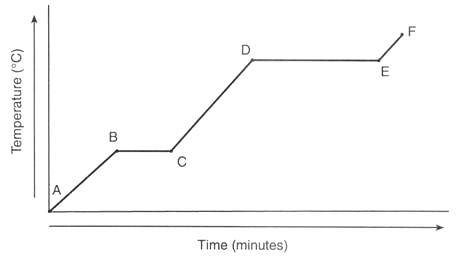
Describe the substance between letters C and D.
a)
Gas
b)
Liquid
c)
Melting
d)
Evaporating
56.

Describe what is happening between letters D and E.
a)
Gas
b)
Liquid
c)
Melting
d)
Evaporating
57.

Describe the substance between letters E and F.
a)
Gas
b)
Liquid
c)
Melting
d)
Evaporating
58.

What is the melting point for this substance?
a)
60 °C
b)
40 °C
c)
80 °C
d)
100 °C
59.
What is the freezing point for this substance?
a)
60 °C
b)
40 °C
c)
80 °C
d)
100 °C
60.
What is the boiling point for this substance?
a)
60 °C
b)
40 °C
c)
120 °C
d)
100 °C
61.
Which direction does energy flow?
a)
from hot to cold
b)
from cold to hot
c)
from lower kinetic energy to higher kinetic energy
d)
every direction
62.
What is the formula to calculate heat energy required to raise the temperature of any substance?
a)
Q=mc∆t
b)
Q=mc
c)
Q= ½mv
d)
m=QC
63.

How many Joules of energy are required to change 10 gram of water from 20 C to 90 C?
a)
1400 J
b)
2800 J
c)
210,000 J
d)
1,400,000 J
64.
If the specific heat of water is 4.18 J/g∙°C, how much heat is required to increase the temperature of 120g of water from 23 °C to 39 °C? (show your work)
a)
-8,256
b)
8.256
c)
8,256
d)
-8.256
65.
How many calories are required to boil 75 grams of water?
(not in sig figs) Hf = 80.0 cal/g, Hv = 560.0 cal/g, SH = 1.00 cal/g ºC
(not in sig figs) Hf = 80.0 cal/g, Hv = 560.0 cal/g, SH = 1.00 cal/g ºC
a)
6,000 cal
b)
3,360,000 cal
c)
42,000 cal
d)
7.46 cal
66.
Calculate the amount of energy required to melt 35.0 grams of ice.
(not in sig figs) Hf = 80.0 cal/g, Hv = 560.0 cal/g, SH = 1.00 cal/g ºC
(not in sig figs) Hf = 80.0 cal/g, Hv = 560.0 cal/g, SH = 1.00 cal/g ºC
a)
19,600 cal
b)
35.0 cal
c)
2,800 cal
d)
1,568,000 cal
67.

What state of matter is X?
a)
solid
b)
liquid
c)
gas
d)
supercritical fluid
68.
What is point A?
a)
triple point
b)
critical point
c)
equilibrium point
d)
normal melting point
69.
What is point B?
a)
triple point
b)
critical point
c)
equilibrium point
d)
normal melting point
70.
What change occurs from F to E?
a)
sublimation
b)
deposition
c)
melting
d)
condensation
71.
What change occurs from C to D?
a)
condensation
b)
vaporization
c)
melting
d)
sublimation
72.
Describe a solute.
a)
part of solution present in largest amount
b)
gets dissolved
c)
water
d)
surrounds and breaks apart
73.
The ___ is the thing being dissolved.
a)
solute
b)
solvent
c)
mixture
d)
suspension
74.
Solution where more solute can still be dissolved at the given temperature.
a)
Saturated
b)
Unsaturated
c)
Supersaturated
d)
Homogeneous solution
75.

Which solute is the most soluble at 10 ⁰C?
a)
KI
b)
KClO3
c)
NH4Cl
d)
NH3
76.

Which solute is the least soluble at 90 ⁰C?
a)
SO2
b)
KClO3
c)
KI
d)
HCl
77.
An ______ is a compound that breaks apart in water, forming charged particles (ions) that can conduct electricity.
a)
electrolyte
b)
nonelectrolyte
c)
polar molecule
d)
non polar molecule
78.

How many grams of Pb(NO3)2 are soluble in 100 g of water at 65 ºC?
a)
80 grams
b)
100 grams
c)
40 grams
d)
90 grams
79.
__________ are made up of solutes and solvents.
a)
Solutions
b)
Suspensions
c)
Heterogeneous Mixtures
d)
Pure Substances
80.
When a solvent contains as much of the solute as it can hold, the solution is said to be
a)
supersaturated
b)
diluted
c)
saturated
d)
unsaturated
81.
How does a solution become supersaturated?
a)
dissolve lots of solute in it.
b)
dissolve a little solute in it.
c)
dissolve more solute than you should be able to.
d)
dissolve a super amount of solvent in it.
82.
Which is an example of a solute?
a)
Egg whites
b)
Sugar
c)
Water
d)
Acetone
83.
Which is an example of a solvent?
a)
Salt
b)
Egg whites
c)
Water
d)
Sugar
84.
What is a solvent
a)
the liquid in which a solute is dissolved to form a solution.
b)
Another word for solution
c)
A thing that make drinks turn colors
d)
Its a metal molecole
85.
Solution where more solute can still be dissolved at the given temperature. (Hasn't reached its maximum solute dissolved)
a)
Saturated
b)
Unsaturated
c)
Supersaturated
d)
Homogeneous solution
86.
What does it mean to be "Soluble" ?
a)
Capable of being a solid.
b)
To have soul.
c)
Capable of being dissolved.
d)
To sink.
87.
Which one of the following solids is insoluble (not soluble) in water?
a)
sugar
b)
sand
c)
copper sulfate
d)
salt
88.
Which one of the following would you use to separate sand from iron filings?
a)
a bar magnet
b)
filter paper
c)
chromatography paper
d)
alum
89.
The separation technique that involves heating a solution until the liquid changes into a gaseous state, leaving behind a solid is known as
a)
decanting
b)
evaporation
c)
loading
d)
chromatography
90.
A physical combination of 2 or more substances is called a
a)
a mixture
b)
a solution
c)
a solute
d)
a solvent
91.
To separate a mixture of salt and water what separation tool/method is used?
a)
hand separation
b)
Screen
c)
Magnet
d)
Evaporation
92.
A pure substance that cannot be broken down into other substances by chemical or physical means.
a)
compound
b)
atom
c)
mixture
d)
element
93.
solution has a large amount of solute and a small amount of solvent
a)
saturated
b)
diluted
c)
concentrated
94.
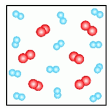
This diagram represents a _____.
a)
pure substance that is a compound
b)
mixture of elements
c)
pure substance that is an element
d)
mixture of compounds
95.

This diagram represents a _____.
a)
pure substance that is a compound
b)
mixture of elements
c)
pure substance that is an element
d)
mixture of compounds
96.

This diagram represents a _____.
a)
pure substance that is a compound
b)
mixture of elements and compounds
c)
pure substance that is an element
d)
mixture of compounds
97.

This diagram represents a _____.
a)
pure substance that is a compound
b)
mixture of elements and compounds
c)
pure substance that is an element
d)
mixture of compounds
98.
Vertical columns on the periodic table are called a
a)
period
b)
group
c)
cluster
d)
unit
99.
Horizontal rows on the periodic table are called
a)
Groups
b)
Periods
c)
Unit
d)
Cluster
100.
How are the elements in the periodic table arranged?
a)
by their atomic mass
b)
by their chemical symbol
c)
by their chemical name
d)
by their atomic number
101.

The yellow atoms are called
a)
metals
b)
nonmetals
c)
metalloids
d)
noble gases
102.

The atoms along the staircase are called
a)
metals
b)
nonmetals
c)
metalloids
d)
noble gases
103.
Who first arranged the periodic table?
a)
Vladimir Mendeleev
b)
Dmitri Mendeleev
c)
Ivan Mendeleev
d)
Vasily Mendeleev
104.
How many significant figures does the following number have: 0.998005
a)
9
b)
10
c)
6
d)
5
105.
How many significant figures does the following number have: 100.00210
a)
7
b)
5
c)
10
d)
8
106.
How many sig figs are there?
4000.
4000.
a)
1
b)
3
c)
4
107.
How many sig figs are there?
27000000
27000000
a)
2
b)
5
c)
8
Reset

